
Miss Cellania's Blog Posts
Wow! This past week, we had more "Neatorama only" feature articles than I can remember ever in one week. In case you missed anything, here's an easy way to find them.
From Stacy Conradt we got Snack Break: The Stories Behind Your Favorite Movie Theater Candy and some strange ways to Predict the Future Using Your Fingernails (and other weird methods).
In every war, there is The Last to Surrender, because not everyone gets the message that the fighting is over. John Farrier followed up that historical post with another: 5 Amazing Early Explorers.
New entries at the Museum of Possibilities this week were Toll Roads for Legalized Car Wars and The Sleeping Bag: Ultra-light or Lightly Humorous?
We tried to make sense of geometry in A Non-Math Look at Math Objects. The sequel is due next week.
From Uncle John's Bathroom reader came Ancient Ninja: Separating the Men from the Myth.
Mental_floss magazine gave us 3 Moguls who Survived Bankruptcy. You and I should be so lucky!
Then Alex surprised us at the very end of the week with Is This Young Abe Lincoln? a post that will no doubt spark some interest in the next few days.
At NeatoBambino, we looked at Parenting through History: A Look at Childrearing in Five Historic Societies and learned how to make our own Fondant Roly Polys.
Check out the new installations at the Neatorama Art Blog! We have new galleries this week by illustrator Hugh D'Andrade, the collaboration known as id-iom, mixed media artist Teale Hatheway, and illustrator Lisa Evans.
We announced the GTFO Winners! Congratulations to first place winner Arm Rotating Girl and all the other prize winners. Go ahead, have another look at all the entries.
Neatorama co-sponsored the How Did You Know? contest at mental_floss this week. Congratulations to daily winners Dan Cinalli and Ryan Pelster, but it's not over yet! Check in with mental_floss on Monday to solve the ultimate puzzle.
NeatoGeek's Caption Contest had a good response this week. Congratulations to pismonque who won a t-shirt from the NeatoShop for his/her caption.
The What Is It? game came around on Thursday. BigWally knew the answer and Serris won a t-shirt by giving the funniest answer, both of which you can see at the post.
At the Decipher the Doodle contest from NeatoBambino, prizes from the NeatoShop went to lolamouse for the correct answer and to xela22 for the funniest answer (which you can read at the post).
If you'd like to be part of Neatorama yourself, find something neat on the web and submit it to our Upcoming Queue. You might find you are a blogger at heart!

From Stacy Conradt we got Snack Break: The Stories Behind Your Favorite Movie Theater Candy and some strange ways to Predict the Future Using Your Fingernails (and other weird methods).
In every war, there is The Last to Surrender, because not everyone gets the message that the fighting is over. John Farrier followed up that historical post with another: 5 Amazing Early Explorers.
New entries at the Museum of Possibilities this week were Toll Roads for Legalized Car Wars and The Sleeping Bag: Ultra-light or Lightly Humorous?
We tried to make sense of geometry in A Non-Math Look at Math Objects. The sequel is due next week.
From Uncle John's Bathroom reader came Ancient Ninja: Separating the Men from the Myth.
Mental_floss magazine gave us 3 Moguls who Survived Bankruptcy. You and I should be so lucky!
Then Alex surprised us at the very end of the week with Is This Young Abe Lincoln? a post that will no doubt spark some interest in the next few days.
At NeatoBambino, we looked at Parenting through History: A Look at Childrearing in Five Historic Societies and learned how to make our own Fondant Roly Polys.
Check out the new installations at the Neatorama Art Blog! We have new galleries this week by illustrator Hugh D'Andrade, the collaboration known as id-iom, mixed media artist Teale Hatheway, and illustrator Lisa Evans.
We announced the GTFO Winners! Congratulations to first place winner Arm Rotating Girl and all the other prize winners. Go ahead, have another look at all the entries.
Neatorama co-sponsored the How Did You Know? contest at mental_floss this week. Congratulations to daily winners Dan Cinalli and Ryan Pelster, but it's not over yet! Check in with mental_floss on Monday to solve the ultimate puzzle.
NeatoGeek's Caption Contest had a good response this week. Congratulations to pismonque who won a t-shirt from the NeatoShop for his/her caption.
The What Is It? game came around on Thursday. BigWally knew the answer and Serris won a t-shirt by giving the funniest answer, both of which you can see at the post.
At the Decipher the Doodle contest from NeatoBambino, prizes from the NeatoShop went to lolamouse for the correct answer and to xela22 for the funniest answer (which you can read at the post).
If you'd like to be part of Neatorama yourself, find something neat on the web and submit it to our Upcoming Queue. You might find you are a blogger at heart!
Fourteen-year-old Kora Wira was fishing in Florida with her parents when a barracuda jumped out of the water and bit her arm! The 42-inch fish landed in the boat and was killed by Wira's father. Between docking the boat and driving to the hospital, there was one more chore to be done.
Wira and her dad stopped for a quick picture before jumping in the car and heading to the hospital. Wira said she wasn't in pain at the moment, but she was still creeped out by the fish. Her arm needed 51 stitches, and doctors told her they had never treated a barracuda bite. Her stitches are out now, and she said her arm is healing.
The complete story is a slide show of photographs that include Wira's wounds, which may be disturbing. http://www.fieldandstream.com/photos/gallery/fishing/2010/07/barracuda-jumps-boat-chomps-koral-wiras-arm?photo=0 -via Buzzfeed
1. Henry Ford's Bumpy Road Henry Ford probably wouldn't be too judgmental about about his company's recent financial troubles. Particularly because he was no stranger to debt himself. When Ford first started the Detroit Automobile Company in 1899, the young engineer was a little too obsessed with perfection. In two years, the plant produced just twenty cars. The poor output, combined with exorbitant costs, wasn't a recipe for success. By 1901, his enterprise had gone bankrupt. Not one to wallow in self-pity, Ford reorganized his talent under a new name, the Henry Ford Company, but soon left to start yet another group-the Ford Motor Company. And that's where he finally started to make the real money. Whatever happened to the Henry Ford Company? It did alright for itself. The group changed its name to the Cadillac Automobile Company.
2. Hershey's Bitter-to-Sweet Success Milton Heshey knew he could make great candy, but running a great business was more daunting. Hershey, who didn't have a formal education, spent four years apprenticing in a Philadelphia candy shop before striking out on his own in 1876. Six years later, his business went under. This wasn't the last time Hershey would go broke. A subsequent attempt to peddle sweets in New York City met the same fate, and the penniless Hershey returned home to Lancaster, Penn. There, he started tinkering with the use of fresh milk in caramel production. And out of nowhere, sweet success! In 1900, Heshey sold his Lancaster Caramel Company for an eye-popping $1 million. But the restless entrepreneur wasn't done yet. He immediately began work on a new idea-manufacturing a Swiss luxury import known as "milk chocolate".
3. The Burt Reynolds Bachelor Pad
Back in the 1970s, Burt Reynolds owned mansions on both coasts, a helicopter, and a lavish ranch. But the next decade was harder on the Hollywood star. Thanks to a pricey divorce and some poor career choices, Reynolds ended up owing creditors almost $10 million. In 1996, he filed for Chapter 11. But instead of hawking his valuables and putting his trademark mustache up for auction, Reynolds found a loophole to protect his wealth. In states such as Florida and Texas, there's a homestead exemption that protects debtors from losing their primary residence. The problem was, Burt Reynolds' shelter happened to be a sprawling $2.5 million Florida mansion. The issue caused such a stink that when Congress passed measures tightening the loopholes in 2001, Reynolds was one of the examples Senators used to show that bankruptcy rules went too easy on the wealthy. _______________________ The above article was written by Ethan Trex. It is reprinted with permission from the Scatterbrained section of the May/June 2010 issue of mental_floss magazine. Be sure to visit mental_floss' entertaining website and blog for more fun stuff!
What a thrill it would be to turn over a page every month and find a new picture of a goat in a tree! You could have that delightful experience in 2011 with the Goats in Trees calendar. Link -via Breakfast Links
Famous men in history sometimes had a special place they went to think, create, or unwind in which they could block out the rest of the world. Almost every man would like to have a "man cave" like these, if he doesn't already! The Art of Manliness shows us what the private or men-only rooms of Thomas Edison, Mark Twain, Andrew Carnegie, Winston Churchill, Charles Darwin, and quite a few others looked like. Shown here is Theodore Roosevelt's trophy room. Link -via Gorilla Mask
Pomparkour is supposedly a new "sport" that is described as parkour with ladders. This ad for a sports drink is raising eyebrows because it has no warning that these are professional stunt people and this should never be tried at home. In fact, we get a glimpse of how they did it in another video.
Notice the safety ropes, which were apparently edited out of the finished ad. -via Metafilter
Notice the safety ropes, which were apparently edited out of the finished ad. -via Metafilter
Did you hear the story about how Allie tried to learn how to ride a bike? She was deathly afraid of the contraption, and for good reason, which you can read about at Hyperbole and a Half. Link
Vandana Gurjar filed for divorce from her husband Hemant Chhalotre in Madhya Pradesh, India. Her grounds for the action included Chhalotre's impotence. That was a mistake. He turned around and sued Gurjar for defamation, and she was ordered to pay 200,000 rupees (£2,747)!
One supposes that a charge of cruelty or adultery might have been better for his ego, if not his reputation. Link -via Arbroath
(Image credit: Flickr user Jo Christian Oterhals)
Mr Chhalotre had complained the impotence accusation "rendered him unmarriageable and sullied his prestige".
The amount of the fine far exceeds the annual income of millions living in India.
One supposes that a charge of cruelty or adultery might have been better for his ego, if not his reputation. Link -via Arbroath
(Image credit: Flickr user Jo Christian Oterhals)
I found out something neat about three-dimensional shapes. Many strange mathematical solids are constructed by rotating the plane of a two-dimensional shape around an imaginary axis. Think of the flat holiday decorations you fold out around its spine/axis. Once I understood what is called a "surface of revolution" in my mind, the construction of many odd mathematical shapes began to make sense.
Superegg
Torus
I learned about the torus from crossword puzzles. If the clue says "donut shape", the answer is torus. The solid is produced by rotating a circle around an imaginary axis, but in this surface of revolution, the axis is outside the circle. The resulting shape is a ring torus. Other torus shapes are produced when the axis is touching or slightly inside the circle. Some really strange mathematical shapes are produced when the rotating plane of the circle is not quite round, or is itself rotating around a point in the plane. A toroid is a ring or donut shaped solid produced by a surface of revolution not necessarily limited to a circle. For example, a square used in this manner will produce a ring that would be uncomfortable on your finger. A toroidal polyhedron is a torus constructed with or converted into flat surfaces, with the shape dependent on how many flat surfaces you use. Toroidal Polyhedron would be a cool name for a band.
Gömböc
You might remember Weebles -they wobble, but they don't fall down. However, if the heavy weight in the bottom of the toy ever came loose, you had a Weeble that fell down. In 1995, Russian mathematician Vladimir Arnold questioned whether there could be a 3-dimensional shape that would always return to its original position without the help of internal weights. If a shape could be found that had as few as two points of equilibrium, one stable and one unstable, the shape would naturally return to balancing on the one stable point. For a long time, mathematicians thought the shape was impossible. But in 2006, Gábor Domokos and Péter Várkonyi developed the gömböc. This odd shape has only two points it could possibly balance upon, and the point on top is too "pointed" to be stable. So, if you roll a gömböc around, it will soon right itself, returning to an upright position because of its shape, not because of any internal irregularities. It's a Weeble that doesn't wear out! Objet Geometries made the first fabricated gömböcs. They were numbered as a limited series (inside, using transparent materials of the same density as the rest of the object) and professor Arnold was presented with number one. You can buy one of your own.
Continue reading
Superegg
(Image credit: Sir48 at da.wikipedia)
A superegg is a mathematical shape constructed by rotating a superellipse around an axis to the formula of |x/a|2.5 + |y/b|2.5 = 1, where a/b = 4/3. (If you search for "superegg formula", you are liable to find something completely different.) But you don't want to bother with formulas, do you? Just look at it! From the side, the superegg looks a bit like a cylinder, but has no corners. If you cut one horizontally, the cross-section will be a circle. However, unlike a natural egg, you can stand the superegg on its end -either end, as a matter of fact, as it is vertically as well as horizontally symmetrical, although it has no straight lines that you can find -although the curvature is zero at the ends, the "ends" are actually quite small and appear to be rounded. The superegg was popularized by Danish mathematician and physicist Piet Hein, who used the shape in designs for household items such as furniture, ice cubes, and candles, as well as a novelty toy (sometimes referred to as a stress-reliever) by itself.Torus
I learned about the torus from crossword puzzles. If the clue says "donut shape", the answer is torus. The solid is produced by rotating a circle around an imaginary axis, but in this surface of revolution, the axis is outside the circle. The resulting shape is a ring torus. Other torus shapes are produced when the axis is touching or slightly inside the circle. Some really strange mathematical shapes are produced when the rotating plane of the circle is not quite round, or is itself rotating around a point in the plane. A toroid is a ring or donut shaped solid produced by a surface of revolution not necessarily limited to a circle. For example, a square used in this manner will produce a ring that would be uncomfortable on your finger. A toroidal polyhedron is a torus constructed with or converted into flat surfaces, with the shape dependent on how many flat surfaces you use. Toroidal Polyhedron would be a cool name for a band.
Gömböc
You might remember Weebles -they wobble, but they don't fall down. However, if the heavy weight in the bottom of the toy ever came loose, you had a Weeble that fell down. In 1995, Russian mathematician Vladimir Arnold questioned whether there could be a 3-dimensional shape that would always return to its original position without the help of internal weights. If a shape could be found that had as few as two points of equilibrium, one stable and one unstable, the shape would naturally return to balancing on the one stable point. For a long time, mathematicians thought the shape was impossible. But in 2006, Gábor Domokos and Péter Várkonyi developed the gömböc. This odd shape has only two points it could possibly balance upon, and the point on top is too "pointed" to be stable. So, if you roll a gömböc around, it will soon right itself, returning to an upright position because of its shape, not because of any internal irregularities. It's a Weeble that doesn't wear out! Objet Geometries made the first fabricated gömböcs. They were numbered as a limited series (inside, using transparent materials of the same density as the rest of the object) and professor Arnold was presented with number one. You can buy one of your own.
The Denver Post has printed a gallery of color pictures taken by photographers of the the US Farm Security Administration/Office of War Information during the Great Depression and World War II. Most were transferred from color slides. The photographs are now part of the Library of Congress. Link -via Metafilter
(Image credit: Russell Lee/Library of Congress)

The first day of the new mental_floss/Neatorama How Did You Know trivia hunt is up at mental_floss! Once again, you have a chance to win prizes from the NeatoShop each of the next four days, and more prizes for the ultimate winner next week. Check in every weekday, follow the clues to figure out the quiz, and you just may be a daily winner. Even if you aren't, the daily clues will help lead you to the ultimate answer next week! Link
Rick Norsigian's hobby of bargain-hunting at rummage sales has paid off big time.
Link -via Boing Boing
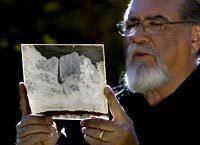
Two small boxes he bought 10 years ago for $45 -- negotiated down from $70 -- are now estimated to be worth at least $200 million, according to a Beverly Hills art appraiser.
Those boxes contained 65 glass negatives created by famed nature photographer Ansel Adams in the early period of his career. Experts believed the negatives were destroyed in a 1937 darkroom fire that destroyed 5,000 plates.
"It truly is a missing link of Ansel Adams and history and his career," said David W. Streets, the appraiser and art dealer who is hosting an unveiling of the photographs at his Beverly Hills, California, gallery Tuesday.
The photographs apparently were taken between 1919 and the early 1930s, well before Adams -- who is known as the father of American photography -- became nationally recognized in the 1940s, Streets said.
Link -via Boing Boing
Salon writer Sarah Hepola moved to tiny apartment in Manhattan and found the lack of space severely affected her cat Bubba. Should she take him outside on a leash? Have you ever been able to leash-train a cat?
After much angst, Hepola tried a leash on her cat and was surprised by how the adventure turned out. You might not be so surprised. Link
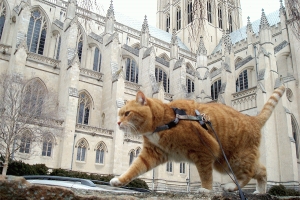
I know, I know, a cat leash is a ridiculous idea. Cats are too prickly, too willful to endure such pampered indignity. I might as well suggest my cat learn to make a delicious veal parmigiana, or play Bob Dylan songs on the harmonica. In five years of living in New York -- a city that prides itself on its vast parade of human experience -- I've only seen one cat on a leash. (Putting the ratio of strangers' penises to leashed cats at 2:1.) The New York Times wrote about a real estate broker on the Upper West Side who leash trained his cat, which suggests just how remarkable the feat is. Even the phrase "cat on a leash" has a campy spark of the impossible, like something you'd see in a Farrelly brothers movie, or hear about in a novelty song: "Cat on a leash! He don't eat quiche!" But if you start digging a bit into the world of cats on leashes, what you will discover is just how many people have already tried it.
After much angst, Hepola tried a leash on her cat and was surprised by how the adventure turned out. You might not be so surprised. Link
If you look hard enough, even the most outlandish legends have a grain of truth somewhere. Reports from antiquity of sea monsters may be fantastic, but they describe what someone at least thought they saw at one time. Consider the sea monk, described in 1546 (left). It sure looks like someone drew it from their imagination. But then look at the sea creature called a Jenny Haniver (right). Read about this and other monsters that may now be explained scientifically. Link -via Gorilla Mask
See also: Baby Stingray
Email This Post to a Friend