The Denver Post photo blog has a wonderful collection of aerial photographs of New York City. I had trouble selecting just one to tease you with. Link -via Laughing Squid
(Image credit: Daniel Acker/Bloomberg)
Wira and her dad stopped for a quick picture before jumping in the car and heading to the hospital. Wira said she wasn't in pain at the moment, but she was still creeped out by the fish. Her arm needed 51 stitches, and doctors told her they had never treated a barracuda bite. Her stitches are out now, and she said her arm is healing.
1. Henry Ford's Bumpy Road Henry Ford probably wouldn't be too judgmental about about his company's recent financial troubles. Particularly because he was no stranger to debt himself. When Ford first started the Detroit Automobile Company in 1899, the young engineer was a little too obsessed with perfection. In two years, the plant produced just twenty cars. The poor output, combined with exorbitant costs, wasn't a recipe for success. By 1901, his enterprise had gone bankrupt. Not one to wallow in self-pity, Ford reorganized his talent under a new name, the Henry Ford Company, but soon left to start yet another group-the Ford Motor Company. And that's where he finally started to make the real money. Whatever happened to the Henry Ford Company? It did alright for itself. The group changed its name to the Cadillac Automobile Company.
2. Hershey's Bitter-to-Sweet Success Milton Heshey knew he could make great candy, but running a great business was more daunting. Hershey, who didn't have a formal education, spent four years apprenticing in a Philadelphia candy shop before striking out on his own in 1876. Six years later, his business went under. This wasn't the last time Hershey would go broke. A subsequent attempt to peddle sweets in New York City met the same fate, and the penniless Hershey returned home to Lancaster, Penn. There, he started tinkering with the use of fresh milk in caramel production. And out of nowhere, sweet success! In 1900, Heshey sold his Lancaster Caramel Company for an eye-popping $1 million. But the restless entrepreneur wasn't done yet. He immediately began work on a new idea-manufacturing a Swiss luxury import known as "milk chocolate".
3. The Burt Reynolds Bachelor Pad
Back in the 1970s, Burt Reynolds owned mansions on both coasts, a helicopter, and a lavish ranch. But the next decade was harder on the Hollywood star. Thanks to a pricey divorce and some poor career choices, Reynolds ended up owing creditors almost $10 million. In 1996, he filed for Chapter 11. But instead of hawking his valuables and putting his trademark mustache up for auction, Reynolds found a loophole to protect his wealth. In states such as Florida and Texas, there's a homestead exemption that protects debtors from losing their primary residence. The problem was, Burt Reynolds' shelter happened to be a sprawling $2.5 million Florida mansion. The issue caused such a stink that when Congress passed measures tightening the loopholes in 2001, Reynolds was one of the examples Senators used to show that bankruptcy rules went too easy on the wealthy. _______________________ The above article was written by Ethan Trex. It is reprinted with permission from the Scatterbrained section of the May/June 2010 issue of mental_floss magazine. Be sure to visit mental_floss' entertaining website and blog for more fun stuff!
Mr Chhalotre had complained the impotence accusation "rendered him unmarriageable and sullied his prestige".
The amount of the fine far exceeds the annual income of millions living in India.
(Image credit: Sir48 at da.wikipedia)
A superegg is a mathematical shape constructed by rotating a superellipse around an axis to the formula of |x/a|2.5 + |y/b|2.5 = 1, where a/b = 4/3. (If you search for "superegg formula", you are liable to find something completely different.) But you don't want to bother with formulas, do you? Just look at it! From the side, the superegg looks a bit like a cylinder, but has no corners. If you cut one horizontally, the cross-section will be a circle. However, unlike a natural egg, you can stand the superegg on its end -either end, as a matter of fact, as it is vertically as well as horizontally symmetrical, although it has no straight lines that you can find -although the curvature is zero at the ends, the "ends" are actually quite small and appear to be rounded. The superegg was popularized by Danish mathematician and physicist Piet Hein, who used the shape in designs for household items such as furniture, ice cubes, and candles, as well as a novelty toy (sometimes referred to as a stress-reliever) by itself.Two small boxes he bought 10 years ago for $45 -- negotiated down from $70 -- are now estimated to be worth at least $200 million, according to a Beverly Hills art appraiser.
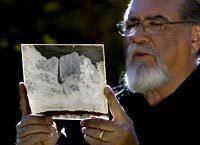
Those boxes contained 65 glass negatives created by famed nature photographer Ansel Adams in the early period of his career. Experts believed the negatives were destroyed in a 1937 darkroom fire that destroyed 5,000 plates.
"It truly is a missing link of Ansel Adams and history and his career," said David W. Streets, the appraiser and art dealer who is hosting an unveiling of the photographs at his Beverly Hills, California, gallery Tuesday.
The photographs apparently were taken between 1919 and the early 1930s, well before Adams -- who is known as the father of American photography -- became nationally recognized in the 1940s, Streets said.