In the relatively early days of the medical profession, doctors weren't all that trusted and got little respect. That went double for medical students, who were condemned for cutting into dead bodies to study them. We've posted many times about how they got those bodies, from grave robbers, resurrectionists, and body snatchers who stole them from cemeteries. So how did that gruesome supply chain change into what we have now, which is voluntary bequests of earthly remains? The body supply business went through several difference stages as the medical business itself went from shady to crucial. Changing attitudes about death played a role, as well as the breakthrough in organ donation, allowing us to save or improve someone's else's life through own own deaths. And as the article asks, would you want a surgeon carving on you who had never practiced with a real body before? Learn the history of medical school cadavers at The Conversation. -via Geeks Are Sexy
It's only natural to be horrified at the idea of being buried alive. Yet at one time, like flagpole sitting or dance marathons, it was a competition for publicity and bragging rights. The fad reached its peak in the 1960s. Although the stunt was not new, earlier attempts at the record amount of time spent underground were not well documented, so spending the longest time buried was a challenge.
On February 21, 1968, 33-year-old Irish laborer Mike Meaney had himself buried in Kilborn, England. He was trying to go for the record set by Bill White of Texas, who had emerged after being buried for 55 days. But Meaney did not know that White was also being buried again at the same time, trying to top his own record. The stunts therefore became a real-time competition for who could stay buried the longest.
An article at Mental Floss has the details of Meaney's burial, including the particulars of his life-sustaining coffin, the history of the fad of premature burial, and a video of the public celebration when Meaney returned from the grave. -via Strange Company
In March 1975, a 50-year-old man sat down on his chair to watch one of his favorite shows. It was a British comedy series called The Goodies, and the man in question, Alex Mitchell, found the show very funny. On that fateful day, the bricklayer laughed really hard as he watched a funny bit of the show. And by really hard, I mean really hard. Mitchell laughed for over twenty minutes. All of a sudden, he slumped into his chair, lifeless. He died then and there.
According to a doctor (probably the one who examined him), Mitchell died from too much laughter. He laughed so hard that "the left side of his heart failed."
But could it really be true? Could a person really die from laughing too much?
Fortunately, the answer is no. However, laughing too hard may trigger something bad in your body, especially if you have a preexisting condition. This is the deadly part.
If you have a cardiovascular condition, like an aortic aneurysm, for example, laughing could increase the pressure inside your thorax, and that might trigger a heart attack.
Laughing too hard has some other undesirable effects on the body, such as blocking the flow of oxygen.
Alex Mitchell's death in 1975 made headlines worldwide. Doctors back then cited "heart failure" as the cause of his death, but doctors in 2012 believe he was suffering from a conduction disorder called the Long QT syndrome, as his granddaughter was diagnosed with the same condition.
They say that laughter is the best medicine. It seems that, like with anything, it is best taken in moderation.
(Image Credit: Pexels)
Cincinnati Animal CARE, the shelter in Cincinnati which also serves as animal control, was called out in late January to get a cat out of a tree. The police probably should have been more specific, so the animal warden could have brought more deputies and more equipment. The 30+ pound cat in the tree was an African serval, and did not want to be captured. The serval had jumped out of a car as police were arresting the driver, and climbed the first tree he saw.
The dog warden eventually managed to get the cat out of the tree, but the serval's leg was broken during the struggle. The serval, named Amiry, was taken to Cincinnati Animal CARE's medical department, where his leg was set. A DNA sample was taken along with a toxicology test, which came back positive for cocaine! The DNA test confirmed that Amiry is indeed a serval, and not a Savannah cat. It is illegal to own a serval in Ohio, while a Savannah cat (which is produced by crossing a serval with a domestic cat) is okay. The serval's owner has been cooperative. He has relinquished ownership of the cat to authorities, and has been paying for Amiry's medical care.
Amiry has since been transferred to the Cincinnati Zoo, where he has been under the supervision of the zoo's medical staff. -via reddit
For the first time, scientists have been able to create a mouse egg cell from a male skin cell. A team led by Katsuhiko Hayashi of Kyushu University in Japan cultivated male mouse skin cells and programmed them to revert to a state resembling a stem cell. They replaced the Y chromosome with a second X chromosome from the same individual, and prompted them to grow into egg cells. With egg cells produced by a male, fertilized by another male, they implanted 600 embryos into female mice, which resulted in seven live pups born with two biological fathers. These mice were healthy, grew normally, and eventually produced offspring of their own.
The process for doing this with human cells is much more complicated, but if it ever succeeds, it could be a boon to people suffering from infertility. The research was prompted by the plight of women with Turner's syndrome, in which one X chromosome is incomplete or missing. Read more about the mice with two fathers at the Guardian. -via Damn Interesting
(Image credit: Rama)
We thought we had reached peak disaster movie insanity with Sharknado, but we were wrong, because Cocaine Bear is out in theaters now. Never mind that Cocaine Bear was inspired by a true story; that just goes to show that truth is stranger than fiction. But if you want to go one better, how about combining them into a film named Cocaine Shark? Wild Eye Releasing went for it, with a story that involves a drug lord, a science lab, experimental animals, and an explosion. What could possibly go wrong? The answer is a cocaine-fueled mutant shark on the loose, with a beach full of unknowing potential victims. Sadly, Cocaine Shark is not coming soon to a theater near you. At least until someone in Hollywood sees this faux trailer, then all bets are off. -via Geeks Are Sexy
Next up: Bubblegum from the moon is our only defense against a mutant cocaine shark.
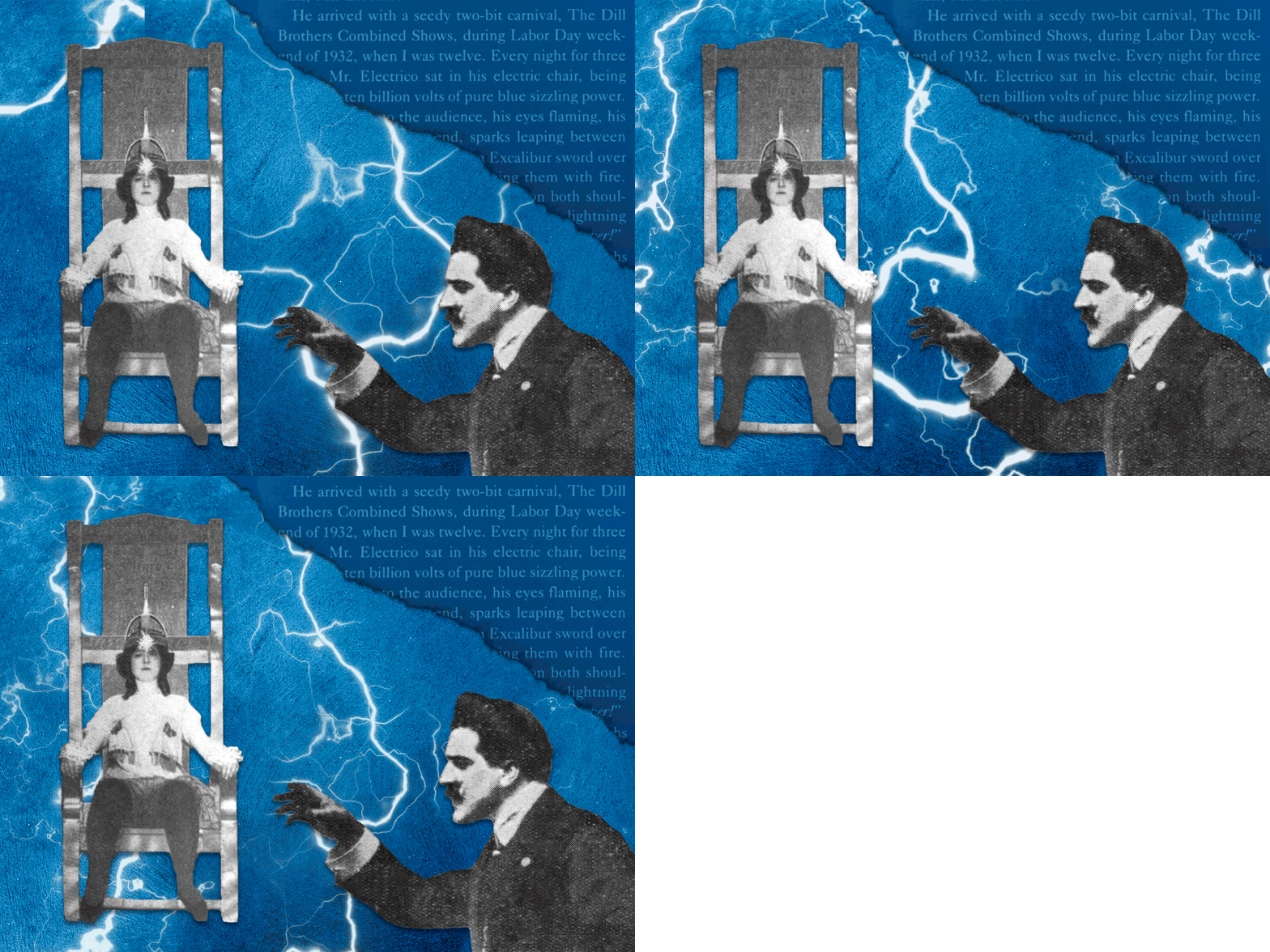
Acclaimed science fiction author Ray Bradbury often recounted an event from his childhood that set him on a lifelong path of writing stories. In 1932, 12-year-old Bradbury saw a magician named Mr. Electrico performing amazing feats of electrical manipulation at a circus sideshow. The showman declared the boy immortal and so impressed Bradbury that he went back for a second performance a couple of days later and met the magician. The experience was so profound for Bradbury that he recounted it over and over after he had achieved fame for his books and short stories. He even made Mr. Electrico a character in his 1962 novel Something Wicked This Way Comes.
But although Bradbury had plenty of details about the encounter with Mr. Electrico, some details tended to change, and didn't quite match up with the historical timeline. Researchers and Bradbury fans have tried to track down Mr. Electrico or the circus he accompanied and came up empty-handed. There were plenty of shows featuring the magic of electricity, which was still fairly new in the early 20th century, but no one has pinned down Bradbury's Mr. Electrico. Read about Bradbury's memories and the search for the real thing at Smithsonian.
(Illustration credit: Meilan Solly)
In the classic TV series Exosquad, when humanity set about genetically engineering a slave race that would one day rise up in rebellion against them, they helpfully gave their slaves two opposing thumbs.
Thumbs are useful. They're pretty much the only reason we humans are in charge of this planet and not dolphins. So let's make best use of this advantage by doubling them.
Dani Clode and Tamar Makin of Cambridge University 3D printed a thumb that can be attached to a hand. The motor is strapped to the wrist and the battery on the upper arm. The controlling sensors are attached to big toes. So, if I understand this Guardian article correctly, twitch your toes to open and close the extra thumb.
At a recently science exhibition, Clode and Makin gave 600 people the chance to try it. 98% were able to figure out the control system within a minute, so this is clearly user-friendly technology.
-via Design Boom
You may have seen the viral photos of a casket decorated with an M&M candy theme. It's real and the story behind it is deeply heartwarming.
Fox News reports that Mary Stocks Martin of Snowflake, Arizona died at the age of 86. She was a teacher for many years who signed her name "MSM" in cursive. Kids often mistook her signature for "M&M" and began giving her M&M candy. She gradually collected a lot of M&M paraphernalia and became known as "the M&M Lady".
Years before her death, she decided that she wanted to be buried in a casket that looked like an M&M and had one of her sons build it. Martin recently passed on and her family conducted an M&M-themed funeral. Those who attended marked her passing by dropping M&Ms on the casket and dressing in M&M t-shirts.
-via The Mary Sue | Images: Scott Roundtree
Strange, mysterious, spherical UFOs have invaded earth's atmosphere. The powers that be tell us they are weather balloons, or spy balloons, or just balloons launched from earth by hobbyists. But what if they were launched by an alien civilization? Maybe from a station on the moon? If the first ones were just spying on us, what happens when the real weapons are launched? A new short from Fabrice Mathieu (previously at Neatorama) leaves a lot to the imagination, so my theory is that the lunar aliens are chewing bubble gum, and they are far from being out of bubble gum! -Thanks, Fabrice!
Tradition is apparently no longer important to modern Britons. Although they will keep the monarchy, they are throwing away one of the great customs associated with royalty: rubbing the monarch at his or her coronation with ambergris.
My headline is borrowed from IFL Science, which explains what's going on.
As King, Charles is the Supreme Governor of the Church of England. His coronation on May 6 is, among other purposes, a religious ceremony. He will be annointed with sacred oil. This oil is made from olives from the Monastery of Mary Magdalene and the Monastery of the Ascension in Israel.
The anointing oil will not contain ambergris, which is a substance that originates in the intestines of sperm whales. Many nations ban the harvesting of ambergris as part of general bans on the exploitation of whales.
-via Dave Barry | Photo: Wikimedia user Dan Marsh
In the hit HBO series The Last of Us, the world is devastated by the parasitic Cordyceps fungus, which infected flour and has mutated to turn humans into zombies. The genus Cordyceps really does turn its host into zombies, but only attacks insects. Does that means we are safe from fungus in our pancakes? Well, yes and no.
There are many funguses (or fungi for Latin readers) that will infect crops of wheat or other grains. Some can make people very sick, either from the fungus itself or from the toxins that the fungus produces. The most familiar of these is ergot, which infects rye and may have produced hallucinations that contributed to a outbreak of "witchcraft" in Salem, Massachusetts, in 1692.
Wheat producers go to great lengths to fight fungus in our food, but there is always a chance that dry flour contains some fungus. The good news is that it is destroyed when that flour is cooked. The bad news is that fungus can still infect food after it is cooked. Read the real story of fungal infections in flour at The Conversation. -via Geeks Are Sexy
An ancient city at the mouth of a mighty river was the recipient of untold wealth due to the shipping trade, but changing conditions along the coastline left it sunken under water. This is the story of the lost Egyptian city of Thonis, also called Heracleion. Once thought to be a myth, it was found exactly where it always was, except underwater in the Mediterranean Sea. The stories of Heracleion involve both real people (Cleopatra) and mythological characters (Helen of Troy), but no trace of the city was seen for a thousand years. Heracleion's ruins are filled with expensive artifacts, leading experts to believe the disappearance of the city was relatively sudden, or else those treasures would have been moved. The upshot is that you can build flimsy structures or sturdy stone structures, but if your foundation is on the sandy coastline, you're at the mercy of the sea. New Orleans, are you taking notes? -via Digg
PS: Don't let the video title "Filthy Secrets" deter you from watching. There's nothing filthy in the video.
Located on the west shore of Hudson Bay, about 140 km (87 mi) away from the Manitoba-Nunavut border, the town of Churchill, Canada. It is a small town home to only about 850 people. Interestingly, the place also has more or less the same number of polar bears. That's a 1:1 ratio if you ask me. While the bears live on the frozen bay to hunt seals during winter, they move inland once the ice melts in July. And then they'd return to the shore by the end of November to wait for the bay to freeze once more. Because Churchill is in the middle of the so-called "polar bear highway," the town has earned the nickname the "Polar Bear Capital of the World." The town even has a company that offers polar bear tours.
But how do the people manage to live peacefully with the polar bears? The answer is through the polar bear holding facility, or as it is colloquially known, the "polar bear jail." Like a real jail, the place is used to "imprison" bears reported to approach humans. They're still dangerous animals, after all.
As they "serve time" in the holding facility, the animals are only given water, so they won't associate humans with food. Their "sentence" doesn't take long, however. Most bears only stay in the facility for 30 days or until the bay freezes. Immediately, they are released and free to hunt seals again.
Atlas Obscura tells more of this bear-y interesting story over at their website.
(Image Credit: Marko Dimitrijevic/ Flickr via Atlas Obscura)
Over a hundred years ago, an amusement park was constructed on Coney Island in New York City. The park was named Luna Park, and it opened in 1903. As the place became popular, other builders borrowed the name. Today, there are multiple Luna Parks around the world. Some of them are defunct, while some of them still operate.
The first Luna Park ceased operations in 1944. However, another one was opened in Coney Island in 2010, just across the street from the original site.
One of the most notable Luna Parks out there is the one in Melbourne, Australia. The said park opened way back in 1912, but it still operates to this day, making it the oldest operational Luna Park. It is also home to one of the oldest wooden rollercoasters in the world.
Artist Daniel Agdag references the wooden rollercoaster in Melbourne Luna Park in this piece called "Lattice." It is a massive ten-foot work made from vellum trace paper and cardboard. And yes, it is structurally sound. The project, a commission from the New York City Department of Education and NYC School Construction Authority Public Art for Public Schools, took two years to make. The truss section alone, which consists of some "897,560 individual hand-cut cardboard members," took him 8 months. Just thinking about how he made this intricate work makes my head hurt.
Agdag documented his process of the work through a series of pictures, which he shared on Instagram.
(Image Credit: Etienne Frossard/ Daniel Agdag via Colossal)