
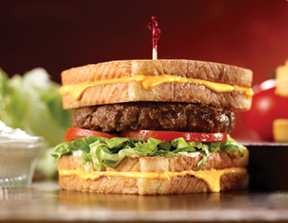
It's a hamburger that uses two grilled cheese sandwiches for the bun, offered by Friendly's. Only 1500 calories! Consumerist has more nutritional information. Link -via Other Crap
Miss Cellania's Blog Posts
It's a hamburger that uses two grilled cheese sandwiches for the bun, offered by Friendly's. Only 1500 calories! Consumerist has more nutritional information. Link -via Other Crap

Sometimes those in traditional media (meaning newspapers) get upset that some on the internet use their material. Apparently that door swings both ways, and if you don't have a proofreader, you could end up with egg on your face! Link -via Blame It On The Voices
Graffiti can be useful! Someone has been painting compasses on the sidewalks of New York City at subway exits. If you've ever ridden a subway beneath a city, you know how helpful this can be when you re-emerge and have to get your bearings on the street level. The question is: why hasn't anyone thought of this before? Actually, they have.
Maybe this time, the idea will stick around. Link -via The Daily What
(Image credit: Paolo Mastrangelo/NYC The Blog)
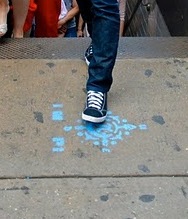
Using sidewalk compasses is an idea that has been tried before by both official and unofficial sources. In 2006, a blogger snapped a photo of a compass on the sidewalk at the 8th Street L station; someone else caught one on Bleecker. The City of New York's Department of Transportation got in on the act in 2007, installing compass decals in the ground at selected stations around midtown, in a pilot program that doesn't seem to have been continued.
Maybe this time, the idea will stick around. Link -via The Daily What
(Image credit: Paolo Mastrangelo/NYC The Blog)
Dawn dishwashing liquid is to go-to soap for cleaning up birds and animals caught in crude oil spills. Wildlife rescue groups swear by it, and have for years. They say it cuts the crude without doing harm to the animal. A company representative says it's a delicate balance of surfactants that make it so effective.
Proctor and Gamble donates supplies of Dawn to animal rescue operations. http://www.npr.org/templates/story/story.php?storyId=127999735&sc=ipad&f=1001 -via Holy Kaw!
(Image credit: Elizabeth Shogren/NPR)
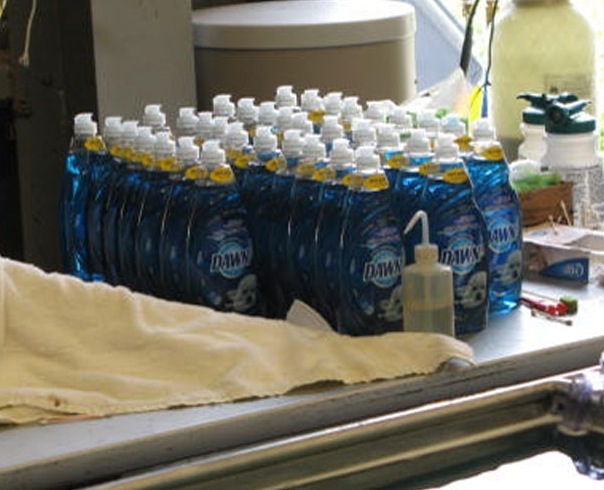
What the company doesn't advertise — and these days is reluctant to admit — is that the grease-cutting part of the potion is made from petroleum.
"To make the best product out there, you have to have some in there," says Ian Tholking of Procter & Gamble. He says less than one-seventh of Dawn comes from petroleum.
"To say Dawn's horrible because of this, that doesn't make a whole lot of sense," he says, "and that's what we're trying to avoid. Because we're not trying to do something evil here."
"I think it's extremely ironic," says Martin Wolf, a chemist for Seventh Generation, which makes a dish liquid without petroleum. "Here we are trying to squeeze every last drop of oil we can out of the Earth, and it's despoiling the Earth. And we're using that same product that's messing up the Earth to clean it up."
Wolf says his company sent a truckload of oil-free detergent to the gulf, but he hasn't heard whether anyone has used it.
Proctor and Gamble donates supplies of Dawn to animal rescue operations. http://www.npr.org/templates/story/story.php?storyId=127999735&sc=ipad&f=1001 -via Holy Kaw!
(Image credit: Elizabeth Shogren/NPR)
Born Rich has named our fearless leader Alex the Cool Geek of the Week! See him with two out of three adorable children (and sans crown) at the post. Link -Thanks, David!

Richard Sullivan posted this lovely color footage from August 14, 1945.
65 Years Ago my Dad shot this film along Kalakaua Ave. in Waikiki capturing spontaneous celebrations that broke out upon first hearing news of the Japanese surrender. Kodachrome 16mm film: God Bless Kodachrome, right?There is more information about the film in the comments at the vimeo link. -Thanks, Duke!
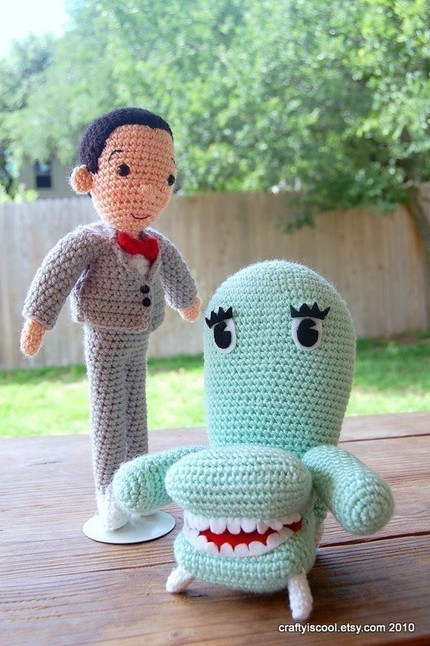
Aren't these adorable! Etsy seller CraftyisCool is selling the patterns so that you can crochet Pee-Wee Herman and his friend Chairy. Contact her if you would like to buy the dolls themselves. Link -via Sofa Pizza
Think Geek added several new products on April Fools Day, as they do every year. The page for one of those products, canned unicorn meat, used the words "the new white meat." The National Pork Board objected to the phrase, which is somewhat similar to their slogan "The Other White Meat." The board sent a 12-page cease and desist letter to the management of Think Geek, who called it "Officially our best-ever cease and desist".
Think Geek also said:
Link -via Boing Boing
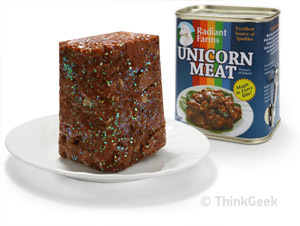
First, it's 12 pages long and very well-researched (except on one point); it even includes screengrabs of the offending item from our site. And we know they're not messing around because they invested in the best and brightest legal minds.
But what makes this cease and desist so very, very special is that it's for a fake product we launched for April Fool's day.
Think Geek also said:
We'd like to publicly apologize to the NPB for the confusion over unicorn and pork--and for their awkward extended pause on the phone after we had explained our unicorn meat doesn't actually exist.
Link -via Boing Boing
There is much more to the produce aisle than lettuce, tomatoes, and cucumbers! Today's Lunchtime Quiz at mental_floss will find out how much you know about other, more obscure vegetables -and you might even learn something new. I scored 67%, which you can well beat. Link

The octopus makes a great metaphor -it has many arms that can do multiple things at once, it is strange and unfamiliar, and it has a long reputation for grabbing things. It's no wonder the cephalopod gets used in political cartoons and propaganda. The blog Vulgar Army documents these historical uses of the octopus, usually to make some entity look too powerful and/or evil, with pictures and in-depth information. Shown is "The Devil Fish of California Politics" from 1889. Link -via Nag on the Lake

(Image credit: F.B. Johnston)
Look at that massive chimney! Can you imagine the size of the fireplaces inside? This is Windsor Shades in King William County, Virginia. In colonial times, it was a tavern, one of George Washington's favorite hangouts. Read more about this unique house at TYWKIWDBI. Link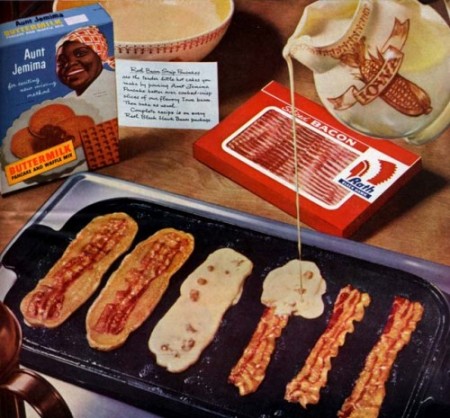
Now this is the way to start a Monday! Has anyone here ever tried bacon pancakes made like this? Link
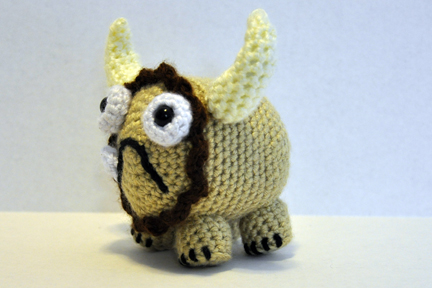
Neatoramanaut SenorMysterioso liked the creature the Alot a lot! He even made one of his own, for a competition among a knitting group called Knit Knack. See the winner and the other runner-up in this post. You can see more of this alot at SenorMysterioso's Flickr stream. Link
Diego Stocco (previously at Neatorama) combined parts from a bass guitar and a piano to make a new musical instrument he calls a bassoforte. http://www.behance.net/gallery/Bassoforte/535175 -via Metafilter
The following is an article from The Best of Uncle John's Bathroom Reader.
Some things we use all the time seem like they've been around forever. They haven't. Uncle John's Bathroom Reader looks at how a few items came to be parts of our world.
BAND-AIDS (1921)
In 1921, Earle Dickson, and employee of Johnson & Johnson, married a woman who kept injuring herself in the kitchen.
* As he repeatedly bandaged her cuts and burns with gauze and adhesive tape, he became frustrated; the clumsy bandages kept falling off. So he decide to create something "that would stay in place, be easily applied, and still retain its sterility." He stuck some gauze in the center of a piece of adhesive tape, and covered the whole thing with crinoline to keep it sterile. It worked.
* He made up a batch for his wife and took a few in to show his co-workers. The company's owner, James Johnson, heard about it and asked for a demonstration-which convinced him to begin manufacturing the product.
* By the '80, over 100 billion Band-Aids had been sold. Dickson, who became an exec at J&J, was amply rewarded for his efforts.
IVORY SOAP (1879)
* One day in 1879, the man operating Procter & Gamble's soap mixing machine forgot to turn it off when he went to lunch. On returning, he discovered that so much air had been whipped into the soap that it actually floated.
* For some reason, the batch wasn't discarded-it was made into bars and shipped out with the other White Soap. Soon, to their surprise, P&G was getting letters demanding more of "that soap that floats." So they started putting extra air into every bar.
* Now that they had a unique product, they needed a unique name. And they found it in the Bible. Procter was reading the 45th Psalm-which say: "All thy garments smell of myrrh, and aloes, and cassia, out of the ivory palaces..."-when it hit him that ivory was just the word he was looking for.
* In October 1879, the first bar of Ivory Soap was sold.
VELCRO (1957)
A young Swiss inventor named George De Mestrel went for a hike one day in 1948. When he returned, he was annoyed to find burrs stuck to his clothes. But his annoyance turned to fascination. Why, he wondered, wouldn't it be possible to create synthetic burrs that could be used as fasteners?
* Most people scoffed at the idea, but a French weaver took him seriously. Using a small loom, the weaver hand-wove two cotton strips that stuck together when they touched. The secret: one strip had hooks, the other had loops.
* But De Mestrel had to figure out how to mass-produce it... and he needed tougher material than cotton, which quickly wore out.
* Years passed; De Mestrel experimented constantly. Finally he found a suitable material-nylon, which, it turned out, became very hard when treated with infrared light.
* Now he knew how to make loops by machine-but he still couldn';t figure out how to mass-produce the hooks.
* Finally a solution hit him. He bought a pair of barber's clippers and took then to a weaver. With the clippers, he demonstrated his idea-a loom that snipped loops as it wove them, creating little nylon hooks. He worked onthe project for a year-and when it was finally completed, Velco ("Vel" for velvet, "cro" for crochet) was born. The product had taken a decade to perfect. Image credit: Flickr user Janice Yuvallos.
POP-UP ELECTRIC TOASTER
* There was a built-in problem, though-the bread had to be constantly watched or it would burn to a crisp.
* In 1919, Charles Strite, a Minnesota factory worker, got sick of the burnt toast in the company cafeteria. So, in his spare time, he designed and patented the first pop-up toaster. Then he went into business manufacturing them. It took years to work out the bugs, but by 1926, Strite's "Toastmasters" were relatively fireproof.
* A few years late, a New York businessman purchased Strite's company and invested heavily in advertising-which proved to be the key ingredient in making the toaster a common household appliance. Every home "had to have one" ...and now they do.
Since 1988, the Bathroom Reader Institute had published a series of popular books containing irresistible bits of trivia and obscure yet fascinating facts.
If you like Neatorama, you'll love the Bathroom Reader Institute's books - go ahead and check 'em out!
Some things we use all the time seem like they've been around forever. They haven't. Uncle John's Bathroom Reader looks at how a few items came to be parts of our world.
BAND-AIDS (1921)
In 1921, Earle Dickson, and employee of Johnson & Johnson, married a woman who kept injuring herself in the kitchen.
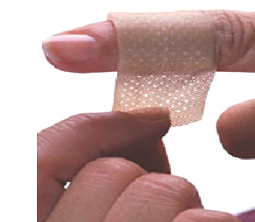
* As he repeatedly bandaged her cuts and burns with gauze and adhesive tape, he became frustrated; the clumsy bandages kept falling off. So he decide to create something "that would stay in place, be easily applied, and still retain its sterility." He stuck some gauze in the center of a piece of adhesive tape, and covered the whole thing with crinoline to keep it sterile. It worked.
* He made up a batch for his wife and took a few in to show his co-workers. The company's owner, James Johnson, heard about it and asked for a demonstration-which convinced him to begin manufacturing the product.
* By the '80, over 100 billion Band-Aids had been sold. Dickson, who became an exec at J&J, was amply rewarded for his efforts.
IVORY SOAP (1879)
(Image credit: Flickr user Stewf)
Harley Procter and his cousin, chemist James Gammble, came up with a special new soap in 1878. It was smooth and fragrant and produced a consistant lather... but it wasn't Ivory-it was called White Soap-and it didn't float.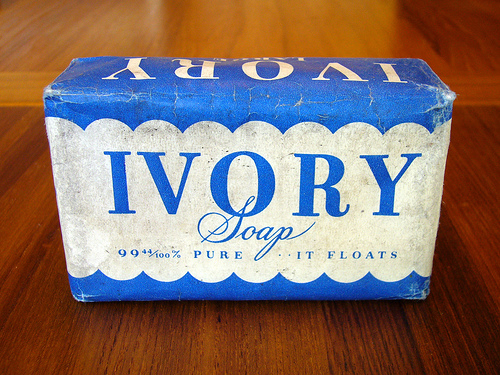
* One day in 1879, the man operating Procter & Gamble's soap mixing machine forgot to turn it off when he went to lunch. On returning, he discovered that so much air had been whipped into the soap that it actually floated.
* For some reason, the batch wasn't discarded-it was made into bars and shipped out with the other White Soap. Soon, to their surprise, P&G was getting letters demanding more of "that soap that floats." So they started putting extra air into every bar.
* Now that they had a unique product, they needed a unique name. And they found it in the Bible. Procter was reading the 45th Psalm-which say: "All thy garments smell of myrrh, and aloes, and cassia, out of the ivory palaces..."-when it hit him that ivory was just the word he was looking for.
* In October 1879, the first bar of Ivory Soap was sold.
VELCRO (1957)
A young Swiss inventor named George De Mestrel went for a hike one day in 1948. When he returned, he was annoyed to find burrs stuck to his clothes. But his annoyance turned to fascination. Why, he wondered, wouldn't it be possible to create synthetic burrs that could be used as fasteners?
* Most people scoffed at the idea, but a French weaver took him seriously. Using a small loom, the weaver hand-wove two cotton strips that stuck together when they touched. The secret: one strip had hooks, the other had loops.
* But De Mestrel had to figure out how to mass-produce it... and he needed tougher material than cotton, which quickly wore out.
* Years passed; De Mestrel experimented constantly. Finally he found a suitable material-nylon, which, it turned out, became very hard when treated with infrared light.
* Now he knew how to make loops by machine-but he still couldn';t figure out how to mass-produce the hooks.
* Finally a solution hit him. He bought a pair of barber's clippers and took then to a weaver. With the clippers, he demonstrated his idea-a loom that snipped loops as it wove them, creating little nylon hooks. He worked onthe project for a year-and when it was finally completed, Velco ("Vel" for velvet, "cro" for crochet) was born. The product had taken a decade to perfect. Image credit: Flickr user Janice Yuvallos.
POP-UP ELECTRIC TOASTER
(Image source: The Cyber Toaster Museum)
The first electric toasters, which appeared around 1900, were primitively constructed heating coils that were terrible fire hazards. However, they were a luxury-it was the first time in history that people didn't need to fire up a stove just to make a piece of toast.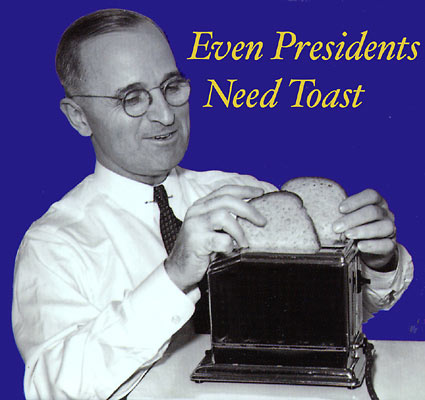
* There was a built-in problem, though-the bread had to be constantly watched or it would burn to a crisp.
* In 1919, Charles Strite, a Minnesota factory worker, got sick of the burnt toast in the company cafeteria. So, in his spare time, he designed and patented the first pop-up toaster. Then he went into business manufacturing them. It took years to work out the bugs, but by 1926, Strite's "Toastmasters" were relatively fireproof.
* A few years late, a New York businessman purchased Strite's company and invested heavily in advertising-which proved to be the key ingredient in making the toaster a common household appliance. Every home "had to have one" ...and now they do.
________________________________
The article above is reprinted with permission from The Best of Uncle John's Bathroom Reader.Since 1988, the Bathroom Reader Institute had published a series of popular books containing irresistible bits of trivia and obscure yet fascinating facts.
If you like Neatorama, you'll love the Bathroom Reader Institute's books - go ahead and check 'em out!
Email This Post to a Friend