There's nothing sadder than a depressed cow. Bunter, a cow owned by the Maungaturoto Historic Inn in Maungaturoto, New Zealand, became blue after the death of her cow companion Rosie last year. A therapy goat named Peaches was donated to lift Bunter's spirits. It worked, as Bunter began eating and cavorting again. But then Peaches disappeared from the hotel in December, and the staff worrried that Peaches had become curry. Local police were notified, and investigated the burglary. Northland Police posted a pun-filled report at Facebook.
In places across the South, it is customary to paint a porch ceiling blue. This tradition began in the Low Country of South Carolina, and is frequently seen in Beaufort and Charleston. It's a pretty color, but there's a reason people incorporated blue in their homes- as protection from evil spirits.
This “haint blue,” first derived from the dye produced on Lowcountry indigo plantations, was originally used by enslaved Africans, and later by the Gullah Geechee, to combat “haints” and “boo hags”—evil spirits who escaped their human forms at night to paralyze, injure, ride (the way a person might ride a horse), or even kill innocent victims. The color was said to trick haints into believing that they’ve stumbled into water (which they cannot cross) or sky (which will lead them farther from the victims they seek). Blue glass bottles were also hung in trees to trap the malevolent marauders.
While “haint blue” has taken on a life of its own outside the Gullah Geechee tradition—it’s currently sold by major paint companies like Sherwin-Williams, and marketed to well-to-do Southerners as a pretty color for a proper porch ceiling—the significance of the color to the descendents of the Lowcountry’s enslaved people still remains.
Indigo was grown in South Carolina by enslaved workers before the Revolutionary War. It was a lucrative trade, but not for those who brought the skill to raise and extract the dye, along with their spiritual beliefs, with them when they were taken from West Africa. While artificial dyes are used almost exclusively now, the Gullah Geechee community is seeking to bring back the indigo plant along with the history behind it. Read about haint blue and the people who produced it at Atlas Obscura.
The first mention of Rickrolling on Neatorama was in February of 2008, but the first mention of a spontaneous and unexpected Rick Astley song was covered earlier, in January of that year. The year 2008 was the peak year for Rickrolling, although it still happens 12 years later ...and is arguably more effective now that it is not only universally understood, but infrequent enough to catch people off guard. But who came up with the idea, anyway? The origins of the prank are a collision of a 2005 episode of It’s Always Sunny in Philadelphia, a 2006 radio show prank, and 4chan's Duckrolling meme. But the ways people used it afterward are more fun than the origin story.
Huffington Post, April 13, 2011, excerpt from “Oregon State Legislators RickRoll: Lawmakers Sneak Lines From Rick Astley Hit Into Speeches”: State lawmakers in Oregon have made a splash online, after a video emerged showing members sneaking the words to Rick Astley’s 1987 hit “Never Gonna Give You Up” into their speeches. The prank was the brainchild of Oregon House member Jefferson Smith. According to The Ticket, Smith convinced his colleagues to take part in the prank and then compiled the lines from their speeches over a period of around two months for inclusion in the video.
Aerists Aleia Murawski and Samuel Copeland didn't set out to make miniature worlds for their snails. The miniatures and the snails were separate projects that eventually came together. The idea of keeping snails as pets happened when Copeland visited his parents' home.
On a venture into the back garden, he happened upon three snails and brought them back to Chicago where he then-resided with Aleia. “We made a terrarium for them,” Aleia tells It’s Nice That, “and around the same time, we started making miniature scenes together. At first, we were keeping them as pets and just loved looking at them every day. Then we realised, the sets we were making were roughly snail-sized and we loved the idea of animating these rooms.”
That was four years ago. The snails now have an amazing variety of sets, from tiny houses and workplaces to fantasy spaces. Continue reading to see more of the clever constructions that the snails inhabit, including videos of how the snails use them.
There have been cases where completely fictional species have been given taxonomic names in scientific journals. These articles are often presented as humor, such as Haggis scoticus vulgaris, but there have been cases where an article on a nonexistent species was submitted to reveal the lack of rigorous peer-review in publishing. This was the case with a flea named Ctenophthalmus nepalensis. Despite the many weird names given to new species, there are rules in taxonomy. In 1975, Peter Scott and Robert Rines published an article in the journal Nature that described the species Nessiteras rhombopteryx. We know the animal as the Loch Ness Monster. The research was based on photographs and the ability of the environment to sustain such a creature, which is not that unusual in science.
But let’s return to the question of whether Nessiteras rhombopteryx is nomenclaturally available, which remains unanswered. Is it a valid name, according to the zoological nomenclature rules? Description, diagnosis, name, publication — check, check, check, check. The discussion is therefore focused instead on whether Nessiteras rhombopteryx names a hypothetical concept, in which case it wouldn’t fall under the purview of zoological nomenclature. Many people would surely assert that Nessie is a creature of myth and legend, lacking a biological manifestation in Loch Ness or anyplace else on Earth, which would therefore indicate a hypothetical concept. However, an important tenet of taxonomy is that, first and foremost, what is published is valid. Based on the publication, there’s no doubt that both Scott and Rines are thoroughly convinced that Nessie exists. In other words, the description of Nessiteras rhombopteryx was not published explicitly for a hypothetical concept, and it’s doubtful that the opinion held by many, if not most, scientists—that is, that Nessie is not real—could be reason enough to strike the name from the list of animal species in Great Britain. So there’s a lot to suggest that Nessiteras rhombopteryx can be accepted as a real, earnest, and, yes, valid name.
Scientific names have also been given to the yeti (Dinanthropoides nivalis), Sasquatch (Gigantopithecus canadensis), and frogs squashed on a highway (Rana magnaocularis). Read about the business of naming species that don't exist at the MIT Press reader. -via Damn Interesting
A script that just might be the original story planned for the ninth episode of the Skywalker saga has been leaked. The script, allegedly written by Colin Trevorrow and Derek Connolly, appears to be an intriguing tale. The A.V. Club tells us more:
According to the breakdown, which originates on YouTube, Trevorrow’s Episode IX was titled Duel Of The Fates (actually a very good title!) and his last draft was written in December 2016, about a week before the passing of Carrie Fisher. Though certain plot points could have changed during production or through reshoots, Trevorrow and Connolly’s story seems far more compelling than The Rise Of Skywalker. In their version, Kelly Marie Tran’s Rose Tico is given a much larger role and spends a good portion of the film with Finn, C-3PO, and R2-D2 on a mission to light a beacon on Coruscant that will draw allies to assist the Resistance in their final battle against the First Order. Meanwhile, Rey, Poe, and Chewbacca head to a distant planet to find answers that may help Rey figure out what to do about this whole (gestures wildly) situation.
A big difference from The Rise of Skywalker is that, in this version, both Palpatine and Darth Vader appear, but as recordings, not resurrected characters. The most fascinating part is that Kylo Ren is literally haunted by the ghost of Luke Skywalker. While Disney has not responded, a second source has verified the script. You can listen to a breakdown of the script in a 2-hour video by Robert Meyer Burnett, or you can read the plot points from the video kindly listed by redditor Lollifroll. Or you can just read the highlights at the A.V. Club.
Just days after the owner of Kangaroo Island Wildlife Park battled encroaching wildfires to save the animals who live there, the facility welcomed Scottish reporter Debi Edward and showed the world that Aussies have not lost their sense of humor. The animal handlers convinced her she needed to wear a protective suit in order to handle a vicious drop bear. Edward fell for it hook, line, and sinker. Just wait until they travel to Scotland- she'll be glad to introduce them to the wild haggis. Video contains NSFW language. -via Boing Boing
Lace was everywhere in the 17th century. Anyone could make it with time and practice. And that's how lacework illustrated the stratification of social classes. Common people had what they themselves made. As you went up the social ladder, more free time meant more intricate lace, and the aristocracy could afford to have lace custom-made by dedicated artisans, embedded with pearls and gems, with patterns that included mythical beasts, historic scenes, and meaningful personal symbols.
Threads of silk and precious metals were imported from the East, and lace making competitions and guilds were established. It transcended the space of domestic hobby, and became a way to flaunt your status; churches would commission “panel” pieces akin to antique comic books that played out biblical scenes, and it wasn’t uncommon to find lace embellishments on the coffins and chariots – as well as the cuffs – of aristocrats.
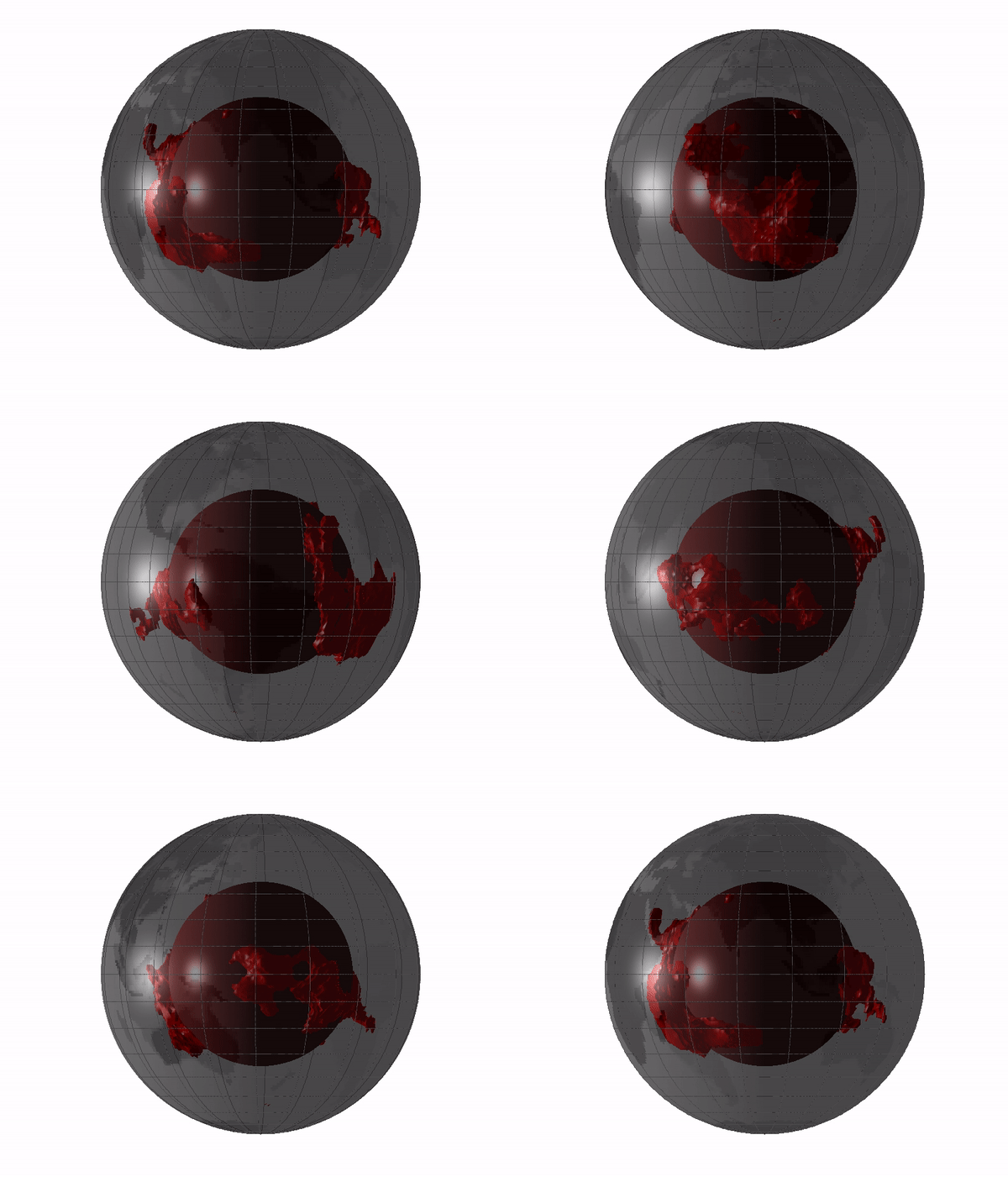
We learned in school that the earth is made of layers: the crust with tectonic plates and oceans, the mantle, and the hot liquid core. But wait, there's more! Deep beneath the surface, there are huge blobs of ...something. Scientists call them LLSVPs, or large low-shear-velocity provinces. But knowing they are there does not tell us what they are, or how they affect our world.
Over the years, better maps kept showing the same bloblike features. One huddles under Africa; the other is beneath the Pacific. They lurk where the planet’s molten iron core meets its rocky mantle, floating like mega-continents in the underworld. Their highest points may measure over 100 times the height of Everest. And if you somehow brought them to the surface, God forbid, they contain enough material to cover the entire globe in a lava lake roughly 100 kilometers deep.
“It would be like having an object in the sky, and asking, ‘Is that the moon?’ And people are like, no. ‘Is that the sun?’ No. ‘What is it?’ We don’t know!” said Vedran Lekić, a seismologist at the University of Maryland. “And whatever it is, it is intimately tied to the evolution of the Earth.”
The first mystery of these hulking, hidden seismic features is whether they’re made of different stuff than the rest of the Earth’s mantle. The second: How do these patterns in the deep leave traces on our surface world?
Neurosurgeon Alex Alamri explains how he cuts into a living human brain to find a tumor without damaging the important parts we need to keep. There's some totally neat technology that helps him, which only makes us wonder how anyone ever dared to attempt brain surgery before this kind of mapping was available.
The all-time list of the most checked-out books at the New York Public Library is out, and while it consists of mostly children's books, Goodnight Moon by Margaret Wise Brown is not among them. That's strange, because the book, published in 1947, is more popular now than it has ever been. But the NYPL didn't even have Goodnight Moon in its collection until 1972! The story of why the book was banned for so long goes back to one very powerful librarian, Anne Carroll Moore.
As it turns out, this footnote on the NYPL’s anniversary list hints at a rich, surprising story of power, taste, educational philosophy, and the crumbling of traditional gatekeepers. Moore was appointed the NYPL’s first “superintendent of work with children” in 1906, at a time when the very idea of children even being allowed into libraries was brand-new. (Children who couldn’t read yet would gain nothing from a library, the theory went, and older children might be corrupted by all the trashy adult books.) Moore oversaw the beautiful Central Children’s Room in the library’s flagship building on Fifth Avenue. As Leonard S. Marcus writes in his biography of Margaret Wise Brown, Moore became perhaps the leading figure in popular children’s books in the first half of the century, and many of her methods seem strikingly modern. She scheduled scores of story hours for children; she encouraged any children who could sign their names to check out a book; she trained librarians drawn from a diverse range of backgrounds and then sent them out into a city of immigrant children, preaching the gospel of reading.
Cairo artist Dina Amin loves to deconstruct existing items to see how they work. For her latest art project, she needed a number of doll's eyes. She could have just ordered a bunch of parts, but instead, she collected used doll heads. The process of finding them and removing the eyes is as interesting as the final project itself. -via Metafilter
The Western has always been a powerhouse American movie genre, allowing for the standard shoot-em-ups where the good guy always wins, and some very different takes set in the same wild west place and/or time. The "acid Western" arose in the 1960s and had its heyday in the '70s by putting a modern and artistic spin on the outlaw narrative. They don't always include drugs, but they certainly try to be mind-expanding.
The term ‘acid western’ is an elusive one. First coined by Pauline Kael in her New Yorker review of Alejandro Jodorowsky’s El Topo (1970), it wasn’t until 2000 and the publication of his monograph on Jim Jarmusch’s Dead Man (1995) for the BFI Modern Classics series that critic Jonathan Rosenbaum would expand upon the terminology more specifically.
“What I partly mean by acid westerns,” wrote Rosenbaum, “are revisionist westerns in which American history is reinterpreted to make room for peyote visions and related hallucinogenic experiences, LSD trips in particular.” He distinguishes these from the “less radical… upheaval of generic norms” that colour “the influence of marijuana on the drifting, nonlinear aspects of the style of McCabe and Mrs Miller (1971),” setting the ‘acid western’ apart from what he calls the ‘pot western’.
You've probably seen some of the movies on this list, and you might want to give them a second look, or even find something new to watch. Every one of them is a product of its time, with some holding up better than others. See the synopses of ten movies at BFI. -via Boing Boing
The Tokyo Olympic Committee has unveiled a series of posters to promote the 2020 Olympic games, which will be held July 24 through August 9, and the Paralympic games, August 25 through September 6. The theme comes off as "variety." Some posters actually feature athletes, others the city of Tokyo, but most are abstract. There are quite a few that channel manga, which is only appropriate in modern Japanese art.
The call for official posters is part of an over century-long tradition. An artist selection committee of nine, ranging from museum professionals and journalists to practicing designers, chose a total of 20 fine artists, manga artists, graphic designers, calligraphers, and photographers from across Japan and beyond to bring their unique perspective to the Games. The inspired results are as diverse as the artists who created them.
Oh, don't we internet denizens just love to categorize things. You've seen plenty of alignment charts fashioned from the moral structure taken from Dungeons & Dragons. Illustrator Robert James Russell (robhollywood) took a stab at categorizing French fries in this manner, and all I can say is "Your mileage may vary." It's difficult to see any pattern in the chaos and morality here. Yes, the relatively nutritious sweet potato fries are a lawful good, while artery-clogging poutine is in the opposite chaotic evil corner, but if healthy eating has anything to do with it, how did cheese fries end up as neutral good? If the shape is important, why are waffle fries lawful? This may be one of those things that is completely dependent on Russell's taste or past experience. -via Geeks Are Sexy