
Miss Cellania's Blog Posts

Children Burned by Fruit

Stephanie Ellwanger of Hanford, California, took her two daughters and three of their friends to a pool party. By the next morning, the girls looked to be badly sunburnt. All five girls developed burns to the point of blisters, and were taken to a hospital. They were all admitted with second-degree burns over 15% of their bodies. Doctors suspected chemical burns.

Then she remembered the lime tree.

A neighbor had a large lime tree that grew over the fence into the backyard where the girls went swimming. They had picked some of the fruits and squeezed them out into imaginary tea cups in their play lemonade stand.

Was there something on the limes? Ellwanger wondered about pesticides. She mentioned this to the doctors, then went home to do some research.

A few attempts on Google yielded a term she’d never heard before: Phytophotodermatitis, a chemical reaction that makes bare skin hypersensitive to ultraviolet light. It’s caused by contact with photosensitizing compounds which occur naturally in some fruits and vegetables — like limes.

The girls spent two weeks in the hospital, and now have to be home schooled to avoid sunlight. Phytophotodermatitis can be caused by lemon, lime, celery, carrot, and other foods. When I was a kid, my friends and I would put lemon juice on our hair before outdoor sports to help the sun bleach it. Little did I know we were playing with fire!  Link  -via Arbroath

(Image credit: Gary Feinstein/The Sentinel)

The Truth About Cow Tipping

Every once in a while, you'll hear someone talk about coming from a rural background where there was nothing for young people to do except get into mischief like cow-tipping. Don't believe them.

So why does the myth of cow tipping persist?

Part of this, of course, is that the closest many people come to a cow is seeing a Holstein along the interstate. Glimpsed at 65 miles per hour, it’s possible to imagine a docile bovine easily overturned by a blacked-out college bro. Approach a cow on foot and you’ll quickly realize how difficult the task of tipping would be. A 1,400-pound dairy heifer is a broad, squarely built animal — there’s a reason the adjective “beefy” exists. You’d have more luck trying to tip over a Camry than a cow.

Nate Wilson, 66, grew up around cows, began milking cows in 1970 and recently retired after selling his dairy farm in Sinclairville, New York. “I think I know a thing or two about cattle,” he says. And for him, the whole notion of cow tipping is, to put it politely, bullcrap. “There’s more cows that have been tipped in people’s imaginations,” says Wilson, “than in the real world.”

But can it be done? At Modern Farmer, the actual physics of turning over a cow are explained in geeky detail. Of course, you also have to add in typical bovine behavior, because there are some things even a cow will not put up with. Link -via the Presurfer


The Debrett's Guide to Mobile Phone Etiquette

The Telegraph has published a 10-point guide to cell phone manners from Debrett's, the traditional authority on British aristocracy and social manners. The kinds of things you'd expect, like:

8. Step away from the phone at meal times

Don't put your phone on the dining table, or glance at it longingly mid-conversation.

9. Don't carry on mobile phone calls when in the middle of something else

Don't carry on mobile phone calls while transacting other business - in banks, shops, on buses and so on. It is insulting not to give people who are serving you your full attention.

Most of it is intuitive, meaning the people who will read it don't need to be told how to take calls or not in various situations. And as commenters at Metafilter quickly pointed out, the list is only about phone calls, which is inadequate in an age when young people use smart phones for much more, like texting, watching TV, web browsing, music, and social networking. If we were going to construct a comprehensive list of rules for using smartphones, what rules would you suggest? Link

(Image credit: Flickr user TheeErin)


What Is It? game 291

Hey look! It's time for our collaboration with the wonderful What Is It? Blog! Do you know what the object in this picture is? It doesn't really matter if you do, because we are looking for the funniest guesses. You can win a t-shirt from the NeatoShop! But first, read the rules:

Place your guess in the comment section below. One guess per comment, please, though you can enter as many as you'd like. Post no URLs or weblinks, as doing so will forfeit your entry. Two winners who submit funny and/or clever (albeit ultimately wrong) answers will each win a T-shirt from the NeatoShop.

If you guess the correct answer, you'll get a big pat on the back, and many thanks from the owner of this thing, because he doesn't know what it is!

Please write your T-shirt selection alongside your guess. If you don't include a selection, you forfeit the prize, okay? May we suggest the Science T-Shirt, Funny T-Shirt and Artist-Designed T-Shirts?

Also, checkout the other mystery items of the week at the What Is It? Blog. Good luck!

Update: Several people contacted the What Is It? blog to say this was used to sharpen cutters for a sheep shearing handpiece. That didn't matter to us, as we were looking for the funniest answers. One that made everyone laugh was from pismonque, who said it was an early working model of the farmship Enterprise. That's worth a t-shirt! Dennis 4 had a funny one, too: "It's a heavy metal record player. It works best playing Iron Maiden." That's good enough to win a t-shirt from the NeatoShop, too! Thanks to everyone who played along this week -all of the guesses were worth reading, so you should do that. Check out the answers to all this week's mystery objects at the What Is It? blog.


R.I.P. Butler Blue II

The news was released yesterday that Butler Blue II, the bulldog mascot for the Butler University Bulldogs, passed away Saturday after an extended Illness. He was nine years old. The whole story comes out in a eulogy from Michael Kaltenmark, who cared for Blue. Butler Blue II is also mourned by Butler Blue III, nicknamed Trip, who took over as university mascot when the older dog retired in 2012. Uproxx has the dog's final Tweets. Link

The university released a video retrospective of Butler Blue II's life and work. Continue reading to see it, but bring a hanky.

Continue reading

More NYC Etiquette Tips

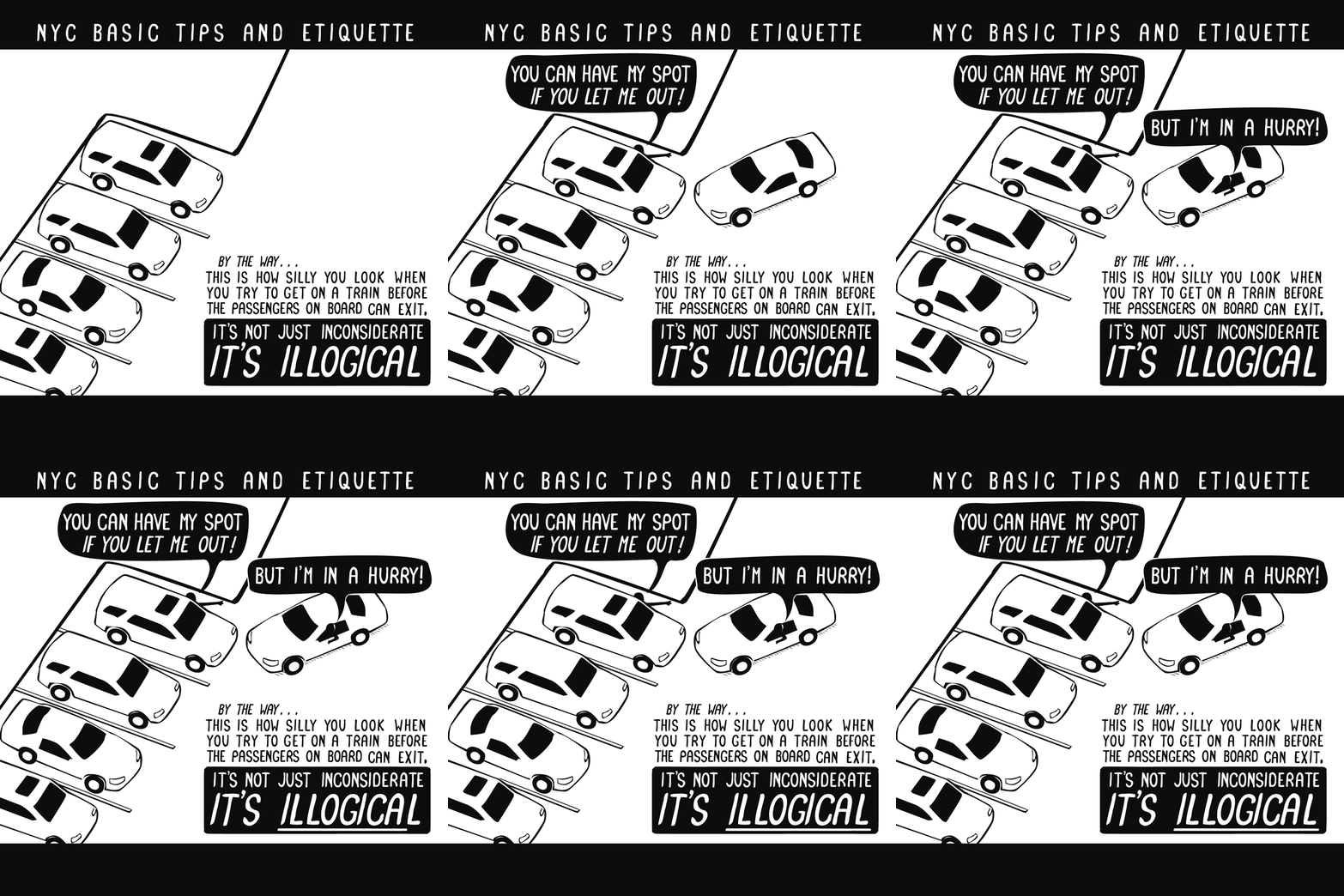
Earlier this year, Nathan Pyle gave us a series of gifs about basic New York City Etiquette. Now he has a follow-up series ready, with more city etiquette and tips to help tourists get around. Plus, he got a book deal! It is scheduled for release next year. Link


Google's Birthday?

I've been getting a lot of notices about today being Google's birthday. At first I ignored them, because Google's birthday is on September 27th, which I recall because it is also my birthday. But I keep seeing birthday notices everywhere, so I "Googled" it. (In other news, "Google" is the only word I've ever put into the Google search field that did not have a Wikipedia entry on the first page of results.) About.com has this to say:

Google's birthday has shifted around over the years, but it currently is celebrated on September 27th. The exact year of Google's "birth" depends on how you measure it.

The Web domain www.google.com was registered in 1997, but Google officially opened for business in September of 1988.

And Wikipedia says:

The domain name for Google was registered on September 15, 1997,[41] and the company was incorporated on September 4, 1998.

The Google blog doesn't say anything, because there's no entry for today -yet. Some big British newspapers: The Independent, The Guardian, and the Daily Mail, all have congratulatory stories on Google's 15th birthday. But the most telling clue is the search page itself, which has no Google Doodle for today, meaning they probably plan to celebrate on another day. Maybe on my birthday!

(Image: last year's Google Birthday Doodle)


107 Regional Slang Words

(YouTube link)

Let the carping begin! Anytime someone tries to pinpoint regional idioms, there are many folks who were born and raised there and have never heard the term. Where I live, that sandwich is called a submarine, shortened often to sub. But then again, I live in Kentucky, which is sometimes referred to as the Midwest and sometimes as the South, but we have a language all our own. John Green has a whole slew of regional slang terms in the latest mental_floss video.


London to Brighton by Train

(YouTube link)

The BBC filmed a POV train ride from London to Brighton in 1953. Thirty years later, they did it again, and now, another thirty years later they took the same trip. Those three films have been placed together and synched up (the film goes much faster than the actual trip). The result is hypnotic. Not much has changed: the trees have grown, and the world is much more colorful now. -via Jason Kottke


Amazing Bird Nests From Around the World

Sharon Beals, fascinated with the variety of birds and the way they adapt, took pictures of nests in museums and educational facilities for her book Nests: Fifty Nests and the Birds that Built Them.

"There are those that build with mud, burrow tunnels, weave hanging pendulous baskets or cups onto branches, stitch leaves, stack sticks, or glue with saliva. Some just make simple scrapes on the ground, or fill cavities with fur and bones, and others that camouflage their nests with lichen, spiderweb, or moss," Beals wrote in her book.

Pictured here is the nest of a Caspian tern, collected from Baja California, Mexico, in 1932. See more at Slate. Link -via Nag on the Lake


Goat Anatomy

Makes perfect sense to me. It will also cause people to want their very own pet goat with its tum and jump sticks. Link


The Arsehole Gene

(YouTube link)

Genticists have made a fascinating discovery that points to a genetic mutation responsible for the behavior of certain people you know. They were born that way. Which, of course, leads them to seek protected status, which is altogether an arsehole thing to do. -via Metafilter


Star Trek: The Art of Juan Ortiz

Artist Juan Ortiz designed a movie-style poster for every episode of the original Star Trek. They're in his new book Star Trek: The Art of Juan Ortiz, but we get a sneak preview of seven of them at Flavorwire, along with Ortiz' comments on each. Link

(Image credit: Juan Ortiz)


Some Genes are More Analog than Digital

Ed Yong has a fascinating article on the behavior of a gene called SRY. It is located on the Y chromosome, and is pivotal in making an embryo develop into a male. But what about studies of Swyer syndrome, in which a child inherits the father's Y chromosome, but does not develop into a male? Children with Swyer syndrome are born and raised female, but do not become fertile at puberty. However, their fathers may have an identical SRY gene, and obviously were male. What makes the difference? The the gene does not always cause maleness, as it has a rather weak mechanism that is dependent on conditions being just so. Michael Weiss from Case Western Reserve University presented the research, and Melissa Wilson-Sayres from the University of Berkeley compares the gene to a dimmer switch as opposed to an off-on switch -or analog vs. digital.

That’s very strange. There are many master genes that play pivotal roles in our development, controlling the growth of eyes, limbs and more. If these genes don’t work properly, the results could be catastrophic. So, they ought to be exceptionally stable—enforcing the status quo in the face of all but the most severe mutations or environmental conditions. It should take much more than a 2-fold difference in activity to change what they do. “We’d expect to see factors of 50-fold or more,” says Weiss. “These master switches are meant to be rigorously locked in. They’re not meant to be this tenuous.”

So, why does SRY operate from such a wobbly position? Why have a set-up that could so easily lead to infertility? For the variety, says Weiss. He thinks that the vagaries of SRY leads to a wide variety within developing testes, and a wide variation in the amount of testosterone they produce. This hormone influences our behaviour, including many aspects of our social lives. So, at the risk of the occasional infertile XY female, a precariously-set master switch leads to a broad spectrum of male brains, which may make for a better-functioning society. “You can’t have all alpha-males in a group,” suggests Weiss.

It’s a fairly speculative idea, and Wilson-Sayres isn’t convinced. She says that the far simpler explanation is that the Y-chromsome is especially prone to picking up mutations with weak harmful effects.

Read more about the gene that can determine male and female, and how it does the job, at Not Exactly Rocket Science. Link

(Image credit: Flickr user Betsssssy)


Meet Lizzie Mae

(YouTube link)

Azie Mira Dungey worked as a living history character at Mount Vernon, George Washington's estate in Virginia. She regularly answered questions about life as a slave, but some of the questions were, shall we say, somewhat clueless. Real questions are recreated in this video, and Dungey does her best to stay in character while answering. Apparently these questions are just the tip of the iceberg, as this is the first episode of her web series directed by Jordan Black called Ask a Slave. Episode two is already up. Link  -via Viral Viral Videos


Email This Post to a Friend

Page 1,661 of 2,642     first | prev | next | last

Profile for Miss Cellania

  • Member Since 2012/08/04


Statistics

Blog Posts

  • Posts Written 39,622
  • Comments Received 109,660
  • Post Views 53,307,827
  • Unique Visitors 43,858,868
  • Likes Received 46,475

Comments

  • Threads Started 5,002
  • Replies Posted 3,739
  • Likes Received 2,793
X

This website uses cookies.

This website uses cookies to improve user experience. By using this website you consent to all cookies in accordance with our Privacy Policy.

I agree
 
Learn More