Here at Neatorama, we love Rube Goldberg machines! So enjoy Wired's gallery of nine such setups, including "The Falling Water" -- a cocktail-making Rube Goldberg machine by Joseph Herscher. It mixes vodka, lemonade, ice, and a slice of cucumber.
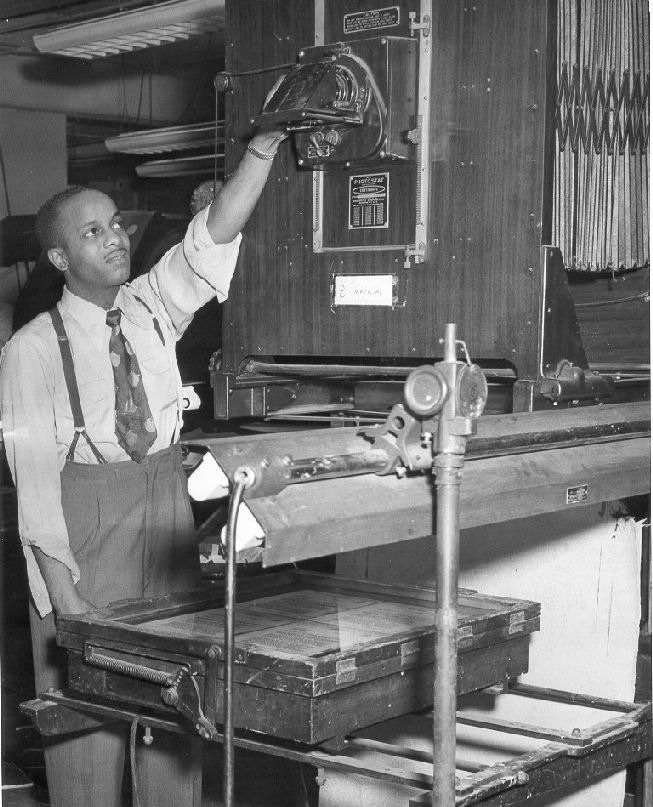
Fifty years ago this month, Xerox shipped out the first commercial document copying machine. This technical innovation began with Chester Carlson, a New York attorney, who discovered in the 1950s that photoconductivity could be used to create a mirror image of a document. From CNN's historical overview:
Carlson spent more than a decade trying to design a working model of his copier -- an obsessive and mostly fruitless quest that cost him his first marriage -- until the Haloid company finally showed an interest.
By the mid-1950s, Haloid had devoted a team of engineers to the project. It was a huge gamble. The team toiled seven days a week in a Rochester warehouse, but progress was slow. One early version of the machine stood almost 12 feet tall. Another could only make copies in the dark. Engineers improvised by cobbling together crude prototypes out of spare parts, such as aluminum pipes and rabbit-fur brushes.
Link via Gizmodo | Photo: 1940s era industrial photocopier, courtesy of the US Social Security Administration
Dondurma -- Turkish ice cream -- is apparently made differently from ice cream in the United States, and has stickier consistency. Jordan Breindel of Urlesque informs us that in Turkey, streetside vendors of the substance often engage in a performance art as they serve portions to customers. More videos at the link.
A simple but elegant solution to a common household problem: you have raw bacon, but you have no frying pan with which to cook it. You do, however, have a machine gun. All you have to do is wrap the bacon in tin foil, tie it around the barrel of your Rheinmetall MG 3, and fire off about 150 rounds (250 if you like it crispy). Step-by-step pictures at the link.
If a bank needs to repossess a car, a repo agent will tow it away. But what does the owner of a leased jetliner do if the renter is behind in payments, won't return the plane, and is based in a country that refuses to enforce the repossession? It calls Sage-Popovich, a company that specializes in extracting large airplanes from defaulting renters. The Smithsonian magazine has article about how the job is done:
His team ran through the checklists and lit engines. Immediately, a jeep-load of gendarmes appeared and Popovich was hauled before a magistrate. “In my infinite wisdom, I admitted that there was something posted on the aircraft’s door,” he recalls. “But I informed the judge that if it was really so important, it should have been in English, since that’s the official language of aviation.” The next day he was escorted, in handcuffs, to the first U.S.-bound flight and sent home.
Popovich and team flew to Madrid and reentered France via rail. At de Gaulle they found the MD-80 still grounded, with tanks drained and more French fine print attached. An Air Afrique Airbus next to it was being refueled. Popovich talked to the captain and got him to sell enough fuel to get as far as Iceland. “Everyone was going to be looking for us,” he says, “so I wanted to get out from under Eurocontrol ASAP.” He had already exercised power of attorney to de-register the aircraft from its Luxembourg flag and had obtained a U.S. registration number. The de Gaulle tower cleared the now-American plane for taxi and takeoff. Popovich landed in Iceland with less than 30 minutes’ worth of fuel remaining.
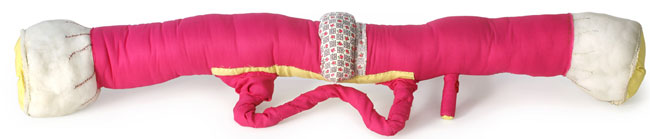
Artist Lauren Fatzinger crafts all sorts of unique products, including a set of weapons made from fabric and a ball gown made from knitted plastic. Pictured above as a cloth bazooka that she made in 2007. It has a button on it marked "KABOOM".
http://www.laurenfatzinger.com/pleasure.shtml via Hell in a Handbasket
A food bank fundraiser at Queen's College in Canada was canceled when the hosting organization, the Alma Mater Society, received a complaint:
They "appropriate an aspect of Japanese culture," turn a racial identity into a "costume," and "devalue an ancient and respected Japanese sport, which is rich in history and cultural tradition." They also "fail to capture the deeply embedded histories of violent and subversive oppression that a group has faced."
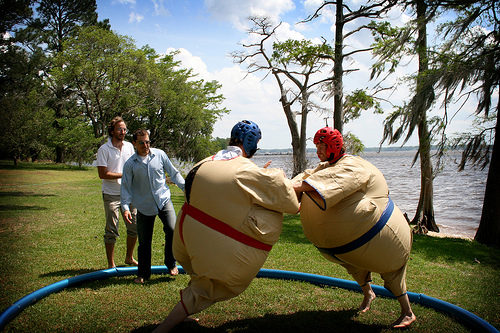
The Alma Mater Society on Monday published a two-page apology letter, and cancelled a foodbank fundraiser scheduled for Tuesday, which was to feature two sumo suits. The letter scolds the student government's own executive for "marginalizing members of the Queen's community" and failing to "critically consider the racist meaning behind [the fundraiser.]"
This short video shows a man getting attacked by a swarm of butterflies near Palo Alto, California. I have a sneaking suspicion that it might be a fake. Probably because the shadows don't match.
Etsy user Stukenborg arranges dice in letterpresses, rolls ink over them, and makes prints. The popularity of this form of printmaking, which formed the basis of Gutenberg's press, has grown in the past two decades.
Architect Takuya Tsuchida solved a unique problem for this new homeowner in Fukushima Prefecture, Japan. He had a nine-car garage, but wanted to be able to view a car of his choice in his living room. So Tsuchida built an elevator to connect the garage and living room. You can see more photos and floor plans for this luxurious home in the links.
Problem: you want to hug someone, but distance and/or restraining orders are in the way.
Solution: Hug-E-Gram! This service will deliver a fuzzy object to the person that you love, who can wrap it around him/herself and hear a personalized message from you. Warning: the link has self-starting audio.
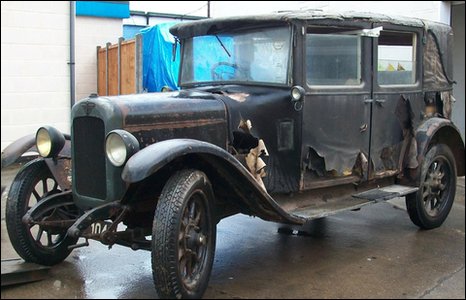
A rare 1929 Austin 12/4, kept in storage since 1961, was found in the personal effects of its late owner:
Mr Bulled, 63, said he discovered the old car whilst going through his father’s possessions shortly after his death in 2008.
He was too frightened to start the engine up fully in case it ruined the car, but is now putting it up for sale to allow an expert to restore it fully and hopefully get it onto the road.
He said: “I pumped up the tyres and they stayed up. The rubber is cracked but the inner tubes are obviously still intact, which is remarkable really.
"And the engine turned over when we tried it with the starter handle, but I didn't try to start her up in case I did any damage but I'm sure it would go.
This video by YouTube user dabedoo shows how often animators for classic Disney movies reused sequences in different movies. brownkidd of Albotas says (presumably facetiously) that they were "a bunch of copy/pasting lazy bums". In the era of hand-drawn animation, I'd cut them a lot of slack.
20th Century British mathematician Alan Turning is popularly known for helping to break Nazi Germany's Enigma code and devising the Turing Test, which is an assessment of artificial intelligence. But he also made major, direct contributions to early computer science. Among them was a 1936 proposal for a computer, which Mike Davey recently built:
Although this Turing machine is controlled by a Parallax Propeller microcontroller, its operation while running is based only on a set of state transformations loaded from an SD card and what is written to and read from the tape. While it may seem as if the tape is merely the input and output of the machine, it is not! Nor is the tape just the memory of the machine. In a way the tape is the computer. As the symbols on the tape are manipulated by simple rules, the computing happens. The output is really more of an artifact of the machine using the tape as the computer.
The heart of the turing machine is the read-write head. The read-write head transports the tape and positions cells of the tape appropriately. It can read a cell determining what, if any, symbol is written there. The machine works on, and knows about, only one cell at a time. The tape in my machine is a 1000’ roll of white 35mm film leader. The characters, ones and zeros, are written by the machine with a black dry erase marker.