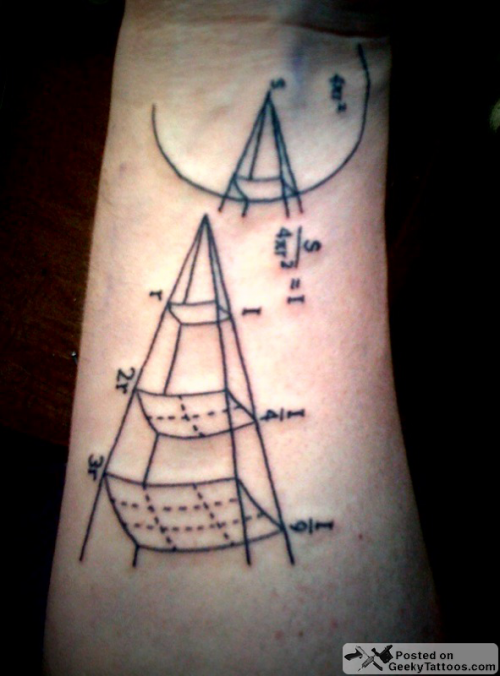
Atlanta-based photographer Erik Dixon got a tattoo illustrating the inverse square law, which "...is the physics equation for the fall off rate of light radiating from a source point. Something I use every time I shoot. This also applies to gravity and sound."
If you were to get an intellectual tattoo, what would it be?
The Monty Hall Problem is a common mathematical fallacy based on Monty Hall's game show Let's Make a Deal. It works like this:
Imagine that you’re in a game show and your host shows you three doors. Behind one of them is a shiny car and behind the others are far less lustrous goats. You pick one of the doors and get whatever lies within. After making your choice, your host opens one of the other two doors, which inevitably reveals a goat. He then asks you if you want to stick with your original pick, or swap to the other remaining door. What do you do?
It's counterintuitive to many people, but switching doors will double your chances of winning:
The problem is that most people assume that with two doors left, the odds of a car lying behind each one are 50/50. But that’s not the case – the actions of the host beforehand have shifted the odds, and engineered it so that the chosen door is half as likely to hide the car.
At the very start, the contestant has a one in three chance of picking the right door. If that’s the case, they should stick. They also have a two in three chance of picking a goat door. In these situations, the host, not wanting to reveal the car, will always pick the other goat door. The final door hides the car, so the contestant should swap. This means that there are two trials when the contestant should swap for every one trial when they should stick. The best strategy is to always swap – that way they have a two in three chance of driving off, happy and goatless.
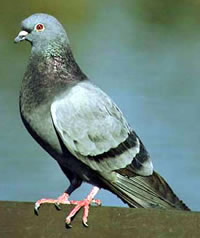
The bad news is that according to a scientific study, pigeons are better as this task than we are:
Each pigeon was faced with three lit keys, one of which could be pecked for food. At the first peck, all three keys switched off and after a second, two came back on including the bird’s first choice. The computer, playing the part of Monty Hall, had selected one of the unpecked keys to deactivate. If the pigeon pecked the right key of the remaining two, it earned some grain. On the first day of testing, the pigeons switched on just a third of the trials. But after a month, all six birds switched almost every time, earning virtually the maximum grainy reward.
The above video shows Stirling engine enthusiasts motoring around on the River Thames. This engine, invented in 1816 by Robert Sterling, consists of, at minimum, two pistons, one of which is heated. Karim Nice of How Stuff Works explains the cycle:
1. Heat is added to the gas inside the heated cylinder (left), causing pressure to build. This forces the piston to move down. This is the part of the Stirling cycle that does the work.
2. The left piston moves up while the right piston moves down. This pushes the hot gas into the cooled cylinder, which quickly cools the gas to the temperature of the cooling source, lowering its pressure. This makes it easier to compress the gas in the next part of the cycle.
3. The piston in the cooled cylinder (right) starts to compress the gas. Heat generated by this compression is removed by the cooling source.
4. The right piston moves up while the left piston moves down. This forces the gas into the heated cylinder, where it quickly heats up, building pressure, at which point the cycle repeats.
The Stirling engine never caught on as well as internal combustion engines did, but has in recent years caught the attention of solar energy developers.
Dutch designer Mieke Meijer compresses and bonds old newspapers so that the print is still legible, but the resulting product has the grain and feel of original wood:
Every day, piles of newspapers are discarded and recycled into new paper. Mieke Meijer has come up with a solution to use this surplus of paper into a renewed material. When a NewspaperWood log is cut, the layers of paper appear like lines of a wood grain or the rings of a tree and therefore resembles the asethetic of real wood. The material can be cut, milled and sanded and generally treated like any other type of wood.
Link via Make | Designer's Website | Photo: Atelier 29
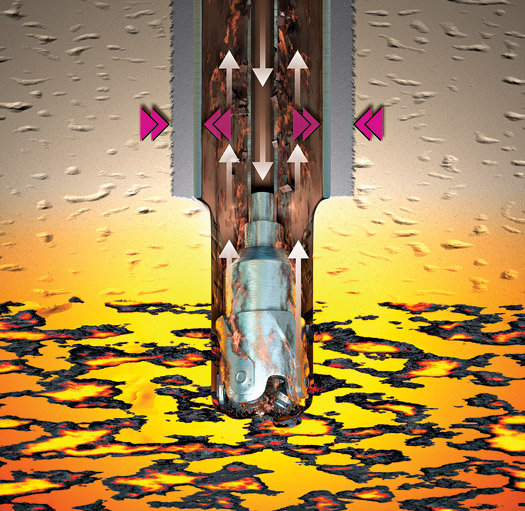
The Chikyu research vessel is a ship with a drill that can reach deeper under the earth's surface than any other drill system in the world. At a cost of $540 million, it's capable of reaching 2,890 23,000 feet below the seabed. Popular Science has an overview of how it works:
In 2007, off the coast of Japan, it became the first mission to study subduction zones, the area between tectonic plates that is the birthplace of many earthquakes. Over the next three years, scientists will tack on at least an extra mile of drill and attempt the most ambitious mission ever: piercing the Earth’s mantle. There, scientists expect to find the same conditions as those in the early Earth—and perhaps the same life-forms that thrived then.
The Defense Advanced Research Projects Agency (DARPA) is an office within the US government that develops military technology. One of their current projects is to design a nuclear reactor that can be sustained with human and animal waste:
The military’s already working on using seawater to create fuel, but that’s more of an option for maritime operations. Without an endless supply of seawater, they’d need an alternative carbon source. Enter the massive quantities of sludge that inevitably accumulate around troop outposts. It’s been a problem for decades, according to environmental management expert Dr. James Lee. In an article for the Army’s Engineer School, he writes that the military spent upwards of $65,000 in annual fuel costs just to burn off human refuse at base camp in the Balkans.
So Darpa’s proposal would offer two major benefits: Less waste to treat and dispose of at bases, and fewer financial and tactical burdens around sourcing adequate fuel — whether to power jets and facilities or burn off heaps of odorous fecal matter. And with a single trooper stationed in Afghanistan using 22 gallons of fuel a day, that’d add up to major savings.
Sculptor Keith Newstead made this lovely brass pegasus automaton. He writes of its metal work:
As they had been cut from 1mm brass they were quite heavy and I was worried that the whole brass horse would be too heavy for the crank to lift it.
I made up the base , fitted all the parts of Pegasus together, fitted Pegasus to the base and joined up all the connecting wires.
As soon as I connected the wings I realised that because of the way they were set up they were actualy lifting the rest of Pegasus, in effect making it lighter.
http://www.keithnewsteadautomata.com/forsale/brass-pegasus and Link via Make
We've heard the Muppets sing "Ode to Joy", "Dust in the Wind", and "Bohemian Rhapsody". In the most recent Muppet music video, a monstrous bunny rabbit and his smaller friends sing the Ben E. King song "Stand By Me".
via Nerdist | Previously on Neatorama: Stand By Me
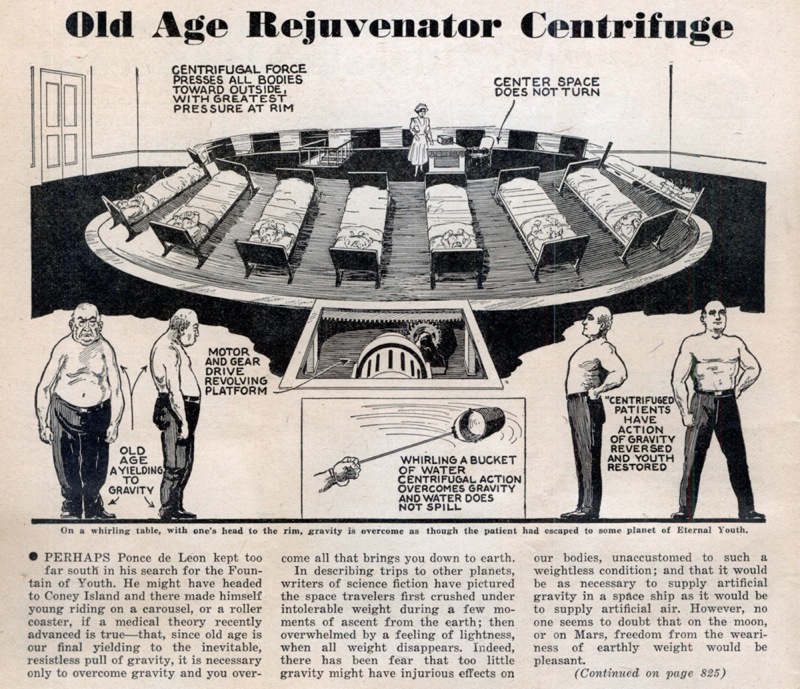
Mark of the blog Life Support has pictures and descriptions of ten unusual medical inventions that were either pointless or dangerous to anyone who would use them. Among them is the 1935 Old Age Rejuvenator Centrifuge, which claims to reverse the effects of aging by counteracting the effects of gravity on the human body.
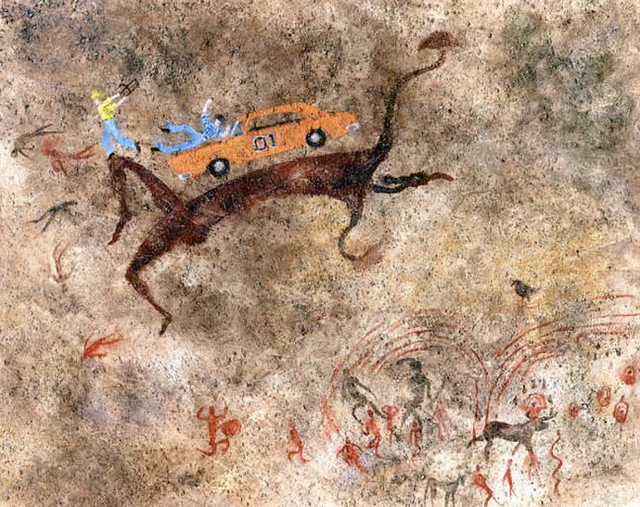
Brandon Bird's "Two Warriors Come Out of the Sky" presents The Dukes of Hazzard as a cave painting. It was created with acrylic paint and dirt on canvas. We've previously featured his Seinfeld/Bruce Lee remix and and his depiction of the death of Jennifer Sisko from Star Trek: Deep Space Nine.
When Icelandic chef Fridgeir Eiriksson learned that the Fimmvorduhals volcano was erupting, he decided to use the opportunity to cook a luxurious meal using the volcano's heat:
On Tuesday, Eiriksson and three mates at the cafi of Reykjavik's luxury hotel Holt drove supplies and "lots of champagne" up to the foot of the mountain in two trucks.
The chefs set up a make-shift dining area near a lava field with a red carpet, a small table and two bolstered chairs for a customers who were to be flown up by helicopter.[...]
With mercury dipping to as low as minus 30 degrees at the mountain over the last few days and the glowing fresh lava around them the diners were offered: lobster soup, flaming lobster and monkfish and lava-cooked shallot onions and Veuve Clicquot champagne.
Link via The Daily Telegraph (larger images available) | Photo: Kristjan Jogason/Demotix Images
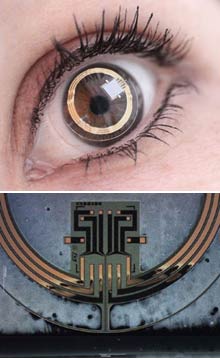
The biotech company Sensimed has developed a contact lens that monitors the user's glaucoma:
The Triggerfish lens is made of the same silicon hydrogel as many of the soft contact lenses currently on the market, but embedded within it is a microprocessor and a strain gauge that encircles its outer edge. When fluid accumulates in the eye, the diameter of the cornea changes, and that change is picked up by the strain gauge. Data is processed and then transmitted via radio frequency to a receiver.
This data can then be used by doctors to provide specific and timely treatments, as well as give researchers a continuous stream of data about the progress of the disease in the same patient.
Link via Popular Science | Photo: Sensimed | Previously on Neatorama: Contact Lenses that Change Color to Alert Diabetics of Glucose Levels
Two men fleeing from police in Cleveland, Ohio tried to climb a barbed wire fence. One made it over the top (getting cut in the process), only to find himself in a prison yard. He was then arrested.
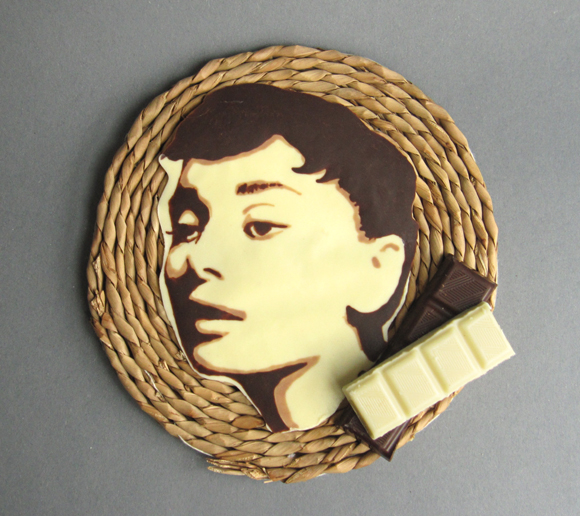
Food artist Jojo Krang of the blog Eye Candy provides step-by-step instructions on how to paint a picture with chocolate. First you create a reverse image, then apply dark tones, midtones, and light tones, in that order, and then flip the product over.
NASA worked with Braille experts to create a tactile representation of the Carina Nebula:
The 17-by-11-inch color image is embossed with lines, slashes, and other markings that correspond to objects in the giant cloud, allowing visually impaired people to feel what they cannot see and form a picture of the nebula in their minds. The image's design is also useful and intriguing for sighted people who have different learning styles.
"The Hubble image of the Carina Nebula is so beautiful, and it illustrates the entire life cycle of stars," says Mutchler, who, along with Grice, unveiled the tactile Carina image in January 2010, at the American Astronomical Society meeting in Washington, D.C. "I thought that people who are visually impaired should be able to explore it and learn from it, too."