John Farrier's Blog Posts

Beat Feat -- Shoes That Are Musical Instruments


(Video Link)


Arturo Vidich, Eric Mika, and Tai Yin Ho equipped pressure sensors to the soles of a set of shoes. They can be played like a musical instrument by dancing in different ways. The project is called "Beat Feat". You can view schematics and construction photos at the link.

http://www.beat-feet.net/project/fabrication-documentation/ via Make

Hummer Stagecoach


(YouTube Link)


As a statement about modern consumerism and consumption, artist Jeremy Dean converted a Hummer into a horse drawn coach:

The work involves a black Hummer H2 (which the artist says gets about 9 miles to the gallon and came tricked out with DVD players in the headsets) partly dismantled and refashioned in the style of a horse-drawn carriage. Dean says the project is inspired by the “Hoover Carts” that cropped up in some rural parts of the U.S. during the Great Depression. In the 1930s, some owners who couldn’t afford to gas up their vehicles, cut them in half and hitched them to horses or mules and used them as carriages to save on fuel.[...]

The Hummer represents all that is wrong with consumer culture, says Dean. He says he sees parallels between the Hummer and the GM vehicles that came out during the 1920s, which were widely bought using some of the earliest versions of consumer credit, then became unaffordable when the Depression hit.


Link via The Presurfer

The 10 Greatest Modern-Day Recreations of Ancient Technologies


Experimental archaeology is a field of study in which scholars attempt to recreate functional implements of ancient technologies. Alasdair Wilkins of io9 has a roundup of ten such efforts, including the Butser Ancient Farm. This is a working farm in Britain using pre-Roman conquest Iron Age technology.

Link | Butser Ancient Farm | Photo: Butser Ancient Farm

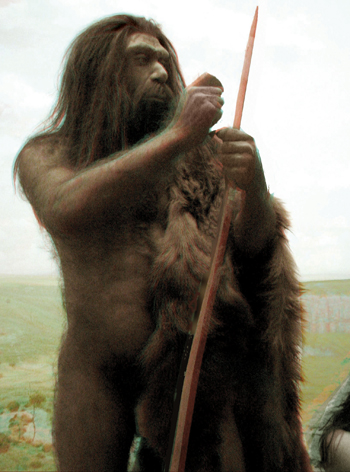
When Did Humans Start Wearing Clothes?

Today, Slate's Explainer feature asserts that humans began wearing clothing about 100,000 years ago. Here's how anthropologists came up with the answer:

Human raiment is not typically preserved in the fossil record, so researchers have turned to lice genetics for hints. Body lice diverged genetically from other louse species about 100,000 years ago. Because body lice live primarily in our clothing, scientists use that moment of differentiation as the likely era when humans started dressing themselves.

It's possible, however, that humans started wearing clothes even earlier. We know that pubic lice jumped over to humans from gorillas—our genetically distinct head lice migrated from chimpanzees—about 2 million years ago. And since pubic and head lice probably couldn't have coexisted on the same body if there was a hairy highway connecting their favorite anatomical spaces (one would have beaten out the other for all the available resources), it's likely that we had lost our body hair by then. Some claim that humans donned clothing shortly after that, but others argue that there's no reason our ancestors would have needed clothing in steamy Africa.


Link | Photo: US Department of Energy

Nature By Numbers


(YouTube Link)


We've previously featured Cristóbal Vila's animated depiction of Frank Lloyd Wright's home Falling Water. Vila's latest project, "Nature By Numbers", illustrates how mathematical properties, such as the Fibonacci Sequence, pervade the natural world. The math of each part of the film is explained in detail at the link.

Link via io9

Computer-Controlled Bacteria Build Microscopic Pyramid


(YouTube Link)


Researchers at the École Polytechnique de Montréal used bacteria that follow magnetic pull to build a tiny pyramid:

By using a computer-controlled magnetic field, the researchers turned the bacteria into fully-compliant biological nanorobots.

The trick was using a type of microbe known as magnetotactic bacteria. These critters have little internal compasses, and will follow the pull of a magnetic field. By manipulating a magnetic field, the researchers tricked the bacteria into forming a giant, computer-controlled swarm. In one experiment, the researchers had the bacterial swarm assemble a small pyramid.


The researchers hope to use this development to perform microscopic tasks normally thought to be the future of nanotechnology, such as organ repair.

via Popular Science

Robbers Call Ahead, Instructing Bank to Have Money Waiting for Them When They Arrive

Bank robbers Albert Bailey and an unidentified sixteen-year-old accomplice were arrested by police in Fairfield, Connecticut as soon as they arrived at the bank that they planned to rob. Perhaps it was calling ahead and telling the bank employees to have the money waiting for them that undermined their cunning plan:

Police arrested 27-year-old Albert Bailey and an unidentified 16-year-old boy on robbery charges on Tuesday afternoon.

Sgt James Perez said the two Bridgeport residents turned up at the bank about 10 minutes after making the call and were met by police in the bank's car park.

Sgt Perez told the Connecticut Post that, in his opinion, the suspects were "not too bright".


Link | Photo: flickr user gcfairch, used under Creative Commons license

Poet Plans to Inscribe His Works into the DNA of a Bacterium

Poet Christian Bök plans to alter the DNA of a particular species of bacteria so that it reflects an encoded version of his poetry:

Canadian poet Christian Bök wants his work to live on after he’s gone. Like, billions of years after. He’s going to encode it directly into the DNA of the hardy bacteria Deinococcus radiodurans. If it works, his poem could outlast the human race. But it’s a tricky procedure, and Bök is doing what he can to make it even trickier. He wants to inject the DNA with a string of nucleotides that form a comprehensible poem, and he also wants the protein that the cell produces in response to form a second comprehensible poem.[...]

Bök will create a code that links letters of the alphabet with genetic nucleotides (adenine, cytosine, guanine, and thymine, aka ACGT). Each triplet of nucleotides will correspond to a letter so that, say, ACT represents the letter a, AGT represents the letter b, and so on.


Link via Marginal Revolution | Image: US Department of Energy

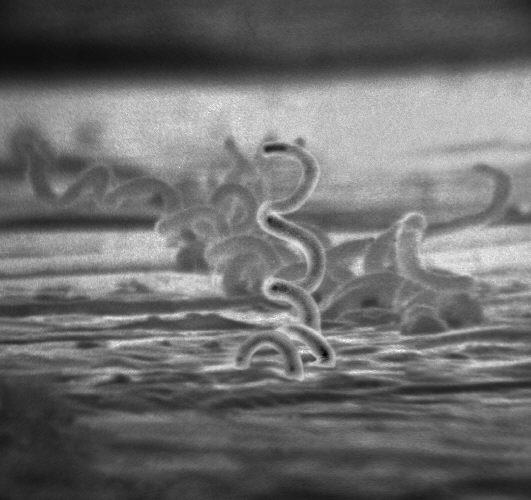
Positive Correlation Found Between Facebook Usage and Syphilis Infection

How long has it been since you ran an anti-virus scan? You'd better do it now because a recent study found that areas of Britain that show a heavy use of Facebook also show a great increase in the incidence of syphilis infection:

The virus has increased fourfold in Sunderland, Durham and Teesside, the areas of Britain where Facebook is most popular, because it has given people a new way to meet multiple partners for casual sexual encounters.

Professor Peter Kelly, director of public health in Teesside, said staff had found a link between social networking sites and the rise in cases, especially among young women.


Just to be careful, we did bloodwork on the Neatorama Facebook page, and it's completely clean and safe.

Link via Geekologie | Photo: CDC

Periodic Table of Periodic Tables


Organizing pop culture data into something resembling a periodic table or making crafts that resemble the actual periodic table of elements is a popular web meme that we've covered in some breadth here at Neatorama. Bill Keaggy took the meme one step further by organizing these periodic tables into a periodic table.  Pictured above is a part of that table.

Link via Nerdcore

Auto Smiley Inserts Smile Emoticons Into an App Whenever You Smile


(Video Link)


Theo Watson developed a program called Auto Smiley. Whenever your computer's webcam determines that you're smiling, the program will insert a smiley emoticon into whatever computer application you're using, such as email or chat. Watson writes "Auto Smiley has many uses from just straight up convenience to enforcing honesty in your online communication [...]"

Link via Make

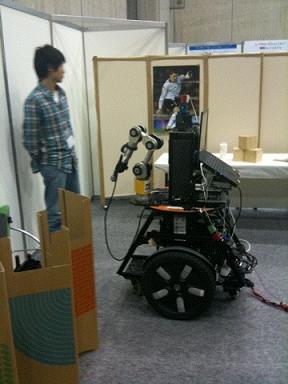
Robot Journalist Seeks Scoops, Interviews People, Takes Photographs, Publishes Stories

Intelligent Systems Informatics Lab at Tokyo University has developed a robot that performs basic journalistic functions:

The robot detects changes in its surroundings, decides if they are relevant, and then takes pictures with its on board camera. It can query nearby people for information, and it uses internet searches to further round out its understanding. If something appears newsworthy, the robot will even write a short article and publish it to the web.


Link via Gizmodo | Photo: Charlie Catlett

Video from Inside a 4-Stroke Engine


(YouTube Link)


This video shows what happens inside a four-stroke engine. That's:
1. the intake stroke of the piston, reducing pressure in the cylinder and forcing gas and air inside
2. intake and exhaust valves close and the piston compresses the fuel-air mix
3. the compression and a spark result in combustion, and therefore a power stroke
4. the piston compresses, pushing out the expended fuel-air mix

Link

Man Builds Flamethrower for His Scooter

Colin Fruze was tired of drivers following his scooter too closely, so he developed a flamethrower to ward them off:

'The flames are pretty big and up to 15ft long so you could definitely set fire to someone's car if you wanted to.'

'The only problem is it can get rather hot if you are riding the moped and blast the flames when the wind is in the wrong direction.'[...]

'It was quite tricky to make and the first version wouldn't fire the flames when the moped was moving,' he said.

'My second attempt kept setting fire to itself, but my third version works really well and I'm very pleased with it.'

But sadly Colin, who built the moped in his spare time in his back garden, will not legally be allowed to use it on the road.


Link via DVICE | Photo: Goeff Robinson Photography

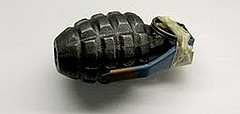
Indian Military Creates Weaponized Chili

India's bhut jolokia is acknowledged by the Guinness Book of World Records as the world's spiciest chili. That nation's military has responded by developing a grenade that carries small quantities of it:

It has more than 1,000,000 Scoville units, the scientific measurement of a chili's spiciness. Classic Tabasco sauce ranges from 2,500 to 5,000 Scoville units, while jalapeno peppers measure anywhere from 2,500 to 8,000.

"The chili grenade has been found fit for use after trials in Indian defense laboratories, a fact confirmed by scientists at the Defense Research and Development Organization," Col. R. Kalia, a defense spokesman in the northeastern state of Assam, told The Associated Press.

"This is definitely going to be an effective nontoxic weapon because its pungent smell can choke terrorists and force them out of their hide-outs," R. B. Srivastava, the director of the Life Sciences Department at the New Delhi headquarters of the DRDO said.


Link via Say Uncle | Photo: (unrelated) US Department of Homeland Security

Email This Post to a Friend
""

Separate multiple emails with a comma. Limit 5.


Success! Your email has been sent!

close window

Page 1,183 of 1,326     first | prev | next | last

Profile for John Farrier

  • Member Since 2012/08/04


Statistics

Blog Posts

  • Posts Written 19,884
  • Comments Received 52,439
  • Post Views 31,858,182
  • Unique Visitors 26,141,268
  • Likes Received 29,425

Comments

  • Threads Started 3,797
  • Replies Posted 2,300
  • Likes Received 1,731
X

This website uses cookies.

This website uses cookies to improve user experience. By using this website you consent to all cookies in accordance with our Privacy Policy.

I agree
 
Learn More