
When humans explore other planets, there's a possibility we may overlook something important. This animation was produced by Joe Bichard and Jack Cunningham. -via Laughing Squid
Miss Cellania's Blog Posts
The original book Chicken Soup for the Soul is 17 years old. There have been sequels published about every topic imaginable -or maybe not. In today's Lunchtime Quiz at mental_floss, you'll be given a Chicken Soup title, and you decide whether it's a real book or an imaginary title. How simple can that be? Not that simple; I scored only 60%. Link
The following is an article from Uncle John's Triumphant 20th Anniversary Bathroom Reader.
If you were to see some of the tacky stuff that adorns the walls here at the BRI, you may not think we are qualified to comment on what anyone else considers art. Well, we say: if dogs can play poker, anything is possible.
This is Art? When making her paintings, O'Flaherty kind of cheats-she lets the maggots do the work for her. An entomology doctoral student at the University of California at Davis, O'Flaherty is fascinated with the larvae of flies. She dips the maggots in nontoxic paint, then lets them writhe around on the canvas (a piece of white copier paper). Result: unique trails of color and form. O'Flaherty displays her maggot paintings at gallery exhibits and even holds maggot-art workshops for kids. She also teaches forensic officers how to collect maggots at a crime scene for evidence and uses the maggot art as an "icebreaker" to get them used to dealing with the squirmy creatures.
Artist statement: "The activity usually begins with some measure of skepticism or disdain, but the maggots are quick to win over the critics."
Artist: Jessica May, the Rembrandt of Roadkill
This is Art? May, a 24-year-old graduate art student at Southern Illinois University-Edwardsville, decided that the roadkill lying on the roadside in and around her Midwestern town needed a little sprucing up. So she dressed dead raccoons in baby clothes, put nail polish on the claws of dead possums, and gave a deer carcass a coat of gold spray paint. May wears gloves when she works on her art, because when she finds the animals, they're "pretty far gone".
Artist statement: "I think of this as my way of paying homage to these animals."
This is Art? Frustrated that his art wasn't getting the attention he thought it deserved, Burnett, 46, decided to scare up some publicity in Melbourne, Australia. In October 2005, he sculpted a vase out of clay and put it on the sidewalk in front of the National Gallery of Victoria. Labeling it "The Peace Bomb", he called police and reported a suspicious package outside of the building. The gallery was evacuated, the surrounding roads closed, and the bomb squad was called in. Burnett received the press he was looking for, but it came in the form of news stories reporting his arrest. The artist was ordered to pay for the police investigation and sentenced to three months in jail.
Artist statement: "I'm totally embarrassed."
Artist: Wenda Gu, the Kandinsky of Coiffure
This is Art? The Chinese artist was commissioned by Dartmouth College in Hanover, New Hampshire, to create two installations on their campus. First project: "The Green House," an 80-foot banner made from 420 pounds of human hair. All that hair came from Hanover barbershops, who collected the clippings from 42,000 haircuts and shipped it to Wenda's Shanghai studio, where his workers dyed it bright colors. Wenda then wove the strands together, creating the colorful banner that now hangs in the college library. Second project: "United Nations, United Colors," a seven-and-a-half-mile-long braid (begun in 1993) made from leftover hair donated by wig factories in China and India.
Artist statement: "The banner is a comment on education and capitalism, an the braid represents a utopian vision of unity among nations." (Image credit: Kawakahi Amina)
Artist: Ian Thorley, the Degas of Doormats
This is Art? In October 2006, Thorley, a British performance artist, received a £1,600 grant ($3,176) from the Wansbeck and Blyth Valley town councils for his weeklong art project "Utilitarian Utopia." The project: Thorley wore a badge that said "Government Doormat tester" and stood on a doormat in the middle of a sidewalk for a week. The councils were widely criticized for spending taxpayer money on the art. But they defended their actions, saying that Thorley "provides viewers with a thought-provoking experience."
Artist statement: "It's about drawing attention to, and invoking some sense of, the absurdity of existence and the things that we do."
Proving that some things do get better with age, the 20th annivesary Bathroom Reader is jam-packed with 600 pages of fascinating trivia, forgotten history, strange lawsuits and other neat articles.
Since 1988, the Bathroom Reader Institute had published a series of popular books containing irresistible bits of trivia and obscure yet fascinating facts.
If you like Neatorama, you'll love the Bathroom Reader Institute's books - go ahead and check 'em out!
If you were to see some of the tacky stuff that adorns the walls here at the BRI, you may not think we are qualified to comment on what anyone else considers art. Well, we say: if dogs can play poker, anything is possible.
(Image credit: Kathy Keatley Garvey/UC Davis photo)
Artist: Rebecca O'Flaherty, the Monet of Maggots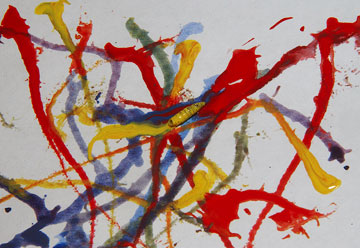
This is Art? When making her paintings, O'Flaherty kind of cheats-she lets the maggots do the work for her. An entomology doctoral student at the University of California at Davis, O'Flaherty is fascinated with the larvae of flies. She dips the maggots in nontoxic paint, then lets them writhe around on the canvas (a piece of white copier paper). Result: unique trails of color and form. O'Flaherty displays her maggot paintings at gallery exhibits and even holds maggot-art workshops for kids. She also teaches forensic officers how to collect maggots at a crime scene for evidence and uses the maggot art as an "icebreaker" to get them used to dealing with the squirmy creatures.
Artist statement: "The activity usually begins with some measure of skepticism or disdain, but the maggots are quick to win over the critics."
Artist: Jessica May, the Rembrandt of Roadkill
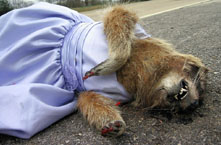
This is Art? May, a 24-year-old graduate art student at Southern Illinois University-Edwardsville, decided that the roadkill lying on the roadside in and around her Midwestern town needed a little sprucing up. So she dressed dead raccoons in baby clothes, put nail polish on the claws of dead possums, and gave a deer carcass a coat of gold spray paint. May wears gloves when she works on her art, because when she finds the animals, they're "pretty far gone".
Artist statement: "I think of this as my way of paying homage to these animals."

(Image credit: Herald Sun)
Artist: Colin Douglas Barnett, the Picasso of PublicityThis is Art? Frustrated that his art wasn't getting the attention he thought it deserved, Burnett, 46, decided to scare up some publicity in Melbourne, Australia. In October 2005, he sculpted a vase out of clay and put it on the sidewalk in front of the National Gallery of Victoria. Labeling it "The Peace Bomb", he called police and reported a suspicious package outside of the building. The gallery was evacuated, the surrounding roads closed, and the bomb squad was called in. Burnett received the press he was looking for, but it came in the form of news stories reporting his arrest. The artist was ordered to pay for the police investigation and sentenced to three months in jail.
Artist statement: "I'm totally embarrassed."
Artist: Wenda Gu, the Kandinsky of Coiffure

This is Art? The Chinese artist was commissioned by Dartmouth College in Hanover, New Hampshire, to create two installations on their campus. First project: "The Green House," an 80-foot banner made from 420 pounds of human hair. All that hair came from Hanover barbershops, who collected the clippings from 42,000 haircuts and shipped it to Wenda's Shanghai studio, where his workers dyed it bright colors. Wenda then wove the strands together, creating the colorful banner that now hangs in the college library. Second project: "United Nations, United Colors," a seven-and-a-half-mile-long braid (begun in 1993) made from leftover hair donated by wig factories in China and India.
Artist statement: "The banner is a comment on education and capitalism, an the braid represents a utopian vision of unity among nations." (Image credit: Kawakahi Amina)

Artist: Ian Thorley, the Degas of Doormats
This is Art? In October 2006, Thorley, a British performance artist, received a £1,600 grant ($3,176) from the Wansbeck and Blyth Valley town councils for his weeklong art project "Utilitarian Utopia." The project: Thorley wore a badge that said "Government Doormat tester" and stood on a doormat in the middle of a sidewalk for a week. The councils were widely criticized for spending taxpayer money on the art. But they defended their actions, saying that Thorley "provides viewers with a thought-provoking experience."
Artist statement: "It's about drawing attention to, and invoking some sense of, the absurdity of existence and the things that we do."
____________________
The article above was reprinted with permission from Uncle John's Triumphant 20th Anniversary Bathroom Reader.
Proving that some things do get better with age, the 20th annivesary Bathroom Reader is jam-packed with 600 pages of fascinating trivia, forgotten history, strange lawsuits and other neat articles.
Since 1988, the Bathroom Reader Institute had published a series of popular books containing irresistible bits of trivia and obscure yet fascinating facts.
If you like Neatorama, you'll love the Bathroom Reader Institute's books - go ahead and check 'em out!
The pictures we see of birds and other wildlife affected by the Gulf oil spill are heartbreaking. What should we do about them? Some wildlife experts advocate euthanizing instead of cleaning individual birds.
Blogger and evolutionary biologist GrrlScientist took a closer look at those serious studies and found the survival rate of oiled birds depends on a number of factors, and can be as high as 100% among some populations. She advocates making the effort to clean and release birds.
There is much more information on previous spills and bird survival rates at Living the Scientific Life. What do you think? Should we leave oiled birds to their fate, euthanize them, or wash and rehabilitate them one by one? Link
(Image credit: Paul Buck/EPA)

"Kill, don't clean," recommends Silvia Gaus, a biologist at NationalPark Wattenmeer (Wadden Sea National Park) in the German state of Schleswig-Holstein. Unfortunately, despite some short-term success in cleaning birds and releasing them into the wild, few, if any, have a chance of surviving even for a few months, reports Ms Gaus, who has worked as a biologist for 20 years.
"According to serious studies, the middle-term survival rate of oil-soaked birds is under 1 percent," Ms Gaus explained. "We, therefore, oppose cleaning birds."
Blogger and evolutionary biologist GrrlScientist took a closer look at those serious studies and found the survival rate of oiled birds depends on a number of factors, and can be as high as 100% among some populations. She advocates making the effort to clean and release birds.
I disagree with Ms Gaus's gloomy policy. Because all people use oil or oil-related products in some form, I maintain that it is both ethical and responsible to try to save as many oiled birds and other wildlife as we can. Some wildlife management professionals argue that cleaning oiled birds isn't worth the monetary cost and effort since little or no impact can be made on a species level. But actually, we don't know this to be true. Additionally, I ask you; what amount of money and effort is too much, and who should be making those decisions anyway? Further, what do we, as scientists and as a society, gain by trying to save these unfortunate animals? Certainly, I think it is imperative to develop our technology to the best level possible so we can use it to help all birds, whether their populations are doing fine or they are threatened or endangered, so we are capable of helping them in the sad event that they are impacted by an oil spill. This requires that we continually refine and improve our techniques and equipment to do the job properly.
There is much more information on previous spills and bird survival rates at Living the Scientific Life. What do you think? Should we leave oiled birds to their fate, euthanize them, or wash and rehabilitate them one by one? Link
(Image credit: Paul Buck/EPA)
NASA's Astronomy Picture of the Day today is a cosmic cloud called Thor's Helmet, for obvious reasons.
Link -via Digg
(Image credit: Star Shadows Remote Observatory and PROMPT/UNC/Steve Mazlin, Jack Harvey, Rick Gilbert, and Daniel Verschatse)

Heroically sized even for a Norse god, Thor's Helmet is about 30 light-years across. In fact, the helmet is actually more like an interstellar bubble, blown as a fast wind from the bright, massive star near the bubble's center sweeps through a surrounding molecular cloud. Known as a Wolf-Rayet star, the central star is an extremely hot giant thought to be in a brief, pre-supernova stage of evolution. Cataloged as NGC 2359, the nebula is located about 15,000 light-years away in the constellation Canis Major.
Link -via Digg
(Image credit: Star Shadows Remote Observatory and PROMPT/UNC/Steve Mazlin, Jack Harvey, Rick Gilbert, and Daniel Verschatse)
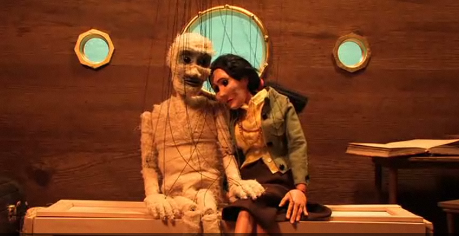
"The Curse" is a new song from Josh Ritter about an archaeologist who falls in love with a mummy. The video was produced by Ritter's drummer, Liam Hurley, who is also a puppeteer. See the video and read more about it at NPR's All Things Considered. http://www.npr.org/blogs/allsongs/2010/05/27/127220892/josh-ritter-video-premiere -via mental_floss
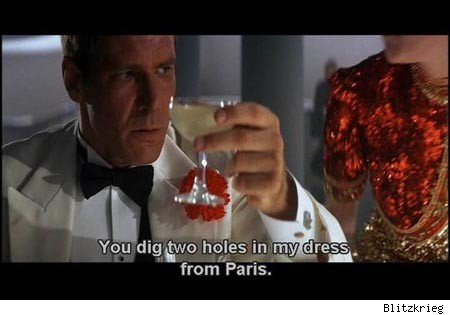
Adding subtitles is work best left done to professionals. Professionals usually work only with languages they actually speak and read. Urlesque has a collection of screen captures featuring subtitles so bad they deserve to be kept for posterity. Some are TV feeds, which have to be done in an instant, but most are bootlegged movies transcribed by ear, or possibly by alchemy. Link
It's been an eventful week here at Neatorama, including the server going down for a few hours this morning. I'm glad you checked back!
Help me welcome a new author to the Neato staff, whom you will recognize in posts by the username marcmywords. Marc's own site is The Red Dwarf Inn.
Two blessed events occurred in rapid order: author John Farrier's wife gave birth to Sophia on Monday, then Wednesday, author Stacy Conradt delivered her first baby, Lydia Louise. Both little girls are pretty as pictures.
We started out the week commemorating Memorial Day with an article from Uncle John's Bathroom reader about the origin of the bugle call "Taps", Day is Done.
Jill Harness posted The Coolest Bikes on Two (Or More) Wheels, containing wacky and wonderful bicycle designs.
From mental_floss magazine, we learned about Flowers You Shouldn't Stop to Smell, because they might hurt you, or at least offend your olfactory senses.
And if you check just below this post, you'll see Jill's tribute to author Richard Scarry on the 91st anniversary of his birth.
We had lots of winners this week, including Nathan Miller, who won an iPad in the Upcoming Queue competition that ran all through the month of May. Three runners-up also won prizes from the Neato Shop. Even though the contest is done, you are all invited to the UQ to try your hand at writing your own Neatorama posts, voting for the best submitted posts, or even just looking around for more neat links.
Congratulations to sudomon, ozzycow, and dennis who won a copy of The Book of Awesome by Neil Pasricha in the Awesome Thing contest. Three other readers won prizes from the Neato Shop: breezy ("That's How I Roll" T-Shirt), laurangatang (Cool Jewels Ice tray), and harmonyroc ("Survive LHC" T-shirt).
Congratulations to jeacobacci, reader 23, and Rhiley, who all won the RARE book on endangered species by Joel Sartore that we featured in the Spotlight Blog.
No one correctly identified the whale oil lamp in the What Is It? game, but Augie won a prize for the funniest answer, “Stanley Hookah Pipe.”
Over at NeatoBambino, we got a look at what's taking over Tiffany and Alex's garden. NeatoGeek published a bunch of the funniest sci-fi and comics links and videos on the net. And there are several new artists appearing in the Indie Art Blog, go check them out!
Help me welcome a new author to the Neato staff, whom you will recognize in posts by the username marcmywords. Marc's own site is The Red Dwarf Inn.
Two blessed events occurred in rapid order: author John Farrier's wife gave birth to Sophia on Monday, then Wednesday, author Stacy Conradt delivered her first baby, Lydia Louise. Both little girls are pretty as pictures.
We started out the week commemorating Memorial Day with an article from Uncle John's Bathroom reader about the origin of the bugle call "Taps", Day is Done.
Jill Harness posted The Coolest Bikes on Two (Or More) Wheels, containing wacky and wonderful bicycle designs.
From mental_floss magazine, we learned about Flowers You Shouldn't Stop to Smell, because they might hurt you, or at least offend your olfactory senses.
And if you check just below this post, you'll see Jill's tribute to author Richard Scarry on the 91st anniversary of his birth.
We had lots of winners this week, including Nathan Miller, who won an iPad in the Upcoming Queue competition that ran all through the month of May. Three runners-up also won prizes from the Neato Shop. Even though the contest is done, you are all invited to the UQ to try your hand at writing your own Neatorama posts, voting for the best submitted posts, or even just looking around for more neat links.
Congratulations to sudomon, ozzycow, and dennis who won a copy of The Book of Awesome by Neil Pasricha in the Awesome Thing contest. Three other readers won prizes from the Neato Shop: breezy ("That's How I Roll" T-Shirt), laurangatang (Cool Jewels Ice tray), and harmonyroc ("Survive LHC" T-shirt).
Congratulations to jeacobacci, reader 23, and Rhiley, who all won the RARE book on endangered species by Joel Sartore that we featured in the Spotlight Blog.
No one correctly identified the whale oil lamp in the What Is It? game, but Augie won a prize for the funniest answer, “Stanley Hookah Pipe.”
Over at NeatoBambino, we got a look at what's taking over Tiffany and Alex's garden. NeatoGeek published a bunch of the funniest sci-fi and comics links and videos on the net. And there are several new artists appearing in the Indie Art Blog, go check them out!
The Stinky
(Image credit: Flickr user b-nik)
The Voodoo Lily Take comfort, Jan Bradys of the world! The voodoo lily-along with other jaded members of the arum plant family-has found an effective way to cope with having the pretty and popular calla lily for a relative. Refusing to go unnoticed, the voodoo lily generates a distinctive odor said to approximate that of rotting flesh. And while this helps it attract flies and other pollination-worthy friends, this "sacred lily of India" has another trick up its sleeve. Common in Asia, the voodoo lily is reportedly able to rid the body of toxins. Of course, that hasn't prevented the more superficial types in other parts of the world from dubbing it "stink lily" and "devil's tongue".
(Image credit: Flickr user Jami Dwyer)
Skunk Cabbage Also a member of the arum family, the foul-smelling skunk cabbage grows mostly in Canada and is known as "devil's tobacco". (Apparently, Satan isn't much of a connoisseur.) In late winter, skunk cabbage gives off heat in order to melt the surrounding snow, strategically making it one of the first plants visible to flies when spring comes. But to its benefit, if its leaves are damaged for any reason, the skunk cabbage uses its ability to release a foul odor to keep predators away and protect itself.The Sinister
(Image credit: Flickr user goateebird)
The Stinging Tree For low-lying plants in the rainforest, it can be a pretty hard-knock life. Being the farthest thing from the sun's rays and the closest thing to hungry herbivores, ground-dwellers such as the stinging tree of Australia have learned a special way to hog any light they can get. In order to seize its brief moments in the sun, the plant is equipped with leaves covered in tiny, shard-like hairs just nasty enough to irritate the crap out of any human or plant that dares invade its personal space. So, how nasty is nasty? Australian legend holds that some stinging tree victims have killed themselves rather than endure the pain.(Image credit: Flickr user petrichor)
The Venus Fly Trap Not familiar with the Dionaea muscipula? You might know it better by its wicked nickname, the Venus Flytrap. And while that's a plenty-cool pseudonym these days, the misogynistic botanists who came up with it in the 17th century didn't mean for it to be flattering. They tried to draw a connection between the Flytrap's method of luring insects and what they saw as the world's other great temptress: the vagina.(Image credit: Flickr user robstephaustralia)
The Cobra Plant Possibly one of the sneakiest carnivorous plants out there, this pitcher-plant relative attracts insects with its long, bright, purple-spotted stalk. When a bug lands on the "cobra tongue" and follows the sweet smell of nectar into the bulb , it gets caught ...but doesn't die. In fact, the insect is only killed when it tries to escape. Because the walls of the cobra bulb are translucent, an insect is given the false impression that it can simply fly out of the cobra's lair and go on to live a long, multi-day life. Instead, the bug bumps against the wall, rolls down the stalk, and drowns in the cobra's digesting pool at the bottom.Of course, tricking a fly is one thing. Tricking a monkey is quite another. According to legend, some Asian pitcher plants, known as nepenthes, have swallowed snakes and small monkeys. However, many botanists believe the largest item consumed by a pitcher plant of any kind to be a frog or small rodent.
(Image credit: Flickr user peupleloup)
Bladderworts Scared of swimming in large bodies of water? Quit worrying about snakes and start focusing your irrational fears on the rootless, carnivorous plants known as bladderworts. These 7-foot-long monstrosities boast hungry bladders-small, hollow sacs designed to ensnare and entrap small animals such as water fleas and aquatic worms. In fact, when prey swim near the plant, tiny hairs on the surface of the bladder are triggered, cuing the bladderwort to take in a big sip of water, thus drawing in its victim.________________________________
The article above appeared in the Scatterbrained section of the January-February 2006 issue of mental_floss magazine. It is reprinted here with permission.Don't forget to feed your brain by subscribing to the magazine and visiting mental_floss' extremely entertaining website and blog today for more!
Andrew Brian McKnight was standing outside the Murfreesboro, Tennessee Waffle House where he worked when three teenagers walked outside, followed by a waitress who said they hadn't paid for their order. McKnight approached the group. The three jumped in a car, and the driver started forward, bumping McKnight. He fell on the hood of the vehicle, which took off. The coffee he was holding spilled on the car hood and made it slippery. While the car sped down the road, McKnight managed to call 911.
Eighteen-year-old Christopher Allen Miller drove for about five minutes at up to 60 mph with McKnight on the hood. When he stopped, McKnight demanded the car keys and gave the teenager a piece of his mind. Police arrested Miller, and turned his two juvenile passengers over to their parents. McKnight was not injured. http://www.dnj.com/apps/pbcs.dll/article?AID=20106030323 -via Fark
(image credit: Aaron Thompson/DNJ)
"Yeah, I need you to send a cop car to Highway 99 at Cason Lane immediately," McKnight tells police after dialing 911. "I'm stuck on the hood of somebody's car and they refuse to stop."
"Now, do what now?" the dispatcher responds.
Eighteen-year-old Christopher Allen Miller drove for about five minutes at up to 60 mph with McKnight on the hood. When he stopped, McKnight demanded the car keys and gave the teenager a piece of his mind. Police arrested Miller, and turned his two juvenile passengers over to their parents. McKnight was not injured. http://www.dnj.com/apps/pbcs.dll/article?AID=20106030323 -via Fark
(image credit: Aaron Thompson/DNJ)
Open your lunchbox and look who's looking back at you! Susan Yuen of Hawai`i's Bento Box Cookbook made this Gene Simmons box lunch of rice, chicken, and seaweed. The tongue is made of boloney! Link -Thanks, Brennan!
I just found out about another blessed event that occurred on Monday of this week. Neatorama author John Farrier (who runs NeatoGeek) and his wife welcomed baby Sophia! Then for some reason, he got busy and didn't tell us. John referred to her as "my newest little Ferengi" (although she is much prettier than any Ferengi could hope to be). Congratulations to mom, dad, and the whole family!
Congratulations to Neatorama author Stacy Conradt (Stacy Bee) and her husband, who welcomed their first child Lydia Louise into the world yesterday! Lydia weighed 6 pounds, 15 ounces and measured 20.5 inches long. Mother and baby are fine, and Lydia's parents and grandparents are as proud as punch! You can see a couple more pictures at NeatoBambino.
What happens when you turn a starfish upside down? This nine-legged starfish couldn't have been too happy about the experiment, but he had a good recovery plan. -via Bits and Pieces
Email This Post to a Friend