Dogs have contributed to our scientific knowledge in many ways, from the dog who sniffs out cancer to the Soviet space dog to prehistoric canine fossils. Pictured is Snuppy, the first ever cloned dog, beside his older, genetically identical progenitor.
The scientific breakthrough, led by biomedical scientist Woo Suk Hwang (who was later dismissed from the university for fabricating data on cloning human stem cells), was as laborious as Snuppy was adorable. Snuppy the puppy marked the single success out of 123 attempts spanning three years. Since then the gangly puppy has sired nine puppies of his own with two cloned females, marking the first successful breeding between clones.
Read about the other nine top science dogs in this slide show at Scientific American. Link -via Digg
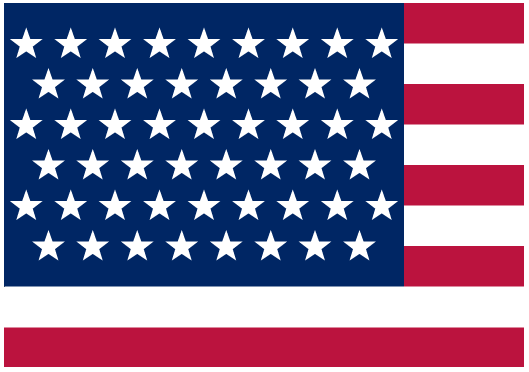
Quick! How many stars are on this flag? No, it's not the American flag we use now, but a pattern with 51 stars, which will be needed if Puerto Rico becomes a state. Mathematician Skip Garibaldi worked out the most geometric layouts that will accommodate more stars if the flag has to be updated if and when states join the union. Slate posted an interactive flag calculator, in which you can enter a number of states, from one to a hundred stars, and see the best pattern according to a computer program Garibaldi created. Some numbers have more than one pattern, with up to six styles. Read all about it in this article from Chris Wilson at Slate. Link
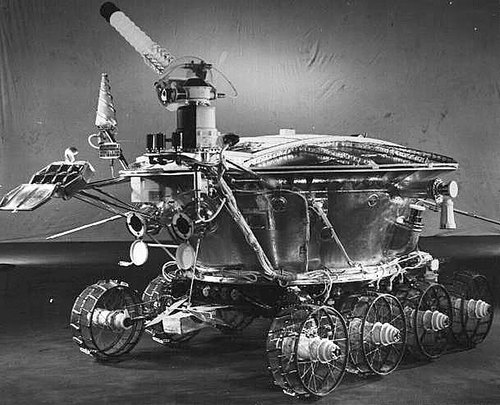
In 1970, during the Luna 17 mission, the Soviet space program landed the first ever remote-controlled vehicle on the moon. Lunokhod 1 spent eleven months taking pictures of the moon's surface, and sent back about 20,000 images. It stopped communicating with the earth in 1971. Fast-forward 40 years, and read about how a new use has been found for Lunokhod 1 at the blog Starts With A Bang! Link
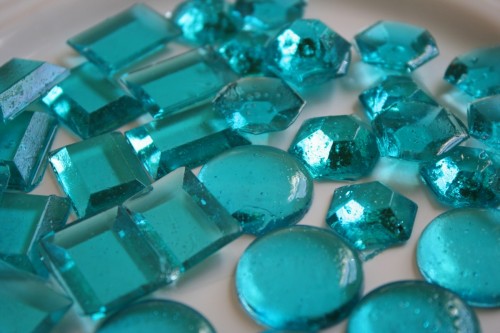
Think of them as edible rhinestones, or maybe lollipops without sticks. Chica and Jo not only have the recipe and step-by-step illustrated instructions for making hard candy jewels, but also warnings about what could go wrong and why. The results are lovely bright colored hard candies folks won't believe you made yourself! Link -via Evil Mad Scientist Laboratories
Oxygen tries to make friends with other elements, with varying results. This animation was Christopher Hendryx's senior project a year ago at the Ringling College of Art + Design. -via Metafilter
Yang Liwei became China's first astronaut when he orbited the earth in 2003. Cameras were rolling as Yang emerged smiling from the space capsule after his landing. It appeared to be a perfect mission. But was it?
In a lecture he gave to a group of journalism students last month, a top official at Xinhua, the state news agency, said that the mission was not so picture-perfect. The official, Xia Lin, described how a design flaw had exposed the astronaut to excessive G-force pressure during re-entry, splitting his lip and drenching his face in blood. Startled but undaunted by Mr. Yang’s appearance, the workers quickly mopped up the blood, strapped him back in his seat and shut the door. Then, with the cameras rolling, the cabin door swung open again, revealing an unblemished moment of triumph for all the world to see.
Xia's account of the space mission agrees with astronaut Yang's story in his new autobiography of how he suffered injuries during the flight. Xia's lecture, which covered other news stories and how they were altered for the public, was posted on many Chinese websites and quickly deleted by authorities. Link -via Fark
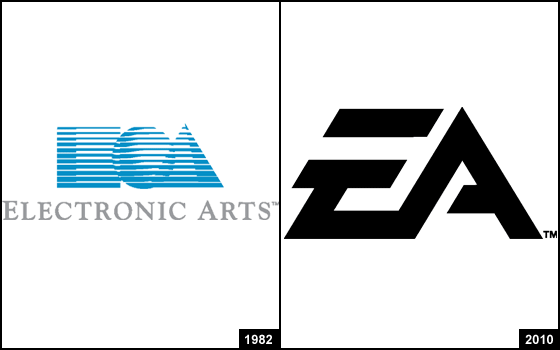
Video game company logos, as logos for any company, evolve and update if they are lucky enough to survive enough years. Geekosystem has a look at how they've changed. Most of these logos look much better now.
Apparently, EA’s old logo confused people.Wikipedia: “Many customers mistook the square/circle/triangle logo for a stylized “EOA.” Though they thought the “E” stood for “Electronic” and “A” for “Arts”, they had no idea what the “O” could stand for, except perhaps the o in “Electronic.” An early newsletter of EA, Farther, even jokingly discussed the topic in one issue, claiming that the square and triangle indeed stood for “E” and “A”, but that the circle was merely “a Nerf ball that got stuck in a floppy drive and has been popping up on our splash screens ever since.” It’s still enough to induce waves of nostalgia in anyone who’s played Starflight.
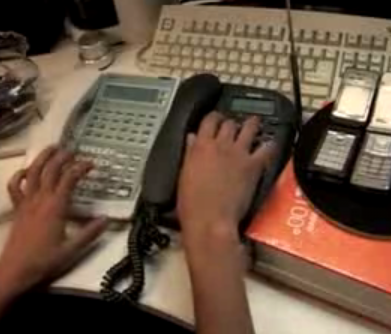
It's one thing to play music on a modern gadget -many people can tap out "Happy Birthday" on a cell phone. It's quite another to perform classical pieces! Believe it or not, this person is playing "Rondo Alla Turka" {audio file} from Mozart's Piano Sonota #11 on four telephones. http://www.butternutjelly.com/home/2010/6/7/phone-piano.html
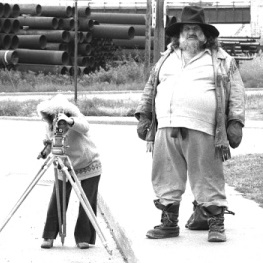
Over the last couple hundred years, many men made a living demonstrating feats of strength, by wrestling, weightlifting, or other stunts such as pulling trains. Ask Men has a list of the ten most memorable, including The Great Antonio.
The adjective “great” is an understatement for Antonio’s stature and personality. Weighting 465 pounds and standing 6-foot-4, his suits were size 90, his shoes size 28 and he often ate 25 chickens or 10 steaks at one sitting. In 1952, the Guinness Book of World Records recognized him for pulling a 433-ton train for 19.8 meters. Guinness also mentioned him again in a later edition for his feat of pulling four city buses loaded with passengers. A noted eccentric, he offered to pull a Boeing 747 down the tarmac provided Boeing gave him a jet for his own personal use, and he approached Don King saying that he would do a fight film for $1 million.
April Pignataro and Michael Curry of New York City got married yesterday. The bride wore a white wetsuit and the groom wore a traditional black wetsuit as they climbed inside a 120,000 gallon shark tank to take their vows at Atlantis Marine World in Riverhead, N.Y. Both are experienced divers, and said their "I dos" over a radio transmitter with an officiant who did not get in the tank.
"My mom was against it," Pignataro said. "She was concerned that my makeup and hair were going to get messed up in the water. But . . . I'm a tomboy. Hair and makeup don't mean a whole lot to me."
When humans explore other planets, there's a possibility we may overlook something important. This animation was produced by Joe Bichard and Jack Cunningham. -via Laughing Squid
The original book Chicken Soup for the Soul is 17 years old. There have been sequels published about every topic imaginable -or maybe not. In today's Lunchtime Quiz at mental_floss, you'll be given a Chicken Soup title, and you decide whether it's a real book or an imaginary title. How simple can that be? Not that simple; I scored only 60%. Link
If you were to see some of the tacky stuff that adorns the walls here at the BRI, you may not think we are qualified to comment on what anyone else considers art. Well, we say: if dogs can play poker, anything is possible.
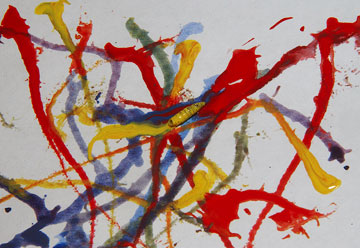
This is Art? When making her paintings, O'Flaherty kind of cheats-she lets the maggots do the work for her. An entomology doctoral student at the University of California at Davis, O'Flaherty is fascinated with the larvae of flies. She dips the maggots in nontoxic paint, then lets them writhe around on the canvas (a piece of white copier paper). Result: unique trails of color and form. O'Flaherty displays her maggot paintings at gallery exhibits and even holds maggot-art workshops for kids. She also teaches forensic officers how to collect maggots at a crime scene for evidence and uses the maggot art as an "icebreaker" to get them used to dealing with the squirmy creatures.
Artist statement: "The activity usually begins with some measure of skepticism or disdain, but the maggots are quick to win over the critics."
Artist: Jessica May, the Rembrandt of Roadkill
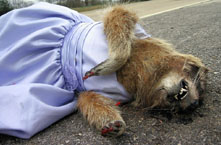
This is Art? May, a 24-year-old graduate art student at Southern Illinois University-Edwardsville, decided that the roadkill lying on the roadside in and around her Midwestern town needed a little sprucing up. So she dressed dead raccoons in baby clothes, put nail polish on the claws of dead possums, and gave a deer carcass a coat of gold spray paint. May wears gloves when she works on her art, because when she finds the animals, they're "pretty far gone".
Artist statement: "I think of this as my way of paying homage to these animals."
Artist: Colin Douglas Barnett, the Picasso of Publicity
This is Art? Frustrated that his art wasn't getting the attention he thought it deserved, Burnett, 46, decided to scare up some publicity in Melbourne, Australia. In October 2005, he sculpted a vase out of clay and put it on the sidewalk in front of the National Gallery of Victoria. Labeling it "The Peace Bomb", he called police and reported a suspicious package outside of the building. The gallery was evacuated, the surrounding roads closed, and the bomb squad was called in. Burnett received the press he was looking for, but it came in the form of news stories reporting his arrest. The artist was ordered to pay for the police investigation and sentenced to three months in jail.
Artist statement: "I'm totally embarrassed."
Artist: Wenda Gu, the Kandinsky of Coiffure
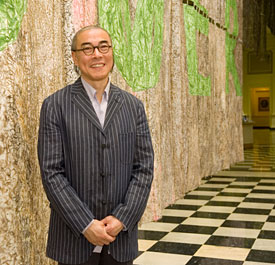
This is Art? The Chinese artist was commissioned by Dartmouth College in Hanover, New Hampshire, to create two installations on their campus. First project: "The Green House," an 80-foot banner made from 420 pounds of human hair. All that hair came from Hanover barbershops, who collected the clippings from 42,000 haircuts and shipped it to Wenda's Shanghai studio, where his workers dyed it bright colors. Wenda then wove the strands together, creating the colorful banner that now hangs in the college library. Second project: "United Nations, United Colors," a seven-and-a-half-mile-long braid (begun in 1993) made from leftover hair donated by wig factories in China and India.
Artist statement: "The banner is a comment on education and capitalism, an the braid represents a utopian vision of unity among nations." (Image credit: Kawakahi Amina)
Artist: Ian Thorley, the Degas of Doormats
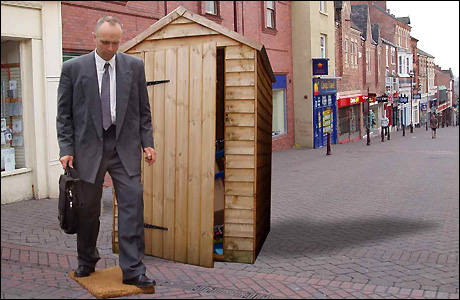
This is Art? In October 2006, Thorley, a British performance artist, received a £1,600 grant ($3,176) from the Wansbeck and Blyth Valley town councils for his weeklong art project "Utilitarian Utopia." The project: Thorley wore a badge that said "Government Doormat tester" and stood on a doormat in the middle of a sidewalk for a week. The councils were widely criticized for spending taxpayer money on the art. But they defended their actions, saying that Thorley "provides viewers with a thought-provoking experience."
Artist statement: "It's about drawing attention to, and invoking some sense of, the absurdity of existence and the things that we do."
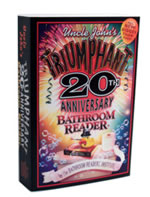
Proving that some things do get better with age, the 20th annivesary Bathroom Reader is jam-packed with 600 pages of fascinating trivia, forgotten history, strange lawsuits and other neat articles.
Since 1988, the Bathroom Reader Institute had published a series of popular books containing irresistible bits of trivia and obscure yet fascinating facts.