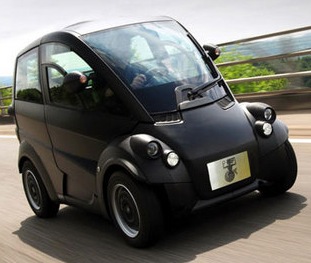
This car is called the T25. Designed by Formula One engineer Gordon Murray, it weighs only 1,200 pounds and can seat three people (although one or two would be more comfortable). It is expected to get 74 miles to the gallon and cost around $9,000, thanks to the highly-efficient iStream manufacturing technology.
The cars are built using an efficient process that first attaches most of the car's parts to the chassis, and then adds a pre-painted body as a last step, similar to the way Formula One vehicles are built.
Look at the gallery below, and you'll see that the car is so tiny that three of them can fit into a single parallel parking space. If all cars were this size, we'd live in a utopian energy-saving world.
The T25 should be available in two years, with an all-electric version, the T27, following later. Link
You might recognize this face, but it's only a small part of the picture in NeatoGeek's Caption Contest. Take a look, put on your thinking cap, select a t-shirt you'd like to win from the NeatoShop, and leave a comment at NeatoGeek! Link
But it's a good kind of weird. Neatorama made the list of Metro.co.uk's "Top 10 Weird blogs", along with Asylum UK, Dark Roasted Blend, Anorak, Oddville Daily, I have seen the whole of the internet, Urlesque, Weird Worm, Unique Daily, and Nothing to do with Arbroath. So we're in good company! Link -Thanks, Jesse Netherland!
Jane Korman's 89-year-old father Adolek Kohn arrived at Auschwitz in a cattle car over 65 years ago. In 2009, he returned to Auschwitz and other locations in Poland associated with the Holocaust and did a victory dance with his daughter and several of his grandchildren. See parts two and three of this project as well. When Korman first exhibited the videos in Australia, she received quite a bit of criticism:
Many Jewish survivors have reacted gravely to the video, accusing her of disrespect. Yet Korman told Australian daily The Jewish News that “it might be disrespectful, but he [her father] is saying ‘we’re dancing, we should be dancing, we’re celebrating our survival and the generations after me,’ - the generation he’s created. We are affirming our existence.”
This mounted Hello Kitty trophy is for sale from Etsy artist datamafia. It is one of 12 Bizarre Hello Kitty Products That Sign The Coming Apocalypse collected by our own Jill Harness at Inventor's Spot.
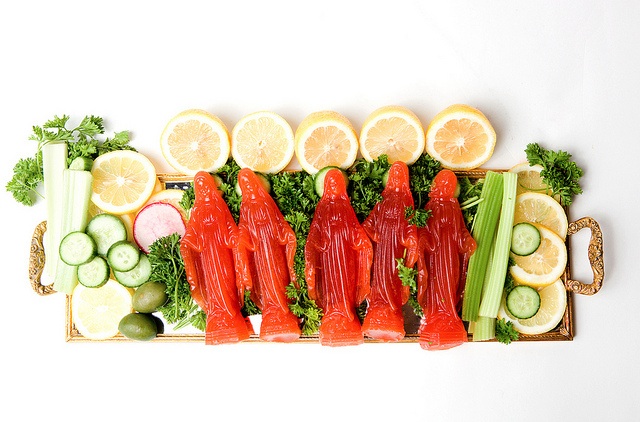
I love the motto on the poster for this year's Jell-O Mold Competition from the Gowanus Studio Space: "Keep Calm and Wobble On." The 2010 winners have been selected! The grand prize was awarded to sculptor Shelly Sabel for her creation Aspic Ascension--Tastes Like Heaven. See all the winners at the contest site. Link -via Nag on the Lake
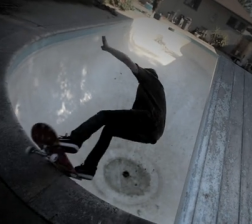
There are a lot of houses under foreclosure in Fresno, California, and many have cement ponds swimming pools that are currently empty. Instead of letting all that surface go to waste, skateboarders use the pools to test their skills, as we see in the short documentary Cannonball: Skating the Recession Pools by vimeo user California is a place. NSFW language. Link
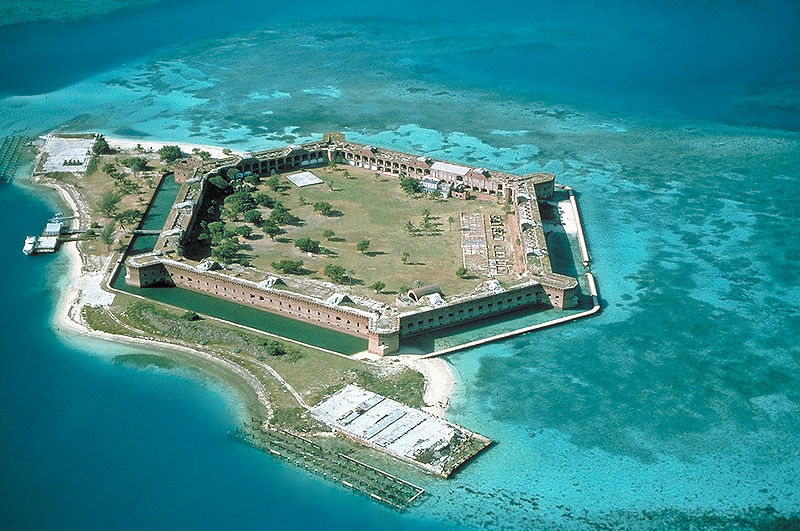
A military fort, out in the ocean, with a moat! Fort Jefferson is a part of Dry Tortugas National Park in the waters off of Key West, Florida. Construction on the "fort in the middle of nowhere" was started in 1846. It was originally meant for the defense of the US, but during the 30 years of construction, some design features became obsolete for that purpose.
During and after the Civil War the fort began to be used as a prison for deserters and other criminals. In 1874 the army completely abandoned the fort after several hurricanes and a yellow fever epidemic, and it wasn't until 1898 that the military returned in the form of the navy, which used the facilities during the Spanish-American War. The fort was also used from 1888 through 1900 as a quarantine station, and was garrisoned again briefly during World War I.
Just when you think you've heard it all... someone comes up with something like this. It's from a little book called It's A Gas, by Eugene Silverman, MD, and Eric Rabkni, PhD. It's required reading for BRI history buffs.
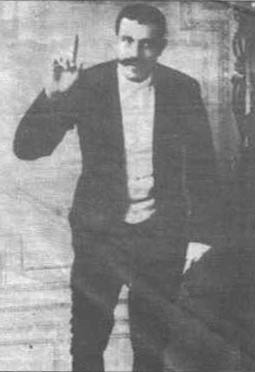
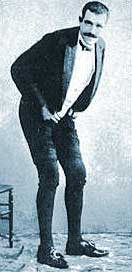
In all fairness to the farters of the world, the greatest of them all was not by his passing of gas also passing a judgment. His completely conscious control of his abilities was confirmed by numerous chemical examinations, including two in published form. This man, a hero at bottom, was a gentle and loving father, a noble and steadfast friend, a successful and generous businessman, and a great stage entertainer. This unique individual, a phenomenon among phenomena, this explosive personality and credit to our subject, was christened Joseph Pujol, but invented for himself the name by which all history knows him: Le Petomane!
THE ART OF THE FART
Le Petomane could fart as often and as frequently as he wished. His farts were odorless. As other people use their mouths, Le Petomane had learned to use his anus. Furthermore, by constricting or loosening his anus he could vary the pitch of the air he expelled and by controlling the force of abdominal contractions he could control its loudness. With these two fundamental tools, simple enough but rarely seen, Le Petomane contrived not only to imitate a variety of farts, but also to make music.
He headlined at the Moulin Rouge in Paris, the most famous nightclub in the world at that time, and brought in box office receipts more than twice as high as those of the angelic Sarah Bernhardt. He was one of the greatest comedians of the turn of the century The manager of the Moulin Rouge kept nurses in the theater to tend to female customers whose uncontrolled laughter in tight corsets often caused them to pass out as Le Petomane passed gas. Here was not a court fool at all, but the toast of civilized society.
DISCOVERING HIS GIFT
As a boy, Joseph had had a frightening experience in the sea. Holding his breath and ducking under water, he suddenly felt a rush of cold water enter his bowels. He went to find his mother but was embarrassed to see water running out of himself. Although he recounted this in later years, apparently as a child he tried to keep his terrifying experience a secret.
Early in his married life he was called to military service and in the all-male atmosphere of the barracks he recounted for the first time his strange experience in the sea. When asked for a demonstration, he agreed to try again. On their next furlough, he and his unit went to the sea. He did succeed in taking water in and then letting it out. This might have been viewed as mere freakishness, but combined with Joseph's gentleness and good humor, it struck the soldiers as a delightful feat.
Pujol, using a basin, practiced this art in private with water and, once able to control the intake and outflow by combined exertions of his anal and abdominal muscles, he soon began to practice with air as well. This, of course, was only for his own amusement and the occasional amusement of his fellow soldiers.
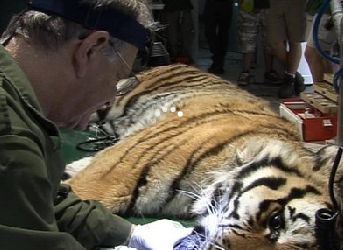
Dr. Peter Kertesz is a dentist in London, England. He has a regular clientele of patients he takes care of during the day. But he also moonlights: Dr. Kertesz recently worked on the huge teeth in the powerful jaws of two tigers at the Dartmoor Zoological Park near Plymouth. One of the tigers had to be treated for a broken tooth. Both were anaesthetized before their dental appointment.
Dr Kertesz is one of only a few specialist zoo dentists in the world, a sideline to his day job of treating humans at his surgery in London's West End.
His animal career began more than 20 years ago when someone brought in their cat for treatment and he has carried out dental work on exotic species including whales, pandas and elephants.
Zoo curator Will Walker said: "We have had him twice before over the last couple of years to do all our bears and other tigers."
Dr. Kertesz is paid well for his bravery and expertise, as the bill for the two tigers was £4,500. Link -via Arbroath
People can pick up skills in the strangest places. Georgia Durante learned evasive driving techniques when she was married to a mobster and drove a getaway car.
Years of evading the police had taught Georgia how to drive like an action hero, so she formed Performance Two, a stunt and precision driving company and wrote a book about her life as a model and mafia wife. Her company has done stunts for over 100 movies and commercials, and she's personally doubled for both Cindy Crawford and Priscilla Presley.
Durante is just one of 6 People Who Turned a Life of Crime Into Legitimate Careers that you can read about at Cracked. Link
This is a sweet ballet -meaning the dancers are fruits, cupcakes, bonbons, and Gummi bears! This stop-motion video was created by Maira Fridman. -via Things I Think Are Kinda Cool
There is so much going on a Neatorama, we sometimes forget that neato stuff happens outside the site, too! This week, our fearless leader Alex was a guest on The Social Blade Show. Yeah, it's an hour long, but it's a talk show, so you can listen while doing something else. Skip ahead to the 31-minute mark for the Neatorama stuff.
From mental_floss magazine, you saw what happens When Propaganda Backfires, and from Uncle John's Bathroom Reader, we had The Curse of the Little Rascals as a followup to last week's Little Rascals.
We added three new artists to the Art Blog: painter Dustin Timbrook, photographer Josh Martin, and folk art painter Ellen Eilers. Congratulations to Christine DePalma and Terry Barrall, who won calendars featuring Ellen Eiler's art in the contest we ran in Eiler's gallery post. See, there's more than one reason to visit the Neatorama Art Blog!
Oh yeah, we had lots more winners. Congratulations to Edward, who correctly guessed the "pain bullet" in the What Is It? game this week, and to DCMikeRotch, who guessed wrongly but entertainingly. Both won t-shirts from the NeatoShop.
NeatoGeek had its first caption competition this week. Congratulations to Augie, who won a t-shirt from the NeatoShop! So many people participated that the NeatoGeek caption competition just might become a regular feature.
We partnered with Fark to bring you this week's Tokyo Flash Treasure Hunt. Congratulations to winners nexusg4, hopscotch0623, numonohimax, and funkyeuph, who won prizes from Tokyo Flash or the NeatoShop.
At mental_floss, the How Did You Know contest wrapped up on Wednesday with all the answers revealed. Congratulations to overall winner Jimmy Luth, and everyone who won prizes from the NeatoShop!
You've still got a week to get your videos ready for the GTFO competition, in which an iPad is up for grabs! Get the particulars at our YouTube page.
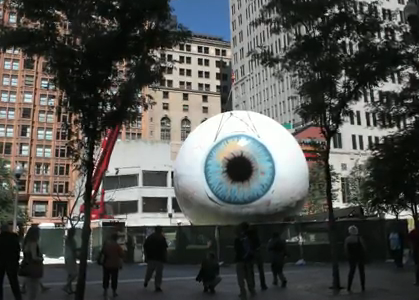
The work of art is called dimply, "Eye." The sculptor is Tony Tasset, who modeled it on his own eye. Folks in Chicago get to see this 30-foot-tall eyeball until the end of October. Watch it being built in a video at Laughing Squid. Link