
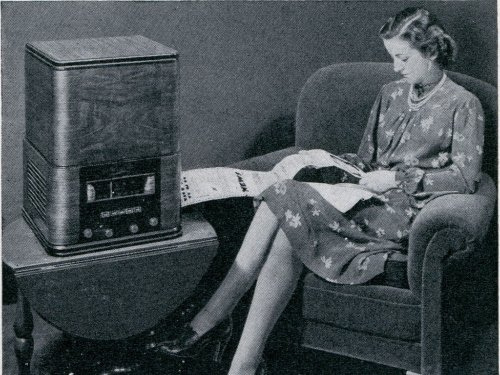
We can always dream up new products that make life easier, no matter how difficult they would be to actually produce. In 1939, Popular Science predicted that we would one day received newspapers printed at home with data transferred by radio broadcasts. That particular invention never came to be, at least in the sense it was envisioned at the time. Why print out the news when you can just read it on your computer screen? This item is one of nine products that were never developed, although some of the end results came to us by other inventions. Link -via Dark Roasted Blend
Miss Cellania's Blog Posts
We can always dream up new products that make life easier, no matter how difficult they would be to actually produce. In 1939, Popular Science predicted that we would one day received newspapers printed at home with data transferred by radio broadcasts. That particular invention never came to be, at least in the sense it was envisioned at the time. Why print out the news when you can just read it on your computer screen? This item is one of nine products that were never developed, although some of the end results came to us by other inventions. Link -via Dark Roasted Blend

Something tells me that these guys aren't at all gloomy! This is one of ten creatively-named night spots in Namibia listed at Buzzfeed. Did I say "creatively-named"? It's possible these bar names were pulled out of a hat! Link
On Tuesday, workers digging a new level for a vehicle security center at the World Trade Center site ran into a set of evenly-spaced wooden beams. Had someone been building a boat in a basement?
The ground where the boat was found had been undisturbed for 200 years. Back then, the site was much nearer the Hudson River. Link -via reddit
(Image credit: Fred R. Conrad/The New York Times)

“They were so perfectly contoured that they were clearly part of a ship,” said A. Michael Pappalardo, an archaeologist with the firm AKRF, which is working for the Port Authority of New York and New Jersey to document historical material uncovered during construction.
By Wednesday, the outlines made it plain: a 30-foot length of a wood-hulled vessel had been discovered about 20 to 30 feet below street level on the World Trade Center site, the first such large-scale archaeological find along the Manhattan waterfront since 1982, when an 18th-century cargo ship came to light at 175 Water Street.
The ground where the boat was found had been undisturbed for 200 years. Back then, the site was much nearer the Hudson River. Link -via reddit
(Image credit: Fred R. Conrad/The New York Times)
If you were impressed that 19-year-old fugitive from justice Colton Harris-Moore has a Facebook fan page with almost 90.000 fans, listen to this: an unnamed fugitive monkey in Florida also has a Facebook page with over 80,000 fans! The rhesus macaque has been roaming the Tampa Bay area for a year.
The monkey's origin is still unknown. Link -via Environmental Graffiti -Thanks, Marilyn Terrell!
Home video shot by Tampa residents and broadcast on local TV stations shows the macaque rummaging through trash bins, scaling walls in a single bound, even hanging out poolside and swiping fruit.
On at least a dozen occasions Florida Fish and Wildlife officials shot the plucky primate with tranquilizer darts. Increasingly large doses barely fazed him. One professional trapper, hunting the monkey, wondered whether the monkey had become a "drug addict."
The monkey's origin is still unknown. Link -via Environmental Graffiti -Thanks, Marilyn Terrell!
Fallout Protection for Homes with Basements is a pamphlet produced by the US Department of Defense to help the average family deal with nuclear attack. The 1967 revision is available online for your edification and ...amusement, yes, because even during the dark days of the Cold War, most people knew that preparing a fallout shelter was akin to rearranging chairs on the deck of the Titanic. However, this booklet has some handy tips for fortifying your basement, or improvising a shelter out of household items, as shown above. Link -Thanks, Steven Johnson!

1. At the National Museum of Racing and Hall of Fame in Saratoga Springs, NY, humans get less respect than their hoofed pals. Although 179 horses have been inducted there, only 91 jockeys have made the cut.
2. Being a jockey doesn't come with a great benefits package, either. All jockeys are self-employed, so they're responsible for their own business expenses, such as agent fees, travel costs, equipment, and some of the highest health insurance premiums in professional sports.
3. They also can't own the horses they ride, or pick the colors they wear. Instead, jockeys use the registered patterns that belong to whoever hired them.
4. Of course, there are some pluses. While most riders make $35,000 to $45,000 a year, the best earn upwards of $2 million in prize money.
5. Frank Hayes is the only deceased jockey to ever win a race. In 1923, the stable hand somehow convinced one of the owners to let him ride at Belmont Park. To everyone's amazement, he and the horse, Sweet Kiss, won. Unfortunately, Hayes didn't live to see it. He died mid-ride from a heart attack, though his body somehow stayed upright through the finish.
6. Hayes' victory was just as bittersweet for his horse. Sweet Kiss had to endure the nickname "Sweet Kiss of Death" for the rest of his life.
(Image credit: Flickr user Travis Isaacs)
7. Speaking of funny names, the odd position that jockeys lift themselves into while racing is called the Monkey Crouch. The stance was universally mocked when American jockey Tod Sloan first introduced it in 1897, but it ended up revolutionizing the sport. Not only did Sloan win a remarkable 48 percent of his races the following year, but according to a study published in Science, "horse-race times and records improved by 5 to 7 percent in 1900" as other riders began copying the position.
8. In horse racing, making weight is no joke. To compete in the Kentucky Derby, a jockey plus his equipment can only weigh 126 lbs. That means most weigh less than 118 lbs.
9. This results in some strange eating habits. In an effort to stay trim, Laffit Pincay, Jr., the world's winningest jockey, would take a single peanut, slice it into slivers, and eat just half of it for lunch.

10. This wasn't Pincay's only secret to success. He also used to speed-walk instead of run to void putting on any extra muscle. (It's a trick other riders still use.)
11. On the other hand, there's no height limit for jockeys. The tallest rider on record is former NBA player Manute Bol, who stands 7'7". He was licensed by the Indiana Horse Racing Commission to race in a charity event.
12. There are some pretty tall non-NBA riders, too. The next tallest jockey is Denmark's Louise Moeller. She's 6'1".
__________________________
The above article was written by Rob Lammle. It is reprinted with permission from the Scatterbrained section of the July-August 2010 issue of mental_floss magazine.
Be sure to visit mental_floss' entertaining website and blog for more fun stuff!
I Write Like is a generator that proposes to analyze your writing and compare it to published authors. The above is the result I got when I entered some text from an article I wrote for mental_floss. However, the results do not tell me why my writing resembles James Joyce's prose. Then I entered another sample, this time from an article I wrote for Neatorama.
Again, no explanation for why the results are different. They might even be random. Grab a few paragraphs of your writing and try it out for yourself! Link -via The Daily What
Wayne Daniels delivered mail for the British Royal Mail service -until March, when it was discovered that he had dumped 420 letters instead of delivering them. The 25-year-old man pleaded guilty to theft and delaying the mail on Monday. Daniels' defense lawyer explained why he did it.
Daniels was ordered to pay a fine and perform community service. Link -via Arbroath

Fran Tyler, defending, said: “He suffers from dyslexia and he was struggling to read the addresses.
“He said it was an impulsive action born out of frustration and said it was a disgrace to himself and to the Royal Mail. He had not discussed the problem with colleagues because of a mixture of pride and embarrassment.”
Daniels was ordered to pay a fine and perform community service. Link -via Arbroath
Shannon immortalized his proposal to Jessica for eternity. Or at least until the wall is repainted. -via Buzzfeed
What, did you think face-stretching and skin-piercing were modern fads? Not by a long shot! People have been undergoing painful procedure to modify their bodies (and their looks) for thousands, maybe even hundreds of thousands, of years.
Continue reading
Lip Stretching
(Image credit: Flickr user Rita Willaert)
Lip stretching is a body modification that goes back 10,000 years and had been practiced all over the world, from Siberia to South America, from the Middle East to Europe, although there is no evidence that the custom traveled from one area to another. The procedure survives only in Africa and among some Amazonian tribes in South America. The practice is seen among women in the Mursi and Surma tribes of Ethiopia. The lower lip is pierced and a peg is inserted, to be replaced with a larger peg as the skin stretches. A plate or labret is inserted when the piercing is large enough. Traditionally, this is done as a young woman prepares to marry, but is now a personal decision rather than an obligation.
Skull Binding
(Image credit: Wikipedia user Robrrb)
Skull binding has been practiced at various points in history in widespread parts of the world, with some evidence of Neanderthal skulls that had been shaped around 45,000 BCE in Iraq. The custom of head shaping has been most notable among skulls excavated in Peru, where the practice dates back 9,000 years. The skull can only be shaped during infancy. The bones eventually harden to the point that skull modification would only break the cranial bones. An infant's skull would be wrapped with cloth (sometimes with wooden boards added) to restrict its expansion sideways, causing the head to grow long and tall instead. This practice was usually restricted to the wealthier classes. Reproductions of such skulls can be purchased online.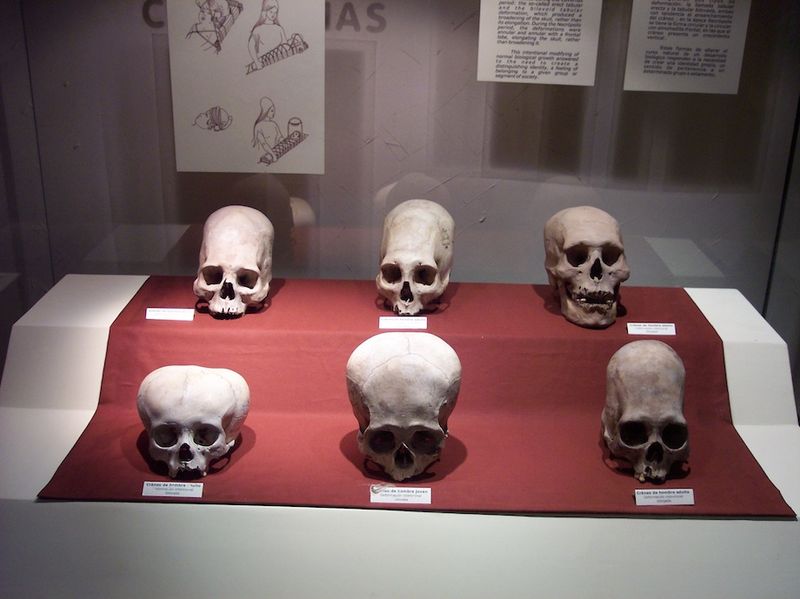
Isaiah Mustafa, the Old Spice spokesman, has been busy at YouTube today responding to messages on reddit, Digg, and Twitter. His response to Matthew Sinclair made me laugh out loud! You can see more personal messages at the Old Spice YouTube channel. Link
Neatorama is giving away an iPad in conjunction with reddit in the Great Talent, Fantastic or Otherwise (GTFO) video contest! Get your talent recorded on video as soon as possible, as the deadline for entry is July 18th. That's Sunday!
What kind of talent will win? Who knows! Use your imagination and impress us with something we would never think of. Remember, if it isn't "fantastic", it could well be "otherwise"!
Grand Prize: 1 Apple iPad (or monetary equivalent if you’re outside the USA)
Runner-Up Prizes: 5 reddit Alien 4GB flash drives, 5 reddit evolution posters signed by the entire reddit staff, 5 $50 shopping sprees from the NeatoShop.
For contest details, visit our YouTube page, but don't put off entering any longer! http://www.youtube.com/neatorama

What kind of talent will win? Who knows! Use your imagination and impress us with something we would never think of. Remember, if it isn't "fantastic", it could well be "otherwise"!
Grand Prize: 1 Apple iPad (or monetary equivalent if you’re outside the USA)
Runner-Up Prizes: 5 reddit Alien 4GB flash drives, 5 reddit evolution posters signed by the entire reddit staff, 5 $50 shopping sprees from the NeatoShop.
For contest details, visit our YouTube page, but don't put off entering any longer! http://www.youtube.com/neatorama
Adolek Kohn's dance at Auschwitz was a powerful and joyful statement, but it wasn't the first of its kind. Groucho Marx visited his mother's home town of Dornum, Germany in 1958. He found that the Nazis had destroyed Jewish graves and the records of Jewish residents. Marx then hired a car to take his travel group to Berlin.
There was no joy in the dance, but the statement was clear. Link -via The Atlantic
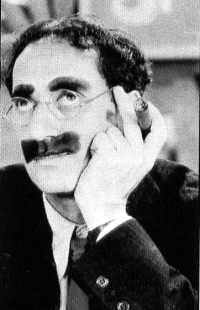
It was surprisingly easy to get there. The car slipped through a checkpoint into a devastated gray and brown city of people in solemn clothing. Marx told the chauffer to drive to the bunker where Hitler was said to have committed suicide, where he was supposedly still buried.
The rubble at the site was about 20 feet high. Wearing his characteristic beret but without the trademark cigar, Marx alone climbed the side of the debris. When he reached the top, he stood still for a moment. Then he launched himself, unsmiling, into a frenetic Charleston. The dance on Hitler's grave lasted a minute or two.
There was no joy in the dance, but the statement was clear. Link -via The Atlantic

Today's Lunchtime Quiz at mental_floss is a continuation of the popular Typeface/Off series. We've tried to guess movies and TV shows by their title fonts; now we can try to figure out what magazines and newspapers are represented by their typefaces. I scored 7 of 10, which would have been 8 out of 10 if I typed decently. You can do better! Link
Take a walk down the uncanny valley with Bina48, a robot designed to be a "friend" with conversational skills. New York Times reporter Amy Harmon interviewed the robot itself (or is it "herself"?) to see how conversational it really is. Whatever you think of its skills, the talking head comes across as creepy.
Part high-tech portrait, part low-tech bid for immortality, Bina48 has no body. But her skin is made of a material called “frubber” that, with the help of 30 motors underneath it, allows her to frown, smile and look a bit confused. (“I guess it’s short for face rubber, or flesh rubber maybe, or fancy rubber,” she said.) From where I was seated, beneath the skylight in the restored Victorian she calls home, I couldn’t see the wires spilling out of the back of her head.
Many roboticists believe that trying to simulate human appearance and behavior is a recipe for disappointment, because it raises unrealistic expectations. But Bina48’s creator, David Hanson of Hanson Robotics, argues that humanoid robots — even with obvious flaws — can make for genuine emotional companions. “The perception of identity,” he said, “is so intimately bound up with the perception of the human form.”
Link to story. Link to video. -Thanks, Carl!
Email This Post to a Friend