Yesterday, US player John Isner won the longest tennis match in history by defeating Nicolas Mahut by 70-68 in a final set at Wimbledon. The competition lasted more than eleven hours spread over three days:
Picking up at 59-59 in the fifth set Thursday, the match continued on serve with no break points until the American hit a backhand passing shot to finish the contest in front of a packed crowd on Court 18.
You can watch the winning play at 20 seconds into the video.
http://www.forbes.com/feeds/ap/2010/06/24/sports-ten-wimbledon-marathon-match_7717203.html?boxes=Homepagetopnews via The Presurfer
Howard Engel is an accomplished Canadian novelist. One day, he had a stroke and lost the ability to read -- that is, his brain could no longer process text as a fixed reference. But Engel found that he could still write, even though, shortly after writing a piece of text, he was unable to read it. So Engel devised a way to use this remaining ability to regain his literacy. Cartoonist and animator Levni Yilmaz produced this video for National Public Radio explaining how Engel was able to do it.
http://www.npr.org/templates/story/story.php?storyId=127745750&ps=cprs via The Agitator | Levni Yilmaz | Previously: Tales of Mere Existence by Levni Yilmaz
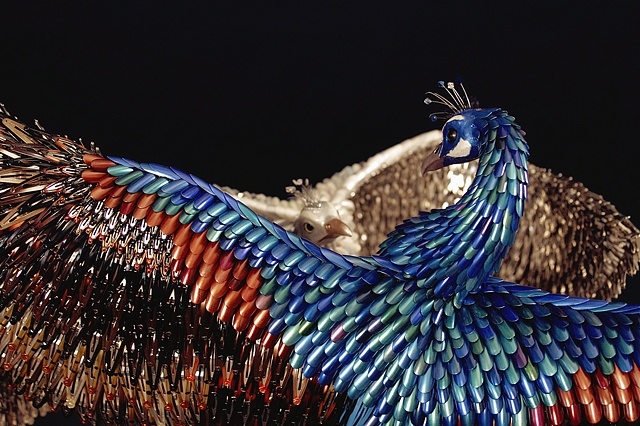
Artist Laurel Roth made a set of peacock sculptures out of cosmetic supplies. The series is called "Birds of Paradise", and the above example was created using fake nails, nail polish, and barrettes.
Last year, we featured a chandelier that she made out of hypodermic syringes.
It combines the classiness of a bottle of fine wine with the convenience of a drink pouch. James Nash debuted his design on a UK reality TV show in which inventors pitched their ideas:
What's really great is the inventor, James Nash, took his invention to a show on BBC called the Dragon's Den. The show listens to pitches for new inventions and awards funding to inventors it feels show promise. Nash, they felt, had a silly idea and was dismissed. But now his product is selling strongly in the U.K. already, and we can't wait to sample it here.
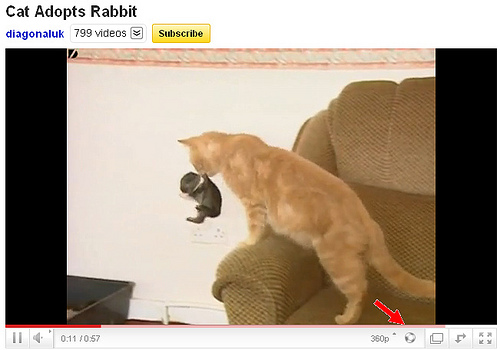
Pull up any YouTube video, and you'll see a button in the bottom right corner that looks like a soccer ball. Click on it, and a vuvuzela will play during the video.
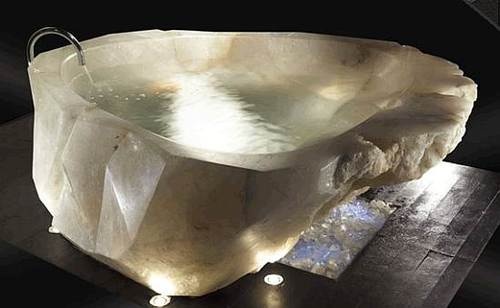
Baldi, an Italian company known for manufacturing luxurious home furnishings, made this bathtub. It was carved out of an enormous block of quartz found in Brazil. The tub will set you back over million dollars if you want to own your own:
The huge tub, 2 metres in length and 55cm in height was previously shown in Milan at I Saloni in April 2010 and is carved from a single enormous block of the purest white rock crystal, quarried in the Amazon region of Brazil. The block was discovered in 2006 when Paolo Baldi, father of the company's current CEO Luca Baldi, learned of the existence of this ten-ton block of flawless crystal and had it extracted and transported to Italy intact.
This incredible bathtub is the second to be made from the immense block. The original was shown at Salone del Mobile in 2008 and immediately snapped up by a Russian magnate, but the tub featured in the Harrods window is by no means a replica of the first. Each is unique, though both were sculpted with diamond cuts and left partially rough to expose the natural beauty of the crystal. If you are thinking of snapping up this incredible tub, your pockets may have to be as deep as the quarries it is excavated from as it comes in at £530,000.
Swedish product designer Richard Stark made this flipper for amputees who would like to use their legs more effectively while swimming. It's made so that it distributes forces to the sides, rather than the tip of the leg. The angle of the flipper can be changed to allow for different strokes. Video at the link.
Taichi Inoue made this unique touchscreen system. As the pictures at the link illustrate, the screen lies at the bottom of a water tank about eighteen inches deep. But the user needs to insert just two inches of a finger into the water to activate a feature on the screen. Inoue accomplished this by directing a webcam at the surface of the water. The webcam then measures the location and depth of the finger to provide instructions to the computer.
http://taichi.s372.xrea.com/minamo_en.html via Make
Five years ago today, reddit received its first submission. This information networking site, founded by college students Steve Huffman and Alexis Ohanian, has grown to be an influential engine of web culture. At Geekosystem, Robert Quigley wrote a thoughtful analysis of how reddit became so powerful in the Internet news cycle:
There’s nothing particularly objectionable about this: The Reddit community and the Reddit algorithm work together to ensure that mostly interesting pictures, videos, and articles quickly make their way to the front page of the site. But then, that’s the function of most social news sites; what makes Reddit special?
Without getting into the tired debate pitting Reddit against Digg or quipping that today’s Digg frontpage was yesterday’s Reddit frontpage, I think that even most Digg users will agree that the Digg frontpage is not geared for speed in the same way Reddit’s is. A big Gizmodo-iPhone type story can shoot up to the top of Digg fairly quickly, buoyed by thousands of Diggs up, but for mid-tier articles of a few hundred votes, Reddit is a lot faster. Now, there’s nothing wrong with enjoying slower-paced news as a reader — what’s the difference if you haven’t seen it yet? — but from the perspective of an online-oriented writer, newer tends to be far more valuable given the blogosphere’s fickle, hour-by-hour appetite for information.
Reddit’s algorithm ensures that new, well-liked stuff shoots up, but it’s up to the community to ensure that ‘well-liked’ and ‘actually good’ have much correspondence.
NASA recently held a design competition for engineering students. The objective was to design a tiltrotor helicopter that could take off from the water. Such an aircraft, NASA hoped, could be used in future maritime rescue operations. The winning design, pictured above, was submitted by students at Virginia Tech:
The winning design, dubbed the Rescue Amphibious Firefighting Tiltrotor (RAFT), was developed by 10 engineering students at Virginia Tech. It features two flying-boat style hulls joined by a central wing to form a catamaran for landings on water even in quite rough seas (up to sea state four). Projecting wings on either side carry swivelling nacelles like those of today's V-22, but more powerful and featuring larger propellor/rotor blades.
According to the designers' calculations the RAFT would be able to cruise at 300 knots and offer range of 800 nautical miles on a fill of just over 4½ tonnes of fuel. It could carry up to 50 passengers or approximately 5½ tonnes of water for firefighting purposes, which it could easily scoop up by making a brief touchdown on a handy body of water. The powerful catamaran flying-boat/copter would weigh in at a hefty 28+ tonnes all up.
http://www.theregister.co.uk/2010/06/23/nasa_tiltrotor_compo/ via DVICE | Photo: Register
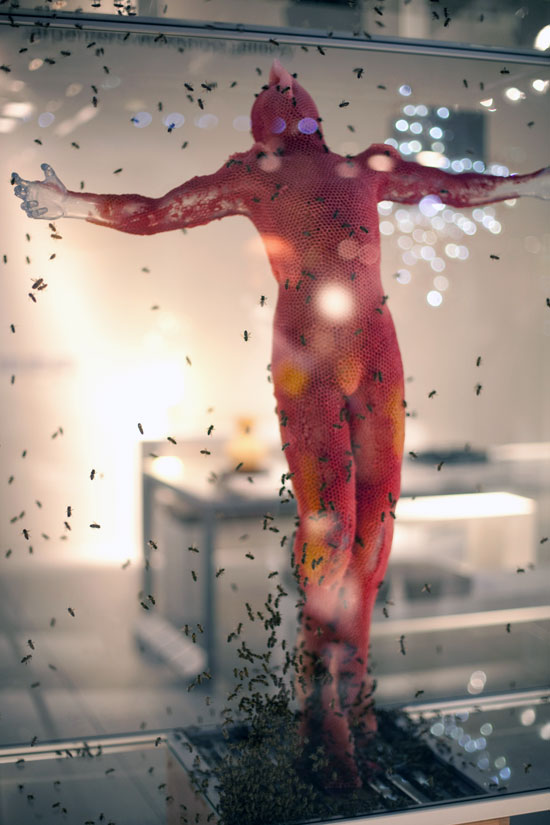
Dutch designer Tomáš Gabzdil Libertiny made a sculpture of Jesus that was completed by bees. He erected a sealed glass container with his mold inside. Libertiny then released 40,000 bees who worked on the honeycombed surface of the mold:
over the course of the fair, 40 000 worker bees were released into the case to complete a wax honeycomb structure over the figure of a martyred christ rising out of the chaos, his weight seeming to be upheld by the mass strength of the swarm. the figure within the vitrine is made of a laser sintered framework in which the industrious bees created a honeycomb skin over before filling each cell with the honey they produce. then bees worked to remove the honey from the cells and return it to the beehive, cleaning the figure back to the wax cells they originally created.
More pictures and a video at the link.
Link via Nerdcore | Artist's Website | Photo: Carpenters' Workshop Gallery
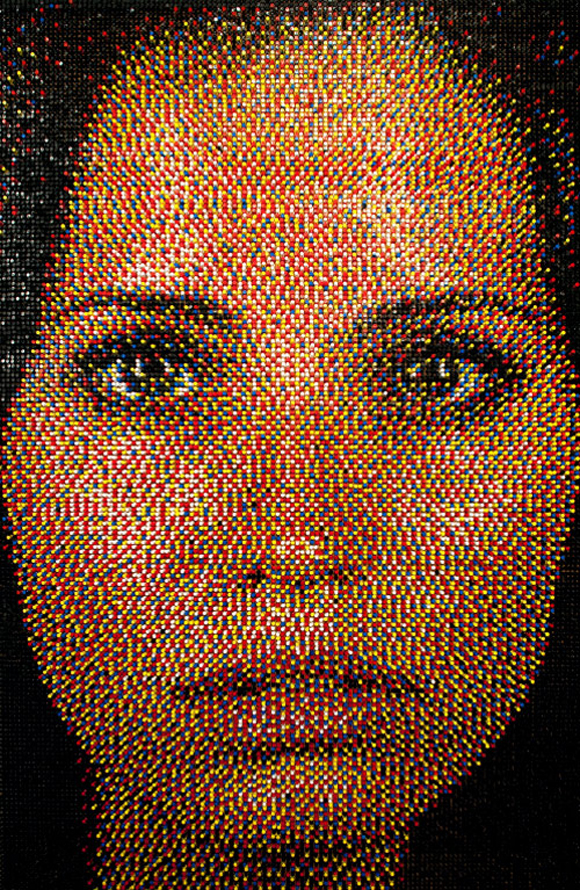
Artist Eric Daigh makes mosaics with pushpins. His primary subject matter is portraiture. Daigh begins the creation process by taking photographs of a person and then processing those images through a computer program that reproduces them in five colors:
“With the push pins, I don’t have every color in the rainbow to use. It’s a limited color palette,” he explains. “Push pins only come in a few colors.”
Daigh gets his multi-colored packs of 500 pins through local retailers. He and his wife, Meghan, sometimes spend their evenings sorting pins into the five colors he uses. Push pins don’t come in black, so Daigh has to spray paint green pins to black.
After breaking the image down to a low resolution, Daigh produces a row-by-row grid that dictates where each color pin should be placed to form the image. Daigh then places the pins, one-by-one, following the grid map. It takes some 11,000 push pins to complete one of his 3×4-foot works.
Do you remember Zach Anner, the Internet sensation who is trying to convince Oprah Winfrey to give him a TV show? He's back with a new video showing viewers around Austin, starting with the Texas State Capitol.
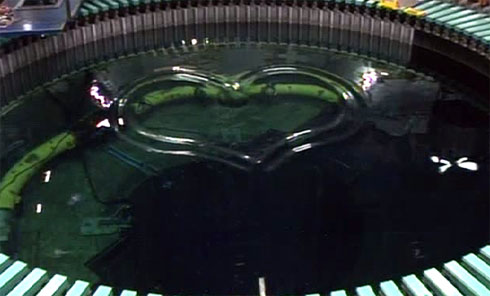
The National Maritime Research Institute of Japan has developed a machine that can create shapes in a pool of water, including a heart and a star. But that's just to entertain reporters. The primary purpose of the machine is apparently to conduct tests for water safety. At the link, you can view a Japanese-language video about the device.
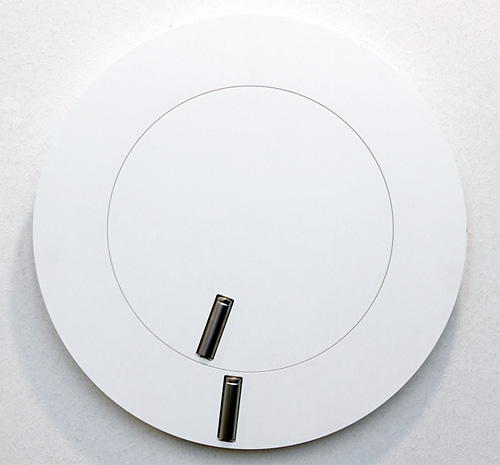
The Front & Back Clock is powered by two AA batteries, which can be seen from the front of the clock. They're used as hands to indicate the time. It was created by the design firm The Wrong Objects and was featured at the 2010 DMY International Design Festival in Berlin. The clock is not yet available for purchase.