Yes, soft serve ice cream is delicious and we are grateful for the food service workers who provide it to us. But perhaps we, the public, are not appreciative of what people can do with soft serve ice cream when it's approached as not a menial task, but a challenge of structural engineering.
If you really push the limits and get inventive, what extreme heights can you reach with mere wheat flower cones and melting, liquid ice cream? Arman Javeed, The Cone Maker on YouTube, shows us in a series of enticing short videos of expert pours from the pump handle.
CRABS Historical Fencing is an organization in Truro, New Glasgow, and Halifax, Nova Scotia that teaches traditional European swordsmanship. If you want to learn how to practically defend yourself with a broadsword, this is the place to go.
Do you anticipate being attacked with a sword while roller skating? Perhaps not, but it's best to be prepared. Here's a brief video of two of their practitioners at work on the roller rink.
People under 40 or so only know two things about Lady Diana Spencer, later known as Princess Diana. She was married to Prince Charles, the future King of England, until they were divorced. Then she died in a traffic accident in 1997 at the age of 36. Older people will remember the big news of the royal wedding in 1981 right after she turned 20. The way she was selected to be Charles' bride seemed a bit skeevy to Americans, but the young preschool assistant seemed happy.
Yet underneath the royal trappings, Diana's life was no fairy tale. From the time she was born, her life was difficult, not financially, but psychologically. Still, she carried the weight of her family's expectations and then the world's expectations like a champ- until she couldn't. Then again, Diana's story contains elements of many stories we've heard before: the beautiful princess, absent parents, betrayal, a stiff upper lip, longing for love, and even a wicked stepmother. Maybe Princess Diana's life really was a fairy tale come true, just without the magic intervention and the "happily ever after" ending.
The headline at Brilliant Maps is a real eye-opener: None of the countries that bordered Romania before World War II border it today. None? The map above shows the borders of the region before the war. Well, okay, the USSR and Yugoslavia no longer exist after the reshuffling of communist Europe in the 1980s and '90s. Hungary and Bulgaria are still there, but they are no longer kingdoms and just go by the individual names, so that's a bit of a cheat. Romania itself was named the Kingdom of Romania back then, too. Can we consider Czechoslovakia a cheat as well? No, because today, neither the Czech Republic (Czechia) nor Slovakia border Romania! The history of the region in the 20th century is enough to make Dracula's head spin.
Okay, how about Poland? It's still a country, but no longer shares any border with Romania. The answer is a bit of land revealed in the modern map that you might be able to guess before you visit the post at Brilliant Maps. -via Nag on the Lake
Eight years ago, John D. Boswell, known as Melodysheep (previously at Neatorama) brought us a timelapse of the entire universe, from the big bang to the present time. We posted it, but the video has been yanked because it has been completely reworked in Boswell's own style and words. The earlier film was a pastiche of video from various sources with celebrity narration. This is the same idea, with upgraded visuals, music, and narration by EpicSpaceMan (Toby Lockerbie).
The story is ten minutes that represent 13 billion years of history. That means that every second covers 23 million years. Human beings don't show up at all until the last fraction of a second. But that doesn't mean there's no drama. A lot of things are happening while you try to wrap your head around the scope of time. This video has been adapted to play at various planetariums to be shown in their immersive theaters. If you've ever been to one of them, you can imagine how good this will look from the inside of a dome without the ads. -via Memo of the Air
A movie star becoming president? That'll never happen! Well, I was just a kid in Kentucky at the time, and didn't even know Reagan was already the governor of California. But no one could have known that exactly 20 years later, the Berlin Wall would indeed fall. This is just one of many pop culture plots or jokes that accurately predicted the future way back in the past.
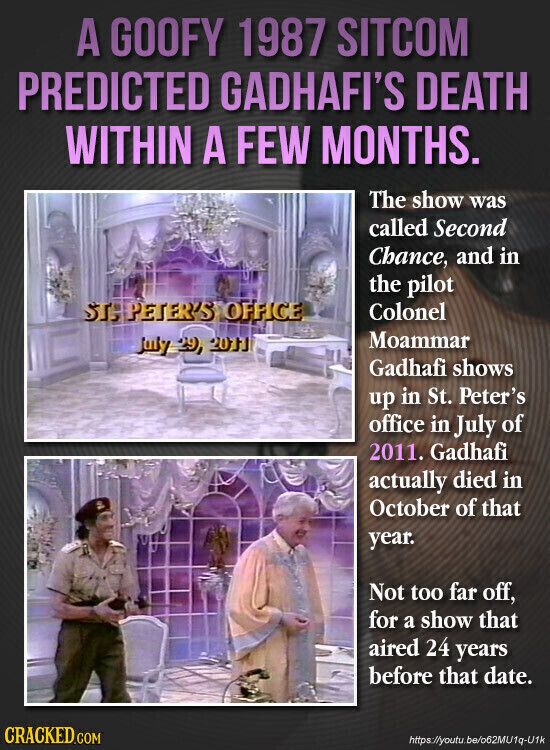
No one remembers the sitcom Second Chance because it didn't last long, but they got the year of Gadhafi's death right- only three months off from his actual demise. Considering how many TV shows and movies make predictions about the future, often for comedic effect, it stands to reason that some of them would get it strangely right. But this list boasts 17 correct predictions, and 12 that were wildly off the mark.
Sure, women in 1966 liked to get out of the house, but not necessarily to shop. A meaningful career that paid a decent wage would do nicely, thank you. Besides, we had been shopping through the Sears catalog for almost a hundred years already. You'll be able to distinguish the best and worst predictions, although some fall into the "anyone could have seen that coming" category. Read all 29 of them at Cracked.
Every once in a while, you think about what people will say about you after you're gone. Will your life have a lasting impact on the world? And did you leave a good impression on the people you left behind? Mostly we picture that at our funeral, which could be the last time anyone talks about you at all. But if you happen to be the victim of a widely-publicized murder, you just might end up in a true crime story available to the entire world. And keep in mind that once you're gone, you cannot control the narrative in any way.
Sure, that's a sad scenario. But in the hands of Ryan George it becomes a comedy as a murder victim's ghost gets a glimpse into the aftermath of that crime, and how his friends, neighbors, and casual acquaintances use their ten minutes of fame on a TV show about him.
Hollywood choreographer Busby Berkeley will always be remembered for his over-the-top production numbers that were filmed from overhead. Dozens of dancers assembled perfect geometric forms that resembled a moving kaleidoscope on the silver screen in the 1930s. You might be surprised to learn that Berkeley wasn't a dancer himself, and never even took one dance lesson in his life. His geometric sequences were born from the military. Berkeley spent World War I arranging military parades and spectacles, and took the idea of precision synchronization to Hollywood.
The chorus girls who auditioned for Berkeley's movies were dancers, but it didn't matter whether they were any good. They were selected if the length of their legs matched his needs, and if they were willing to follow Berkeley's orders. That could mean holding a pose in a cold swimming pool for hours. And none could stand out. But it was a job during the Great Depression. Audiences loved the overhead shots, and Berkeley had all the work he wanted for a few glorious years. But he also had a dark side, from the night he drove away from a party drunk and killed two women to the movies he was fired from. Read about the rise and fall of Busby Berkeley at Utterly Interesting.
Pumpkin was spoiled by her previous owner, an elderly lady who died. She's a megachonker who weighs 25 pounds. Now, I had an orange cat who weighed 20 pounds, but he didn't seem fat because he was a large fellow who stood as tall as my knees on four legs. But Pumpkin is an average sized house cat, so 25 pounds is twice what she should weigh. She's so wide they couldn't have given her any other name.
As a special case, Pumpkin landed in a special home- with the president and CEO of Cincinnati's SPCA! Chris Seelbach is making getting Pumpkin back to a healthy weight his goal, but she's not quite on board yet. To make up for restricted food, Pumpkin is enjoying plenty of affection from the family. She doesn't like to walk much, but at :06 and 2:43 you'll see her walking toward the camera and you can almost hear the floor shaking under her. Oh Lawd, she comin'! See more videos of Pumpkin at TikTok. -via Laughing Squid
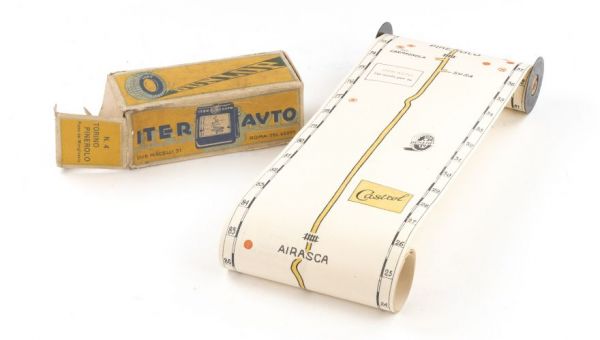
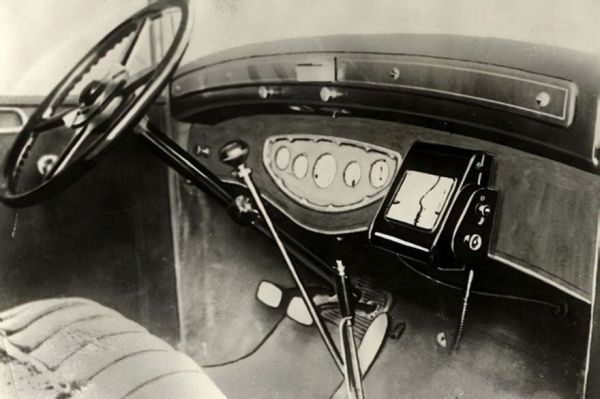
A folded map on the passenger seat is from the past and narrated driving directions by a computer is the present. In between came various gadgets designed to help drivers get to where they were going. Among them is Iter Auto, an Italian invention from the 1930s. It consists of a paper scroll identifying waymarkers along a popular driving route.
Place the appropriate scroll in a machine which is hooked into the car's speedometer. It scrolled automatically to match the pace of the car.
I found this information on Tangible Media, a marvelous online museum of various forms of historic physical media organized according to a well considered taxonomy.
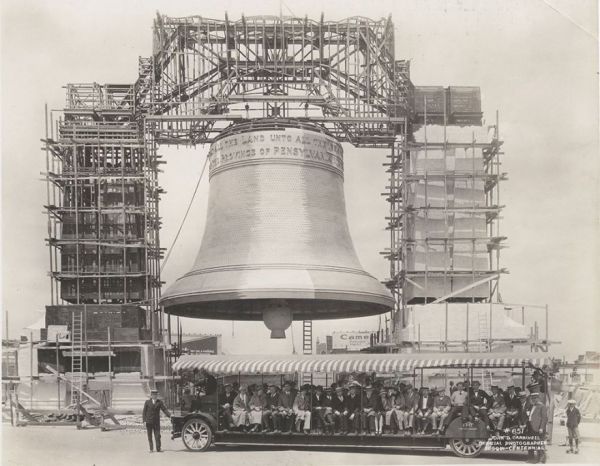
The US goes all out for historical anniversaries, but the Sesquicentennial International Exposition in Philadelphia to celebrate 150 years since the signing of the Declaration of Independence left a bad taste in many mouths. Called the Sesqui for short, the world's fair opened in May of 1926 while still under construction and closed on December 31st with a whimper instead of a bang. Early visitors were not impressed, and word of mouth kept crowds away the rest of the year. The project nearly bankrupted the city of Philadelphia.
What went wrong? World's fairs usually take ten years of planning, but this time it was delayed by World War I. Federal money was allocated, but it was not nearly enough. Philadelphia itself was wracked by political corruption at the time, and taxpayers did not line up to support the venture. The original site proved to be inadequate, and the second site had problems that drove up costs and delayed construction. Philadelphia's political boss refused to delay the Sesqui because he needed the fair timed for an election. There were other factors that went into the failure of the Sesqui, too, which you can read about at Smithsonian. -via Strange Company
Demi Remick is one of the world's foremost tap dancers. In addition to traditional tap, she can express her creative interpretations of famous musical themes on the tap board.
Remick is now on tour with Scott Bradlee's Postmodern Jukebox, where she is dancing to jazzy renditions of famous science fiction musical compositions.
You look at your income, your rent, and your grocery bill, and you think you should be able to make it work, despite the rising costs of rent, gas, and groceries. So why are you still broke?
The modern world of internet apps makes everything simple and convenient, particularly spending money. When all you have to do is push one virtual button to buy something, the price doesn't hit you nearly as hard as handing over cash. That price may look small now, but when it's multiplied over time, you'd be shocked by the total. Automatic payments often go ignored, but the effect on your bank balance adds up, and suddenly you're broke and you don't even know how it happened. Chill Dude Explains goes over ten ways your money is disappearing while you don't even notice. Not all of them are due to the convenience of the internet, but all are easy to miss if you aren't paying close attention.
Matt Thompson is a master "creator of mostly ridiculous and unncessary things", usually with wood as a source material. He has a model railroad that runs along the fence-line of his backyard. In the winter, he hooks a snowplow locomotive to the front to clear off the harsh winter precipitation on the tracks.
The train provides Thompson with endless opportunities for creative fun. Most recently, he added a model DeLorean DMC-12 to the front of his train. It is, specifically, a model of Doc Brown's time-traveling DeLorean from the Back to the Future film franchise.
Thompson reenacts the climactic scene from that film in which Marty McFly attempts to travel back to the future--if his car can reach 88 miles per hour.
In early television history, tapes were sometimes recorded over or preserved in slipshod conditions, which is why, for example, many early episodes of Doctor Who are missing. Their rediscovery is a source of joy to fans.
This is the equivalent experience for medievalists.
St. Augustine of Hippo (354-430) lived during the twilight of the Western Roman Empire, dying as the Vandals were literally at the gates of the city where he lived. He was a classically trained Roman intellectual who synthesized Platonic philosophy and Christian theology to a greater degree than previously accomplished.
Many but far from all of his voluminous written works survive to this day. But it was in only 2024 that Latin scholar Christian Tornau at University of Würzburg translated a manuscript discovered in Poland that contained six sermons by Augustine. Two of them were previously unknown.
Both sermons, which are concerned with the Witch of Endor, are confirmed to be very much in Augustine's style and thought, so Tornau is convinced that they are genuine. You can read more about this discovery at the webpage of University of Würzburg.