Kitsune: Japan's Most Popular Yokai Monster

Yokai are a Japanese pantheom of supernatural folklore spirits that range from demonic to the beneficial. They include monsters, ghosts, and demons, which aren't always separate categories as they are in the West. Kitsune is the one you are most likely to run into today. 

Foxes are known for being cute and intelligent, so clever that it was easy to ascribe superpowers to them, which is exactly what happened in ancient Japan. The supernatural fox called Kitsune could be a mischievous prankster, a shapeshifter, a protector, a blessing, or a spirit that possessed humans, depending on the time and place. They are rarely 100% malevolent, but they can ruin your life in order to teach you a lesson. Kitsune can take a form of a beautiful woman, and in some cases even reproduce with humans to provide hybrid offspring or some form of Kitsune ancestry. 

Dr. Emily Zarka explain Kitsune, from ancient tales (with many tails) to modern depictions in pop culture, including a bizarre (and clueless) American plan for weaponing Kitsune against the Japanese during World War II. 


A Really Nice Retirement Home for ...Penguins!

African penguins are a critically-endangered species, but the New England Aquarium in Boston has a thriving colony. These penguins usually live 10-15 years in the wild, but in the aquarium's protective environment, they can live to more than twice that age. Earlier this year, the aquarium designed a separate island as a geriatric ward, sort of a retirement home, for six penguins. Four of them are in their 30s, and two others, aged 29 and 14, were included because they are mates of the older penguins. The penguins are dealing with maladies like arthritis or cataracts that penguins in the wild rarely survive long enough to suffer. 

The new island separates the "retired" penguins from the more rambunctious younger birds, although they are still in sight. It is equipped with level mats that make it easier for older penguins to get around and to find their way despite poor eyesight. They also get world class medical treatment and nutritional supplements for their aches and pains. Read about each individual retired penguin and their new home in a press release. You can read more about meeting the penguins' medical needs at National Geographic, although you'll have to sign up for notifications to read it. -via Metafilter 

(Image credit: Vanessa Khan/New England Aquarium) 


Romantic Proposal at the Museum of Civil War Medicine

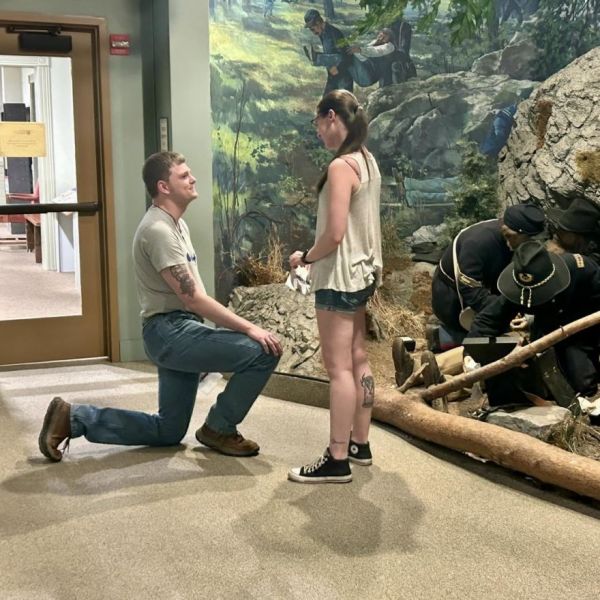
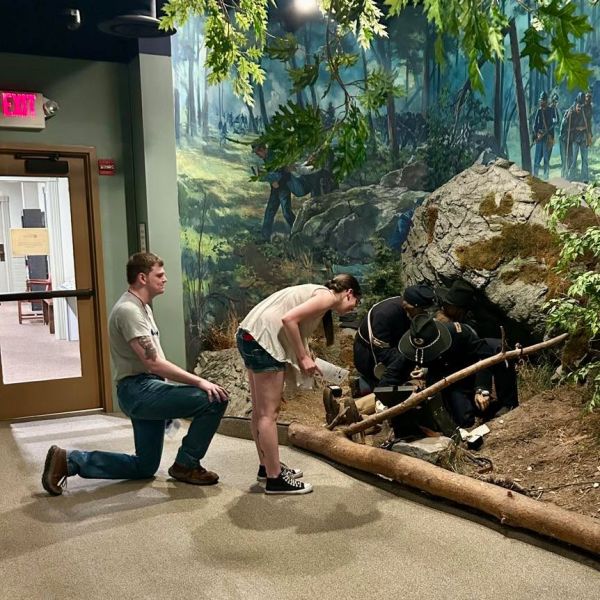
The National Museum of Civil War Medicine in Frederick, Maryland is, apparently, a romantic venue for couples. A few days ago, Jacob and Selena became engaged there when Jacob dropped to one knee and popped the research question.

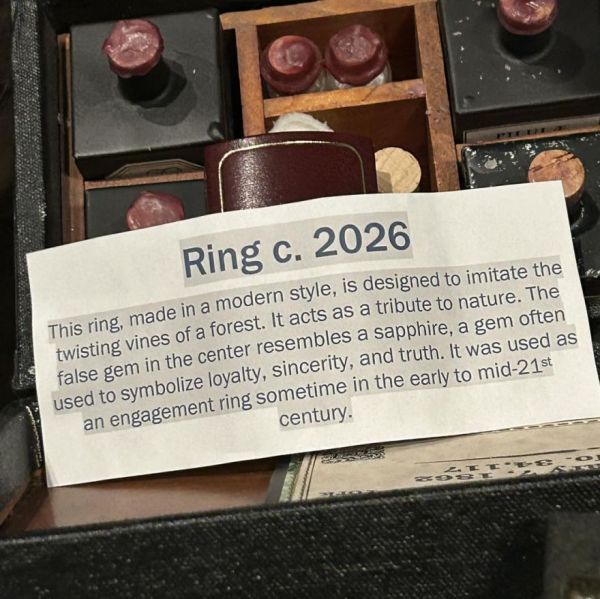
Note that the museum was an enthusiastic participant in the plot. I gather that it allowed Jacob to place the engagement ring in an exhibit and direct attention to it with an official marker.

How do you set the mood? Direct your lady to a mock-up of some grisly surgical procedure. Then wait for her to read the placard and turn around.

-via Patrick Heizer


Ten Real World Examples of Temporal Distortion

We think of time as a constant, sometimes the only constant, in our lives. It's true that time seems to pass much more quickly as we get older, but that's just a matter of human perception. The way we measure time varies from place to place and from culture to culture, so we manage to confuse ourselves about it. Human perception of time can't always be trusted, but objective time isn't always constant, either. It's mind boggling how time itself can vary once you get away from the earth, whether it's merely on a mountaintop or in outer space. Chill Dude Explains (previously at Neatorama) gives us a list of ten anomalies in time, from the mundane and easily understood to the cosmic. There are no time machines here, just real examples of time distortion, or at least distortions in the way we understand time. The mispronounced word in this video is Byzantine. 


The Turf Houses of Iceland Were Anything But Luxurious

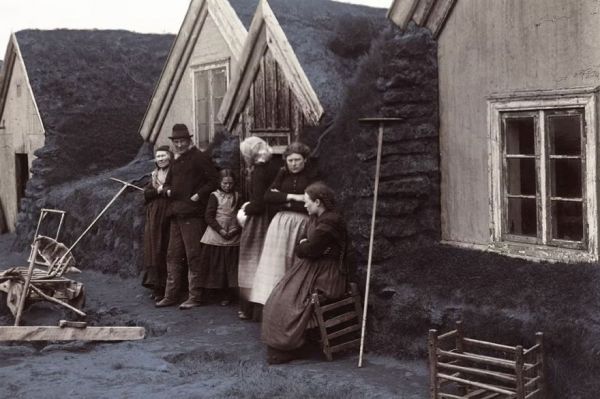
When the Vikings settled Iceland a thousand years ago, it had plenty of forests, but the trees were cut down to build homes and ships, and to clear the land for livestock. That led to erosion and poor agriculture. For centuries, the only wood available to build homes was driftwood. So people instead built homes using wood for only the roof supports and doors, and filled in the walls and roof with turf. These homes were innovative, and today would be called sustainable and charming, but they weren't what we'd call pleasant to live in. 

For one thing, if you had a decent-sized turf home, you were obliged to take in all family members, plus widows and other indigent people as servants. These all lived together in one room upstairs with the family's children. Downstairs, you might need to take sheep inside to gain a little extra warmth. Besides that, the turf tranferred moisture inside. They may be traditional, but when imported lumber became available, Icelanders rushed to replace their turf houses with wooden structures. This was not only for comfort, but to shed their reputation as uncivilized. Read about life in the turf houses of Iceland at JStor. 


The Bering Sea Donut Hole

X user Patrick Heizer brings to our attention this geographical oddity. Under the current law of the sea, nations have exclusive economic regulatory authority over a certain distance beyond their territorial seas.

Many of these claims overlap each other or lead to unusual borders for the exclusive economic zones. The Bering Sea Donut Hole refers to one such area that was heavily overfished in the 1980s. Several nations with large fishing fleets rejected American claims to the maritime region.

The Donut Hole Convention (as it was popularly but not officially called) is a 1994 treaty between the United States, Russia, Poland, Korea, Japan, and China determining the status of the area.

Continue reading

Classic Texts Translated into Cat

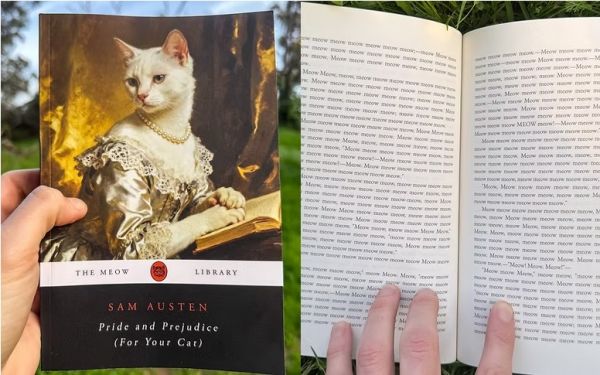
Yes, that's Jane Austen's Pride and Prejudice with all words replaced with meows.

You may think it's a fun gag, but have you seen the state of public education these days? Many cats are functionally illiterate. Even those cats who can read at grade level aren't getting exposure to the classics.

Fortunately, the Meow Library is here to help. This organization has translated essential works from the Western canon into cat, including War and Peace, Crime and Punishment, The Odyssey, and the Constitution of the United States of America.

The organization also has a podcast for cats interested in engaging with serious literature.


Transparent Corset for Concert-Goers

For security reasons, many public performance venues do not allow people to bring in bags unless they are transparent. Accessory makers manufacture and sell specialized bags to accommodate this need.

Etsy seller Slater the Creatorr of Chattanooga, Tennessee offers an alternative: a clear plastic corset. In a video on Instagram, she demonstrates how to use it.


The First Full Trailer for Digger

The new movie Digger is the story of Digger Rockwell, a wealthy and powerful oil tycoon whose previous actions have set the world on a course of total environmental destruction. The character may remind you of any of a number of real people. Facing old age and possibly death, he decides he now has to save the world. The real kicker is that it's a satirical comedy.

You might not recognize Tom Cruise at all in the title role. The actor is 64 years old, and has taken some criticism in the past few years for continuing to portray much younger characters. He seems to have finally come to terms about playing someone his age, or older in this case. The movie also stars Jesse Plemons, Riz Ahmed, and John Goodman as the president of the United States. But we can tell right now that the real star of the movie is Digger's beloved cat. Digger is scheduled to open nationwide on October 2.  This trailer contains NSFW language. 


The Complicated Struggle for Abolition in France

The United States declared its independence from the British Empire in 1776, but it was almost 90 years later that its enslaved people achieved their own independence. In France, the abolition of slavery started and ended earlier, but it came about in fits and starts. 

In 1789, during the French Revolution, Count Mirabeau of the new National Assembly declared that freedom should extend to all men, even the slaves in the French colonies of the New World. His suggestion was ignored, because the plantations of the Caribbean were just too lucrative. Then in 1794, enslaved colonists were not only granted freedom, but also citizenship. This only lasted until 1799, when Napoleon took over and rescinded those rights. Meanwhile, Haiti staged its own revolution and became independent in 1804. It wasn't until 1848 that slavery was permanently abolished in France, but they were still ahead of the US. Read how the French abolished slavery at the Conversation. 


An Honest Trailer for Troy

As the Odyssey may be considered a sequel to the Iliad, the new film opening this weekend The Odyssey may be considered a sequel to the 2004 film Troy, at least by certain fans of the genre, even though the two movies are separated by more than 20 years and completely different casts and crews. At least the original poems were written by the same author. So in honor of the occasion, Screen Junkies goes back in the vault and gives us an Honest Trailer for Troy

Of course, they quickly focus on the overwhelming beefcake angle that the movie was so derided over. Give the audience what they want. There's plenty of bloodshed, too. When you've got this much sex and violence, you don't need much historical accuracy- or even literary accuracy. That said, you might want to go back and rewatch Troy before seeing The Odyssey this weekend. And then let us know how they compare. 


Creating the Technology for Terminator 2's Groundbreaking Visual Effects

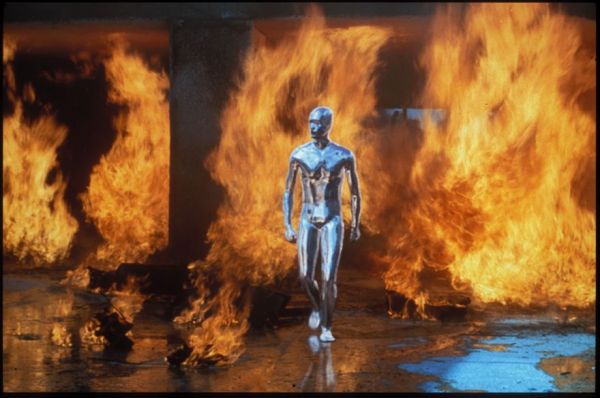
James Cameron wrote, produced, and directed Terminator 2: Judgement Day after announcing a 1991 release date. The movie was put together at breakneck speed, and the theatrical prints were delivered to theaters only the night before opening day. Now, if you recall, T2 had some pretty innovative special effects, especially the shapeshifting T-1000 that melted and reformed at will. 

Industrial Light & Magic only had about a dozen employees at the time, so the call went out to hire plenty of effects people. They were given the storyboards that showed how Cameron imagined the T-1000 passing through prison bars. They did not know how to do that. CGI was in its infancy, and the team figured they would have to spend millions on computers and storage to get it done. And they only had ten months. They did have the software that created the creature in The Abyss, but how would they transfer those tools to work with a real human? They ended up developing an early version of motion capture by drawing a grid on actor Robert Patrick's body and rotoscoping it. And that was just one of the problems they had to solve with 1990 technology. Read an oral history of how it all came to be from the effects team of the movie Terminator 2: Judgement Day. -via Metafilter


The Wishing Stone at St. Brigid's Cathedral

Around the year 480, Saint Brigid formed a convent in the town of Kildare in east central Ireland. The abbey and its compound was razed and rebuilt many times. The present structure, which includes a cathedral, dates to the Thirteenth Century and was restored in the late Nineteenth Century.

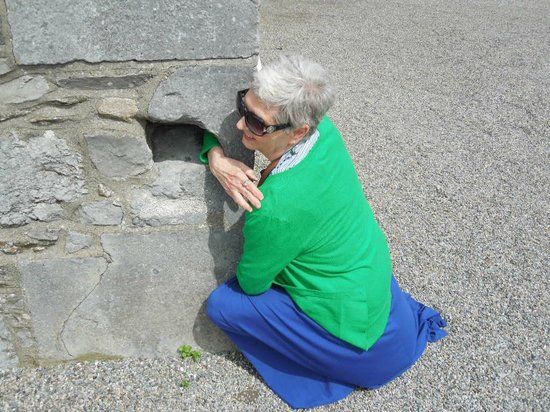
As well as serving as a Catholic house of worship, it is a popular tourist destination. Visitors will find that one corner has a hole reaching through the other side. This is called the Wishing Hole or Wishing Stone. The story goes that if you stick your arm through the hole, touch your shoulder, and make a wish, the wish will come true.

-via Maddie Smith | Photos: 瑞丽江的河水/TripAdvisor


For Sale: Scenic Vermont Home/Jail

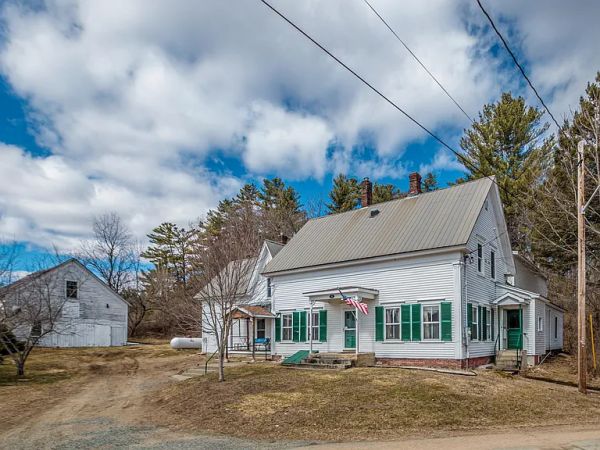
Everything I know about Vermont I learned by watching Newhart, so this home for sale on Zillow fits in nicely to my mental image of the place. The four bedroom, two bedroom, four cell house was built in in 1880 and later served as the residence of the Essex County jailer until 1969.

Continue reading

How the World Developed Passports

Passports as we know them are a relatively recent invention in the grand scheme of things. But travel documents of some sort have been around since ancient times. Whether those documents got you into a different country was often a crapshoot. Like many other systems, the birth point of the passport boils down to how you define one. And how you define borders, visas, and rules of passage. You might have guessed by now that the answer to the how and why of passports is war. The journey to the standardized passport was a long and crooked one, since nations don't like to be told what to do, yet most still want their citizens to have freedom of travel. Even today, passport rules are different depending on who you are and where you are going. Not only that, but the rules can change suddenly. Let's hope you are not sitting in an international airport lounge when that happens.   


Email This Post to a Friend
X

This website uses cookies.

This website uses cookies to improve user experience. By using this website you consent to all cookies in accordance with our Privacy Policy.

I agree
 
Learn More