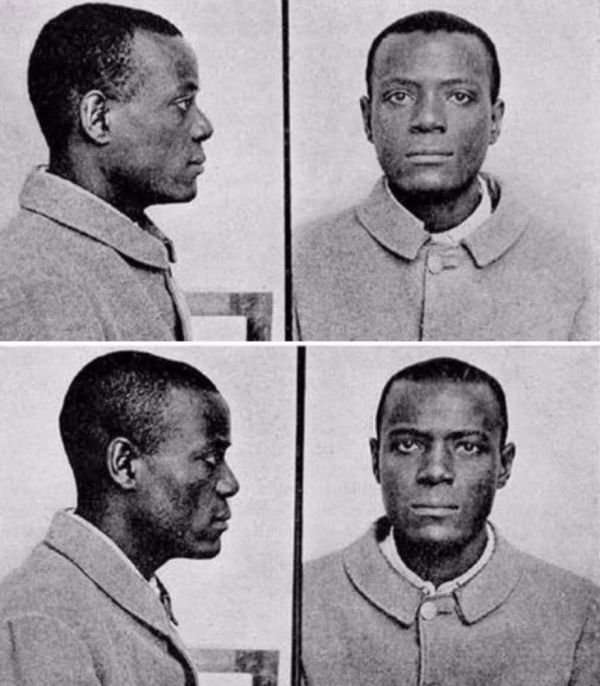
In the 1880s, French criminologist Alphonse Bertillon introduced the standardized mug shot as a way to identify criminals. This was accompanied by his thorough system of measurements of the person, from height to the width of a foot.
In 1903, the clerk at Leavenworth prison logged in a new inmate named Will West. Checking the records, he found that Leavenworth already had an inmate named William West who'd been there for two years. His mugshot (at the bottom in the image above) looked a lot like the new prisoner Will West (pictured at top), and his measurements, as recorded in the Bertillon System, were identical. Could these two prisoners be one and the same? The case is often cited as the death knell of the Bertillon System and the complete adoption of fingerprint identification of prisoners, although mug shots remained. Will West and William West had very different fingerprints.
What throws a wrench into that story is the fact that Leavenworth prison did not adopt fingerprint identification until 1904. That's when the two Wests were first fingerprinted, so the prison had to have used a different method of keeping the two inmates straight until then. Read about Will West, William West, and the way we identify prison inmates at Utterly Interesting.