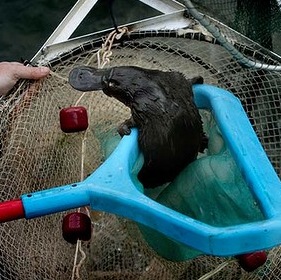
How many humans does it take to pull a platypus from a sewer pipe? About 27 were there when the creature was pulled from a pipe at the Penrith Sewage Treatment Plant in Sydney, Australia.
After Sydney Water staff gently flushed the pipe, it took four National Parks and Wildlife Service rangers to corral the juvenile male in a net before he was whisked away to a vet for a check-up.
Sightings of platypus in Western Sydney are rare, said the NPWS area manager, Jonathan Sanders.
A spokeswoman for the NSW Wildlife Information Rescue and Education Service said there were no records of a platypus rescue in Sydney in the past four years.
But cleaner waterways might be helping the animals to make a comeback, Mr Sanders said.
"It could be that we're getting a re-colonisation of old habitats."
Trains go where other vehicles can't, but only if there are tracks in those places. So it only makes sense to lay train tracks with a train! The P811-S Track Renewal Train does just that. This train finished the line to Overpelt, Belgium on May 5 of this year. -via the Presurfer
Every time we blog about an octopus, or rather, more than one octopus, we can count on a debate in the comments about the proper plural form for the animal. Here's the real scoop from Kory Stamper, who is an Associate Editor at Merriam-Webster, the dictionary company. -via Holy Kaw!
The Horton Plains slender loris has never been photographed before, and was thought to have been extinct before a rare sighting in 2002. Now a team of researchers led by Saman Gamage have captured the tiny primate on camera in Sri Lanka.
The pictures show a 20-centimeter long male adult sitting on a forest branch forest. Conservationists have discovered it appears to have shorter and sturdier limbs than other loris; a possible adaptation for the cooler, high-altitude montane -- or cloud -- forest in which it lives.
That could mean the Horton Plains slender loris is a distinct species in its own right, said Gamage. Results of the study are published in the latest edition of the journal Primate Conservation.
What kind of twisted mind came up with a baby harp seal as a pinata for kids to whack with a stick? It's OK to laugh, since it is only paper, filled with blood-red candies ready to spill out when the clubbing is done. Link
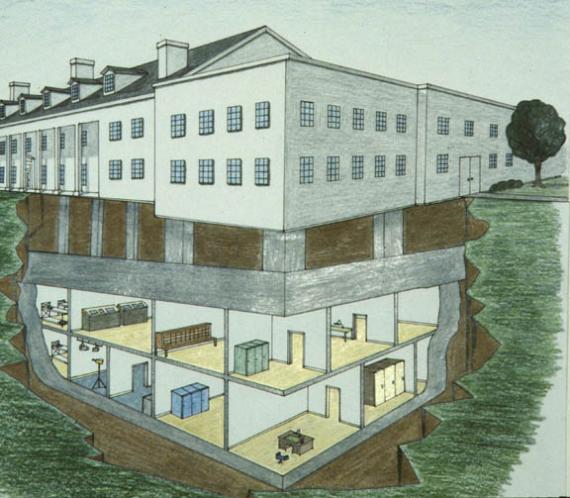
From the 1958 until 1992, the Greenbriar Resort in White Sulfur Springs, West Virginia sat on top of a secret. Underneath was a huge fallout shelter designed to accommodate members of the US Congress and their aides in case of a nuclear attack.
The 18 dormitories could sleep 60 people each on metal bunk beds. Each had a shower, toilets, and small lounge.
The clinic covered 600 square feet and had 12 beds, an operating and intensive care room. It would be manned by military doctors and nurses.
During its life, it was constantly maintained in a state of readiness. Communications, electronics, and mechanical equipment was updated as needed. Supplies were cycled to insure freshness.
A complete TV and radio studio was equipped with modern facilities including a 75' telescoping antenna hidden on the top of the rise beside the new West Virginia Wing. Congressmen and Senators would broadcast to survivors important information, most importantly that the central government was still in operation.
The project was abandoned after a 1993 Washington Post article brought it to the public's attention. Link -via Atlas Obscura
Today's Lunchtime Quiz at mental_floss continues the popular Typeface/Off series with more brands and products you should be able to guess by the font only. Beware, the words say Mental Floss, not the product name. Spelling counts, but there is a list of answers you can highlight. I scored 80%, as I switched the two candy bars. Link
According to traditional baseball lore, our national pastime was invented by Abner Doubleday, in Cooperstown, New York. Was it? Not even close. Here's the story.
Baseball team, circa 1870s.
THE MISSION
At the turn of the century, baseball was becoming a popular pastime ...and a booming business. Albert G. Spalding, a wealthy sporting goods dealer, realized that the American public would be more loyal to a sport that had its origins in the U.S. than one with roots in Europe. So it became his mission to sell baseball to Americans as a completely American game.
THE COMMISSION
In 1905, Spalding created the Special Baseball Commission to establish the origin of baseball "in some comprehensive and authoritative way, for all time." He appointed six cronies to serve on it: Alfred J. Reach, head of another sporting goods company; A.G. Mills, the third president of the National League; Morgan G. Bulkely, first president of the National League; George Wright, a businessman; and Arthur P. Gorman, a senator who died before the study was completed. James Sullivan, president of an amateur athletic union, functioned as secretary for the commission.
In 1907, the commission issued its report, which it called "The Official Baseball Guide of 1906-1907." One member, A.G. Mills, declared confidentially that it "should forever set at rest the question as to the origin of baseball." But the truth was, they had done almost no research. Their files contained just three letters-one from Henry Chadwick, an Englishman who had helped popularize baseball; one from Spalding himself; and one from James Ward, a friend and supporter of Spalding.
THE "ROUNDERS CONTINGENT"
In his letter, Chadwick pointed out the obvious similarities between baseball and a game called "rounders", a popular sport in England as well as colonial America. Rounders was played on a diamond with a base in each corner. A "striker" with a bat would stand behind the fourth base and try to to hit balls thrown by a "pecker". If he hit the ball fair, the striker could earn a run by "rounding" the bases. If the striker missed the ball three times, or if his hit was caught before touching the ground, he was "out". After a certain number of outs, the offensive and defensive teams switched. Ring a bell? It didn't with Spalding and his men. The commission, which selected Chadwick's letter to represent the "rounder's contingent", quickly dismissed it, because Chadwick was born in England.
THE "AMERICAN CONTINGENT"
In deference to Spalding, James Ward supported the theory of American origin, though his letter stated that "all exact information upon the origin of Base-Ball must, in the vary nature of things, be unobtainable." His testimony amounted to no more than a friendly opinion.
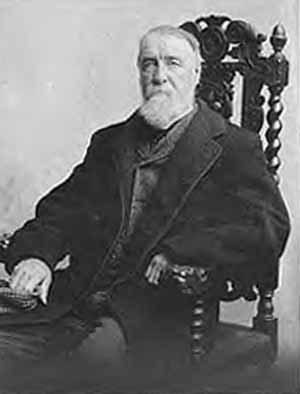
In his own letter, Spalding argued vehemently that baseball had been created by Abner Doubleday in 1839 in Cooperstown, New York. "The game of Base-Ball," he said, "is entirely of American origin, and has no relation to, or connection with, any game of any other country." On what evidence did he base his argument? On the letter of a mystery man named Abner Graves, a mining engineer from Denver, who, Spalding said, recalled Doubleday inventing the game 68 years earlier (Graves was over 80 years old when he gave his account).
CREATING HISTORY
In his report, Spalding stated that Graves "was present when Doubleday first outlined with a stick in the dirt the present diamond-shaped field Base-Ball field, including the location of the players on the field, memorandum of the rules of his new game, which he named Base-Ball."
However, none of this romantic imagery was actually in the Graves letter-no stick and no "crude pencil diagram of the rules." Spalding made the whole thing up. Nor was Graves present at the first game, as Spalding claimed. Graves stated in his letter, "I do not know, nor is it possible to know, on what spot the first games was played according to Doubleday's plan." Graves's letter simply recounted the rules of the game and how he though Doubleday "improved" an already existing game called "Town Ball". Spalding cleverly embellished and promoted the old miner's tale to make it the stuff of legends.
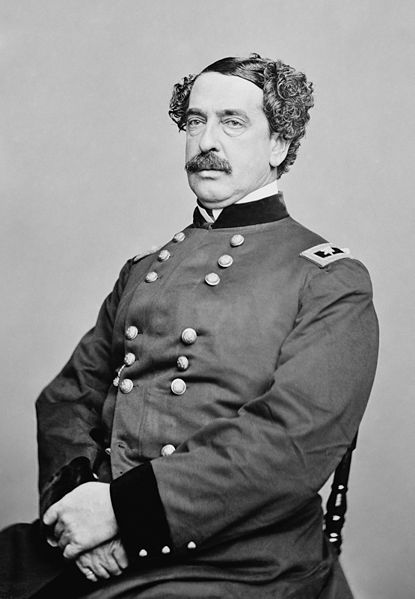
Spalding was also clever enough to know that Doubleday, a famous Civil War general, was "legend material" and would be an effective marketing tool in selling the myth. "It certainly appeals to an American's pride to have had the great national game of Base-Ball created and named by a Major General in the United States Army," wrote Spalding.
DOUBLEDAY AND BASEBALL
In fact, no record anywhere associated Doubleday with baseball before 1905. Circumstantial evidence indicates that the Baseball Hall of Fame in Cooperstown probably should be somewhere else.
*Doubleday entered West Point on September 1, 1838, and was never in Cooperstown in 1839.
*Doubleday's obituary in The New York Times on January 28, 1893, didn't mention a thing about baseball.
*Doubleday was a writer, but never wrote about the sport he supposedly invented. In a letter about his sporting life, Doubleday reminisced, "In my outdoor sports, I was addicted to topographical work, and even as a boy amused myself by making maps of the country." No mention of baseball.
Since 1988, the Bathroom Reader Institute had published a series of popular books containing irresistible bits of trivia and obscure yet fascinating facts.
Neatorama author JohnnyCat received a bit of inspiration in the form of an animated short story.
For the past few days, I’ve been seriously considering getting trained to be a wind turbine specialist. There’s a school right here in town that certifies people to go out and maintain the growing number of windmills providing renewable energy.
Looks like he's going to take the course, after watching The Windmill Farmer by Joaquin Baldwin. Link (embedded YouTube clip)
Do you pronounce "often" with the "t"? Boston Globe columnist Jan Freeman noticed that although the "t" fell silent in the 15th century, it appears to be coming back, at least among college students. It may sound pretentious, but she asks us to be kind.
Pretentious pronunciation surely exists -- I sympathize with McIntyre's aversion to "Bach uttered as if the announcer suffered from catarrh, or a Spanish name pronounced as if the studio were in the foothills of Andaluthia." But I think that in general, we're much too eager to label people dimwits or social climbers on the basis of pronunciations they probably acquired in the usual way -- by imitating the people they talk to.
More at the delightfully-named blog Throw Grammar From The Train. Link -via TYWKIWDBI
Pandemic takes the idea of audience participation to the world of social networking. The Colony is a simulated-reality Discovery Channel show that creates the scenario of a disease pandemic and we watch to see how isolated participants react to the altered world. You can join in via Facebook. The Pandemic site takes your circle of friends and puts them into that world. You can change the time line from the outbreak to the pandemic to the survival phase. I have to admit it was unnerving to read as my Facebook friends "reported" on the fictional chaos. The pandemic requires you to allow access to your Facebook data. http://thecolony.discovery.com/#fbid=5jr0YEqLhk6
They are beautiful, otherworldly, full of secrets, and can kill you. It takes bravery and special training to venture into the hydrogen sulfide atmosphere of the Bahama caves known as inland blue holes. Those who dare are looking for the chemistry of how our earth supports evolving life.
Offshore flooded caves, so-called ocean blue holes, are extensions of the sea, subject to the same heavy tides and host to many of the same species found in the surrounding waters. Inland blue holes, however, are unlike any other environment on Earth, thanks largely to their geology and water chemistry. In these flooded caves, such as Stargate on Andros Island, the reduced tidal flow results in a sharp stratification of water chemistry. A thin lens of fresh water—supplied by rainfall—lies atop a denser layer of salt water. The freshwater lens acts as a lid, isolating the salt water from atmospheric oxygen and inhibiting bacteria from causing organic matter to decay. Bacteria in the zone just below the fresh water survive by exploiting sulfate (one of the salts in the water), generating hydrogen sulfide as a by-product. Known on land as swamp or sewer gas, hydrogen sulfide in higher doses can cause delirium and death.
These strange but natural environments are threatened by both rising sea levels and people who use them for garbage dumps. Link
Stinkers was raised as a pet, and later came to live at the Alaska Wildlife Conservation Center. Do porcupines make good pets? No. Despite the puppy-like behavior, notice the handler is wearing thick leather gloves. -via Digg