The annual July 4th hot dog eating contest was held today in front of Nathan's Famous Hot Dogs in Coney Island. And once again, American Joey Chestnut defeated all the others by scarfing down 62 hot dogs.
It wasn't a personal best for the 27-year-old nicknamed Jaws, but it was enough to out-eat second-place finisher Patrick Bertoletti by nine wieners. Chestnut, of San Jose, Calif., won $10,000 and the coveted mustard-yellow belt.
"I feel great!" he said after the contest, adding that he was going to drink a lot of water and avoid hot dogs for a few days.
In a separate division for women, Sonya Thomas ate 40 hot dogs to claim the pink belt championship. Chestnut's longtime rival, Takeru Kobayashi, did not participate because he refused to sign a contract with the eating league. Link -via J-Walk Blog
Protect yourself against embarrassing photos by setting a black rectangle over your eyes -before your picture is taken- with Paparazzi Shades from the NeatoShop! Censor bars hide your identity even in real life, so your fans (and friends) can snap away while your anonymity is protected. Paparazzi Shades make a great gift, too!
An article at The New Inquiry is a conversation between a college-level philosophy teacher and a person who writes college papers for money. Much of it concerns the prevalence, ease, and mechanics of cheating on papers, whether the work is plagiarized or commissioned. But this explanation of why so many students cheat saddened me:
I think that the system, grading in general, grading as a gold standard of employability, college as the necessary step between high school and employment, all of these things alone aren’t necessarily wrong. But when you get them all together in this network, and college is going to define your future, the grades will determine where you go, one, for a fifth of you, those of you who are going to grad school or law school or med school. For the rest of you, to get that job, you need that paper that says, “Diploma,” which means you need to pass. That’s all that matters.
If the only purpose in going to college is to get a diploma (not knowledge, not an education, and not good grades), then its no wonder students assume that you should get one just for paying the tuition and arranging for the required papers by any means necessary. Link -via TYWKIWDBI, where you can join the discussion.
Who looks more patriotically American: Superman, Captain America, or Wonder Woman? Take a close look at a gallery of cosplay photographs of these and other heroes posted to celebrate the Fourth of July at Geeks Are Sexy and decide for yourself! http://www.geeksaresexy.net/2011/07/04/fun-with-cosplay-the-star-spangled-edition/
Jeremiah Warren attached a small (and tough) camera to fireworks and captured quite a few POV sequences. Some launches had the camera facing up and some were facing down. -via Cynical-C
Did you ever order Sea Monkeys from an ad in the back of a comic book? The man behind the "Bowlfull of Happiness" was Harold von Braunhut, who's life was so much more than sea monkeys.
The accounts Von Braunhut gave of his adventures in American kitsch are consistently winning. Granted, he makes some claims that a skeptic is inclined to independently confirm. At some point in the years after he raced motorcycles as The Green Hornet, von Braunhut worked as a talent agent of sorts. He tells Planet X about a stunt performer he used to manage—the article has von Braunhut calling him “a fella by the name of Henry Lamore”—who would dive from a height of 40 feet into a kiddie pool filled with 12 inches of water. I began to lose faith while trying to verify this doozy, but it turns out that the Internet allows you to watch a man named Henri LaMothe still pulling off this feat at 71 years old, as an opening act for Evel Knievel.
As anyone sold by the Sea-Monkey ads could tell you, it was hard to say exactly where von Braunhut was walking on the terrain between truth, embellishment and con. That was his gift. He convinced us to look at the jazz hands and lose sight of the footwork. Von Braunhut’s inventions were not quite what they seemed to be. Neither was he.
Von Braunhut was best known for his Sea Monkeys, but it was only one of his 195 patents. Even more unusual was his association with the Aryan Nation. Link -via Nag on the Lake
by Annalee Newitz Editor, io9 San Francisco, California Chart by Stephanie Fox. Additional reporting by Katharine Duckett.
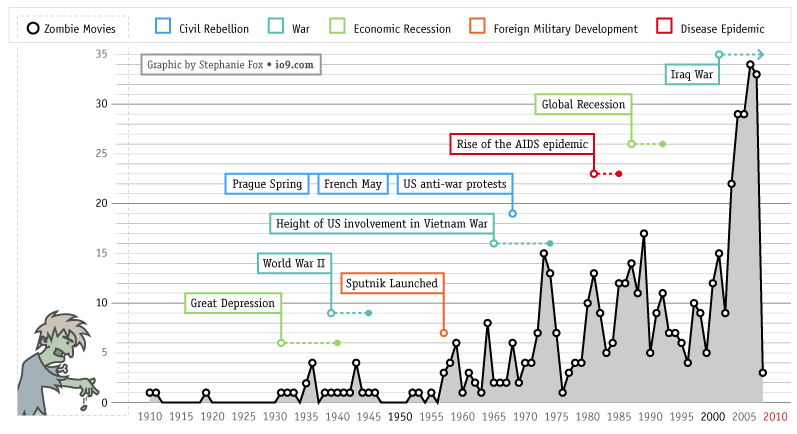
There’s been a huge spike in the production of zombie movies lately, and many of them seem to be inspired by war. Everything from 28 Days Later... to Zombie Strippers makes explicit reference to wartime, as did seminal 1968 zombie flick Night of the Living Dead. Is there really a connection between zombie movies and social unrest? We decided to do some research and find out. The result is a line graph showing the number of zombie movies coming out in the West each year since 1910, and there are definite spikes during certain years, which always seem to happen eerily close to historical events involving war or social upheaval.
Mostly we’ve focused on movies from the U.S. and Europe, and we’ve included mummies but not vampires and ghosts. It’s necessary to correct somewhat for the fact that more movies are being made as we get closer to the present, and (more importantly) there are better records of those movies with better tagging. So it’s easier to research movies with zombies in them if you’re looking at productions from the 1980s onward. In addition, there’s been a huge boom in indie and low-budget horror movies over the past ten years, and that undoubtedly accounts somewhat for the giant spike you see during the last 8 years or so.
Click image to enlarge.
If you’re going to look at these historical correlations, you have to consider that movies inspired by a real-life event aren’t going to show up in theaters for at least six months to a year, so we’ve accounted for that. Still, even correcting for these factors, there are distinctive spikes in zombie popularity, and they always seem to fall slightly after a huge political or social event has caused mass fear, chaos, or suffering. World War II, Vietnam, and the current Iraq War are all followed by a zombie rush at theaters, as are other periods of trauma such as the AIDS epidemic. Is there a causal connection, or is it just coincidence? You be the judge.
A smiley-face is very expressive, statistically. By tweaking the eyes, mouth and other bits, you can literally put a meaningful face on any jumble of numbers. Herman Chernoff pointed this out in 1973 in the Journal of the American Statistical Association, in a monograph called “The Use of Faces to Represent Points in K-Dimensional Space Graphically.”
Subsequently, folks took to calling these things Chernoff faces. Chernoff faces can make statistical analysis into a recognizably human activity.
Most people, when shown some statistics, sigh and get boggled. But Herman Chernoff realized that almost everyone is good at reading faces. So he devised recipes to convert any set of statistics into an equivalent bunch of smiley-face drawings.
Each data point, he wrote, “is represented by a cartoon of a face whose features, such as length of nose and curvature of mouth, correspond to components of the point. Thus every multivariate observation is visualized as a computer-drawn face. This presentation makes it easy for the human mind to grasp many of the essential regularities and irregularities present in the data.”
“The Use of Faces to Represent Points in K-Dimensional Space Graphically” is one of the few statistics papers that is visually goofy, rather than arid.
One page is filled with 87 cartoon faces, each slightly different. Some faces have little beady eyes, others have big, startled-wideawake peepers. There are wide mouths, little dried-up “I’m not here, don’t notice me” mouths, and middling mouths. Another page shows off some of the cartoony variety that’s possible: roundish simpleton heads, jowly alien-visitor heads, and a smattering of noggins that look froggy. Elsewhere, the study perhaps inevitably includes conventional statistics machinery — charts of numbers, differential and intergral calculus equations, and plenty of technical lingo.
Chernoff discovered, by experiment, that people could comfortably interpret a face that expresses quite large amounts of data. “At this point,” he wrote, “one can treat up to 18 variables, but it would be relatively easy to increase that number by adding other features such as ears, hair, [and] facial lines.”
Chernoff faces made from data gathered by measuring rocks, and presented in Chernoff’s original paper in the Journal of the American Statistical Association. The paper explains that “Eight measurements were made on each of 88 nummulited specimens from the Eocene Yellow Limestone Formation of northwestern Jamaica.
The world has gone on to employ Chernoff faces a little, but not yet a lot. A 1981 report in the Journal of Marketing, for example, used them to display corporate financial data, with this explanation: “From Year 5 to Year 1, the nose narrows as well as increases in length, and the eccentricity of the eyes increases. Respectively, these facial features represent a decrease in total assets, an increase in the ratio of retained earnings to total assets, and an increase in cash flow.”
A note at the very end of Chernoff’s 1973 paper hints at a practical reason why his idea would not catch on immediately: “At this time the cost of drawing these faces is about 20 to 25 cents per face on the IBM 360-67 at Stanford University using the Calcomp Plotter. Most of this cost is in the computing, and I believe that it should be possible to reduce it considerably.” Chernoff faces representing data about a series of Swiss bank notes, some real, some forged, from Bernhard Flury and Hans Riedwyl,’s 1981 study in the Journal of the American Statistical Association. The main variables are: Xl length of the bank note X2 width of the bank note, measured on the left side X3 width of the bank note, measured on the right side X4 width of the lower margin X5 width of the upper margin X6 length of the print diagonal from the lower left to the upper right corner
“Use of Chernoff Faces to Follow Trends in Laboratory Data,” John A. Lott and Timothy C. Durbridge, Journal of Clinical Laboratory Analysis, 1990, pp. 459-63. The authors are at Ohio State University in the USA and the Institute of Medical and Veterinary Sciences in Adelaide, Australia.
This article is republished with permission from the July-August 2010 issue of the Annals of Improbable Research. You can download or purchase back issues of the magazine, or subscribe to receive future issues. Or get a subscription for someone as a gift!
Visit their website for more research that makes people LAUGH and then THINK.
For those times when you feel the need for emergency art, there's the Inflatable Van Gogh in a can, now available at the NeatoShop. It's Van Gogh's most famous work, Starry Night, that can be inflated to hanging size or stored in its full-color illustrated tin. Never be caught short on art again! Add some class to your condo or cubicle with this Inflatable Van Gogh painting! Each 19-1/4" x 15-3/4", vinyl masterpiece is a stunning example of high concept kitsch for the cultured cosmopolitan. Makes a great gift!
Anyone who says one person can't make a difference has never heard the story of the Statue of Liberty.
BIRTHDAY GIRL
In 1865 a young French sculptor named Frédéric-Auguste Bartholdi went to a banquet near the town of Versailles, where he struck up a conversation with Edward de Laboulaye, a prominent historian.
De Laboulaye, a great admirer of the United States, observed that the country's centennial was approaching in 1876. He thought it would be a good idea for France to present America with a gift to commemorate the occasion. But what? Bertholdi proposed a giant statue of some kind... and thought about it for the next six years.
COMING TO AMERICA
By 1871 Bartholdi had most of the details worked out in his mind: The American monument would be a colossal statue of a woman called "Liberty Enlightening the World." It would be paid for by the French people, and the pedestal it stood on would be financed and built by Americans.
The idea excited him so much that he booked passage on a ship and sailed to New York to drum up support for it. As he entered New York Harbor, Bartholdi noticed a small, 12-acre piece of land near Ellis Island, called Bedloe's Island. He decided it was the perfect spot for his statue.
Bartholdi spent the next five months traveling around the U.S. and getting support for the statue. Then he went back to France, where the government of Emperor Napoléon III (Napoléon Bonaparte's nephew) was openly hostile to the democratic and republican ideals celebrated by the Statue of Liberty. They would have jailed him if he had spoken of the project openly- so Bartholdi kept a low profile until 1874, when the Third Republic was proclaimed after Napoléon III's defeat in the Franco-Prussian War.
Bartholdi went back to work. He founded a group called the Franco-American Union, comprised of French and American supporters, to help raise money for the statue. He also recruited Alexander-Gustave Eiffel, soon to become famous for the Eiffel Tower, to design the steel and iron framework to hold the statue up.
A WOMAN IN A HURRY
By now the centennial was only two years away. It was obvious that the huge statue couldn't be designed, financed, built, shipped, and installed on Bedloe's Island in time for the big celebration. But Bartholdi kept going anyway.
Raising the $400,000 he estimated was needed to build the statue in France wasn't easy. Work stopped frequently when cash ran out, and Bartholdi and his craftspeople missed deadline after deadline. Then in 1880 the Franco-American Union came up with the idea of holding a "Liberty" lottery to raise funds. That did the trick.
In the United States, things were harder. There was some enthusiasm, but not as much as in France. It was, after all, a French statue ...and not everyone was sure the country needed a French statue, even for free. The U.S. Congress did vote unanimously to accept the gift from France... but it didn't provide any funding for the pedestal, and neither did the city of New York. Neither did the state.
Kids these days don't know what hazardous fireworks are... why, back in my day, when we walked six miles to school uphill both ways, fireworks were dangerous. I mean real dangerous, like the M80s we used to by all the time. How dangerous were they?
Federal law now caps the flash powder content of firecrackers at 50mg per firework. Typical M-80s contained somewhere in the neighborhood of 3,000mg of powder apiece, or roughly 60 times as much explosive. (This power makes sense given the M-80’s original purpose: simulating the sound of gunfire and artillery during military training missions.)
Read about how these changes came about at mental_floss. Link
Jeff Wysaski at Pleated Jeans put together 13 scenarios in which we are most likely to do or say something extremely dumb. Have you ever said, "You, too!" after someone wishes you a happy birthday? I have. Link