
Language is a funny thing. It changes over time, and the exact meaning of a word can drift to become more broad or more specific, or something else completely. That confusion can spill over into a courtroom, when the exact wording of a law is debated. Does a more modern interpretation of those words change the intention of those who originally passed the law? And how do we determine exact meanings- by the current dictionary, the generally-understood meaning at the time the law was written, or how the wording of the law is understood today? It depends on how you look at it, or even more importantly, who looks at it. Dr. Erica Brozovsky (previously at Neatorama) breaks down the legal battle over words, and bfings us some court cases where a definition made all the difference. All I could think of while watching this is a quote: "It depends on what the definition of 'is' is."
Miss Cellania's Blog Posts

The American colonists who fought against Britain for independence had help from other countries, mostly notably France, but others as well. The British Empire had plenty of enemies, and people all over liked the idea of fighting for freedom. One of those helpers was a small group of Jewish settlers on an island in the Caribbean.
St. Eustatius is now more often called Statia, and it's a part of the Caribbean Netherlands, along with the islands of Bonaire and Saba. In the 18th century, up to 40% of the thousand or so residents of St. Eustatius were Jewish refugees who had found safe haven in the Netherlands and continued on to settle in the New World. Some of them built a lucrative trade network with both Europe and the American colonies, which included smuggling gunpowder to the Continental Army. The British were so upset that they raided St. Eustatius, looted the Jewish community of its wealth, and confiscated all the adult men they could find to send them into exile without their families. Now a new history exhibit is hoping to bring light to this forgotten chapter of American history. Read about the Jewish smugglers who aided the patriots at Smithsonian.
(Image credit: Jrryjude)
The Shiki Theater Company is the biggest such company in Japan, and they have a longstanding partnership with Disney. Beginning in August they will stage the musical The Little Mermaid at the Maihama Amphitheater in Maihama, near Tokyo. This preview video has sparked a lot of interest, even though the actual production is still months away. Rina Tachibana stars as Ariel. She has a lovely voice (crucial for the plot, I know) and belts out "Part of Your World" that sounds very much like the movie version, except it's in Japanese. But how does she do it while floating through the water? And how do they make swimming underwater look so effortless onstage? For that matter, how are they going to pull this off in an amphitheater? During the song, we also get glimpses of other scenes from The Little Mermaid, such as Ariel trying out her new legs. -via Kuriositas
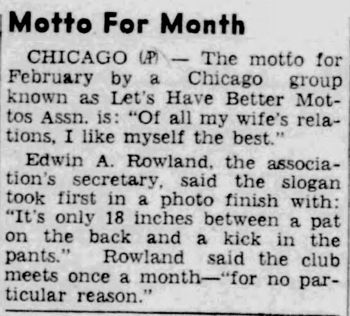
The Let’s Have Better Mottoes Association was the brainchild of Cleveland circus musician and advertising man Frederick E. Gymer, although he usually stayed in the club's background, with the permanent rank of executive secretary. Formed in 1950, the association awarded a monthly prize for the best new motto, for anything, which was the title of club president for the month. The group, founded in 1950, was pretty popular and had quite a few chapters around the country until Gymer died in 1962, after which it petered out. But during its heyday, the club got all the newspaper publicity it wanted, since the mottoes they came up with were so funny, in a 1950s kind of way.
In case of fire, yell "Fire!"
The More You Explain It, The More I Don't Understand.
I'd Like To Compliment You On Your Work. When Will You Start?
You're doing a good job, but you're doing it all wrong.
We Don't Want 'Yes Men' Around Here — Everybody Agree?
And my personal favorite:
Do It Rihgt.
See newspaper clippings from the association and more mottoes at Weird Universe.
(Image credit: Daytona Beach News-Journal - Feb 4, 1955)
Most Americans aren't aware of how different toilets in Britain are, even those who have traveled to the UK. Oh yeah, there are places you have to pay to use them, but at least they are available. Laurence Brown, with years of experience living on both sides of the pond, is very aware of how our toilets are different. And our sinks and bathtubs, for that matter. The toilets actually use different mechanisms for flushing. He doesn't mention which system uses more water, but that's not really a concern in Britain, which is geographically consistent and it rains all the time. Now that I'm in the know for watching this, it's my opinion that American toilets are superior, with the exception of having to plunge or snake them occasionally, which is honestly not often enough to be a bother (your mileage may vary). American sinks and tubs seem to be better as well.
It's somewhat amusing to hear how he talks about toilet efficiency without using any rude words. There's a skippable ad from 2:55 to 4:10.
When you think of musicians who were in the US military, you think of Elvis Presley and Glenn Miller, who were both quite well known before joining up. Miller volunteered during World War II and Presley was drafted in 1958. But there were other big names who served before we knew who they were.
Their military careers varied. One credits his navy training in logistics for his ability to later organize concert tours. One was a Morse code expert who intercepted Russian transmissions. Another got his start in the business by singing with an army band as his official duty. One gave up an opportunity to teach at West Point in order to pursue a music career. And two of them were victims of the "enlist or go to jail" scheme that judges once used for young offenders. Neither lasted out their full hitch. Find out which successful musician is matched with each of those stories at Mental Floss.
History is long and history classes are short, so what you learn about the movers and shakers of the past are only the highlights. You know, what they did that affected the world of today. But every person has a backstory that doesn't get covered as well, and some of them can be pretty wacky. Chill Dude Explains gives us the details that you would never learn unless you did extra reading outside of class.
I knew most of these stories, because I've been here at Neatorama for 20 years. You may have read them, too, but if you didn't and and you find yourself interested in learning more, you can put any of these names into the search bar at the top right and read about them. Yet there are always more details. Who knew that Abraham Lincoln loved to tell dirty jokes, and that Harriet Tubman suffered from narcolepsy? Neither fact changes their great accomplishments, but you might change your opinion on some of the others in this list.
The modern way to grab a TV audience is to launch a reality game show in which we get to know the contestants and a winner is only crowned at the end of the season. A modern way to gamble is to place bets on Kalshi or Polymarket on what will happen. But those bets affect the odds, and the odds are made public. The 50th season of the reality game show Survivor (titled Survivor 50: In the Hands of the Fans) ended on May 20th with Aubry Bracco as the winner. But the show was filmed months earlier. Six weeks before the February premier, prediction markets had Bracco's odds of winning at 61%. Just before the winner was announced, her odds stood at 97%.
Both betting platforms ban insider knowledge, but there are plenty of ways around that. Survivor isn't the only reality show the markets have spoiled, either. Betting on the outcome had produced spoilers for Next Level Chef, The Bachelorette, and The Masked Singer. You may care little about reality TV game shows, but you also have to consider the affect of insider knowledge on betting markets as they pertain to business ventures, politics, and national security as well. Read about what betting markets are doing to TV at Variety. -via Metafilter
Almost all animal babies emerge from their mother or from an egg able to do the things that its species is expected to do. Mammals feed their young for a time, but even kittens and puppies can walk around on their own at about two weeks of age. Then there are humans, who are spectacularly helpless for a very long time. They can't walk, talk, eat, or control elimination for a couple of years, and even then they need guidance and protection. Why do we have such an extended infancy?
In one version of the story, Eve ate the fruit of the tree of the knowledge of good and evil, and was cursed to bear big-brained babies in pain. That's not far from the science version, because humans have enormous brains for their body size, and we had to offload a lot of that brain growing to after birth. Not all of it, of course, as anyone who has given birth will tell you. Human mothers wouldn't survive much more baby brain size. That equates to humans being born relatively premature compared to other animals. Getting a child to maturity is quite a chore, but it also has its upsides, as this video from The Thought Vortex explains.

Amusing Planet looks at two very different counterfeiters this month, with unusual stories that earned them notoriety and represent two ends of the spectrum. Both were unassuming immigrants from the former Austro-Hungarian empire. Over in this corner, we have Emerich Juettner, an elderly man who lived alone in a basement in New York City. He spent ten years passing fake bills and led the US Secret Service on the longest and most expensive counterfeit investigation in their history. He was no criminal mastermind. Juettner's bills were poorly manufactured, with inferior paper, hand-painted details, and sometimes even contained spelling errors. The reason he was able to evade the law for so long was because he only printed one dollar bills! People aren't in the habit of examining ones, so the fake money passed through many hands before they were noticed. After Juettner served his time, he made more money from a movie about his crimes than he ever did by counterfeiting.
On the other end of the spectrum we have Czesław Bojarski, who was not only a counterfeiter, but an artist. Bojarski fled to France during World War II and fought for the underground Polish army. He stayed in Paris after the war, and turned to counterfeiting to support his family. His work was exquisite, and very hard to detect. Bojarski specialized in the 100-franc Bonaparte note, shown above, and traveled far and wide to cover his tracks when passing them. Like Juettner, it took authorities more than a decade of investigation to find Bojarski, who was by then known as "the Cézanne of counterfeiters." Today, his counterfeit Bonaparte notes go for thousands of euros to collectors.
(Image credit: Banque de France)
Meet Flaco, Blasco Paterno Castello, Mael Bovey, Jordy, Andrea de Angelis, and Keti Vasadze. These guys are members of the Buldoz Project Crew, Swiss skiers who do "snowless skiing." Oh yeah, they ski on snow, but also down snowless hills, streams, stairs, and any other incline they can find. You may have heard of dry slope skiing, which is done on prepared slopes with artificial surfaces that mimic snow, great for off-season practice, but this is a whole different level. Buldoz goes to places where skates, skateboards, and bicycles are prohibited, but the signs don't say anything about skis because who in their right mind would try it? Yes, they injure themselves. This is a hardcore sport.
Oh, and before you complain about too much music and not enough information, you should be aware that this is a music video from The Foo Fighters. The song is "Of All People," from their new album Your Favorite Toy. -via the Awesomer
With recent outbreaks of hantavirus and Ebola virus, and the continuing trauma of COVID, the last thing we need is a another disease to worry about. You need not worry about encephalitis lethargica, because it appears to have come and gone already. In fact, the last known person to have survived the disease died in 2002. However, between 1917 and 1930, it was terrifying.
People started suffering from a mysterious constellation of symptoms, ranging from tremors to fatigue to drooling. Many slept for days at a time or became paralyzed with locked-in syndrome, in which there's complete awareness, but the body cannot respond. Doctors figured out encephalitis lethargica was based in the brain, hence the name. But they never figured out what caused it. The disease infected around a million people across Europe and Northern America. Half of those who suffered from it died, and many of the survivors had lingering effects, or declined mentally or physically from a resurgence many years later. Read about the mysterious epidemic of encephalitis lethargica at Mental Floss. -via Strange Company
What do kids say when you ask them what they want to be when they grow up? When I saw the premise of this video, I immediately thought "Astronaut! President!" This reflects the historical era I grew up in, and I well remember being set straight that girls cannot be either. But this graphic video covers children ages 8-12 from 1920 through 2026, and things change. It begins with "cowboy" being the most popular answer, and reflects what children are exposed to over time. Watch how fast "pilot" ascends to the top early on. World War II promotes "soldier." "Astronaut" debuts in 1958 and quickly becomes the go-to profession, although "spy" is pretty popular during the Cold War. "Pro Athlete" takes the top as the Apollo program ends. "Programmer" debuts in 1985. "Dinosaur Expert" hits the list in 1992, a year before Jurassic Park, but the same year that PBS's miniseries The Dinosaurs! aired. "YouTuber" joined in 2007, only two years after the platform launched, and became the real aspiration for children going forward.
Pay attention to what's simmering under the top. "Nurse" and "teacher" were consistently on the list until the 1970s, because little girls assumed those were the only professions open to them. I'm surprised "movie star" stayed so low throughout the period. Also keep in mind that the very question assumes that a grownup will be defined by their job, which is a very American thing. -via Born in Space

Warner Bros. animation and Tubi have announced a new project, in which Scooby-Doo goes anime. The series will be called Yokoso Scooby-Doo!, which means Welcome, Scooby-Doo. The premise is that Shaggy and Scooby go to Japan for some kind of food event, and accidentally unleash a pantheon of Japanese ghosts and folklore monsters. Fred, Daphne, and Velma will not be a part of the story, but Shaggy and Scooby find new friends like gadget whiz Takumi, magical pixie dream girl Yume, and Scooby's uncle Daisuke-Doo. And they have the Mystery Machine, too!
Lending credence to the legitimacy of the project, actors Frank Welker (the longtime voice of Scooby-Doo) and Matthew Lillard (who played Shaggy in the films) are signed to voice the main characters. The one available image gives hope that the anime will reproduce the joyful nonsense of the original series. The series is slated to become available in 2027. Read more about Yokoso Scooby-Doo! at Cracked.
Miska is a snow leopard living at the Melbourne Zoo. In January, she gave birth to a litter of four cubs, two males and two females. When she decided the cubs were old enough to leave the nursery and go outside, zoo videographers were there to record the cuteness. The chubby, fluffy cubs tried running, jumping, and playing in the big new world as best as their little legs could, while Miska kept an eye on them just in case they needed help. This milestone was also the right time for the cubs to get their first veterinary check, in which they were weighed, vaccinated, and thoroughly examined. They all seem quite healthy, if a bit confused. One stood out as being extra spicy over the indignity.
If you want to see them being born, you'll find that video at Laughing Squid. The cubs have since grown more agile and willing to pounce on each other -and their mom- as you can see at Facebook.