
It's only natural to be horrified at the idea of being buried alive. Yet at one time, like flagpole sitting or dance marathons, it was a competition for publicity and bragging rights. The fad reached its peak in the 1960s. Although the stunt was not new, earlier attempts at the record amount of time spent underground were not well documented, so spending the longest time buried was a challenge.
On February 21, 1968, 33-year-old Irish laborer Mike Meaney had himself buried in Kilborn, England. He was trying to go for the record set by Bill White of Texas, who had emerged after being buried for 55 days. But Meaney did not know that White was also being buried again at the same time, trying to top his own record. The stunts therefore became a real-time competition for who could stay buried the longest.
An article at Mental Floss has the details of Meaney's burial, including the particulars of his life-sustaining coffin, the history of the fad of premature burial, and a video of the public celebration when Meaney returned from the grave. -via Strange Company
Miss Cellania's Blog Posts
Cincinnati Animal CARE, the shelter in Cincinnati which also serves as animal control, was called out in late January to get a cat out of a tree. The police probably should have been more specific, so the animal warden could have brought more deputies and more equipment. The 30+ pound cat in the tree was an African serval, and did not want to be captured. The serval had jumped out of a car as police were arresting the driver, and climbed the first tree he saw.
The dog warden eventually managed to get the cat out of the tree, but the serval's leg was broken during the struggle. The serval, named Amiry, was taken to Cincinnati Animal CARE's medical department, where his leg was set. A DNA sample was taken along with a toxicology test, which came back positive for cocaine! The DNA test confirmed that Amiry is indeed a serval, and not a Savannah cat. It is illegal to own a serval in Ohio, while a Savannah cat (which is produced by crossing a serval with a domestic cat) is okay. The serval's owner has been cooperative. He has relinquished ownership of the cat to authorities, and has been paying for Amiry's medical care.
Amiry has since been transferred to the Cincinnati Zoo, where he has been under the supervision of the zoo's medical staff. -via reddit
For the first time, scientists have been able to create a mouse egg cell from a male skin cell. A team led by Katsuhiko Hayashi of Kyushu University in Japan cultivated male mouse skin cells and programmed them to revert to a state resembling a stem cell. They replaced the Y chromosome with a second X chromosome from the same individual, and prompted them to grow into egg cells. With egg cells produced by a male, fertilized by another male, they implanted 600 embryos into female mice, which resulted in seven live pups born with two biological fathers. These mice were healthy, grew normally, and eventually produced offspring of their own.
The process for doing this with human cells is much more complicated, but if it ever succeeds, it could be a boon to people suffering from infertility. The research was prompted by the plight of women with Turner's syndrome, in which one X chromosome is incomplete or missing. Read more about the mice with two fathers at the Guardian. -via Damn Interesting
(Image credit: Rama)
We thought we had reached peak disaster movie insanity with Sharknado, but we were wrong, because Cocaine Bear is out in theaters now. Never mind that Cocaine Bear was inspired by a true story; that just goes to show that truth is stranger than fiction. But if you want to go one better, how about combining them into a film named Cocaine Shark? Wild Eye Releasing went for it, with a story that involves a drug lord, a science lab, experimental animals, and an explosion. What could possibly go wrong? The answer is a cocaine-fueled mutant shark on the loose, with a beach full of unknowing potential victims. Sadly, Cocaine Shark is not coming soon to a theater near you. At least until someone in Hollywood sees this faux trailer, then all bets are off. -via Geeks Are Sexy
Next up: Bubblegum from the moon is our only defense against a mutant cocaine shark.
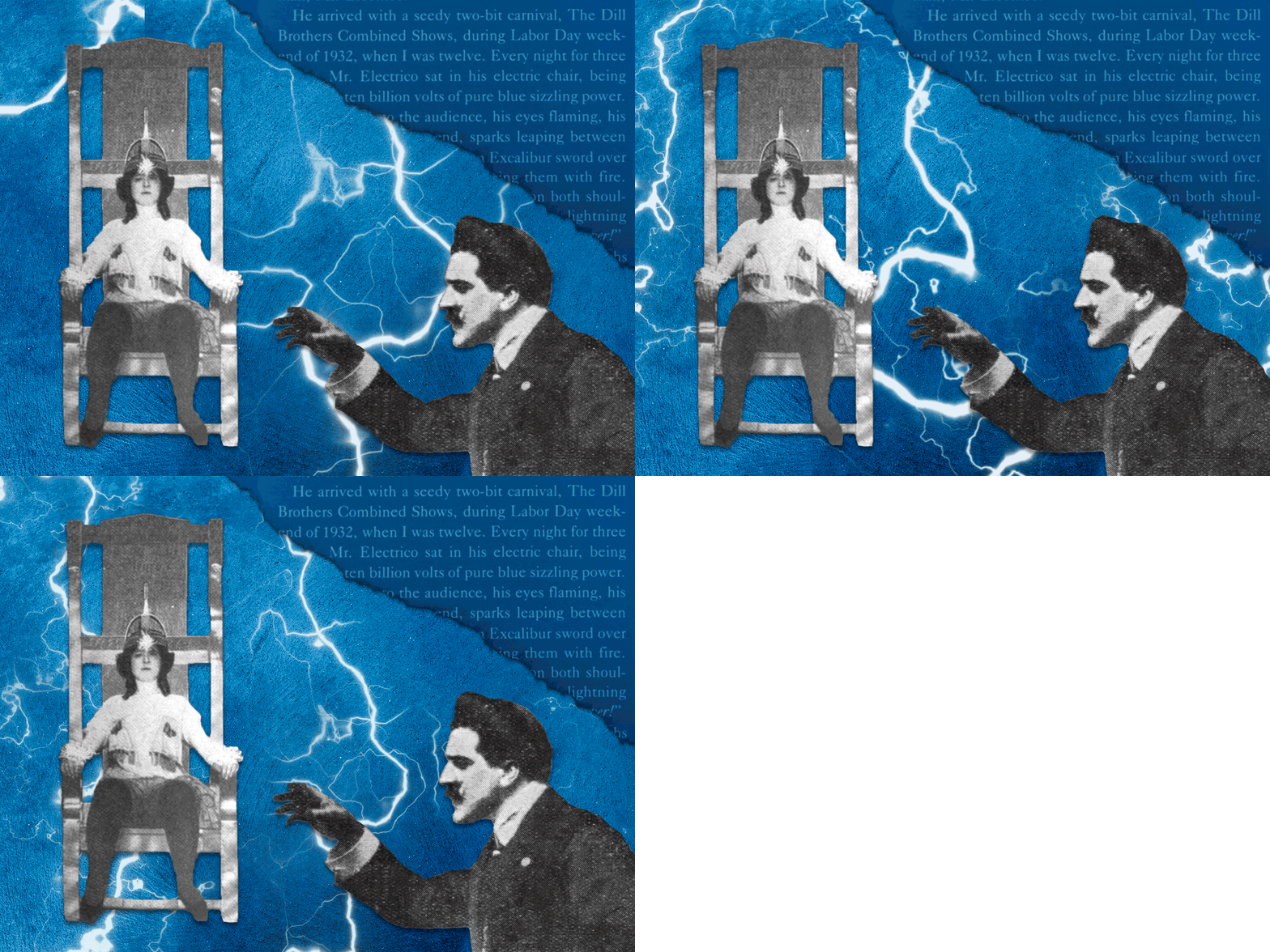
Acclaimed science fiction author Ray Bradbury often recounted an event from his childhood that set him on a lifelong path of writing stories. In 1932, 12-year-old Bradbury saw a magician named Mr. Electrico performing amazing feats of electrical manipulation at a circus sideshow. The showman declared the boy immortal and so impressed Bradbury that he went back for a second performance a couple of days later and met the magician. The experience was so profound for Bradbury that he recounted it over and over after he had achieved fame for his books and short stories. He even made Mr. Electrico a character in his 1962 novel Something Wicked This Way Comes.
But although Bradbury had plenty of details about the encounter with Mr. Electrico, some details tended to change, and didn't quite match up with the historical timeline. Researchers and Bradbury fans have tried to track down Mr. Electrico or the circus he accompanied and came up empty-handed. There were plenty of shows featuring the magic of electricity, which was still fairly new in the early 20th century, but no one has pinned down Bradbury's Mr. Electrico. Read about Bradbury's memories and the search for the real thing at Smithsonian.
(Illustration credit: Meilan Solly)
Strange, mysterious, spherical UFOs have invaded earth's atmosphere. The powers that be tell us they are weather balloons, or spy balloons, or just balloons launched from earth by hobbyists. But what if they were launched by an alien civilization? Maybe from a station on the moon? If the first ones were just spying on us, what happens when the real weapons are launched? A new short from Fabrice Mathieu (previously at Neatorama) leaves a lot to the imagination, so my theory is that the lunar aliens are chewing bubble gum, and they are far from being out of bubble gum! -Thanks, Fabrice!
In the hit HBO series The Last of Us, the world is devastated by the parasitic Cordyceps fungus, which infected flour and has mutated to turn humans into zombies. The genus Cordyceps really does turn its host into zombies, but only attacks insects. Does that means we are safe from fungus in our pancakes? Well, yes and no.
There are many funguses (or fungi for Latin readers) that will infect crops of wheat or other grains. Some can make people very sick, either from the fungus itself or from the toxins that the fungus produces. The most familiar of these is ergot, which infects rye and may have produced hallucinations that contributed to a outbreak of "witchcraft" in Salem, Massachusetts, in 1692.
Wheat producers go to great lengths to fight fungus in our food, but there is always a chance that dry flour contains some fungus. The good news is that it is destroyed when that flour is cooked. The bad news is that fungus can still infect food after it is cooked. Read the real story of fungal infections in flour at The Conversation. -via Geeks Are Sexy
An ancient city at the mouth of a mighty river was the recipient of untold wealth due to the shipping trade, but changing conditions along the coastline left it sunken under water. This is the story of the lost Egyptian city of Thonis, also called Heracleion. Once thought to be a myth, it was found exactly where it always was, except underwater in the Mediterranean Sea. The stories of Heracleion involve both real people (Cleopatra) and mythological characters (Helen of Troy), but no trace of the city was seen for a thousand years. Heracleion's ruins are filled with expensive artifacts, leading experts to believe the disappearance of the city was relatively sudden, or else those treasures would have been moved. The upshot is that you can build flimsy structures or sturdy stone structures, but if your foundation is on the sandy coastline, you're at the mercy of the sea. New Orleans, are you taking notes? -via Digg
PS: Don't let the video title "Filthy Secrets" deter you from watching. There's nothing filthy in the video.
To people who have never eaten fermented meat, the traditional Inughuit dish kiviaq may seem disgusting and possibly dangerous. But the people of northern Greenland have perfected the process of making kiviaq over thousands of years, and enjoy the flavorful fermented bird meat. The fact that kiviaq has been publicized as a disgusting food is a sore spot for the Inughuit, and the tendency for younger generations to prefer imported food supplies means that traditional preparation methods are in danger of dying out. Kiviaq is made by
...packing 300 to 500 whole dovekies—beaks, feathers, and all—into the hollowed-out carcass of a seal, snitching it up and sealing it with fat, then burying it under rocks for a few months to ferment. Once it’s dug up and opened, people skin and eat the birds one at a time.
This method of fermenting came about because dovekies (also known as little auks) are seasonal. In late spring, millions of birds come to Greenland to nest. They are so thick you can catch them by swinging a net through the air. This bounty of edible game had to be preserved for leaner times, so kiviaq was developed to meet that need. Read about the traditional art of making kiviaq and the people who want to preserve the dish at Atlas Obscura.
(Image credit: AWeith)
There are ten movies nominated for the Best Picture Oscar at the Academy Awards this Sunday. But you have probably seen two or maybe three of them at most. It's possible you haven't even heard of most of them! Screen Junkies knows that, and so every year they compile an Honest Trailer to let us in on what all the fuss is about for the ten nominated films. They haven't done Honest Trailers for any of these movies except for Elvis, because, uh, no one requested them (they tell us Avatar 2 is being edited now). Best Picture nominees are expensive art films that are "good," by most metrics, but we, the audience, mainly watch movies so we can escape the real world and feel good for a couple of hours. But you might get to know at least one film in this video that you'd like to see in its entirety.
This Sunday, the Academy of Motion Picture Arts and Sciences will present its 95th annual awards to the movies of the previous year. While Hollywood is excited, the nationwide ratings for the Oscar awards show have been declining for years now. The show is too long, scheduled for four hours but often running five, so even avid movie fans tend to skip watching it live.
The problem is that the producers are working with obsolete concepts of drawing a television audience: keep them tuned in, and keep them waiting. In the 20th century, the audience had no choice. If you wanted to see how many awards your favorite movie won, you had to sit through production numbers, technical awards, and stand-up routines. With the internet, you can get notifications for the parts you really care for. Yet movie fans all have different parts they care about.
The Ringer proposes a plan to bring viewers back to the Oscar ceremony by breaking the telecast into three parts aimed at different kinds of movie fans. It sounds ingenious. On its face, the plan appears to be sacrificing a captive four-hour audience, but those viewers are already gone. It could bring back many of those viewers, albeit for shorter segments. The reasoning behind each part of the new plan is explained in detail, and it might just work. The sad part is that this plan is not only too late for the ceremony coming up March 12, but also that it was not proposed by the Academy itself. -via Digg
You can often tell where someone is from by the way they pronounce the letter "r." Bostonians and the British don't pronounce it at all when it's in a word, but sometimes tack one on the end of a word when you least expect it. But some linguists say that under some circumstances, "r" can be a vowel. That theory won't change our spelling, and probably won't change any pronunciation. We won't soon be seeing bird spelled "brd," even though we do see it spelled "birb" quite a bit these days. The series Storied from PBS explains the different ways different languages and cultures use "r" and how it could be considered a vowel, under the strange standards of linguistics. -via Geeks Are Sexy
Illness and disease were once inescapable parts of life before germ theory, antibiotics, and vaccines. People did what they could to avoid diseases, but sometimes just had to work around them. That affected clothing and fashion styles. When just enough men discovered that wearing a codpiece protected their junk while undergoing the useless syphilis treatments of the 16th century, the look caught on with the general public. But their hair still fell out, which led to powdered wigs, which had an upside in that they attracted lice away from the rest of their bodies. Are you keeping up?
Tuberculosis, syphilis, and smallpox were not easy subjects to talk about, but they were all too common once upon a time. Read about five bygone fashion trends that were instigated by people either trying to prevent these diseases or trying to live with them, whether their fashion followers knew it or not, at Cracked.
(Image credit: Wellcome Images)
When you drape a big city over a group of mountains, you end up with a lot of stairs, hairpin streets, and workarounds. Wellington, New Zealand, is such a city. Public transport is offered by cable cars, which lift people uphill and then downhill like in San Francisco. But there are also around 100 private cable cars that people install just to reach their house! While that may seem extravagant, it will come in handy when you buy a new table, or break your leg, or come home drunk, or want to invite Grandma to visit, or when you're just too tired to climb many flights of stairs to get home. And if you want to stay in your Wellington hillside home through your advanced years, a private cable car, or "inclinator," makes a lot of sense. Tom Scott shows us how these private cable cars work in Wellington.
Where I live, there are a lot of houses that cling to the sides of mountains, too, but they are spread out enough that we can build access roads and bridges to reach them. I can tell you from experience that some of those roads out in the middle of nowhere are terrifying.
The 1939 film Gone With the Wind was a sweeping epic soap opera about one Georgia woman's life during the Civil War, based on the best-selling novel by Margaret Mitchell. The finished product featured big Hollywood stars and beautiful cinematography, won eight Academy Awards, and was the top movie of all time for 30 years. But putting that story in its historical backdrop was a struggle behind the scenes. Director David O. Selznick went through a dozen script writers, and working scripts were changed constantly.
The script writers were divided into two camps: The "Romantics" who wanted to depict the South as a genteel and honorable place where enslaved people were happy, and the "Realists" who were keen to show an accurate depiction of the brutality and dehumanization of slavery. The Romantics won out, and the movie projected a whitewashed version of the Confederacy that pleased white audiences in Atlanta but gave generations of viewers a distorted idea of the Civil War era South. The movie was shaped by many scenes that were written and some even filmed, but were then discarded. Evidence of the battle between the Romantics and the Realists remain in surviving working copies of the script, with notes from Selznick and others, that the director had ordered destroyed.
Read about the script decisions that shaped Gone With the Wind and the scenes that never made it into the film at The Ankler. Then imagine the same film with the deleted scenes retained. It would have been six hours long, but it would have told a more complete story. -via Mental Floss