
Miss Cellania's Blog Posts

15 Things You Probably Didn’t Know About Fast Times at Ridgemont High

The film Fast Times at Ridgemont High inspired dozens of teen comedies that came after and launched the careers of a whole slew of now-famous actors. Even if it’s been a long time since you’ve seen the movie, you recall how funny it was. Now you can learn some of the trivia behind the 1982 hit. For example:

1. Fast Times at Ridgemont High began as a non-fiction book.

While a freelance writer for Rolling Stone, screenwriter Cameron Crowe spent a year secretly embedded at Clairemont High School in San Diego, California under an assumed name (and in cooperation with the school’s administration) to gather stories for a non-fiction book with the same title. Crowe’s book was published in 1981; a year later, it was adapted for the screen.

5. Nicolas Cage made his big screen debut in Fast Times as “Brad’s Bud.”

Cage was originally supposed to play Brad, but the filmmakers relegated him to a background role after his improvisations during the auditioning process were deemed too weird. The credits list Cage as “Nicolas Coppola.” He later changed his last name professionally to avoid charges of nepotism—he is the nephew of director Francis Ford Coppola.

In addition to Nicolas Cage, you’ll read about Sean Penn, Jennifer Jason Leigh, Forest Whitaker, and the folks behind the cameras in this trivia list at mental_floss.

Eyes of Hitchcock

(vimeo link)

This supercut reminds us of how Sir Alfred Hitchcock would often have actors stare directly into the camera to engage us in their emotions (and often creep us completely out). How many films do you recognize just from one shot of a character’s eyes? Kogonada produced this short for The Criterion Collection. -via Laughing Squid


The Mercurotti

(YouTube link)

Marc Martel sings "Nessun Dorma" while doing his Luciano Pavarotti impression, then switches to singing the song as Freddie Mercury! This was done in one continuous take with two cameras, except for the last part where the two characters sing together; that required an overdub. The impressions are accented by his unique shave. I think he did a lovely job, don’t you? Martel calls the one-man duet The Mercurotti. -via Viral Viral Videos


Classic Hollywood’s First Asian-American Star

Anna Mae Wong grew up in Los Angeles, determined to be a part of the glamorous world of Hollywood. She became the most famous of the very few Chinese actors of the 1920s and ‘30s, navigating an industry that woefully underutilized her talent. Still, she had a groundbreaking career in silent films and talkies in both the U.S. and Europe.  

Wong’s acting was subtle and unmannered; her eyebrow game was on point. She had a piercing stare that made you feel as if she saw the very best and very worst things about you, and her signature blunt-cut bangs made her face seem at once exquisitely, perfectly symmetrical. Given the quilt work of exotic roles she’d played on the silent screen, audiences expected her to speak with a broken, accented, or otherwise un-American English. But her tone was refined, cool, cultured, like a slap in the face to anyone who’d assumed otherwise.

Her early success, like that of Japanese star Sessue Hayakawa, can at least partially be attributed to the global market for silent films. Yet to truly understand Anna May Wong’s unique place in Hollywood — and the particular type of racist role available to her — you have to understand both the rampant fetishization of the “Orient” by the West and the place of Chinese-Americans in California in the early 20th century.

One illustration of this was how fan magazines tried to explain that Wong was all American, and therefore nothing to be afraid or suspicious of, yet they also explained that she was really Chinese, really, because audiences were used to Asian roles being played by white actors in makeup. And the roles Wong got were stereotyped as the exotic victim, villain, or sidekick. There was one role that she was dubbed “too Chinese” for, although the character was, in fact, Chinese. The role went to Helen Hayes. Read about Anna Mae Wong’s life and career at Buzzfeed.


The Selfie Sombrero

What fashion statement does the Selfie Sombrero make? “I can take a hands-free selfie, and all it requires is a really dumb-looking hat.” Or maybe the more obvious “Look at me! LOOK at ME!” Yes, this hat exists, although you probably won’t see it at your local Target store anytime soon. Read how the Selfie Sombrero came about at Inventors Spot.


This Cereal Cake is a Cereal Killer

(YouTube link)

Charles Phoenix is famous for his quirky, over-the-top recipes, such as Frosty the Cheeseball Man and the Cherpumple. Now he brings us his Six-Layer Milk Soaked Cereal Cake with Frosted Flake Frosting! Different layers contain Apple Jacks, Trix, Cinnamon Toast Crunch, Cap’n Crunch, Froot Loops, and Coco Puffs, embedded in different flavors of cake batter. And then there’s the frosting. Just looking at it, I feel the need for a quick dose of insulin. Get the complete recipe at Phoenix’s site. -via Blazenfluff

See also: Other recipes by Charles Phoenix.


Zavikon Island

This is Zavikon Island, one (or actually two) of the Thousand Islands between New York and Ontario in the St. Lawrence River. You may have seen this picture, with the bridge with flags attached, and the story that the larger island is in Canada and the smaller island is in the United States, causing the homeowner to become an international traveler when visiting his/her other island. That’s not true. According to Wikipedia,

The smaller and more southeasterly of the pair of islands is sometimes called Little Zavikon Island. It has a US-Canada Boundary Commission reference monument, from which, along with other reference monuments on the shore and islands, surveying measurement are used to calculate the international boundary line turning points in the waterway (in this case, about 140 meters southsoutheast of the southern tip of Little Zavikon Island as shown on the largest scale USGS map of the area.

Google Maps shows that the border does not run between the islands. Reportedly, tour guides still beef up their patter with the tale of the island divided by an international border, which is believable because of the flags decorating the bridge. But what a lovely place! You can see a larger version of this picture at Wikipedia.  -via reddit

(Image credit: Malcolm Clark)


Advances in Miscreant Trapping

The follwing is an article from The Annals of Improbable Research.

A haphazard look at inventions to trap bad guys
by Alice Shirrell Kaswell and Stephen Drew, Improbable Research staff

In the lusty tussle between Good and Evil, technology has come to play a prominent role on each side. The side of Good more consistently documents its innovations. Here is a very partial selection of inventions invented on the side of Good, to try to trap persons engaged in Evil.

Three Ig Nobel Prize--winning Miscreant-trapping Inventions

Gustano Pizzo was posthumously awarded the 2013 Ig Nobel Prize in safety engineering, for inventing an electro- mechanical system to trap airplane hijackers. The system drops a hijacker through trap doors, seals him into a package, then drops the encapsulated hijacker through the airplane's specially-installed bomb bay doors, whence he parachutes to earth, where police, having been alerted by radio, await his arrival.


1. Detail from Pizzo's patent for trapping and disposing of an airplane hijacker.

For details, see U.S. Patent #3811643, "Anti Hijacking System for Aircraft," granted 1972.

Kuo Cheng Hsieh was awarded the 2007 Ig Nobel Prize in economics, for patenting a device, in the year 2001, that catches bank robbers by dropping a net over them. 


2. Detail from Hsieh's patent for using a net to scoop up a bank robber.

For details, see U.S. patent #6219959, "Net Trapping System for Capturing a Robber Immediately," granted 2001.

Charl Fourie and Michelle Wong were awarded the 1999 Ig Nobel Peace Prize, for inventing an automobile burglar alarm consisting of a detection circuit and a flamethrower.

Continue reading

The Months of the Year, Ranked

Now this is a highly subjective and altogether meaningless list, but we all have our opinions on our favorite time of year. I used to tell my kids that I loved every season except for that part of winter that falls after Christmas. That part of the year only serves to make me appreciate the other months. Danger Guerrero posted his rankings at Uproxx, along with his reasoning for each, and I’m pretty much in agreement with him except for October.

What is it, exactly, that you like about October? Is it the brisk temperatures and the leaves changing from green to a scenic collage of reds, yellows, and oranges? Well, (a) late-March and early-April have the same temperature range with added benefit of the days getting longer instead of shorter, and (b) those leaves you are ooo-ing and ahh-ing over are dying. You are taking pleasure in the yearly, cruel death of a living organism while simultaneously praising the environmental conditions that cause it to happen. You monster. You monster.

Or is it the aforementioned bonus features that come with mid-fall: the pumpkin-y bric-a-brac, the sports (football, start of basketball, the baseball playoffs), the fall TV season, and so on and so forth? Well, if we wanna get real about this for a second — if we wanna get really, really real — we could easily move most of those things out of October.

I love October. Living here in the mountains, I get an urge to make a patchwork quilt in the shades of autumn leaves every time I admire the colorful hills. Then there’s Halloween, which is catnip for a blogger. I also would have ranked August a little lower. Check out the ranking and let us know how you would improve that list.

(Image credit: Flickr user Indy Kethdy)


Don Hertzfeldt’s Simpsons Couch Gag

(YouTube link)

If I’d had any idea that Don Hertzfeldt had made the opening sequence for The Simpsons’ season premiere, I might have made an effort to catch it. However, thanks to YouTube, we can all enjoy it anytime. You know Hertzfeldt from his animations posted here before, or from the classic Rejected. That’s the one with “My spoon is too big.” Ah -now you know who I’m talking about!

The gag itself looks at the possibility of The Simpsons still being on the air thousands of years in the future, with a few differences due to evolution. And why not? The family has been around since 1987!    


10 Mind-Boggling Paradoxes

Mental_floss has a list of ten paradoxes, dealing with math, logic, physics, language, or some other method of cramping your brain. There’s the crocodile who grabs a kid, a race with a tortoise, the dehydrated potatoes, and this one:

3. THE BOY OR GIRL PARADOX

Imagine that a family has two children, one of whom we know to be a boy. What then is the probability that the other child is a boy? The obvious answer is to say that the probability is 1/2—after all, the other child can only be either a boy or a girl, and the chances of a baby being born a boy or a girl are (essentially) equal. In a two-child family, however, there are actually four possible combinations of children: two boys (MM), two girls (FF), an older boy and a younger girl (MF), and an older girl and a younger boy (FM). We already know that one of the children is a boy, meaning we can eliminate the combination FF, but that leaves us with three equally possible combinations of children in which at least one is a boy—namely MM, MF, and FM. This means that the probability that the other child is a boy—MM—must be 1/3, not 1/2.

Wait a minute, I’ve flipped enough coins in statistics class to know that the real answer is still 50%, but how in the world did they come up with 1/3? Wait, wait: just who said these were “equally possible combinations”?

Still, debunking that one was easy compared to some of the other paradoxes in the list at mental_floss.
 
(Image credit: Flickr user Alex Proimos)


Curious Owls

(YouTube link)

When you set up a camera to capture wildlife in their natural habitat, you hope they don’t know they’re being recorded. It turns out that you can’t fool critters all the time. Someone attached a GoPro to a tree just beneath an owl’s nest. The owls, being eagle-eyed, immediately noticed something new in their environment. The camera gets a thorough inspection, which leaves us with the image of an entire family of owls staring directly into our souls. The owls don’t care, once they’ve determined it’s something they can’t eat and won’t eat them. I got a little nervous when one owl chick hiked his leg, but I guess he was just stretching. Next, someone will give them funny dialogue. -via Everlasting Blort  


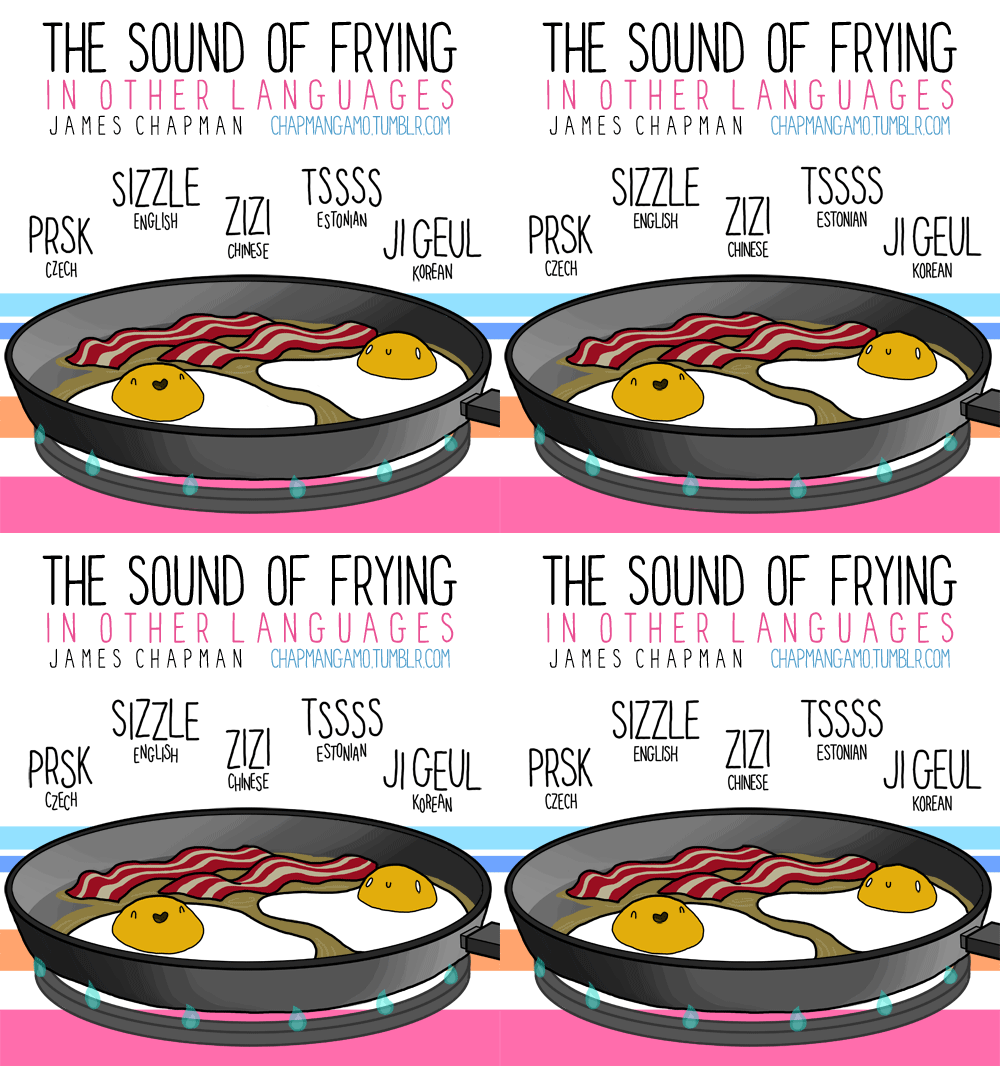
The Sound of Frying

What does the sound of breakfast frying on the stove make? If you speak English, you would call it “sizzle,” but what’s the word in other languages? James Chapman rounded up several words from various languages, and they’re all pretty onomatopoeic. Which I never would have been able to spell without autocorrect. -via Blame It On The Voices

See more language roundups from James Chapman.


Trapped in a Game of Fetch

(YouTube link)

This guy sees a dog’s ball that unfortunately fell outside the fence. Like any good Samaritan and dog lover, he gives it back to the poor puppy. He soon realizes that he’s been outsmarted by a clever border collie who wants to play. I’m sure he’s not the first passer-by who’s been fooled into throwing the ball for this smart, energetic, and adorable dog. -via Daily Picks and Flicks


The Lady’s Not a Tramp: History's Greatest Courtesans

The following is a list from the book Uncle John's Bathroom Reader History's Lists.

For most of recorded history, women had just a handful of options open to them: they could marry (hopefully to men of means), they could teach, they could join convents, or they could do something a little more exciting …like becoming mistresses to the rich and famous. These eight are among history’s best-known high-class ladies of the night.

1. PHRYNE (Fourth Century BC)

As a child, she was called Mnesarete (Greek for "virtue"), but because she was born with sallow skin, she was called Phryne (Greek for "toad"). Still, Phryne became the most successful and sought-after courtesan in ancient Greece, commanding 100 times the going rate. Supposedly, she was even the model for the sculpture called Aphrodite of Cnidus, one of the most famous works of Greek art.

Lust Rewards: Phryne became incredibly rich thanks to her liaisons with powerful men in Athens. According to legend, she even offered to pay to rebuild the city walls of Thebes, which had been destroyed by Alexander the Great in 336 BC, but there was a condition: the new wall had to contain the inscription “Destroyed by Alexander, restored by Phryne the courtesan.” Her offer was declined.

Around 340 BC, Phryne was accused of affronting the gods by appearing nude during a religious ceremony. At her trial, the orator Hyyperides -her defender and also one of her lovers- ripped open Phryne’s robe and exposed her to the court. Why? He considered it a legitimate defense. She was, after all, the most beautiful woman in Athens, and someone that gorgeous must be on good terms with Aphrodite, goddess of love and beauty, no matter what codes of conduct she appeared to have broken. It worked. The judges ruled in Phryne’s favor.

2. THEODORA (497-548)

Theodora’s father died when she was young, so her mother sent the girl to work, first as an actress and then as a prostitute.

Theodora became the mistress to a politician named Hecebolus and then caught the eye of Justinian I, the emperor’s nephew. Justinian was so enamored with Theodora that he wanted to marry her, but Byzantine law forbade royals from marrying mere actresses (and prostitutes, presumably), so his uncle changed the law and Justinian and Theodora became husband and wife.

Lust Rewards: Justinian ascended to the throne in 527, and together he and his wife ruled Byzantium (also known as the Eastern Roman Empire). Theodora proved to be a gifted politician -she helped to create a new constitution to curb corruption, expand the rights of women in divorce, closed brothels, and founded convents for former prostitutes. When she died at around the age of 50, she had been empress of Byzantium for more than 20 years. Historians consider her to be the most influential and powerful woman in the empire’s 1,100-year history.

3. VERONICA FRANCO (1546-91)

Like mother, like daughter: Veronica Franco was the privileged offspring of Venetian courtesan Paola Fracassa. She studied Greek and Roman literature and learned to play the lute. After marrying and divorcing a doctor, Franco consorted with politicians, artists, philosophers, and poets. She became an accomplished poet herself and celebrated her sexual prowess in writing -her book Familiar Letters (published in 1580) was a collection of 50 letters written to her lovers, including King Henry III of France and the Venetian painter Jacopo Tintoretto.

Continue reading

Email This Post to a Friend

Page 1,396 of 2,639     first | prev | next | last

Profile for Miss Cellania

  • Member Since 2012/08/04


Statistics

Blog Posts

  • Posts Written 39,572
  • Comments Received 109,642
  • Post Views 53,262,519
  • Unique Visitors 43,816,403
  • Likes Received 46,475

Comments

  • Threads Started 5,001
  • Replies Posted 3,738
  • Likes Received 2,793
X

This website uses cookies.

This website uses cookies to improve user experience. By using this website you consent to all cookies in accordance with our Privacy Policy.

I agree
 
Learn More