
Miss Cellania's Blog Posts

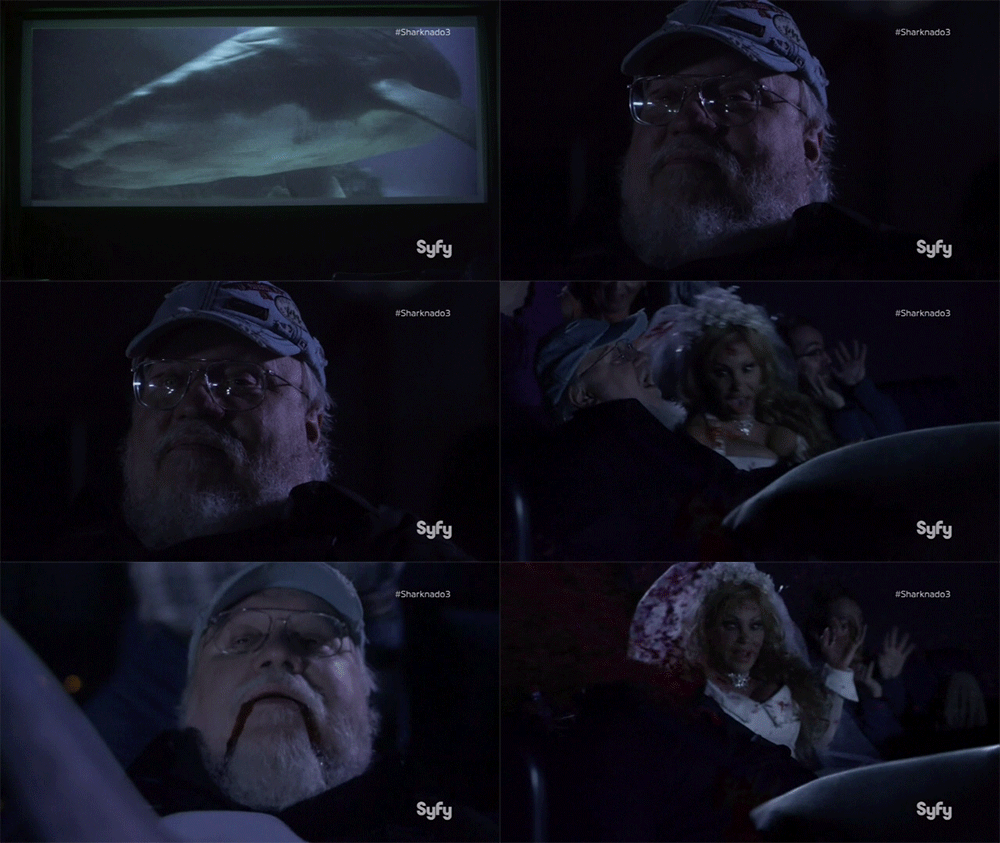
George R.R. Martin Died in Sharknado 3

The author behind A Song of Ice and Fire, George R.R. Martin, continues his quest to avoid writing an end to the saga that spawned the TV show Game of Thrones. Martin was seen briefly in the TV movie Sharnado 3: Oh Hell No when it debuted last night. In a bit of poetic justice, his character was promptly killed. Director director Anthony C. Ferrante had this to say about the cameo:

"We wanted him in the movie, he wanted to be in the movie, so we went to New Mexico, and we shot it for a day,” Ferrante said. “He originally had a line — and we’ll add it back in for the DVD — where he went outside, shivered, and said, ‘Winter’s coming.’ But we thought about it and decided that we wanted people to watch it and go, ‘Wait, is that … Is that George R.R. Martin?’ ”

Beyond the fun factor of spending a day with Martin and filming the cameo, Ferrante was also excited about the reaction that the author’s appearance would induce in a certain segment of the viewership. “I love the fact that we’re going to piss off all the Game of Thrones fans," he said. "Instead of writing his damned book, he was busy hanging out with us, filming a scene for Sharknado 3!”

-via Uproxx


15 Things You Might Not Know About Yellowstone National Park

Everyone should travel to Yellowstone National Park at least once in their life. I did a couple of years ago, but there’s so much to see that you’d have to spend weeks there to even scratch the surface. Which means, of course, that there’s a lot to learn about the huge park. It’s got geysers, volcanos, extremophiles, and more wildlife than you can shake a stick at. But don’t do that -the animals may find it annoying. You don’t want to annoy bears, bison, and wolves. And the things you don’t see are interesting, too.

13. YELLOWSTONE IS THE SUBJECT OF A LEGAL ANOMALY.

All Yellowstone National Park territory falls under the legal jurisdiction of the United States District Court for the District of Wyoming. However, only 96 percent of Yellowstone falls within Wyoming state lines; the remaining four percent is split between Montanan and Idahoan land. This makes Wyoming’s the only district court to oversee land in more than one state.

14. THE PARK HAS ITS OWN JUDICIAL SYSTEM.

The previous point is more than just legal trivia. While Yellowstone offers a treasure trove of spectacles that any visitor should make a point to see, the park’s jail isn’t a must-see destination. As of 2006, Yellowstone boasts its own justice system, which includes a courtroom, presiding judge, and four holding cells. Furthermore, major crimes that occur on park grounds fall under the legal jurisdiction of one specifically assigned FBI Agent.

Read more of the history, features, and trivia of Yellowstone National Park at mental_floss. 

(Image credit: Daniel Mayer)


Magic Money Stickers

I read this comic from Megacynics and had to go look up postage rates… maybe I’ve missed something? No, postage stamps aren’t a dollar each just yet. It is currently 49 cents for a first-class letter. But if you had asked me yesterday, I really didn’t know the current postage rate -the last time I paid attention, it was 44 cents. I do send out mail, but only a few bills each month, and I buy stamps by the page, usually by sending a kid to get them. Since they are all “forever” stamps, they don’t say how much they cost on them. You know, that was a genius move on the part of the USPS. They could easily go to a dollar and few would even notice. Especially since you only buy them about once a year. But a dollar rate would certainly wipe out the few remaining Christmas card senders.   


Rosie Retrieves Her Ball

(YouTube link)

Rosie is upset that her ball went into the pool. Rosie doesn’t want to swim, and really doesn’t even want to get wet. What will she do? She uses her brain, that’s what! Oh well, maybe it was a lucky move, but she got her ball back in the end! -via Arbroath


The Story of "Hey Jude"

Neatorama presents a guest post from actor, comedian, and voiceover artist Eddie Deezen. Visit Eddie at his website or at Facebook.

It was the summer of 1968. John Lennon's six-year marriage to his first wife, Cynthia Powell, had ended abruptly, due to his open affair with his newly discovered soulmate, Japanese conceptual artist Yoko Ono. Cynthia, after spending almost ten full years as John's wife and girlfriend, was immediately an outcast in the Beatles' inner circle.

One sunny afternoon, it was Paul McCartney who drove out to Cynthia's home to visit her and her son, Julian. Paul arrived and gave Cynthia a single red rose. “Hey Cyn, how's about you and me getting married, then?" he joked.

“I was truly surprised when, one afternoon, Paul arrived on his own. I was touched by his obvious concern for our welfare,” Cyn recalled.

Paul: “We'd been good friends for millions of years and I thought it was a bit much for them to be persona non grata and out of my life.”

It was one of Paul McCartney's finest moments. But something else was significant about that memorable afternoon.

On the way to visit Cyn and Julian, Paul thought up a catchy song in the car.

“Hey Jules...." he sang to himself- the song was a song invented to console little Julian, who was caught up in the sad mix of his parents' separation. The rest of the lyrics flowed into Paul's head as he drove on in his journey.

Paul originally called the tune “Hey Jules.” He soon decided to change the lyric to “Hey Jude.”

Cynthia Lennon was never to forget Paul's kind gesture, and “Hey Jude" was to become indelible in her mind: “It always brings tears to my eyes, that song,” she recalled.

Continue reading

What Is It? game 341

Hey look! It's time for our collaboration with the wonderful What Is It? Blog! Do you know what the object in this picture is? It doesn't really matter if you do, because we are looking for the funniest guesses. You can win a t-shirt from the NeatoShop! But first, read the rules:

Place your guess in the comment section below. One guess per comment, please, though you can enter as many as you'd like. Two winners who submit funny and/or clever (albeit ultimately wrong) answers will each win a T-shirt from the NeatoShop. This week, we are limiting contestants to those who have not already won this month. 

Please write your T-shirt selection alongside your guess. If you don't include a selection, you forfeit the prize, okay? May we suggest the Science T-Shirt, Funny T-Shirt and Artist-Designed T-Shirts?

Check for more clues at the What Is It? Blog. Good luck!

Update: These objects are caulks (cleats) for horseshoes, they are used for getting better traction in mud and snow. I should also mention that Skipweasel was not eligible to win this week. He did not know beforehand what the objects are, but he submitted the photo. Thanks!

Congratulations to MEM, who wins a t-shirt from the NeatoShop for this scenario:

These are dice for the now forgotten medieval game of Truth-or-Wedgie. This game was staggeringly popular during the reign of Ethelred the Unready, but the fad ended when people started to realize that the dice nearly always came up 'wedgie.'

And to Soup Fick for this story:

These are the earliest examples of dental implants made by Mo-Larr of Eternia. In Skeletor's youth, he had quite a sweet tooth, but never brushed his teeth, so he would commonly require root canals. Later, as his teeth degraded, he would require implants in order to preserve his bite alignment, jaw bone and beautiful smile. As Mo-Larr's prosthesis making skills improved, Skeletor's implants were upgraded, so that he has the smile we know and love today.

Thanks to everyone who played, and we’ll look forward to another What Is It game, from the What Is It blog and Neatorama!


Wyatt Earp and the ‘Fixed' Heavyweight Title Fight

The modern day image of Wyatt Earp is that of a gunslinger, Old West lawman, and gambler. We know from previous articles that there was much more to his adventurous life. Part of that was his involvement in boxing. In fact, some historians will tell you that at the beginning of the 20th century, Earp was better known for refereeing a boxing match than he was for the fight at the OK Corral. This was because he was the referee at the infamous 1896 fight that many believed was fixed -by Earp.

After Tombstone and the OK Corral, Earp drifted to San Diego where he ran saloons and dabbled in real estate. He also refereed a number of fights both with gloves and bare knuckles, Dyke said. By the time Earp moved to San Francisco in 1891 he was well-known in west coast boxing circles.

The Sharkey-Fitzsimmons fight was to settle a three-year question as to the rightful holder of the gloved (Marquess of Queensberry rules) heavyweight title. Boxing was illegal in San Francisco but such trivialities as city law hardly mattered as city officials and police commissioners embraced the bout, Mechanics Pavilion was secured as a venue and more than 10,000 tickets were sold.

So what happened? Earp was suspect the minute he entered the ring, as he was friends with Sharkey’s manager and should have never been chosen as the referee. When Earp made a controversial call against Fitzsimmons, the crowd went wild. Read the entire story of the fight that ruined Earp’s reputation for the rest of his life at the Guardian. -via Digg


NAO Bot Figures It Out

A study of robot consciousness from the Rensselaer AI and Reasoning (RAIR) Lab yields some interesting findings. These robots were told that two of them received a “dumbing” pill that rendered them unable to speak, and one received a placebo. They were then asked which pill they received. Let’s see what happens.

(YouTube link)

In reality, two of the robots’ ability to speak was turned off, but the third robot did not know that. From the study:

The test of robot self-consciousness described above was performed on three Aldebaran Nao humanoid robots, at the RAIR Lab. The simulation transpires as follows:

1) The robots are programmed to access a DCEC∗prover, and to interact appropriately with a human tester (corresponding to the aforementioned t1 = “apprise”).

2) In place of physically ingesting pills, the robots are tapped on sensors on their heads (t2 = “ingest”). Unknown to them, two robots have been muted, to simulate being given dumb pills. One robot has not been muted; it was given a placebo.

3) The robots are then asked: “Which pill did you receive?” (t3 = “inquire”), which triggers a query to the DCEC∗prover. Each robot attempts to prove that
it knows, at time t4, that it did not ingest a dumb pill at time t2.

4) Each robot fails in this proof attempt, and, accordingly, attempts to report ‘I don’t know’ (t4 = “speak1”). However, two robots, having been muted, are not heard to speak at all. The third robot, however, is able to hear itself speak. It updates its knowledge base to reflect this, and attempts to re-prove the conjecture.

5) This time, it is able to prove the conjecture, and says (t5 = “speak2”) “Sorry, I know now! I was able to prove that I was not given a dumbing pill!”

They are adorable. Still, I don’t think this so much shows that the robots have consciousness as that they can use logic.  -via the Presurfer


Healing Spas and Ugly Clubs: How Victorians Taught Us to Treat People With Disabilities

Before the Industrial Revolution, people with disabilities were considered just another part of the fabric of society. They were given jobs they could do, and often ridiculed, and few outside their families gave them much thought. But during the Victorian era, more and more people got involved with doing something about them, which took many forms, some helpful, and some not so helpful.  

In fact, society didn’t have a concept of “lacking ability” until industrialization, which, by the 19th century, had created an obsessive demand for “able-bodied workers” who could rapidly churn out mountains of goods. Unfortunately, in the 1800s the sciences of biology and medicine hadn’t kept pace with advances in mechanical technology, so one infection or unfortunate encounter with a factory machine could lead to invalidism, loss of a limb, or early death. As people with disabilities became more visible and regarded as problematic, able-bodied citizens started to feel compassion for what they perceived as tragic lives. What to do with all these “unproductive” bodies?

Everyone had different ideas. Social reformers in the 19th century attempted to “normalize” people with disabilities through rehabilitation, education, and discreet new prosthetics. Inventors created all sorts of bizarre quack devices to help people “overcome” their disabilities. Certain educators even waged a war against sign language to force deaf people to learn how to speak like regular folk. Darwin-inspired eugenicists supported sterilizing anyone thought to have inherited undesirable traits, which physiognomists asserted could be read on one’s face or body. Many people with obvious physical disabilities and deformities still made a living by being gawked at and mocked in freak shows, while men with deformities but deep pockets raised their own esteem by joining Ugly Clubs, even as cities were starting to pass “ugly laws” against “unsightly beggars.”

An article at Collectors Weekly looks at all these reactions to people with any kind of disability, some of which led to consequences we are still dealing with today.

(Image credit: Wellcome Images)


The Legends, History, and Lore Behind 10 Game of Thrones Locations

The filming locations used in the HBO series Game of Thrones are perfect for the medieval magical fantasy world in which the show is set. Those locations are not only striking, but they come with a lot of history and legends of their own. For example, these trees are from the Dark Hedges of Armoy in Northern Ireland, which is used for the Kingsroad of Westeros.   

In the real world, its beech trees were originally planted in 1750 by the Stuart family in the grounds of Gracehill House, creating the haunting effect which features prominently in the show. John Stuart, who named the property after his wife, Grace, wanted to create an epic approach to his home. And the result is spectacular, especially considering the avenue of twisted trees stands amid Northern Ireland’s unpredictable weather.

And, of course, there are tales attached to the eerily beautiful stretch of road, and given how the trees seem to have a reaching, grasping sort of life of their own, it can be rather chilling, even if you don’t believe in ghosts. Paranormal stories aside, it’s one of those places that simply has an unmistakable aura of age about it.

Photographers, locals and tourists alike tell stories about a Grey Lady. It’s thought that she walks along the strip of road at night, either the ghost of a maid from the Stuart mansion, or, in other versions, the restless spirit of a young girl buried in the nearby graveyard. On Halloween, those who are buried beside her are said to walk with her. Others guess that she’s the daughter of John Stuart, who was always referred to in family history and genealogy not by her given name Margaret, but instead, as “Cross Peggy”. No one is sure why.

The article at Urban Ghosts also looks at the history and legends of the castles of Northern Ireland, the fortress in Morocco, and the gorgeous town in Croatia that became King’s Landing, among other places. The pictures are something else!

(Image credit: Flickr user horslips5)


25 Lost Cities

(YouTube link)

You already know about the abandoned city of Machu Picchu and the buried city of Pompeii, but there are many other cities of he past that are no more. John Green tells of many more in this week’s mental_floss List Show. Some of those cities make our modern metropolises look small! Each city has a fascinating, and sometimes heartbreaking, story behind them.


My Guy!

This Russian guy comes home after six weeks away, and his dog is somewhat glad to see him return.   

(YouTube link)

In the comments at reddit, someone mentioned that he was probably just gone to the grocery store, and the dog does this every time.


That’s a good dog.  


Texas Ranch For Sale

You might need to fire up the theme to the TV show Dallas while you read this article. Tom Waggoner didn’t have an easy time running his spread. Every time his ranch hands dug a well to bring water to his cattle, they’d find oil instead. That’s the kind of problem we should all have. But that was 100 years ago. Now Waggoner’s descendants are selling the Texas ranch that comprises over a half-million acres.  

FOR SALE: Largest ranch in the U.S. within a single fence. Texas fixer-upper with more than 1,000 oil wells; 6,800 head of cattle; 500 quarter horses; 30,000 acres of cropland; tombstones for legendary cowboys, long-dead dogs, and a horse buried standing up. Favorite of Will Rogers and Teddy Roosevelt. Colorful history of drinking and divorce. Fifteen-minute drive to rib-eyes at the Rusty Spur in Vernon. Ideal for Saudi oil sheiks, billionaire hedge funders, and dot-commers who can tell a cow from a steer. Profitable. Zero debt. Property taxes only $800,000 a year. Price: $725 million.

That blurb doesn’t begin to describe what’s involved in this real estate offer. Not that any of us have that kind of money available, but you can read the history of the ranch, its many other features, and the years of wheeling and dealing that went into the decision to sell it, at Bloomberg Business. 


How Would You Change the World?

Soul Pancake asked a bunch of folks of all ages, from children up to a man who is 105 years old, how they would change the world if they could.

(YouTube link)

Their answers vary depending on their life experiences, and reflect how we change as we age. A kid wants to bring dinosaurs back, while teenagers worry about social standing, and the elderly know that global cooperation comes down to one-on-one caring about each other. And then there’s one older lady who has simple desires- she just wants nice weather. -via Buzzfeed


Regarding Thumbnails in the Feature Banner

I just wanted to step in here and announced that we have a new rule at Neatorama.

All thumbnail images at the top of the page used to illustrate Neatorama's exclusive articles must have a diagonal line running from the top left to the bottom right. Partial lines or a slightly steeper angles will be tolerated only when necessary.   

Those illustrating older feature stories, which you can access using the arrows on either side, are grandfathered in.

This rule will remain in effect until I can think of another one.

Thank you. You may now resume your normal activities.


Email This Post to a Friend
""

Separate multiple emails with a comma. Limit 5.


Success! Your email has been sent!

close window

Page 1,243 of 2,623     first | prev | next | last

Profile for Miss Cellania

  • Member Since 2012/08/04


Statistics

Blog Posts

  • Posts Written 39,345
  • Comments Received 109,555
  • Post Views 53,131,259
  • Unique Visitors 43,699,150
  • Likes Received 45,727

Comments

  • Threads Started 4,987
  • Replies Posted 3,730
  • Likes Received 2,683
X

This website uses cookies.

This website uses cookies to improve user experience. By using this website you consent to all cookies in accordance with our Privacy Policy.

I agree
 
Learn More