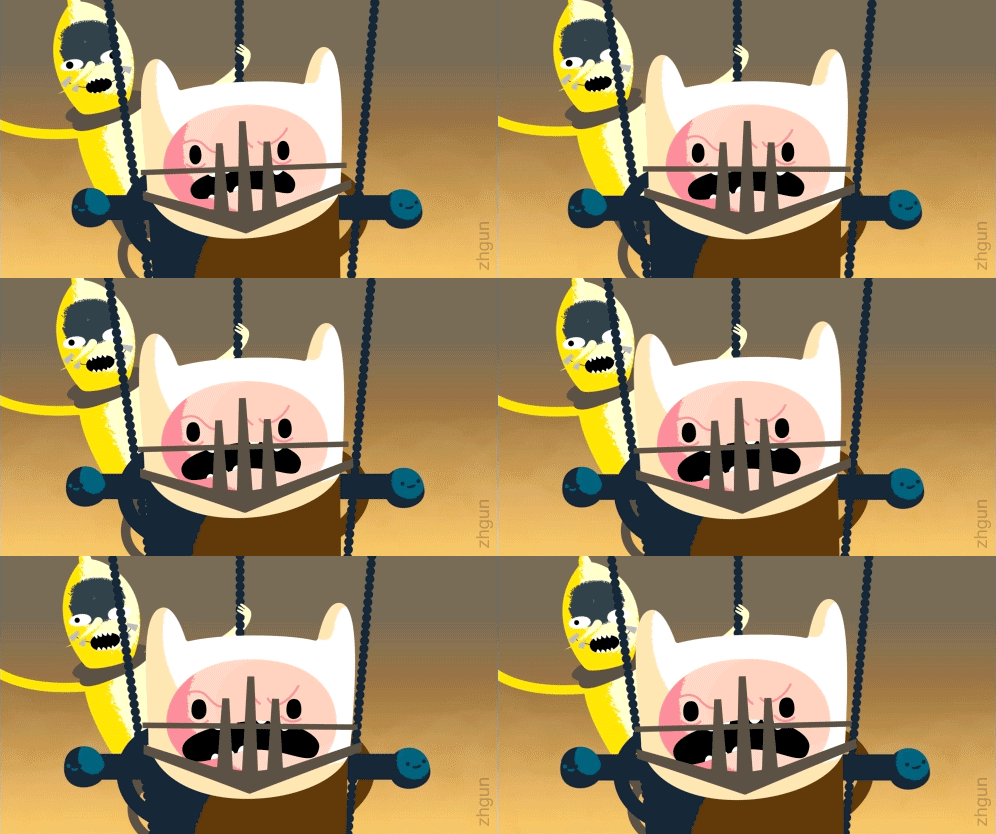
Egor Zhgun created a delightful mashup of Adventure Time and Mad Max: Fury Road. The audio of the original movie trailer is accompanied by Finn, Princess Bubblegum, the Ice King, and the rest of the cast. See more animated gif from the project here. -via The A.V. Club
There were 164 skydivers jumping out of seven planes over Chicago. Plus photographers. They managed to latch onto each other to set a new record in aerial formation. Don't bother counting them, just enjoy the beauty of the video.
The previous record was 138 skydivers in formation. These folks did it by linking up head down in the sky. Read about how it came about at Redbull. -via The Kid Should See This
How an architect revolutionized the basketball shoe.
(Image credit: Mike Rogalski)
Something strange was in the air at the Nike headquarters in Beaverton, Oregon. It wasn’t just that deadlines loomed—that was typical. A shareholders meeting was just around the corner, which never brightened the mood, but that wasn’t it either. Tinker Hatfield Jr., a 35-year-old sneaker designer, couldn’t quite put his finger on it. His boss, Nike’s creative director and lead shoe designer, Peter Moore, typically blasted music in his office while he sketched new ideas for shoes. But this summer morning in 1987, the music wasn’t playing.
A few weeks prior, Rob Strasser, Nike’s vice president, had suddenly handed in his resignation. Nobody had seen it coming. Strasser was an industry veteran who’d spent nearly two decades as Phil Knight’s marketing guru. He’d become a local legend, “the man who saved Nike.” In three years, he’d turned the company’s fortunes around by signing Michael Jordan to the most high-profile and successful athlete endorsement deal in history. Soon, Jordan’s contract would be coming up for renegotiation. Wherever Strasser was about to go, he seemed poised to take Jordan with him.
Moore, who’d designed the first two iterations of the Air Jordan, was clearly frustrated. Suddenly, he called Hatfield into his office. Sketches for a new shoe were scattered around the desk. Handing Hatfield a thin sheet of tracing paper, Moore said, “You do it. Design Michael Jordan’s next basketball shoe.” A week later, Moore followed Strasser’s lead and walked out the door, leaving behind a thin file filled with those same sketches. The deadline to present the new Air Jordan was a few weeks away, and the company’s fate seemed tethered to the deal.
Hatfield had never even worked on an Air Jordan, let alone designed one. In fact, he was new to the field: He’d barely worked on sneakers for two years. But now, with Nike reeling from the loss of its design and marketing leadership and with its relationship with Jordan on the line, Tinker had a lot riding on this one shoe. (Image credit: Jimmka89)
In high school, Hatfield had been a standout track athlete. He was part of Oregon’s robust amateur-sports culture (near the center of which was his father, a legendary track coach). He attended the University of Oregon on a track-and-field scholarship and held the school’s pole-vaulting record for a while, but his teammate, Steve Prefontaine—who would go on to become one of the most celebrated track stars in history—got most of the attention. That was fine by Hatfield. He’d chosen Oregon because the school offered a bachelor’s degree in architecture—his true passion.
What a difference a word makes! These films sound so prosaic when the titles are changed to something that means the same thing. Have fun translating all ten of them. I have to admit, I had to look the last one up, because even though I recall it better than the other movies in the series, I forgot the complete title. This is the latest from Randall Munroe at xkcd. As usual, the punch line is in the hovertext at xkcd.
Americans have always loved their whiskey. Even George Washington had his own distillery. Colonists in the north made their own rye, while those further south came up with bourbon. Eventually glass bottles were developed. When Americans loved whiskey too much, there was always someone else who wanted them to reel it back in, which led to Prohibition. But even then, we found ways around it. One way was medicinal whiskey. Noah Rothbaum, author of the book The Art of American Whiskey, tells us about it.
I had known medicinal whiskeys were available at this time, but I assumed they came in nondescript bottles, like rubbing alcohol or aspirin. But of course, they didn’t. They were packaged in these beautiful, engaging, and highly illustrated boxes and bottles, which shows that, in fact, the whole medicinal whiskey business was not about “medicine” but about letting people continue to drink whiskey.
Before Prohibition, whiskey was prescribed for a range of real symptoms and illnesses, but after alcohol was outlawed, I think it was prescribed for things like the common cold or stress or anxiety as a way to get around the law. I imagine a lot of prescriptions were for subjective conditions. I think it’s an accurate parallel to some of the marijuana clinics today, with prescriptions ranging from the legitimate to the recreational.
Obviously, these companies were still trying to sell and market their products during Prohibition, and the ones that survived had to demonstrate they already had large supplies of whiskey already on hand since they weren’t allowed to make new whiskey. You also had a lot of consolidation, as companies that were allowed to bottle medicinal whiskey ran low on stock and acquired companies that hadn’t been permitted to bottle it. The government also eventually declared a distiller’s holiday because they ran out of medicinal stock, and this allowed them to make more. It shows how much of this “medicine” was actually being sold.
And the day Prohibition ended, there was plenty of whiskey available to celebrate, as if it had been manufactured all along -which it had. Read about the history of whiskey in America at Collectors Weekly.
We love to hear about conspiracy theories. Some of us believe them, while others of us are amazed at what people can come up with… just when you think you’ve hear it all, here comes something new. John Green goes over some you are familiar with and others that may be new to you, in the latest episode of the mental_floss List Show. The Illuminati is responsible for LeBron James joining the Miami Heat? Some people think so!
Tyranitard has an aquarium in his office with a skull inside. Take a good look at it. He saw this and freaked out, but then looked carefully to find out what caused the skull to look back at him. It’s a snail that climbed up into the eye socket! Must be a cozy place to hang out. That’s a picture you have to share. The tank has a second snail, so he’s waiting for the other socket to be occupied. -via reddit
Chad Gadya is a traditional Passover song (lyrics here). Nina Paley and Theodore Gray animated it using embroidery on matzoh covers, a process Paley calls “embroidermation.” She also calls it “Our most ridiculously labor-intensive animation ever!” I can see that.
Each embroidered matzoh cover, used in zoetrope fashion, provides six frames of animation. The covers are for sale. Gray explains the process of creating the video here. Not only did they have to embroider hundreds of characters, but create custom software, too!
This video is a part of Paley’s ongoing feature film project Seder-Masochism (previously at Neatorama). She says Chad Gadya will serve as an intermission in the story. -via Metafilter
In the post-apocalyptic world of Mad Max, gasoline is what makes the world go round. I’m not sure why, because it seems food and water would be more important. But you can’t have a good car chase movie without gas!
CorridorDigital brings us story set in the that bleak world, revolving around the quest for gasoline. It’s violent, gory, and contains NSFW text. But at the same time, you have to laugh. But really, this is not for children or those with a weak stomach. -via Uproxx
No, he doesn’t do Disney like people do -the tiny hamster gets his own tiny rides and his own tiny concessions. And his own tiny Mickey Mouse ears. Watch him take a tour throughout the Haunted Mansion and eat churros and Doel whips! The best moment is at 1:05, when he realizes he’s on camera. Check out the behind-the-scene video here. -Thanks, Elijah Jones!
Neatorama presents a guest post from actor, comedian, and voiceover artist Eddie Deezen. Visit Eddie at his website or at Facebook.
“I’m gonna knock your pallies off the charts" -Dean Martin
Ricci Martin, son of the world-famous singer Dean, was just like most any other teenager in the early months of 1964. Ricci was totally crazy about and obsessed with the Beatles.
Ever since the Beatles arrival in America a few months previously, they had captivated teenagers far and wide and taken the entire country by storm. They were making appearances on TV, their new film A Hard Day's Night was a smash hit, and their songs were blasting out of every radio on the continent. The records: “She Loves You,” “I Want to Hold your Hand,” “Please Please Me,” etc. were inevitably turning up on the record charts- in the number one spot.
And now it was August of 1964 and the theme song to their brilliant first film A Hard Day's Night was sitting brightly atop the charts. And so it was, a few months previous, that Ricci Martin was raving on and on about "the Beatles this" and "the Beatles that" and “Beatles Beatles Beatles.”
Dean Martin, star of stage, screen, television, Las Vegas, and the record world, got fed up one day and, with a bravado that would have put Muhammad Ali to shame, confidently took Ricci to the side and breezily told him, “I’m gonna knock your pallies off the charts.”
Ricci smirked and barely held back from rolling his eyes right to his father's face. Sure, his dad was the great Dean Martin, but Dino hadn't had a hit record in six years. And come on man, these guys were the Beatles!
Closing credits to a TV show often end with the production company’s animated logo, which are becoming more and more like little works of art in themselves. We remember them better than the show we just watched -mainly because of repetition, but we don’t mind repetition when they are so short. For example, Bad Hat Harry productions.
Made famous by: Movies, mainly, but TV-wise, was used in House.
Slogan: “That’s some bad hat, Harry.”
What’s the story? This animated closing logo is another movie homage, this one to a Steven Spielberg classic. It’s a line from Jaws, spoken by Roy Scheider’s character to a local man in a delightfully askew swimming cap, as comeback for ribbing Brody about never going in the water. Here’s the original movie clip, for reference.
Quentin Tarantino’s 2009 film Inglourious Basterds was part war movie, part farce, part drama, part comedy, and part science fiction. The combination worked, and the final product was a masterpiece. But there are some things that were going on behind the scenes that you don’t know about -like the casting decisions.
6. Christoph Waltz wasn’t the first choice to play Hans Landa.
Tarantino originally wanted to cast Leonardo DiCaprio .
7. Adam Sandler was originally set to play Donny Donowitz, a.k.a. “The Bear Jew.”
He dropped out to appear in the film Funny People instead.
8. Another German actress was supposed to play Bridget von Hammersmark.
Tarantino wanted Nastassja Kinski to play the role that eventually went to Diane Kruger.
Read the rest of the 15 things about Inglourious Basterds at mental_floss …and if you still haven’t seen the movie, go ahead, because there are no spoilers here.
We set our thermostats down in the winter because we don’t want to waste gas. Meanwhile, a big hole in the ground in Turkmenistan has been burning natural gas for over 40 years, just to get rid of it.
If you want to get up close and personal with snakes, visit the Tokyo Snake Center (English translation). They just opened to the public over the weekend. You can enjoy a drink in the presence of a snake, and even handle some of the large snakes. Snake experts are on hand to supervise and explain about each species. They are all non-venomous. -via Metafilter, where one response was: