Minnesotastan's Blog Posts

Collecting and Reusing Grain and Seed Sacks

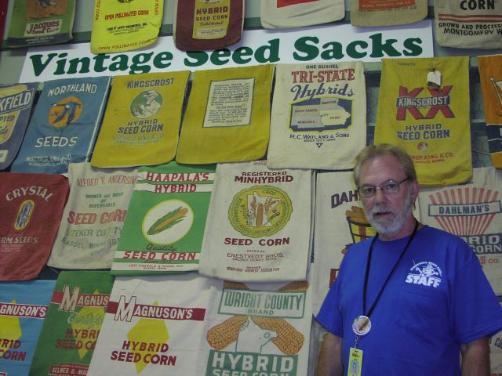
Feed and seed sacks have traditionally been repurposed for clothing and for other practical purposes on the farm.  Now these items are moving upscale as artisans discover they can be used for decorative as well as utilitarian purposes.
"A lot of people frame them for their graphic quality or use them as curtains," he said. "They can be used in cabinets that have windows in them in the kitchen, or as a throw over a small table. ... Some have a Christmas theme and we use them then. It's definitely easy to use them in the fall, the ones with grain or vegetable themes."

Vintage grain sacks are a challenge to find and collect, because they were traditionally manufactured using washable dyes for the design elements, so that they could be refashioned into underwear and towels.  This is in contrast to flour sacks and feed sacks, whose permanent color patterns allowed them to be recycled into aprons and dresses.

Link.  Photo credit: Roger Wippler, Minnesota Crop Improvement Association
An Impressive Collection of World Records


Boston.com's The Big Picture has assembled about 30 photographs of people achieving or attempting to set Guiness World Records.  Pictured above is He Pingping, who until his death this past week was the world's shortest man (2 feet 5 inches), standing next to Sultan Kosen (8 feet 1 inch) of Turkey.

Other records depicted at the link include the world's largest cheesecake, largest meatball and largest plate of hummus, and the tallest dog (and horse), and the biggest Pokemon collection, and many more.  Those interested in such phenomena are reminded that Neatorama has a subcategory of posts devoted to world records.

Link.  Photo credit: Osman Orsal (Reuters).

Too Lazy to Floss? Get a Zebra.


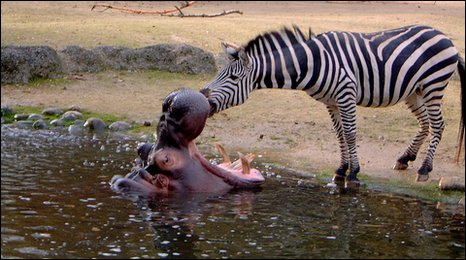
The photo above was taken by a visitor to the Zurich zoo, who observed a zebra placing its head in the mouth of a hippopotamus.
But the hippo had no intention of having the zebra for lunch - it was having its teeth cleaned... the teeth-cleaning session lasted 15 minutes and the zebra came to no harm.

Link.  Photo: Jill Sonsteby/Solent News.

70+ Years of Collegiate Grade Inflation

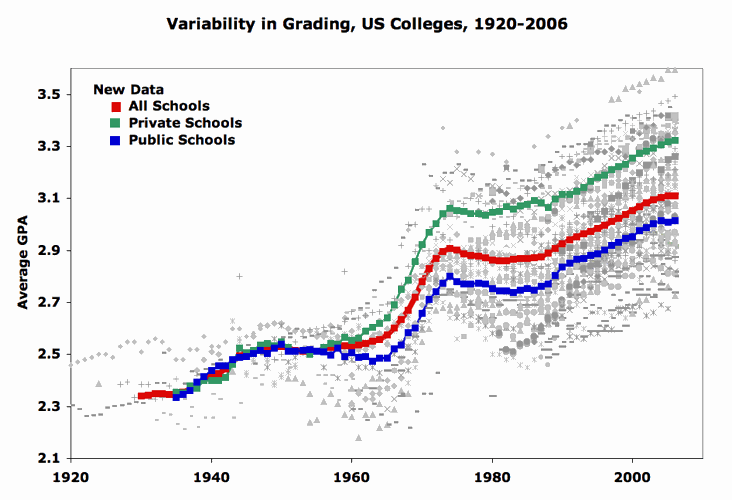
Everyone is familiar with the fact that grades in American colleges and universities are prone to "inflation" over time, but the data are much more striking when presented as a graph.
We’ve looked at contemporary grades from over 160 colleges and universities in the United States with a combined enrollment of over 2,000,000 students and historical grades from over 80 schools... The rise in grades in the 1960s correlates with the social upheavals of the Vietnam War. It was followed by a decade period of static to falling grades. The cause of the renewal of grade inflation, which began in the 1980s and has yet to end, is subject to debate, but it is difficult to ascribe this rise in grades to increases in student achievement.

In a companion piece, the authors discuss these trends in detail, compare the sciences to the humanities, and note that the same trend is not evident in community colleges.  Of particular interest are links to the data from over 200 colleges and universities.  At my college the GPA was 2.7 in the mid-1960s, and is now nearly 3.5.

Link.

Forge That Made Hindenburg Souvenirs is Destroyed By Fire

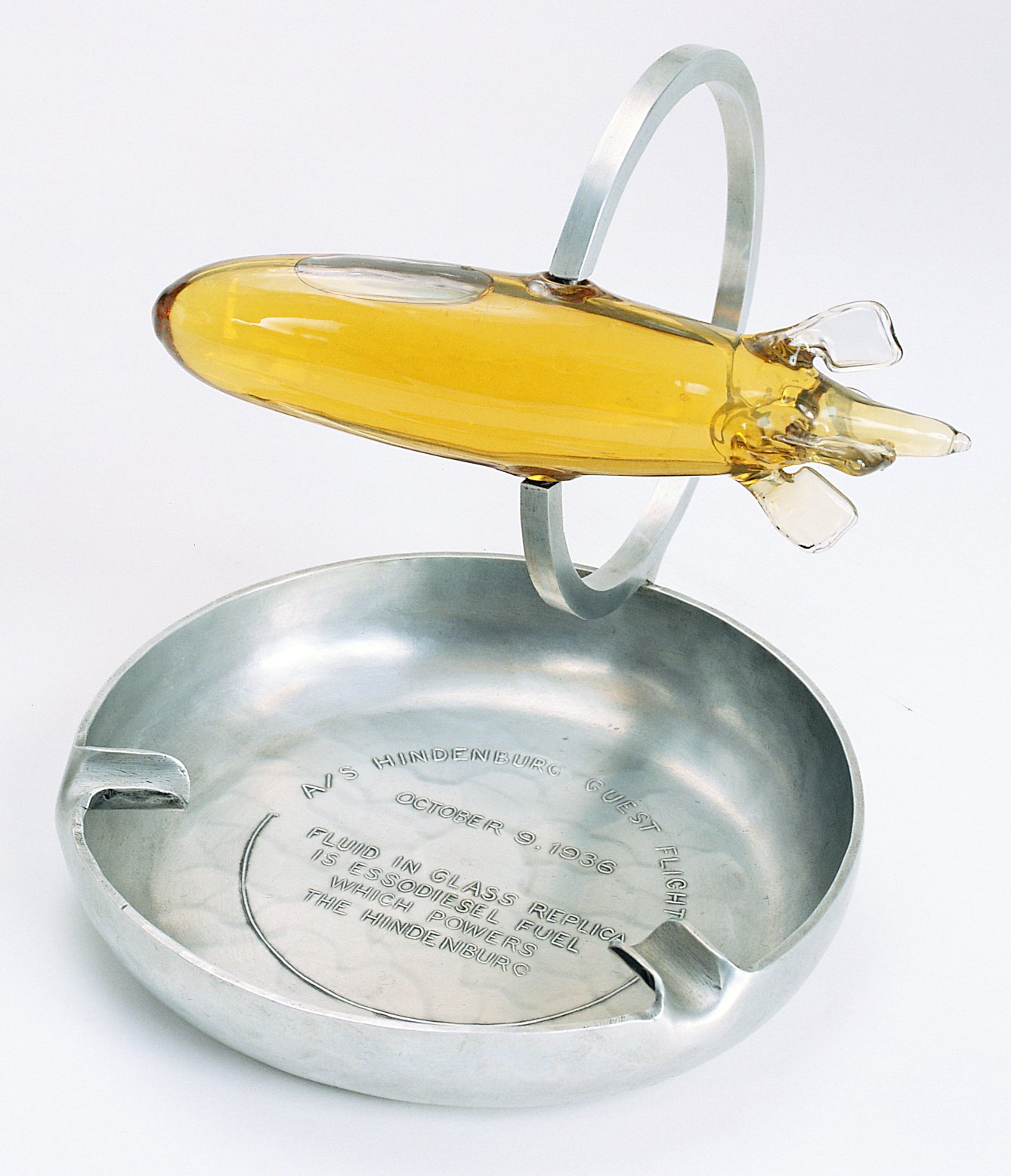
The Wendell August Forge in Grove City, Pennsylvania, has been in business since 1932.  Among its notable products were ashtrays made for the Millionaires Flight of the Hindenburg.
The flight was jointly organized by the Deutsche Zeppelin-Reederei (DZR) and Standard Oil of New Jersey (Esso), which supplied hydrogen and diesel fuel to the Hindenburg, and each passenger was given a souvenir duralumin ashtray with a glass model of the airship filled with Esso diesel fuel.

The fire started in a workshop and rapidly consumed the building, listed on the National Register of Historic Places.  Fortunately, many of the iconic dies were spared.

http://www.post-gazette.com/pg/10066/1040959-54.stm.  Wendell August Forge history.

The Streets of San Francisco in 1905/06

YouTube link.

"In 1905, an unknown cameraman filmed a streetcar trip along San Francisco's Market Street. The following year, the Great Earthquake struck, and he filmed the trip again. This is a five-minute silent film that edits together excerpts of his two films. Footage from the Prelinger Archives, edited by Matt Lake."

Perhaps the more startling aspect of the video to a modern viewer is the realization that a century ago people walked, ran, drove, rode bicycles and horses wherever they wanted, whenever they wanted in the streets.  The first electric traffic lights weren't invented until a decade after these segments were filmed.

Via ArchaeoBlog.

The Research Blogging Awards, 2010

ResearchBlogging.org is a website whose mission is to "identify serious academic blog posts about peer-reviewed research with an aggregation site where others can look to find the best academic blogging on the Net."

Over 1,000 blogs are now registered with the site, so this year they are instituting a set of awards for the best blogs in each of twenty different categories, which include specific disciplines (biology, chemistry, psychology, health, etc) and blogs in different languages.

Voting will apparently be limited to registrants at the site, but Neatoramanauts with interests in academic science may want to browse the list of nominees for sites to add to their bookmark folder.

Link to list of award nominees, via Time To Eat The Dogs.

Hunting Mammoths in Siberia


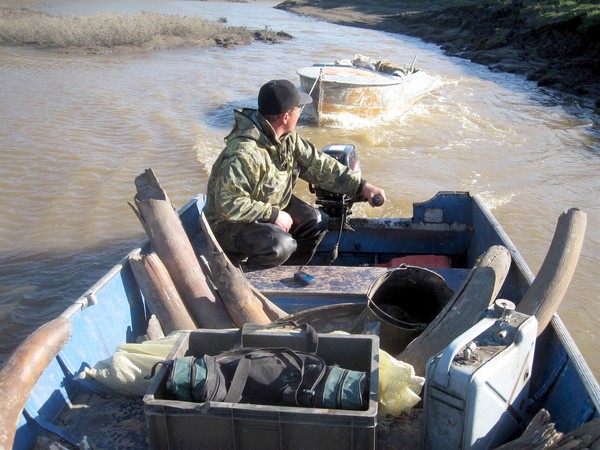
Gradual melting of the Siberian permafrost has changed mammoth carcass recoveries from occasional incidents to a full-time industry.  The Los Angeles Times reports that hundreds of tons of bones are now being discovered every year.
They are shaped into picture frames, chess sets, pendants. They are gathered and piled, carved and whittled, bought and sold on the Internet.

The once-obscure scientists who specialize in the wastelands of Siberia have opened lucrative sidelines as bone hunters, spending the summer months trawling the northern river banks and working networks of locals to gather stockpiles of bones...

Now entire villages are surviving on the trade in mammoth bones. And a new verb has entered the vernacular: mamontit, or "to mammoth" -- meaning, to go out in search of bones...

The smoothest bones go to collectors and museums around the world; the less perfect samples are shipped to carving factories, especially in China, where they are refashioned into high-end household items and keepsakes.

Some people are dismayed that the discoveries are not being curated more precisely; others note that this source of ivory may decrease the incentive for elephant hunting in Africa.

Previously on Neatorama: Waking the Baby Mammoth.

Still on Neatorama: Mammoth 3D Anatomy Model/Puzzle.

Link, via A Very Remote Period Indeed.  Photo credit Fyodor Shidlovsky Archives

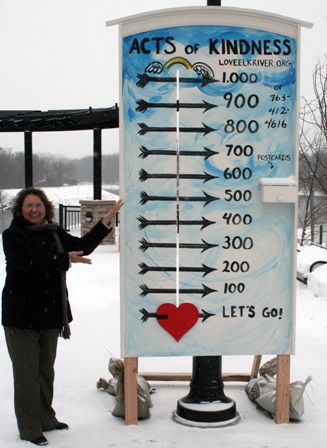
Town Residents Perform 1300 "Random Acts of Kindness"

The mayor of Elk River, Minnesota, challenged its residents to perform 1,000 acts of kindness.  They responded.
At Christmas time, Klinzing saw a YouTube video about a restaurant in Philadelphia where people kept paying for other diners' meals.  "I got the sense that if we did a similar thing through the entire city, something would change. It would be kind of a climate change. That basically is what happened."

... even doing little things, like putting a nice note on a student's locker, can have an effect.  "People pay it forward. It makes your day and you are happy because you have such a positive effect on someone. And once you've done that, you want to do it more."

The acts of kindness are posted online.  The mayor has challenged other cities to match this accomplishment.

Previously on Neatorama: How Hard Is It to Give Away Umbrellas in a Rainstorm?

http://www.startribune.com/local/north/86457367.html?page=1&c=y.

.9999999... Is Equal to 1.000000

And now for something completely different.  A math puzzle.  Or conundrum, if you will.

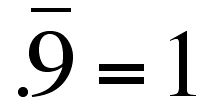
In the figure to the left, the bar above the number 9 indicates that it is to be repeated forever.  For the remainder of this post, we will represent that concept by several nines with an ellipsis (.999...).

Now, here is the conundrum.  .9 repeating is EQUAL TO ONE.   Not CLOSE to one, mind you, but EQUAL to one.

Nonsense, you reply.  It is obviously less than one.  Not by much - by an infinitely small amount, in fact.  But the simple fact (?) that it is not one is enough to demonstrate that it can't be equal to one.  It's as close as you can get to one without being one.

Wrong.  It is in fact equal to one, and that fact can be demonstrated mathematically in several ways.

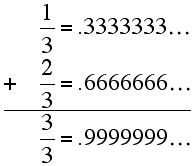
The most easily understood is to revert to other familiar repeating digits.  Everyone knows that 1/3 is 0.333... and that 2/3 is 0.666...  If you add them together, you get 3/3, which is one.

But now note that the sum of the decimals on the right side of the equation is 0.999...

Therefore, one is equal to (not close to) .999...

You don't agree?  Then try this.  Subtract .999... from one.  What you have is 0.000...  An infinitely long string of zeroes, which can only be equal to zero.  And if the subtraction of .999... from one leaves zero, then the .999... must be one.  But, you say, there's a one at the end that string of zeroes.  No, there isn't, because the string of 9s doesn't end.

There are other proofs at the Polymathematics blog, along with a long series of comments, an update refuting the counterarguments, and a final refutation of the most stubborn skeptics.

Link.

Ride the Trans-Siberian Railway from the Comfort of Your Desk

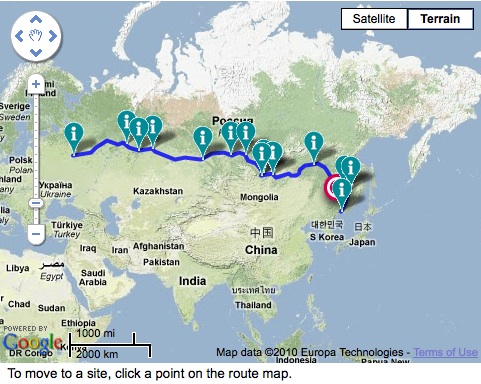
Google Maps has assembled a series of about 40 YouTube videos which apparently cover the entire distance from Moscow to Vladivostok.  Thankfully you can jump instantly and randomly from one segment of the trip to another either by clicking on a different selection or dragging the cursor on the map, which moves in sync with the videos.  The map beneath the video can be zoomed, switched from satellite to terrain mode, and dragged like any Google Map.  All of the segments I visited were filmed in daylight.  While viewing the videos, you can select an audio background of railroad sounds, Russian music, or recitations of Russian literature.

http://www.google.ru/intl/ru/landing/transsib/en.html, via.

"The Endless Night"

YouTube link.

This montage nicely blends a musical score with excerpts from movies of the film noir genre. The resolution is good enough for full-screen viewing.

This is the sort of tribute that will make film buffs want to see the movies they've missed, so thankfully RubyTuesday717, who assembled the clips, has listed the 35 component films in the sidebar at the YouTube link.

Via J-Walk.

A "Rain of Fish" in Australia

Lajamanu, a small community in the Northern Territory of Australia, has experienced a "rain of fishes."  Hundreds of spangled perch, some frozen, some still  alive, fell from the sky onto the desert community.

Rains of fish, frogs, and other aquatic creatures have been recorded with surprising frequency throughout history.  The conventional  explanation is that  tornadoes or waterspouts scoop the creatures out of bodies of water and then transport them substantial distances before releasing them.

This is the third such event at Lajamanu in the past 30 years.  Local residents apparently have said "thanks for all the fish" and are grateful that the waterspout did not scoop up crocodiles.

Link.  Photo: NT News Newsbreaker Christine Balmer.

The Most Reproduced Work of Art in the World


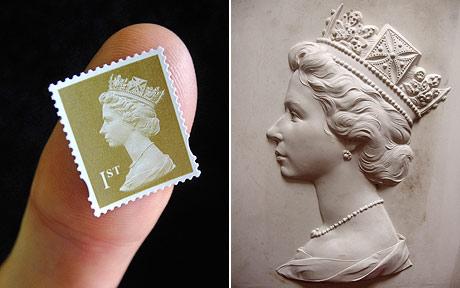
The world's first adhesive postage stamps were issued by Great Britain in 1840, with the issuance of the "Penny Black" depicting Queen Victoria.  Thus began the convention of designating British stamps by the depiction of the country's sovereign.  Great Britain is the only country allowed by international postal regulations to omit a text name of the issuing country, which allows artists much greater flexibility in the creation of stamp designs.

In 1966 Arnold Machin sculpted a bust of Queen Elizabeth for the Royal Mail.  This "Machin head" has been in continuous use since then, and has thus been reproduced some 320 BILLION times.  Three copies of the original bust were known to exist, but recently a fourth one was discovered at the Machin family home.

In October the Queen's head will be sold to the highest bidder; it is expected to fetch £10,000.

Link.  Photo: BNPS.co.uk

Amazing Restorative Dental Work


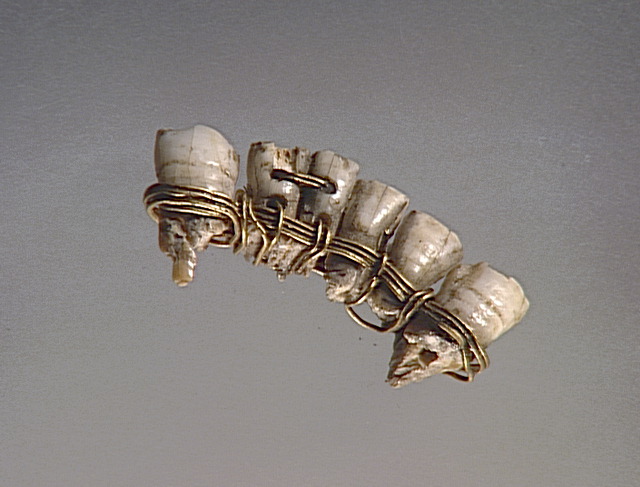
This photo of a specimen from the Louvre was not accompanied by any explanatory text, and just a modicum of identifying information.
Bridge consists of a gold wire ligature of female human teeth.
Place of discovery: Sayda.
Period: 6th century BC

There is a town in Saxony, Germany called Sayda, but since this specimen comes from a "Near Eastern Antiquities" fund, the Sayda referred to is apparently the one in Lebanon.  Regarding the work itself, one presumes that the two outermost teeth were still embedded in the jaw, since the gold wire wraps around them, and that the four center teeth with wire underneath them were fashioned into a bridge to serve a cosmetic (?and masticatory?) function.  Perhaps someone with dental restorative experience can offer a more enlightened opinion.

The mind-numbing aspect of the specimen is, of course, the prehistoric date.  One doesn't expect this degree of sophistication in 500 BC, although two-and-a-half millennia ago dental implants were being performed in Mesoamerica by the Maya.

Link (and a photo of other side of teeth), via Titam.

Email This Post to a Friend
""

Separate multiple emails with a comma. Limit 5.


Success! Your email has been sent!

close window

Page 13 of 23     first | prev | next | last

Profile for Minnesotastan

  • Member Since 2012/08/04


Statistics

Blog Posts

  • Posts Written 339
  • Comments Received 3,475
  • Post Views 646,562
  • Unique Visitors 533,792
  • Likes Received 51

Comments

  • Threads Started 428
  • Replies Posted 0
  • Likes Received 18
X

This website uses cookies.

This website uses cookies to improve user experience. By using this website you consent to all cookies in accordance with our Privacy Policy.

I agree
 
Learn More