In 1850, the HMS Investigator sailed into the Canadian Arctic in search for the fabled Northwest Passage. Captain Robert McClure and his crew, after getting trapped in ice in 1853, abandoned the ship. But a team of archaeologists recently found the ship, which is in remarkably good condition. Canadian parks official Marc-Andre Bernier said:
"The ship had not moved too much from where it was abandoned," said Bernier.
The masts and rigging have long been sheared off by ice and weather. But the icy waters of the McClure Strait has preserved the vessel in remarkably good condition.
"It's incredible," said Prentice from Mercy Bay. "You're actually able to peer down into the water and see not only the outline of the ship but actually the individual timbers.
Photographer Michael Wesely specializes in long exposures. As in years. The above picture shows the 2001 renovation of the Museum of Modern Art in New York City and was captured over a 34-month period. You can view more examples of Wesely's work at the link.
http://itchyi.squarespace.com/thelatest/2010/7/20/the-longest-photographic-exposures-in-history.html?SSScrollPosition=232 via DudeCraft | Artist's Website | Photo: Michael Wesely
GarE Maxton is a machinist in Michigan. He built this puzzle called "The Intimidator." It's composed of 125 pieces composed of 6 different metals and requires a special key to begin disassembling it. About 20 of the pieces can be reconstructed into a functional, single-shot .45 caliber handgun, pictured below. -- Link via Make | Photos: Maxton
This is a music video for the song "Ritalin" by techno band Dancing Pigeons. It depicts two men armed with a flamethrower and a fire extinguisher shooting at each other. Director Tomas Mankovsky wrote about the challenges involved in making the video:
It was difficult to know how this shootout would look like in superslowmo. We did some tests with a gas-flamethrower but the flame was only 2-3 meters and it looked quite bad in slowmo, so the special effects guys had to build a new flamethrower from scratch. They made one with liquid fuel, and that one was much better, firing out 10-15 meter flames. But the first time we saw how the flamethrower and fire extinguisher looked and behaved in slowmo was on the day of the shoot.
Back in school, you may have learned about the European Age of Discovery: the time during the 15th-18th Centuries when Europeans traveled all over the world to lands previously unknown to them. But there were other early explorers who made remarkable journeys. Let's look at five of them. Pytheas lived in the Greek city of Marseilles in what is now southern France. In the 4th Century BC, perhaps with the backing of merchants who wanted a cheaper source of tin than was available using the overland through Gaul, he went on a long ocean voyage. Slipping past the Carthaginians guarding the exit of the Mediterranean, Pytheas entered the Atlantic Ocean and headed north. In what is now Cornwall, Britain, he observed the operations of tin miners and smelters. Pytheas then allegedly circumnavigated the island and made a rough estimate of its size based upon his assessment of the speed of his ship. Thereafter he proceeded to a land that he called “Thule”, which he reported as laying six days north of Britain and a day south of ice floes. Pytheas asserted that the night only lasted two or three hours. The inhabitants had an abundance of beer, amber, honey, and millet, and seemed friendly. Some fanciful authors have proposed that Thule was Iceland, but as that island remained uninhabited until the 8th Century AD, this is a preposterous claim. It is more likely that Pytheas visited Norway, southern Sweden, or the Shetland Islands. He recorded his findings in a book, which unfortunately only survives in quotations or indirect references in works by other Greco-Roman authors, not all of whom believed Pytheas. In the 1st Century AD, Strabo writes:
Now Polybius says that, in the first place, it is incredible that a private individual — and a poor man too — could have traveled such distances by sea and by land; and that, though Eratosthenes was wholly at a loss whether he should believe these stories, nevertheless he has believed Pytheas' account of Britain, and the regions about Gades, and of Iberia; but he says it is far better to believe Euhemerus, the Messenian, than Pytheas. Euhemerus, at all events, asserts that he sailed only to one country, Panchaea, whereas Pytheas asserts that he explored in person the whole northern region of Europe as far as the ends of the world — an assertion which no man would believe, not even if Hermes made it. (Geography, 4.2.2)
Hippalus was a 1st Century BC Greek from Egypt who sailed down the Red Sea and explored India. He speculated that the subcontinent stretched far to the south, and so if he crossed the open Arabian Sea instead of taking a coastal route, he could bypass coastal port authorities, who levied taxes on passing ships. Hippalus was able to do this after discovering a favorable monsoon wind, as Pliny the Elder describes:
If the wind, called Hippalus happens to be blowing, it is possible to arrive in forty days at the nearest mart of India, [Mangalore] by name. (Natural History, 6.26)
This wind blew west to east for six months before reversing itself, thus making regular travel on this route feasible. By reducing the number of middlemen involved in the trade routes between India and the Greco-Roman Mediterranean, Hippalus' discovery led to a blossoming of commerce. One anonymous nautical directory written a century later gave Hippalus all the credit:
From that time to the present day ships start, some direct from Cana, and some from the Cape of Spices; and those bound for Damirica throw the shlp's head considerably off the wind; while those bound for Barygaza and Scythia keep along shore not more than three days and for the rest of the time hold the same course straight out to sea from that region, with a favorable wind, quite away from the land, and so sail outside past the aforesaid gulfs. (The Periplus of the Erythraean Sea, 57)
The life of Saint Brendan of Clonfert (484-577) is recorded in the medieval text The Voyage of Saint Brendan. It describes the Irish religious leader taking monks on a journey across the sea to a promised land where the monks could live and pray in peace. Here is a passage describing Brendan’s arrival at this mythical place:
He then said to St Brendan: ‘This is the land you have sought after for so long a time; but you could not hitherto find it, because Christ our Lord wished, first to display to you His divers mysteries in this immense ocean. Return now to the land of your birth, bearing with you as much of those fruits and of those precious stones, as your boat can carry; for the days of your earthly pilgrimage must draw to a close, when you may rest in peace among your saintly brethren. After many years this land will be made manifest to those who come after you, when days of tribulation may come upon ‘the people of Christ. The great river you see here divides this land into two parts; and just as it appears now, teeming with ripe fruits, so does it ever remain, without any blight or shadow whatever, for light unfailing shines thereon.’ When St Brendan inquired whether this land ‘would. be revealed unto men, the young man replied: ‘When the Most High Creator will have brought all nations under subjection, then will this land be made known to all His elect.’ Soon after, St Brendan, having received the blessing of this man, prepared for his return to his own country (28).
This is an allegorical rather than historical text, but it does represent the extraordinary exploratory journeys of early Christian Ireland. By the 7th Century, Irish monks had discovered and settled the Faroe Islands, and by the 8th Century, Iceland. These explorations can be confirmed by archaeological findings as well as Latin and Old Norse documents. A journey that is more speculative and daring is Greenland -- an incident that would establish the Irish as the first Europeans to arrive in North America. The sole extant evidence for this journey consists of iron bells and crosses of Irish design found in Greenland. Ahmad ibn Fadlan was a 10th Century Arab nobleman who the Caliph in Baghdad designated his ambassador to the Volga Bulgars, a tribal nation living in what is now the area of Kazan, Russia. At the time, Swedish Vikings had regular commerce through the rivers of European Russia, dragging their ships from the Baltic Sea to the Volga and Dnieper Rivers and into the Caspian and Black Seas. So Fadlan arranged for passage on a Swedish ship to the Bulgars. But when they arrived, the Swedes refused to allow him to leave, so Fadlan continued on with them, ultimately touring the Baltic Sea before returning to Baghdad. His story was adapted into the Michael Chrichton novel Eaters of the Dead, which was in turn adapted into the Antonio Banderas film The 13th Warrior. Fadlan’s frank and detailed anthropological text about his journeys is a good read, and I highly recommend it -- especially his long description of Viking sexual practices, which is absolutely hilarious. But as this is a family-friendly blog, I offer instead a passage from after Fadlan witnessed a funeral:
One of the [Swedes] stood beside me and I heard him speaking to my interpreter. I quizzed him about what he had said, and he replied “He said, “You Arabs are a foolish lot!’” So I said, “Why is that?” and he replied, “Because you purposely take those who are dearest to you and whom you hold in highest esteem and throw them under the earth, where they are eaten by the earth, by vermin and by worms, whereas we burn them in the fire there and then, so that they enter Paradise immediately.” Then he laughed loud and long.
Zheng He (1371-1435) was a Chinese naval explorer. Born into a Muslim family in southern China, he was castrated at the age of 11 by a Ming general and sent to the imperial court. He rose in the service of the Zhu Di, the Prince of Yan and distinguished himself at the Battle of Zhenglunba. When Zhu Di became emperor, he instructed Zheng He to lead a naval expedition to southeast Asia to address the growing problem of piracy. This 1405 mission, consisting of 27,000 men in 315 ships, crushed piracy in the Straits of Malacca and established Ming hegemony over the region for a century. The Emperor sent Zheng He on six expensive expeditions across the waters, most likely to build a great sea empire by collecting tribute from distant lands. Now Zheng He went to India and Ceylon, where he opened up direct trade between those nations and China. Later missions went as far as Arabia and East Africa, where Zheng He collected tribute for the Emperor. Here’s a passage about a journey to Arabia, taken from a 1431 inscription:
In the fifteenth year of Yongle, commanding the fleet we visited the western regions. The country of Ormuz presented lions, leopards with gold spots and large western horses. The country of Aden presented a giraffe, as well as the oryx. The country of Mogadishu presented zebras as well as lions. The country of Brava presented camels which run one thousand li as well as ostriches. The countries of Java and Calcutta presented the animal miligao. They all vied in presenting the marvellous objects preserved in the mountains or hidden in the seas and the beautiful treasures buried in the sand or deposited on the shores. Some sent a maternal uncle of the king, others a paternal uncle or a younger brother of the king in order to present a letter of homage written on gold leaf as well as tribute.
Zheng He died on this last voyage and was buried at sea. After his death, the great Chinese voyages of discovery stopped. There is some speculation that he travelled to the western shores of the Americas, but little evidence to support this claim. Nevertheless, Zheng He’s known travels were extraordinary maritime feats, moving farther over distant seas than anyone had ever done previously. Images: Wikimedia Commons, Harvard University, Wikimedia Commons, Flickr user mamarie used under Creative Commons license, Flickr user hathu- used under Creative Commons license, respectively.
We've previously featured two short films by Freddie Wong: a light graffiti action movie and a depiction of immature Jedi. In this new video, Wong and his girlfriend fight off home invaders with guns that fire deadly flowers. It's called "Flower Warfare."
Felix Vorreiter invented the txtBomber, a handheld gadget that prints text on any flat surface using Arduino-controlled pens:
The txtBOMBER is a one-hand-guerillia-tool - a machine not much bigger than a pressing iron - that generates political statements on the fly and immidiately prints them on any flat surface. If you feel you are part of our modern viewless generation, the txtBOMBER is the perfect tool for you!
http://www.behance.net/gallery/txtBOMBER/406136 via DudeCraft | Video
Steve McGranahan calls himself "the world's strongest redneck". That's why he's able to wield his hedge-trimming invention: the lawnmower on a stick. His YouTube channel is filled with similar farcical inventions, including Windows Vista.
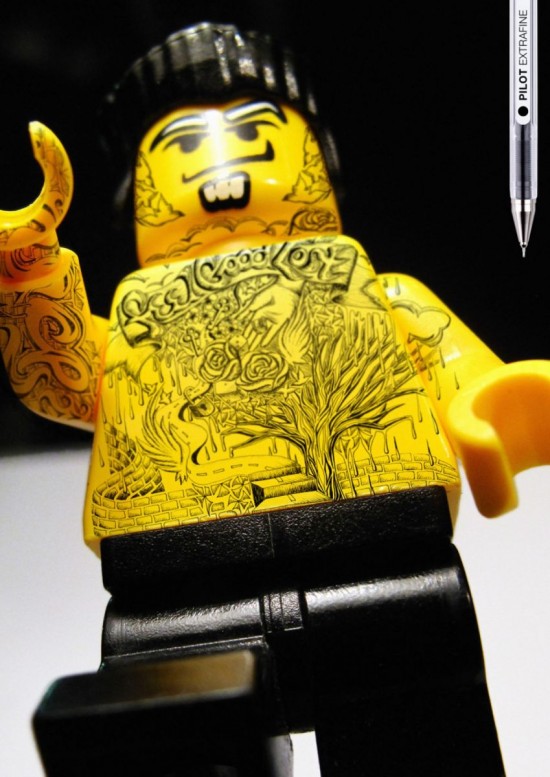
The ad firm Grey Group made a series of LEGO minifigs that look as though they've received tattoos. They're advertisements for Pilot brand ballpoint pens. You can view several more images at the link.
Israeli researchers have developed an interface that can be controlled by breathing through the nose. This technology could be used to help people with limited mobility gain more independence:
The "sniff controller," as it is known, is worn externally via a rubber tube not unlike the ones often used in hospitals for patients who need oxygen. The nasal device is not universal, as about a quarter of all people in a healthy control group were found to have insufficient volitional control over their soft palate, the part of your nasal passageway that lets you regulate the strength of your sniffs. But for those with sufficient soft palate control, the sniff controller gave test subjects a new degree of freedom.[...]
The team also created an interface for controlling an electric wheelchair using the sniff detector (two successive sniffs in = forward, two successive sniffs out = backward, etc.) and tested it on ten healthy patients. Again, they found that after a bit of practice the control group could easily navigate the wheelchair, so they put a man paralyzed from the neck down in the driver's seat. To their amazement, they found that after just 15 minutes a paraplegic can become quite skilled at navigating a wheelchair using the sniff detector.
Nick Homer and Stewart Clyde, students at Brigham Young University, built a motorized couch and started driving it around campus:
Two twelve volt car batteries power the broken wheel chair moving the couch. It's a pretty stable ride and the BYU students who made it have been riding in comfort through Provo. But, they aren't getting a warm welcome from BYU campus police. Motorized vehicles are banned on campus.
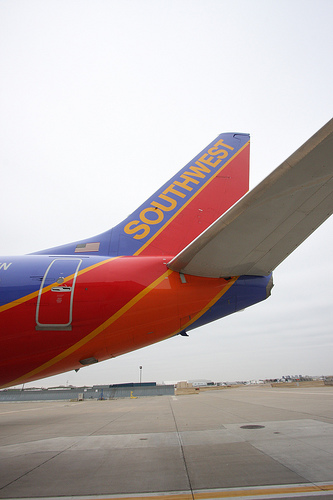
A woman flying on standby on a Southwest Airlines flight was removed from the plane because one passenger needed two seats:
A petite Sacramento woman was bumped from a Southwest Airlines flight to make room for an extra-large 14-year-old child who required two seats.
The 5-foot-4, 110-pound woman, who was flying standby from Las Vegas to Sacramento, was buckled up and ready to go when the teen arrived late to the gate, reported the Sacramento Bee.[...]
Southwest generally requires large passengers to buy two tickets. But in this case, the child's parents had purchased only one.
Link via Say Uncle | Photo by Flickr user Cordey used under Creative Commons license
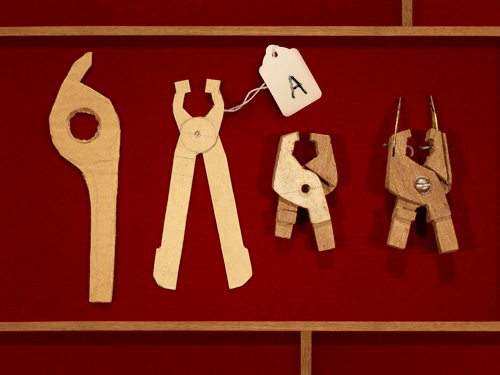
Jim Gorman of Popular Mechanics took a look at some of the early schematics and prototypes for the popular Leatherman Multi-Tool developed by Tim Leatherman in the 1980s. Pictured above are cardboard cut-outs and wooden models that Leatherman carved during the design process.
Artist Clëmence Joly knitted a scene from a butcher shop and put it in a shop window in London. Her project is called "The Wool Butchery" and you can view a gallery of eighteen images at the link.
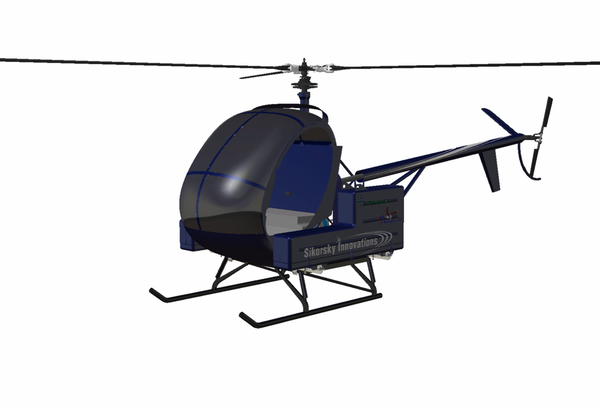
Pictured above is an artist's conception of Sikorsky's new project. The Firefly, if successful, will be a full-sized helicopter that is powered entirely by electricity:
The Firefly is built around the existing S-300C helicopter, a popular two-seat trainer design that was originally built by Hughes Aircraft in the 1950s. The existing 190-horsepower, four-cylinder gasoline engine has been replaced with a 200-horsepower electric motor. Powered by lithium ion batteries, the Firefly will feature new cockpit displays, as well.