In Vampire Energy, Good Magazine and Nigel Holmes take a look at "stand-by power" or how much electricity is used by all the electronics and appliances simply by being plugged in, even if they are not turned on.
Art From Code is a blog by Keith Peters about turning source codes into visual art - he's mum on the process (explained here) but there's no arguing that the results are very intriguing: Link
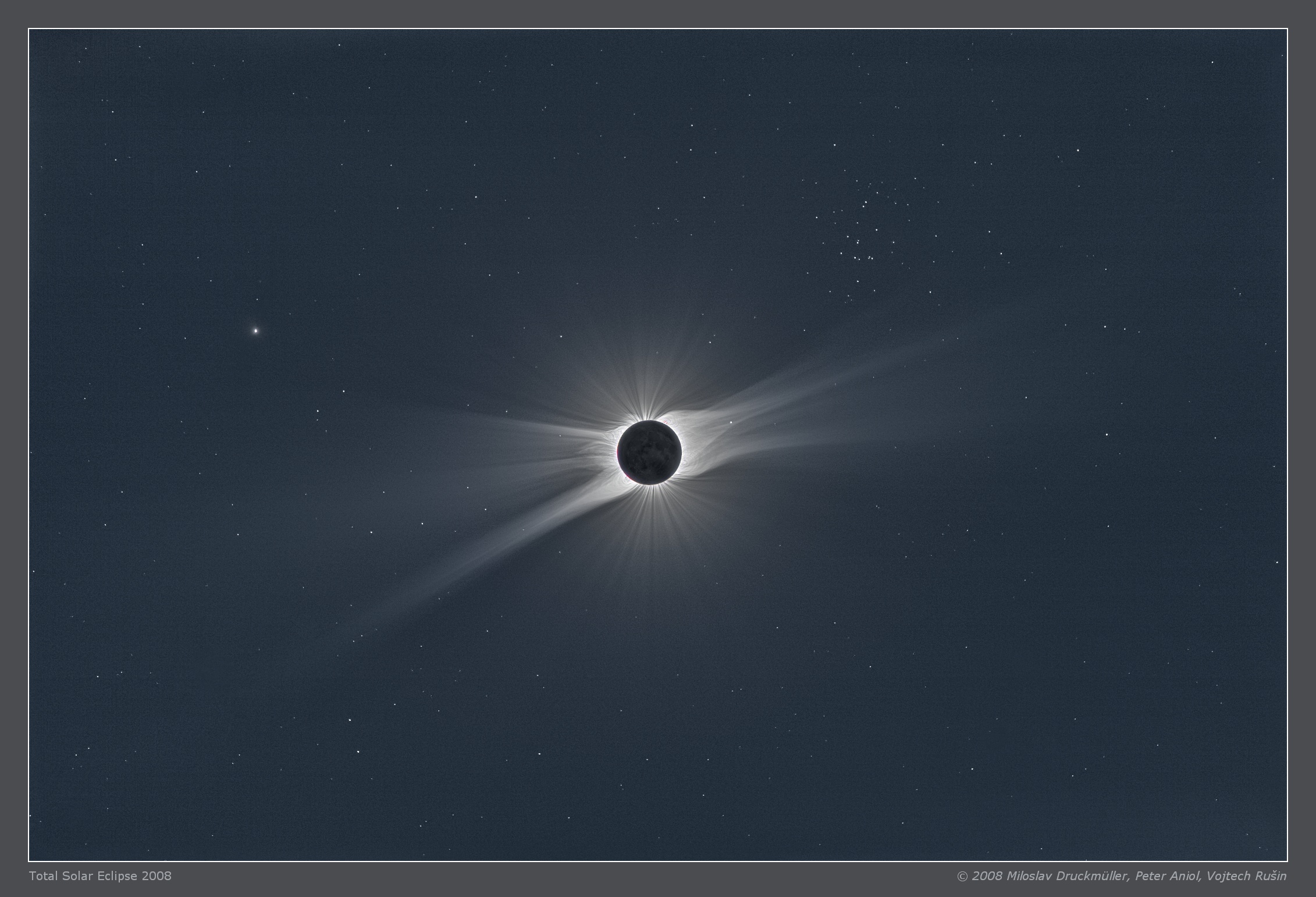
Photo: Miloslav Druckmuller (Brno University of Technology), Peter Aniol, Vojtech Rusin - Biggify here
This has got to be one of the most beautiful photo of a solar eclipse I've ever seen (and the relatively small pic on Neatorama really didn't do it justice). Head on over to APOD to see the big pic:
For a moment on August 1st, the daytime sky grew dark along the path of a total solar eclipse. While watching the geocentric celestial event from Mongolia, photographer Miloslav Druckmuller recorded multiple images with two separate cameras as the Moon blocked the bright solar disk and darkened the sky. [...] the composite presents a range in brightness beyond what the eye could see during the eclipse.
Title: A comparative view of the lengths of the principal rivers of Scotland (with comparative view of the height of the falls of Foyers and Corra Linn), John Thomoson's Atlas of Scotland (1831)
BibliOdyssey blog has a really neat post about ye olden books that are all about comparative heights of mountains and lengths of rivers. The pictures are worth a thousand words, so thankfully, large pics are just a click away:
In what must have been something of a eureka moment of innovation, the originator of the comparative map (rivers, mountains, lakes, islands, continents &c.) presentation style perfectly captured the common ground between science, graphic design and education. It's equally possible to imagine a geographer, artist or teacher having conjured up the idea for such a novel means of data visualisation.
All I could think about when I perused the large pics is this: "Ain't no mountain high enough... Ain't no valley low enough... Ain't no river wide enough..."
This Halloween, don't just settle for that ho-hum jack-o-lantern. Instead, make some fantasy pumpkins like this fantastic carriage pumpkin. Hallmark Magazine has the DIY guide: Link - via Ursi's Blog
Here are my "lazy, no carving required" pumpkins from a year ago: http://www.neatorama.com/2007/11/03/neatoramas-halloween-pumpkin-owls/
Spotted at the Calgary Zombie Walk 2008, here's the Amy Winehouse walking dead. Unfortunately, the health of the real Amy Winehouse isn't too far off from the photo above - via The Seven Deadly Sinners
With all the news of banks imploding nowadays, it's refreshing to read an article about some of the world's oldest surviving banks.
This one above is from Banca Monte dei Paschi di Siena, founded 1472 in Siena, Italy. It is the oldest surviving bank today:
Originally formed as The Monte di Pietà, or Monte Pio, to make loans to the poor out of charity, this is the longest running bank in the world. “Monte,” meaning “heap” or “pile,” referred to the collection of money used for charitable distribution, and the bank truly served to benefit the city’s economy. One interesting historical note is that the citizens of Siena put up income from the land as guarantees against loans for farming and city infrastructure, which led to it being referred to as Monte dei Paschi in reference to the land. Today it stands out as the oldest existing bank in the world by far, and remains an esteemed bank that has branches throughout Italy.
Read about 4 more really old banks here: Link - via Presurfer
Nick and Danielle Bilton made these awesome iPhone App Cupcakes. They took first place at the NYC Cupcake Decorating Championships and Ignite NYC: http://daniellebilton.com/?p=47 - via RuebenMiller
We've probably all played around with a shopping cart in the store's parking lot - but Korean artist Jaebeom Jeong took it a step further: here's Cartrider, a bicycle and shopping cart hybrid!
I just wanted you to know that I've tried hard to avoid the temptation of posting a lot of political stuff on Neatorama because some of you get all worked up in the comment section, but I couldn't resist this one: the winking Republican vice presidential nominee Sarah Palin in LEGO by ochre jelly.
Do you dream in color? Or black and white? It turns out that the color of your dreams is determined by what TV you watched growing up:
While almost all under 25s dream in colour, thousands of over 55s, all of whom were brought up with black and white sets, often dream in monchrome - even now.
Almost six decades ago, when Stanley Miller was just a 22-year-old PhD student, he and his professor Harold Urey did an experiment that became legendary in science: Miller mixed basic chemicals that were present in primordial earth and added electric sparks to stimulate a thunderstorm. The result? Miller found traces of amino acids - the building blocks of proteins.
After Miller died last year, his former student found a (scientific) treasure trove: the vials containing dried samples from his groundbreaking 1950s experiment. And when they tested the samples using today's more sophisticated equipments, they found a lot more stuff:
"We found not only did these make more of certain amino acids than in the classic experiment, but they made a greater diversity of amino acids."
Miller, using the old methods, had found five amino acids; Jeffrey Bada and his teams tracked down 22. What is more, the overall chemical yields were often higher than in the first set of experiments - the mixture appeared to be more fertile.
Professor Bada points out that today, almost all volcanic eruptions are accompanied by violent electric storms. The same could have been true on the young Earth. "What we suggest is that volcanoes belched out gases just like the ones Stanley had used, and were immediately subjected to intense volcanic lightning.
"And so each one of those volcanoes could have been a little, local prebiotic factory. And so all of that went into making the material that we refer to as the prebiotic soup."
There's a new diet fad sweeping through Japan: the Morning Banana Diet, where you eat only bananas for breakfast, then anything you want for lunch and dinner ... and it's making bananas a scarce commodity!
Keiko Akai is very annoyed. The attractive 21-year-old university student has been planning to do a banana diet for some time now, but she can't get started — and not for lack of trying. "I keep going to OK Store, my local supermarket every single day," she says. "In fact, I've just been there. There are no bananas on the shelves, and it's been like that for a month."
Akai has never weighed more than 100 pounds, and is so slim that her waist is swimming in Zara's smallest size XS skirt. She doesn't need to lose any weight. But Japanese girls obsessed with diets tend to jump at any trendy new ones, so, when Akai heard about a popular actress who'd lost 26 pounds through the Morning Banana Diet, she had to try it. And the dearth of bananas as her local supermarket, and many others, is testimony to the popularity of the new dieting fad.