
Most of us are aware, by adulthood, that silica gel is used as a desiccant, or a substance to keep the area around it dry. That's why you see them packed in with all kinds of new purchases, like shoes, pills, snack foods, and electronics. You don't want your stuff arriving moldy or rusted after it's been in a warehouse for a while. I live in a humid area, and sometimes save these packets, thinking they may be useful someday. Then I forget where I stash them, so they never reach a useful number. These little packets of silica gel beads always say "DO NOT EAT" as if they are poison.
But what is silica gel, anyway? You may be surprised to learn that it has properties that make it useful in other applications besides absorbing humidity. A miracle material, indeed. And what's worst that could happen if someone did eat it? After all, the warning looks a bit like a challenge to people who don't like to be ordered around.
Miss Cellania's Blog Posts

Kate Wagner has been suffering from Long Covid and has barely posted anything new at McMansion Hell in the past year, but she's recovering and found a house that just had to be featured. This home in Illinois has a 10,000 square foot interior and is for sale for $2.5 million. This was obviously custom built to someone's dream vision of luxury living, and conforms to no known rules of architecture. The front entrance seems to be set at a 45-degree angle to the house, but another picture of the rear shows that other parts of the house jut out at odd angles, too. And just what are those columns supposed to be supporting? It's as if the designer demanded all the features they ever admired be included in one building.
But the interior is just as insane. The rooms come in odd sizes and shapes that have no relation to what the space is for. There are ledges and angles and odd windows everywhere, all illuminated by cheap modern light fixtures. The furniture and art is just as weird, but those can be changed. Take a tour of this modern disaster at McMansion Hell.
When all you have is a hammer, everything looks like a nail. Imagine you're Edward Teller and you've spent years of your life probing the mysteries of the atom and finally invented a nuclear bomb. That happened with the Manhattan Project, and resulted in two nuclear bombs that finally ended World War II. What then? The US and the Soviet Union developed more powerful bombs and large nuclear arsenals until the concept of mutually-assured destruction took hold. These bombs were so deadly that neither side could use them as weapons, since that would be suicide.
So what good are these very expensive bomb-splitting weapons if they can't be used in war? Maybe they could be used for infrastructure projects, like digging canals, opening up harbors, oil extraction, or maybe geothermal heat production. What could possibly go wrong? If you've ever wondered what all those underground nuclear tests in the 1960s were for, Kurzgesagt is glad to explain them to us. There's a promotional break from 4:49 to 5:56. The video ends at 11:56.
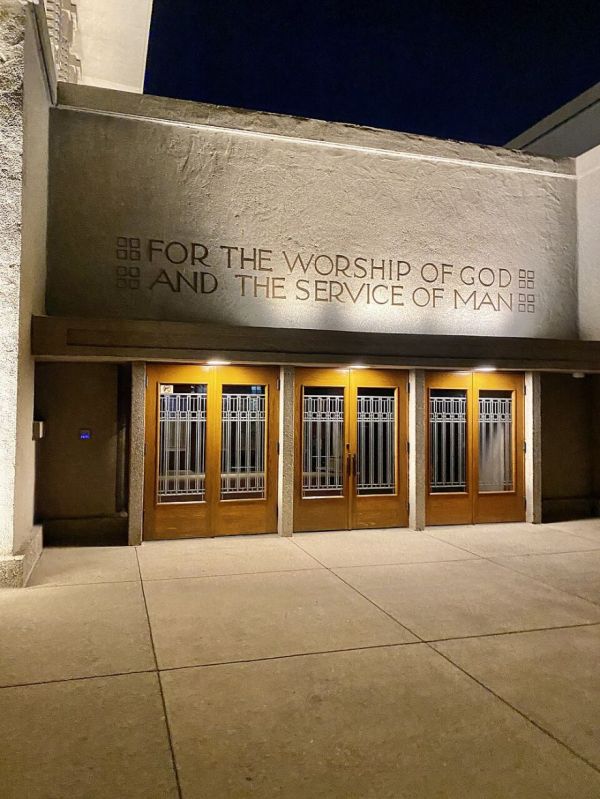
Paul Lukas of Inconspicuous Consumption notices things that other people don't, and in this case he went to great lengths to get to the bottom of the story. The results are not at all earth-shattering, but you have to admire his dedication and research. The picture above shows the entrance to Unity Temple in Oak Park, Illinois. It was designed by Frank Lloyd Wright and completed in 1908, and features a typeface that Wright designed himself. If you study it closely, you might notice that the first "H" is upside down! The horizontal line is supposed to be above the midpoint. The other two "H"s are oriented correctly. How did that happen?
Lukas dug into the history of the building and found that the letters have been removed and replaced several times, and were even stolen once. The only thing to do was search historical photos to find out when and how it happened. But those photos over the past century showed that there were sometimes more than one "H" installed upside-down, and an "S" was also an occasional victim! Lukas was able to reconstruct a timeline of the lettering over the 120 years of the temple, and it's a wild story.
There's a part two, but it's paywalled and not crucial to the story. That said, after looking at so many pictures of type, I am personally bothered by the inconsistent kerning, especially in the word "SERVICE." -via kottke
(Image credit: w_lemay)
It may seem a little premature to get nostalgic about the internet of 20 years ago, but it's normal. In the 1970s, we all watched a TV show (Happy Days) that harnessed nostalgia about the 1950s only 20 years earlier. That said, the history of the internet can be a little jarring. Back in the 2000s (no one really calls them the aughts), graphics were rough, users were naive, and goofiness was everywhere. It was a lot of fun!
Then came algorithms, social media, SEO, and endless advertising. The sites that were the most fun were bought up by corporations. Paywalls went up. Personal data became a commodity. Influencers made money by making you feel inadequate. Spam and viruses gave way to bots. And then there's artificial intelligence. But let's not think about those things- Weird History is glad to take us back to the days of flourishing creativity and goofiness in the 2000s. This video has a promotional break from 5:18 to 6:29.
Through most of history, people developed regional accents from talking to the people around them. Then movies and TV helped to flatten those accents as people were exposed to the way Hollywood talks. Then we got the internet, which shattered the shared media landscape, and allowed like-minded people around the world to find each other. So now instead of accent being a matter of geography, it is a more likely a matter of media choice.
In this world, there arose a way of speaking that is termed the "lifestyle influencer accent," which is designed to create intimacy and engagement for SEO purposes. A subset of this accent is the "lip filler accent," which is when people speak as if they have had their lips filled even if they haven't. The procedure changes the way someone moves their mouth and affects their speech. In that online world, word pronunciation spreads virally, and people who are too young, or too broke, to get lip fillers, end up sounding like the people who've had it done. Read how the lip filler accent came about and what it means for English linguistics. -via Nag on the Lake
We've posted about some really strange airports before, but that's mainly because they are scary. The geography of the world doesn't adapt to the needs of air travelers, yet people want to flly to remote places. Ercan International Airport in Cyprus, on the other hand, is weird merely because it's caught in a political no man's land. The history of Cyprus is like a lot of other country's histories: ruled by the Greeks, the Romans, the Ottoman Empire, the British Empire, then left to their own devices, which can open up ancient rivalries and prejudices. In Cyprus, independence led to a split between the ethnic Greeks and the ethnic Turks, and the formation of Northern Cyprus, which is not recognized as a country by the UN. That designation puts the Ercan International Airport in a weird spot, as Half as Interesting explains. The video is only six minutes; the rest is promotional.
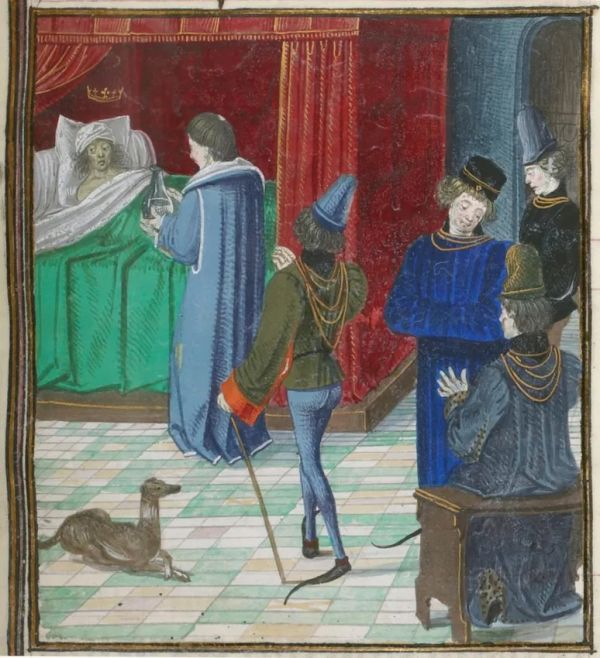
In the winter of 1393, the young French king Charles VI (previously at Neatorama), who was known to be mentally ill, became convinced that he was made of glass and ordered iron rods sewn into his clothing in order to protect him from breaking. His was the first documented case of what became known as the "glass delusion." Over the next several centuries, there would be plenty of others. The glass delusion varied, as some thought their bodies were glass pitchers or lamps, some felt they were encased in glass, and some believed they had glass inside of them. They were all terrified of being shattered.
Then the glass delusion died out in the 19th century. Some believe it came about because glass was the most technologically magic material available during those years, and this delusion was later replaced by the scarier materials of the modern world. Read up on the rise and fall of the glass delusion at the Public Domain Review. -via Messy Nessy Chic
Despite the fact that they will soon rise up and kill us all, this robot is pretty darned neat. It has only two legs, but it moves amazingly well, just like a certain roadrunner cartoon character we are all familiar with. Roadrunner uses its powered wheels to move in dual mode, inline mode, and even balances on one wheel. It never needs to turn around, because forward, backward, and sideways are human constructs. Then it can lock its wheels and just walk like a human, which includes navigating stairs and ramps. Can Roadrunner dance? Of course! It wouldn't be a robot demonstration without a little dancing.
You might wonder what good all this is. Besides the research in kinetic movement, this kind of locomotion would come in handy for wheelchairs and bomb disposal units that need to negotiate rough terrain. Unfortunately, its first real use would more likely be offensive battle. -via Born in Space

Accounts of how sperm whales give birth are pretty rare, and video from the event is even rarer. But in 2023, a research boat in the Caribbean studying whale communication noticed some odd calling between whales and grabbed their camera drones for deployment. What they found was astonishing, and was published in two scientific journals yesterday.
The actual birth took about half an hour. Then the whales took turns, in groups of two or three, lifting the newborn above the water with their bodies, for several hours until the calf was able to swim on its own. These were whales known to the researchers, and they identified them as the calf's grandmother, sisters, and aunts, plus a second family of sperm whales. Most of those involved were female. After the blessed event, the researchers went back and analyzed the sounds made, which is why the papers are only published now. See video clips of the whales supporting the newborn calf at AP news.
The Gregory Brothers and friends sing a little song about the Maspeth neighborhood of Queens, New York. They call it the "Bermuda Triangle" of the city, because there is a 60th Street, 60th Avenue, 60th Lane, 60th Road, 60th Place, 60th Court, and 60th Drive. No wonder you can't find anything, including a way out. It's a catchy song.
But why is Maspeth like this? It's not like Peachtree in Atlanta, where everyone wants to live or work on Peachtree. The wacky numbering system goes back to the turn of the 20th century, when New York City annexed Queens. The city wanted to lay a logical grid of numbered street names like they did in Manhattan, but the geography of Queens was not amenable to the logic of the system. Streets run along longitude lines, and avenues run along latitude lines. But Queens already had plenty of streets. There's a real explanation for the streets named 60th in Maspeth, and good luck understanding it. -via Laughing Squid

The Roman Empire mined gold in Spain by digging shafts and tunnels deep into the mountains. This yielded gold, but not as much as what came after. At the same time, they built aqueducts and diverted mountain runoff water to the hilltops. When they had enough water, they would flood the shafts and tunnels until the pressure split the mountain open! The fallen rock could then be sifted for gold. The technique was called ruina montium, or the wrecking of mountains. The tons of gold they recovered ended up stamped with Caesar's likeness, and the mountains still show the scars 2,000 years later.
The mountains shown above are Las Médulas in northwestern Spain, where the mining technique and the aqueducts still remain. It is a UNESCO World Heritage Site. Read about the wrecking of the mountains and what it left behind, with plenty of pictures, at Amusing Planet.
(Image credit: Udri/CC BY-NC-SA 2.0
There are two main reasons to buy Peeps. Either you are filling an Easter basket for the kids, or you have a great idea for a funny diorama and don't want to mold clay figures. But around Easter, they are sitting there in a store, five or ten in a box, at a rather low price, and your mouth waters at the anticipation of a sugar rush. By the time you get to the third one, you're full of regret.
But did you know that before 1955 Peeps had wings? They were works of confectionary art that really looked like cartoon chicks. But that's neither scalable nor affordable. The family that runs the Just Born company were inventors as well as confectioners, and they figured out how to get Peeps made in a hurry at mass scale- but they had to lose the wings. That made Peeps what they are today- an Easter tradition made of sugar and air that you can either eat or keep from year to year.
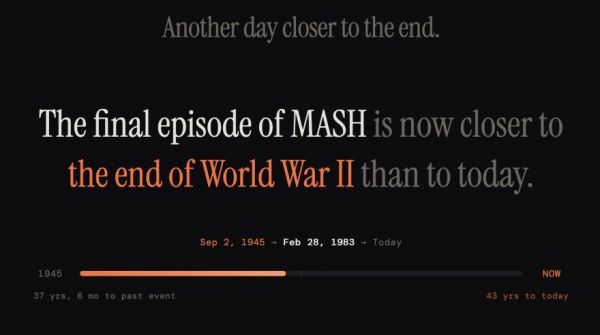
Does it ever feel to you that time is accelerating as you age? It happens to all of us. My mother used to say that life is a like a roll of toilet paper- it goes faster as you get closer to the end. The web toy Another Day highlights this time distortion by calculating how old the pop culture of your life really is. The first episode of South Park is closer to the moon landing than to today. The release of Toy Story is closer to the attack on Pearl Harbor than to today. The birth of Wikipedia is now closer to the release of Star Wars than to today. Well, pop culture sticks around, and if it's good, several generations will enjoy it. But you can put your own birthday into the calculator and feel really old.
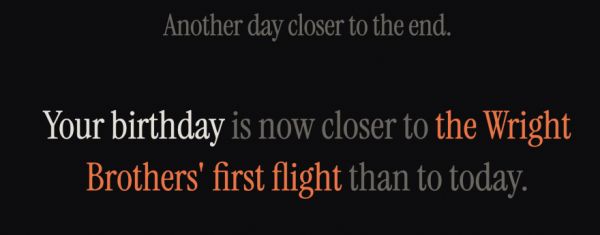
Oh dear. I may have to go lie down for a while. The relevant discussion at Metafilter might make you feel even older.
Passover is the Jewish festival that celebrates the exodus of the Hebrews from Egypt. It begins at sunset on April 1st and continues through sunset on April 9th, and just in time we get the traditional song parody from the Jewish a cappella group Six 13 (previously at Neatorma). This year, it's a medley of Michael Jackson hits with new lyrics that explain the history that led to the holiday and the traditions of the Passover seder, from the wine to the bitter herbs, all created with nothing but the human voice.
The songs included in this video are "Billie Jean," "Wanna Be Startin’ Somethin’," "Beat It," "Smooth Criminal." and "Man in the Mirror." I would have included at least one song from The Jackson Five, but those songs are older than any member of the group. Maybe next year. Send this song to anyone you know who is celebrating Passover and wish them Chag Pesach Sameach!