
Two guys who go by the name Taste Buds came up with the most enjoyable (to produce) YouTube series imaginable. They embarked on a quest to try the food of every country in the world, without leaving New York City! They pick countries pretty much at random and go to a different restaurant every week. Does New York City have a restaurant from all of the 195 nations on their list? They've found 21 so far, and we haven't seen any evidence that they've ever picked a country that's not represented by some eatery.
At each restaurant, they explain their project and get the VIP treatment. They ask questions about the cuisine while they eat their way through several dishes and quite a few drinks. It would take a week to recover from such excess. I'm quite envious. The last time I was in New York, I managed to eat from a non-American cuisine for every meal, but it was only for a few days (I've done the same in Washington, DC). Now I'm craving Hungarian goulash, but I'll have to make it myself.
You can see videos from all 21 restaurants so far at YouTube. -via Laughing Squid
Miss Cellania's Blog Posts
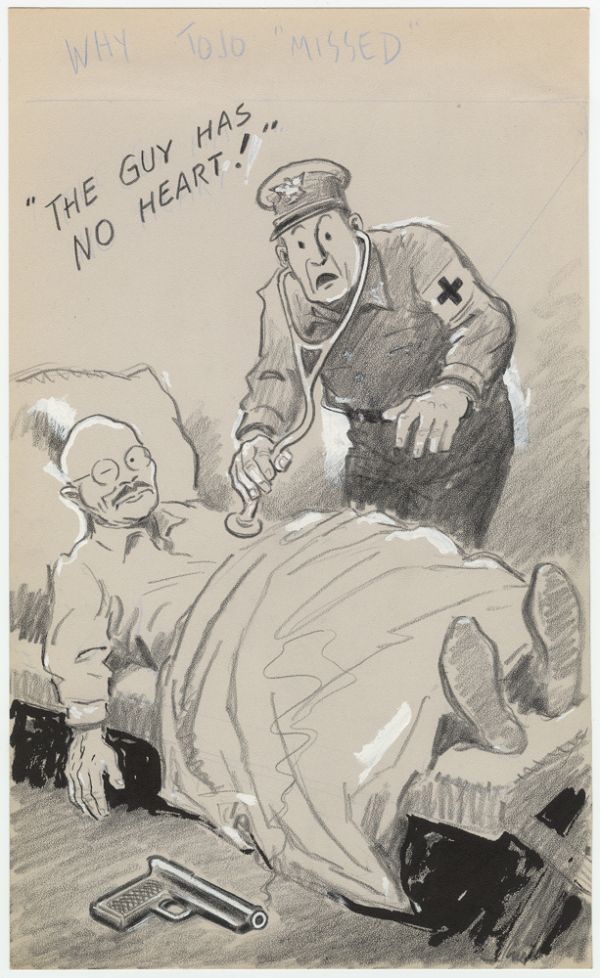
If you know anything about General Hideki Tojo, it's that he commanded the Japanese military during World War II. He rose through the ranks to become commander of the army, and also served as Japan's prime minister from October 1941 to July 1944. Tojo was thrown out of office a year before the war ended, and was retired in Setagaya, Tokyo, when Americans came to arrest him in on September 11, 1945.
Tojo didn't plan to give them the satisfaction. He shot himself in the chest as they approached his house. But the bullet missed his heart, and Tojo was saved by the ultimate indignity- blood transfusions from American donors. The general was then kept in prison for months and went on trial for war crimes, which lasted another three months. During this time, Tojo received complete medical care, including dentures to replace his rotten teeth. He refused a full set, since he knew he would ultimately be executed, but the dentures he received included another indignity from the Americans, in the form of a Morse code message embedded in them. Read about his life, arrest, and the words that Americans put in Tojo's mouth at Utterly Interesting.
(Image credit: SMU Central University Libraries)
Pancreatic cancer is one of the most deadly cancers, with a 13% survival rate at five years. But the ability of scientists to custom-design therapeutic vaccines using mRNA technology may change that. A trial from Memorial Sloan Kettering Cancer Center enrolled 16 patients with pancreatic cancer. After surgery, material from their individual tumors was studied to design an mRNA vaccine specifically for them, which could teach their bodies to recognize the exact cancerous cells that made up the tumor, wherever they occurred in the body. The vaccines were used alongside standard treatments of immunotherapy and chemotherapy. Of those 16 patients, half showed responses to the vaccines by producing more of certain kinds of T-cells.
Six years later, only two of the eight patients whose bodies did not respond to the vaccines are still alive. But seven of the eight who produced more T-cells have survived! This is a remarkable finding, since cancer cells are the body's own cells, and finding the slight difference between what the immune system should attack and what it should not is a major undertaking. Even more fine-tuning of the customized vaccines may raise the success rate. As it is, those involved want to expand trials to more patients. Read more about this research at Memorial Sloan Kettering Cancer Center. -via kottke
(Image credit: Miguel Tremblay)
The long-awaited Coyote vs Acme is finally going to see the light of day. Based on a 1990 story, the film is a combination of animation and live action, and it's a courtroom drama. The Coyote, after untold disappointments in their products, is suing the Acme corporation. As you might guess, not all the action takes place in the courtroom, because it wouldn't be the Coyote we know without a lot of destructive chaos.
Warner Bros. seemed to be against this film from the start. First, they put limitations on their cartoon characters. Then they declined to move ahead with the movie. Years later, they approved a different script. Coyote vs Acme was completed, and got great reviews from anyone at previews or test screenings. However, in 2023, Warner Bros. announced it would not be released, drawing a lot of backlash from fans. They later said it could be released if the producers could find another distributor, but they also demanded too much money from anyone willing. Finally, in 2025, Ketchup Entertainment got a deal. Coyote vs Acme will open in theaters on August 28. -via Metafilter
We don't know exactly what's going on in someone else's mind, but we can take a guess based on their behavior. That goes for primitive species like worms with few neurons, up through animals with many neurons, to humans, who have taken the concept of "mind" a lot further. Yet we still don't know where to draw the line on which animals have "minds" as we think of them. Heck, we can't even define "mind" as opposed to sentience, self-awareness, and consciousness.
Humans, with the most complex of all brains, have managed to use our collection of neurons to develop and understand higher concepts like empathy, morality, art, fiction, prediction, language and math, long-term planning, and civilization itself. We've become pretty good at telling others what's on our minds, although we still cannot totally experience the way someone else thinks. Kurzgesagt gives us a brief tour of how brains differ between species and how more complex brains work. There's an ad from 4:44 to 6:00. The video ends at 10:42.
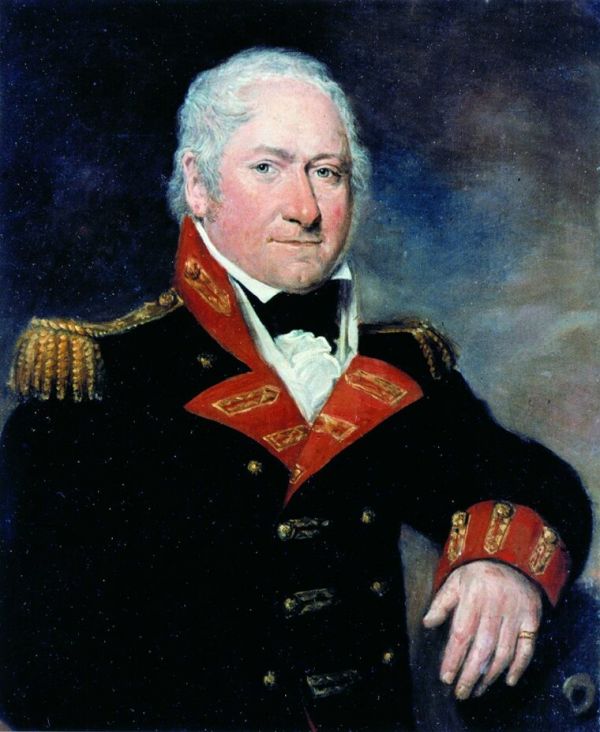
"Shrapnel" is a war term for broken pieces of a bomb or mortar that rip through a human body at a high speed and cause all kinds of damage. It sounds like it evolved from "scrap," but it actually comes from Lieutenant-General Henry Scrope Shrapnel of the British Army. Oh, was Shrapnel the first person to be wounded by shrapnel? No, he more or less invented it.
In 1784, Shrapnel began experimenting with making artillery infinitely more damaging (on his own time and his own dime), and invented a cannonball that was also a bomb filled with round bullets, or shot. The bomb's fuse was timed to explode when the projectile neared its target. He called it a "spherical case shot," but soldiers called it a "Shrapnel shell." They rained havoc on uncounted personnel during World War I.
As artillery was improved and became even more deadly, the Shrapnel shell was discontinued. But the pieces of shell that ripped through soldiers' bodies became known as shrapnel, and the term stuck. -Thanks, WTM!
Don't call a plumber! All you need to unclog a stubborn drain is something you already have around the house ...eggs! Lots and lots of eggs. By the time you get to the end of this tutorial, you'll start to fear an egg shortage. Or maybe this guy has his own chicken coop and few neighbors to give eggs to. But at least, you'll be slightly entertained.
The YouTube channel HowToBasic (previously at Neatorama) most often gives us recipes, with similar results, but this time they went in another direction. This has to be a riff on those ads you see about why you should put oil in your toilet or aluminum foil on your door knobs. I still don't know those things because I am well aware that if I click on the ad, I'll be led down a 45-page primrose path of more ads. At least this video gets to the point quickly. -via Boing Boing
Thirty years ago yesterday, the movie Mystery Science Theater 3000: The Movie opened in theaters. You might not remember it at all, because it went to video after a short theater run that made a million dollars against a $5 million production budget. What happened?
In the '90s, getting into theaters was the ultimate goal for any entertainment franchise. MST3K had been on TV for eight years, and had built a following of loyal fans. Why not make the leap to the big screen? But then they had to deal with Hollywood producers, who wanted all the jokes to appeal to a mainstream audience, and MST3K's success was due to the show being completely out of the mainstream. There were other factors that make the movie difficult that you can read at Inverse. Despite the lost money, the movie wasn't really a disaster, and fans now consider it a pretty good TV episode.
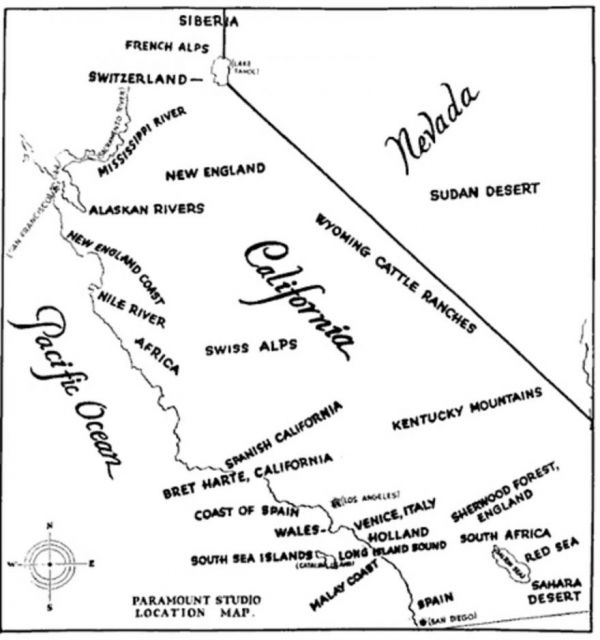
The Golden Age of Hollywood came about when synchronized dialogue came to theaters and there were five big studios cranking out fantasies for the masses. One of the benefits of the industry being centered in southern California was the access to many types of locations. In 1927, Paramount Studios developed this location map showing what California landscapes could be used for faraway movie settings. No need to send a cast and crew overseas to recreate the Sahara Desert or a South Sea island! The audiences wouldn't know the difference, since they'd never been to those places.
But do these locations really resemble what they portrayed? Peter Atwood found photographs of the California spots labeled on the map and constructed another map with them. How plausible they are depends on how familiar you are with the real location. The picture of "Kentucky" looks like nothing I've seen in the state; your mileage may vary. Of course, in the 21st century, movie budgets often allow for shipping an entire production overseas, which can actually be cheaper than filming in California. See the two maps together here. -via kottke
A chimpanzee is sent on a long deep space mission to find a habitable planet for earthlings to colonize. The fact that the astronaut is a chimp is a nod to our human habit of outsourcing our most mundane and dangerous work. The astronaut and the mission are both named HOPE-65, and she's from a long line of chimps specially trained for this kind of task. We can assume there is no question of ever coming back, no matter what she finds. We don't know how the all previous missions went, but this one found a planet, with oxygen, water, and life! The real question is- is this really a suitable planet for colonization by humans?
HOPE-65 is a 2026 senior film project from the French art school Brassart-Grenoble, specifically the students in the 3D animation and video effects department. You can read more about the film at Kuriositas. -via Nag on the Lake

The remains of a Neanderthal infant were found in a cave in Israel, dating back more than 50,000 years. The skeleton, named Amud 7, was surprisingly complete, and yielded some surprising findings. The growth of the teeth showed that only two had erupted, making the child around six months old at death. But the size of the brain case and the limb bones indicated a child that would be around 12-14 months old! The bones of Amud 7 were compared with known specimens of Neanderthal children who were somewhat older at death, and the conclusion is that Neanderthal children grew at an astonishing rate in the first year.
The energy demands of such growth imply that nutrition was abundant where they lived. Neanderthals began eating solid food at about six months, just like ancient and modern homo sapiens. We don't yet know if Neanderthal children may have started walking at a much earlier age. But is this "abnormal" in the line of human development? It's possible that the line that became homo sapiens is the outlier in that human infancy is longer than it could have been. Read more about Neanderthal babies at ZME Science. -via Damn Interesting
(Image credit: AI/ZME Science)
When I first moved to my current home, my neighbors were up in arms because my ten-year-old was out in the creek turning rocks over to find crawfish. Didn't I know that's not safe? Honestly, I wouldn't have expected anything less from her. Many people who grew up as free-range children lament the regimented lifestyles of today's youngsters, because it can result in anxious young adults ill-equipped to navigate the world. But we won't be going back to those days. Back then, there was safety in numbers, and now you can't even find other children except at school and play dates. Kids still need time, freedom, and risk to develop competence and confidence. So what can we do?
One thing we can do is replicate some of the elements of free play and exploration with designed spaces that are less sterile and obvious and more open to imagination. Children want to try things they've never done before, and it helps if they get to figure it out themselves. This TED-Ed lesson looks at some of the factors that go into slightly risky play that helps children develop their own agency. The downside is that these kinds of playgrounds will inevitably cost money to use.
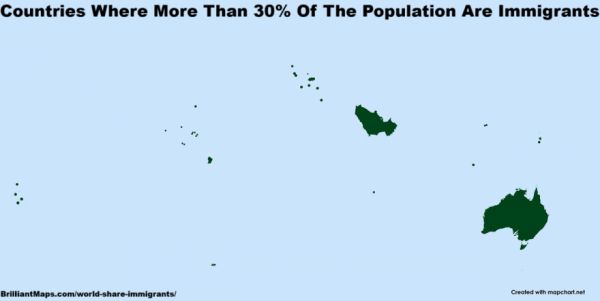
When you think of immigration, you have to consider why someone would want to move to a different nation, which almost always involves the promise of a better life. The nations of the world vary greatly in population, from city-states like Singapore and Vatican City to giants like China and India, so a map or list using percentages can be surprising. Brilliant Maps sorted all this out, and their results seem to show that people tend to move to smaller countries. This is a bit deceiving, since one person moving to a tiny country shifts the percentage more than one person moving to a huge nation. But you may still be surprised. There is one country on earth that is 100% populated by people born elsewhere, and you might be able to guess which it is. There's also one country that has no immigrants. The United States is nowhere near the top nor the bottom.
The image above showing the nations with more than 30% immigrants has two sizable countries. In Saudi Arabia, native-born citizens are supported by oil money through the government, so they hire people from other countries to do the work (smaller oil states do likewise). Australia just seems like a great place to live, despite the deadly wildlife.
Besides the maps, there is an accompanying list of countries ranked by the percentage of immigrants, which also tells you where people want to live if they have the opportunity, the guts, and the wherewithal. -via Nag on the Lake
The Garpenberg Zinc Mine in Sweden stretches to 1,120 meters (3,675 feet) below sea level, and even further from the earth's surface. The company that owns the mine, Boliden, thought "Hey! let's host a foot race down there!" And the idea of the World's Deepest Marathon was born. It happened last October, when 55 runners took off, wearing helmets with lanterns, and ran 26 miles in the darkness. The temperature stayed at 75°F and the humidity was at 72%. No electronic devices were allowed, so they ran in silence as well as darkness. To make 26 miles, they ran from one end of the mine to the other and back, eleven times.
James Mason hadn't run a marathon in ten years, but he was intrigued by the idea and entered. He had never been inside a mine, though. The race was very different, because there was no music, and no scenery- just gray walls every inch. Mason was amazed to find himself crossing the final finish line first! He tells us about his experience at The Guardian. -via Metafilter
The title is "She Holds Me Like This." Is it a love song or a cry for help? The song sounds like the cat is having the time of his life, while the expression on his face ranges from terror to anger to resignation. You know how cats are- some of them would rather die than admit they are enjoying your company, even when they very much do.
A bangin' song, a black cat, wrestlers, musicians that include a penguin, and unhinged animation make for an earworm. This is Frugit, who is both a musician and a cat who works in a biscuit factory. Another song makes it clear that he has a great relationship with his human, but like any cat, he has days when he thinks the world is against him. Frugit can be philosophical, and he knows how to relax like nobody's business. See more of Frugit's animations, musical and not, at Instagram.