Miss Cellania's Blog Posts

Looking Beneath the Veneer of a McModern Slopcore House

Last year, Kate Wagner of McMansion Hell introduced us to the concept of the McModern, a new, larger, glass-enclosed version of the mid-century modern home built for rich people, but not designed as well as the originals. She now shows us the perfect example, a home for sale for $6 million, and she hates it.

Wagner hates this home because it is totally form over function. And the form isn't even all that great, as the rooms are a postmodernist vision built of fake materials. It may look like concrete, but it's a printed surface on something else. Stone is made of aluminum. Everything is too big because that means more expensive. And it resembles an institution of some sort. Even the staging is fake, with furniture Photoshopped in, giving the illusion of a house made of artificial intelligence. 

You might like this home at first glance, but the more you see, the less you want to consider living there. And Wagner's poetic critique will help you recognize what is wrong with such houses forever after.  


Evidence That Will Ryker is the Best Star Trek Character

Star Trek: The Next Generation aired from 1987 to 1994. When it debuted to much hype, fans of the original Star Trek series from the 1960s were eager to see what else happened with Starfleet. As the characters were introduced, we could see their type and purpose. They had a captain who was a wise, experienced, and stern leader, a woman doctor, her teenage son who was a prodigy, a tough woman security officer, an android, and a blind engineer. Then there was First Officer Will Riker, who was obviously there as the everyman male viewers could relate to, and eye candy for some of us. 

But Riker proved to be so much more throughout the series. The Art of Storytelling lays out in detail how Riker was the moral center of the show from the very beginning, displaying honor, loyalty, responsibility, and a willingness to set his own ego aside for the greater good. But he was no Pollyanna, and had flaws that made him only seem more real to those who were paying attention. He confronted his self-doubt and human desires often. This video is a bit longer than I would normally share, but it's from The Art of Storytelling, so you know it's worth it. -via Laughing Squid  


The Name is Off-Putting, but Cybertongue Can Save Milk

A breakthrough in testing may have a global impact on the infrastructure we've built in dairy processing. When dairies produce milk, it is tested for protease, an enzyme that breaks down proteins. Protease is important for digestion, but it's not great for commercial milk supplies. Some milk products are more sensitive to protease than others. The problem is that protease testing normally takes about three days, and by the time the results get back, that milk has already been designated for fresh milk, UHT milk, yogurt, cheese, or other products. 

UHT milk, the shelf-stable kind that needs no refrigeration, is not all that popular in the US, but globally it makes up more than half of all milk purchased. It is particularly important in countries that do not have reliable refrigerated transportation and storage. UHT milk is also the milk product that is most sensitive to protease. A new testing process called Cybertongue, developed by PPB Technology in Canberra, Australia, can detect the amount of protease in milk in just three minutes! That means that milk with more protease can be diverted to make products like cheese that are less sensitive, or it can be treated with protease inhibitors. Milk with little or no protease can be made into UHT milk, which would extend its shelf life. The innovation could cut into the millions of tons of milk that are wasted every year. Read about Cybertongue and what it can do for the dairy industry at the Australian Broadcasting Company.  -via Metafilter 

(Image credit: Per Meistrup


World Cup Visitors' First Impressions of the US

Soccer fans (not FIFA fans) from all over the world are arriving in the US to attend the World Cup games, and for many, it's their first trip to America. Games are being held in the US, Mexico, and Canada. They've seen a lot of American culture in movies, but finding out it's all real is a different experience. What is impressing them the most? Our food! 

We often think of American cuisine as a mix of dishes from everywhere else, but in the US, we manage to put our own spin on it, and that's something you can't learn from the movies. Visitors are amazed by the size of our drinks, Taco Bell, Waffle House hash browns, french fries, gravy, and most of all, ranch dressing. You have to wonder what the rest of the world actually eats. I'm sure they will go home with an extra few pounds as a souvenir.   


The Fierce Warrior Women of the Medieval Era

Women as foot soldiers were not common the medieval era. After all, someone had to stay and tend the farm, the children, and the infirm while armies marched off to war. But when an invading army approaches the farm or the children, women can fight with a fierceness that defies all reason. In the case of royalty and the aristocracy, battles between nations often became personal, and queens, countesses, and duchesses were quite willing to command armies to defend their families and kingdoms. 

Jeanne Laisné grabbed an axe and defended the town of Beauvais, France, against invading Burgundians and became in inspiration to the townspeople. Tomoe Gozen was a distinguished horsewoman, archer, and swordswoman who fought in the Genpei War in Japan. Queen Matilda of Boulogne led supporters  against Empress Matilda to secure her husband King Stephen's release from bondage in the English civil war. And contrary to the first paragraph, a Viking woman named Lagertha fought so bravely as a foot soldier that king Ragnar Lodbrok married her. Medievalists.net brings us the stories of 15 medieval warrior women who led armies and defended kingdoms.  -via Strange Company 


A Song Composed and Played With No Musical Instruments

Andy Brewer is an audio engineer and composer. He was playing around with pink noise, what we lay people would call static or just noise, on an equalizer and found he could extract musical notes from it with a little work. Could he play a song using just those notes? It would be a song without a voice or musical instrument. Yes, he could, although it was a lot of work. You wouldn't be able to do this if you didn't know a lot about music already. This song is technically "electronic music," and it's what a synthesizer (which is a musical instrument) does, although Brewer didn't use a synthesizer; just an equalizer. 

Music buffs in the comments said this is an additive synthesizer or a subtractive synthesizer. I don't know which is correct, but it took many people many years to develop the music synthesizer, while Brewer started from almost nothing and figured it out on his own. I'm impressed. The song is quite pleasant, too. -via kottke 


Frances Farmer: Hollywood's Bad Girl of the 1930s and '40s

The world has always known people who just do not want to be told what to do. Sometimes it can be hard to draw the line between rebellion and mental illness, especially when you throw in exacerbating factors. Frances Farmer was a beautiful woman who became a movie star in the 1930s. Naturally rebellious, she could not abide the Hollywood studio system that had her under contract. They told her what to wear, who to talk to, and even who to marry. They prescribed amphetamines to keep her weight under control. Eventually, it became too much. 

Farmer was arrested several times in the 1940s for various offenses, in which she resisted arrest, even fighting the cops. She back talked a judge in a court exchange that reporters found hilarious. To keep her out of jail, Farmer was sent to a series of mental institutions, where she underwent electroconvulsive therapy, and she came out with stories of neglect, rape, and abuse that were common to such institutions at the time. She still made comebacks, in film, in television, and then on stage, but she never lost her rebellious streak. Read about the crimes of Frances Farmer at Messy Nessy Chic. 

(Image source: Photoplay, January 1937


A Catnip Addiction is Actually Beneficial for Cats

Crazy cat lady that I am, I have a small part of my garden dedicated to catnip (and strawberries; they seem to get along well). The cats like it, and it makes my home the cool place for neighborhood kitties to hang out. But is there any evolutionary reason for cats to go crazy for catnip? Research has isolated the exact compounds that intoxicate cats, nepetalactone in catnip, and nepetalactol in silver vine, another popular cat attractant. 

Not only have scientists found how these compounds affect cats, but also why. It's an adaptive feature of their evolution! Cats rarely pay any attention to plants, but the cats who went for catnip or silver vine were more likely to survive and reproduce millions of years ago until a catnip attraction became quite common among several cat species on the African savannah. This TED-Ed video explains why with some charming cat animation, although you might not like one of the experiments that led to this knowledge. -via Geeks Are Sexy 


That Time a Polar Bear Tried to Attack a Netflix Film Crew

Cinematographer Jamie McPherson took a crew to northern Canada to shoot footage of narwhals for the Netflix documentary series Our Planet in 2017. In his account of the trip, we will learn more about narwhals than about polar bears, but it was the bear that made the project dramatic. Narwhals gather at the edge of the ice in spring, waiting for the ice to crack so they can reach fishings grounds that were closed to them all winter. The crew got aerial footage in a helicopter, and underwater footage from a specialized crew, but they needed footage from the ground, meaning the ice, to round out the collection. For safety, they were using a boat.

They spotted the polar bear asleep as they prepared to set off in the boat. When the bear woke up and started running toward them, one crew member fired a warning shot to scare it off, but found the gun didn't work. They got the boat into the water in a hurry, planning to put some distance between themselves and the bear. But the boat motor didn't work, either. Since McPherson is telling the story now, you know he survived, and you can read his account at DiscoverWildlife. The moral of the story is to check all your equipment before going on an Arctic adventure. -via Damn Interesting 


The Myth and the Reality of Lover's Lane

The story of Lover's Lane is an urban myth about a couple who goes parking and narrowly escapes a horrible death. What we called "parking" is the custom of young people in a car finding a secluded space to canoodle away from prying eyes, and many towns have at least one road that is famous for such activities nicknamed Lover's Lane. The first part of this video explores the history of how parking itself became a thing. 

Then at about five minutes in, we learn about the very real crimes that may have sparked the urban legend. Or did the urban legend inspire the crimes? Since we don't really know how far back the legend goes, it's not quit clear. But for someone who wants to kill and get away with it, teenagers in a car on a lonely road present a tantalizing opportunity. 

The third section of the video goes into how these crimes and the Lover's Lane legend influenced the modern horror film. That seems only natural, since the target audience for these movies are young people who have the world in the palm of their hands, until they don't.


Juan Romero Carried Guilt Over RFK's Assassination for 50 Years

On June 5, 1968, presidential candidate Robert F. Kennedy made his way through a crowd at the Ambassador Hotel in Los Angeles after winning the California primary. He was shaking hands as a bullet tore through him, and he was dead the next day. The last hand he shook was that of 17-year-old hotel busboy Juan Romero. Romero crouched down beside Kennedy, and became a subject in the photograph that everyone remembers from that day.

That photo brought Romero celebrity, but he had a hard time dealing with it. He was only a teenager, and was wracked with guilt. What if he hadn't gone for a handshake from Kennedy? Would the bullet have missed him? It didn't help that other people were thinking the same thing, and let him know about it. Romero lived with the "what ifs" for the next fifty years, until his death in 2018. But he eventually made peace with history, and was even able to talk about it. Read Romero's account of what happened that day, and how he dealt with the aftermath at Utterly Interesting. 

(Image credit: Sven Walnum


Science Fiction vs. Physics: The Lightsaber Question

When a cool science fiction weapon sticks around for half a century and gathers more and more fans and more fiction, there will be people who put way too much thought into it. The lightsabers from Star Wars were born out of a cool special effect, but now everyone wants one, or at least wants to understand them.   

What happens if you drop a lightsaber? Specifically, what happens if you drop one vertically, business end first, into the ground. Would it keep burning its way through the earth indefinitely? In the Star Wars universe, no, because there's a safety feature that disables the blade when it's not held. But there have been depictions of Jedi throwing lightsabers, so this feature apparently can be disabled. So what would happen in the real world? Rocket Riley goes through all the ways a lightsaber would act on earth, if there were such a thing. -via Laughing Squid 


Pics or It Didn't Happen: Child Labor in America

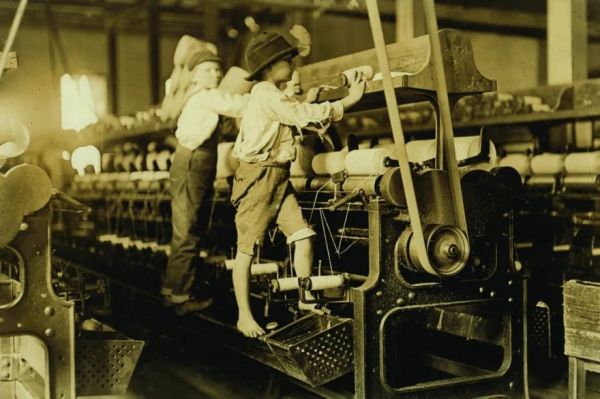
Around the turn of the 20th century, about two million children in America younger than 15 were full-time workers. Some were a lot younger than 15, and they worked dangerous jobs, sometimes 12 hours a day or more, just like their parents. The photo above shows two boys at a cotton mill in Georgia. An adult working this machine would have their feet on the floor, but children were assigned such work because they had smaller hands and arms that could manage the machines better. And of course, they weren't paid much. 

The National Child Labor Committee was formed in 1907, and they commissioned sociologist and photographer Lewis Hine to document the practice in 1908. Hine knew that nothing would move popular opinion like a photograph. Factory overseers knew it, too. He had to sneak into workplaces, pretending to be an inspector or a Bible salesman to gain access, and he often took notes with his hands in his pockets to avoid detection. Hine's photos taken between 1909 and 1911 shocked the country, and led directly to the first federal child labor law in 1916. See samples of Hine's child labor photographs that led to changes in the system at Smithsonian. 


Rory the Bengal Cat Talks Back

First, you watch the video because cat, but wow, what a fine looking cat. Then you are impressed by her behavior. Rory (short for Aurora Borealis) is a four-year-old Bengal cat with nice markings and stunning aqua blue eyes. But Rory is more than her looks. She understands the English language better than you can imagine! That's because her person has so many delightful activities and rewards that go with those words. Or is Rory just a magical being trapped in a pretty cat body? She responds to a variety of commands, and she talks back, too. You have to wonder whether she's giving her own commands when she speaks. And since we don't understand, who are the real dumb animals here? 

Rory takes that in stride. She has her mom wrapped around her little paw, and she's living a good life, chasing a plastic propellor around the house and impressing the internet. See more of Rory at her Instagram page. 


What a Massive Dose of Psilocybin Did for an Alzheimer's Patient

A case study from Brazil offers a tantalizing possibility for treating dementia with magic mushrooms. A woman in her 80s suffering from advanced Alzheimer's disease had been incontinent for five years, did not initiate conversation, and only spoke in monosyllables. Her medical guardian gave permission for a dose of hallucinogenic mushrooms. She was given five grams of mushrooms containing psilocybin, which is a massive dose, much more than in other such experiments. 

After sleeping for 19 hours, the patient woke and began talking to herself. Over the next few days, she began speaking to others in complete sentences, controlled her bladder, and was even able to dress herself! The effects were lasting, too. She was given a second three-gram dose a month later, and showed even more improvement. The data from this one patient is a little sparse, as they didn't do any brain scans before and after treatment, but it may lead to more such experimentation. Read more about the magic mushroom treatment at Science Alert. 

-via Damn Interesting 

(Image credit: Cannabis Pictures


Email This Post to a Friend

Page 1 of 2,643       next | last

Profile for Miss Cellania

  • Member Since 2012/08/04


Statistics

Blog Posts

  • Posts Written 39,636
  • Comments Received 109,665
  • Post Views 53,316,494
  • Unique Visitors 43,866,616
  • Likes Received 46,475

Comments

  • Threads Started 5,003
  • Replies Posted 3,739
  • Likes Received 2,794
X

This website uses cookies.

This website uses cookies to improve user experience. By using this website you consent to all cookies in accordance with our Privacy Policy.

I agree
 
Learn More