The Bible says in Matthew 24:36 "No one knows about that day or hour, not even the angels in heaven, nor the Son, but only the Father." That never stopped people from trying to predict when the world will end. Smithsonian has a list of ten predicted apocalypses from ancient times to 2009 (when this list was first published).
An Assyrian clay tablet dating to around 2800 B.C. bears the inscription: “Our Earth is degenerate in these later days; there are signs that the world is speedily coming to an end; bribery and corruption are common; children no longer obey their parents; every man wants to write a book and the end of the world is evidently approaching.”
The world hasn't changed much since then; everyone still wants to write a book. Link
Barak Hardley decided to draw all the presidents. Some he drew more than once, some are actually sculpture, but these are not your everyday presidential portraits. He drew Jimmy Carter as a vampire, Richard Nixon as Mr. Potato Head (the view from the rear is even more interesting), and Warren G. Harding as a samurai warrior. See all the illustrations at 50yearplan. http://50yearplan.com/?cat=9 -via Everlasting Blort
One way mammals are different from most animals is their large brains, in relation to the rest of the body. A new study says that the larger brains were developed for the sense of smell. CT scans of 190-million-year-old mammal fossils indicate that much of the the brain growth was in the area dedicated to the sense of smell.
"We studied the outside features of these fossils for years," said Tim Rowe, professor in the Jackson School of Geosciences and director of the Vertebrate Paleontology Laboratory at The University of Texas at Austin, and lead author of the new study. "But until now, studying the brains meant destroying the fossils. With CT technology, we can have our cake and eat it, too."
According to the study, other factors leading to larger brains in early mammals included greater tactile sensitivity and enhanced motor coordination. Fossils of some of the earliest mammals, such as Hadrocodium, bore full coats of fur, explaining the need for enhanced tactile sensitivity.
Researchers scanned a dozen early mammal fossil and more than 200 current species over ten years for this study. Link -via Geeks Are Sexy
Clive Thompson gave in and chatted with “babygurl01475,” who had been trying to engage him for a couple of days. He spoke of technological philosophy while "she" tried to get his credit card number. Apparently, babygurl01475 was bored to death. Link -via Boing Boing
Sheng Xianhui of Kunming, China went into a hospital to have gall stones removed. A week after surgery, his wife noticed a tattoo on his rear end. Sheng claims that the staff at Yunnan Stone Disease Hospital tattooed his backside with characters meaning “stone disease” while he was in surgery.
The hospital has now called police to try to evict Sheng - but he has welcomed the police involvement and asked them to investigate.
"I'm not leaving," he said. "I'm worried that if I go out for even half an hour, the hospital will claim I had the tattoo done outside.
"But even if I wanted a tattoo, I wouldn't want those characters and I wouldn't want it on that part of my body."
The hospital staff blames the marks on a possible allergic reaction. Link -via Dave Barry
Vaudeville makes a modern comeback! Tuesday's game between Clemson and Davidson was delayed by rain, so the players jumped into the gap to keep the fans amused. -via Metafilter
A litter of kittens was dumped at a concrete factory in Redruth, Cornwall, England. They were taken to an animal shelter named Cats Protection. The staff fed the kittens and washed them, but one is still stained pink -and will be until her fur grows out. So they named her Pink Panther!
She was rescued by workers along with her two sisters and a tom cat - called Clouseau, Dusty and Cerise. It is thought that they came into contact with red pigment used in concrete manufacturing which had caused their unusual appearance.
The dying is less obvious in three of the cats but Pink Panther has a creamy fur so she appears bright pink.
Attempts have been made to wash the dye out because different variations of red are seen as 'danger colours' to animals but they failed.
Instead, Cats Protection manager Claire Rowe says they will have to wait until the pink fur has grown out.
She said:'They are absolutely adorable, but Pink Panther is probably the pick of the bunch. It's amazing. Until we washed her we had no idea what her natural colour was.
When gasoline was rationed or nonexistent during World War II, many cars were converted to run on firewood. The trend is making a comeback of sorts as gas prices rise higher and higher. See some of these cars and find out how it's done at Low-Tech Magazine. Link -via the Presurfer
Cog railways can travel up steep hills and mountains because of an extra rail underneath with teeth. Cogwheels on the train itself fit into those teeth and keep it pushing upward. Some of these railways have been in service over a hundred years in the Alps and the Rockies! Take a closer look at how they work and see some spectacular photographs at Dark Roasted Blend. Link
Redditor suziecreamcheese made this quilt for a baby shower. Each quilt block is a representation of a Beatles album cover. I think she nailed the White Album, don't you? Link -via Blame It On The Voices
Since the dawn of time, people have found nifty ways to clean up after the bathroom act. The most common solution was simply to grab what was at hand: coconuts, shells, snow, moss, hay, leaves, grass, corncobs, sheep’s wool—and, later, thanks to the printing press—newspapers, magazines, and pages of books. The ancient Greeks used clay and stone. The Romans, sponges and salt water. But the idea of a commercial product designed solely to wipe one’s bum? That started about 150 years ago, right here in the U.S.A. In less than a century, Uncle Sam’s marketing genius turned something disposable into something indispensable.
How Toilet Paper Got on a Roll
The first products designed specifically to wipe one’s nethers were aloe-infused sheets of manila hemp dispensed from Kleenex-like boxes. They were invented in 1857 by a New York entrepreneur named Joseph Gayetty, who claimed his sheets prevented hemorrhoids. Gayetty was so proud of his therapeutic bathroom paper that he had his name printed on each sheet. But his success was limited. Americans soon grew accustomed to wiping with the Sears Roebuck catalog, and they saw no need to spend money on something that came in the mail for free.
Toilet paper took its next leap forward in 1890, when two brothers named Clarence and E. Irvin Scott popularized the concept of toilet paper on a roll. The Scotts’ brand became more successful than Gayetty’s medicated wipes, in part because they built a steady trade selling toilet paper to hotels and drugstores. But it was still an uphill battle to get the public to openly buy the product, largely because Americans remained embarrassed by bodily functions. In fact, the Scott brothers were so ashamed of the nature of their work that they didn’t take proper credit for their innovation until 1902.
“No one wanted to ask for it by name,” says Dave Praeger, author of Poop Culture: How America Is Shaped by Its Grossest National Product. “It was so taboo that you couldn’t even talk about the product.” By 1930, the German paper company Hakle began using the tag line, “Ask for a roll of Hakle and you won’t have to say toilet paper!”
As time passed, toilet tissues slowly became an American staple. But widespread acceptance of the product didn’t officially occur until a new technology demanded it. At the end of the 19th century, more and more homes were being built with sit-down flush toilets tied to indoor plumbing systems. And because people required a product that could be flushed away with minimal damage to the pipes, corncobs and moss no longer cut it. In no time, toilet paper ads boasted that the product was recommended by both doctors and plumbers.
The Strength of Going Soft
In the early 1900s, toilet paper was still being marketed as a medicinal item. But in 1928, the Hoberg Paper Company tried a different tack. On the advice of its ad men, the company introduced a brand called Charmin and fitted the product with a feminine logo that depicted a beautiful woman. The genius of the campaign was that by evincing softness and femininity, the company could avoid talking about toilet paper’s actual purpose. Charmin was enormously successful, and the tactic helped the brand survive the Great Depression. (It also helped that, in 1932, Charmin began marketing economy-size packs of four rolls.) Decades later, the dainty ladies were replaced with babies and bear cubs—advertising vehicles that still stock the aisles today.
By the 1970s, America could no longer conceive of life without toilet paper. Case in point: In December 1973, Tonight Show host Johnny Carson joked about a toilet paper shortage during his opening monologue. But America didn’t laugh. Instead, TV watchers across the country ran out to their local grocery stores and bought up as much of the stuff as they could. In 1978, a TV Guide poll named Mr. Whipple—the affable grocer who implored customers, “Please don’t squeeze the Charmin”—the third best-known man in America, behind former President Richard Nixon and the Rev. Billy Graham.
Rolling the World
Currently, the United States spends more than $6 billion a year on toilet tissue—more than any other nation in the world. Americans, on average, use 57 squares a day and 50 lbs. a year. Even still, the toilet paper market in the United States has largely plateaued. The real growth in the industry is happening in developing countries. There, it’s booming. Toilet paper revenues in Brazil alone have more than doubled since 2004. The radical upswing in sales is believed to be driven by a combination of changing demographics, social expectations, and disposable income.
“The spread of globalization can kind of be measured by the spread of Western bathroom practices,” says Praeger. When average citizens in a country start buying toilet paper, wealth and consumerism have arrived. It signifies that people not only have extra cash to spend, but they’ve also come under the influence of Western marketing.
America Without Toilet Paper
Even as the markets boom in developing nations, toilet paper manufacturers find themselves needing to charge more per roll to make a profit. That’s because production costs are rising. During the past few years, pulp has become more expensive, energy costs are rising, and even water is becoming scarce. Toilet paper companies may need to keep hiking up their prices. The question is, if toilet paper becomes a luxury item, can Americans live without it?
The truth is that we did live without it, for a very long time. And even now, a lot of people do. In Japan, the Washlet—a toilet that comes equipped with a bidet and an air-blower—is growing increasingly popular. And all over the world, water remains one of the most common methods of self-cleaning. Many places in India, the Middle East, and Asia, for instance, still depend on a bucket and a spigot. But as our economy continues to circle the drain, will Americans part with their beloved toilet paper in order to adopt more money-saving measures? Or will we keep flushing our cash away? Praeger, for one, believes a toilet-paper apocalypse is hardly likely. After all, the American marketing machine is a powerful thing.
_______________________
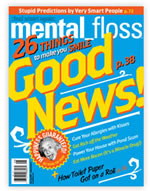
The article above, written by Linda Rodriguez, is reprinted with permission from the Jul/Aug 2009 issue of mental_floss magazine.
Be sure to visit mental_floss' website and blog for more fun stuff!
Get this: According to the 2010 Census report, ten of America's 100 largest cities have names that starts with a "C". How many can you name in five minutes? That's the challenge of today's Lunchtime Quiz at mental_floss. I only got five of them (and would have never come up with the other five). Maybe you will get them all! Link