
Have you ever wondered what makes the famous and expensive Baccarat crystal so special? This pretty video by James Bort following the glass workers who hand craft it may give you some clues. Link
Miss Cellania's Blog Posts
Have you ever wondered what makes the famous and expensive Baccarat crystal so special? This pretty video by James Bort following the glass workers who hand craft it may give you some clues. Link
Jill Harness is getting ready to cover Comic Con this week in San Diego. I hope she brings back lots of pictures! As a preview, she's posted a roundup of quite a few products that will be officially unveiled at, or exclusive to, the convention, like this awesome limited edition Nerd Domo. See the rest at Rue the Day. Link
Jim asked Julie to marry him by creating a website with comics drawn of their lives together. This may sound like something you've seen before, but there are parts along the way that will draw you in and make you wish them happiness forever. A video of her reaction has been added at the end. Link -via the Presurfer
(YouTube link)
Josh proposed to Brook and took the idea of a "leap of faith" to a ridiculous level! I don't think her "No way!" is a rejection; I think she was only shocked and probably trying to lower her blood pressure. -via I Am Bored
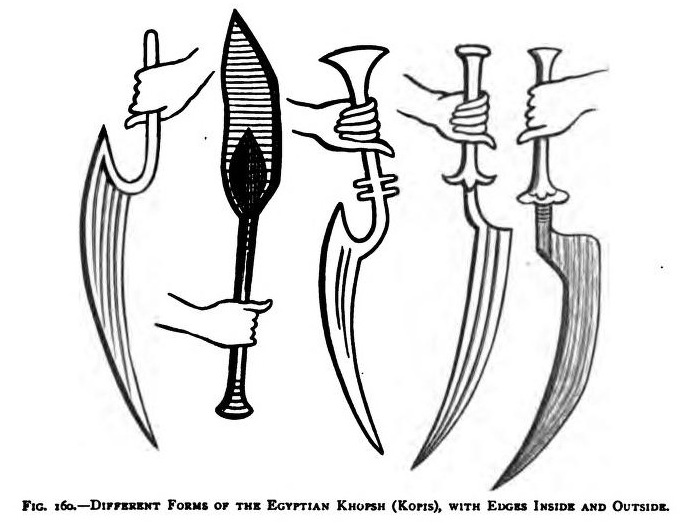
Ancient Arab swords. Note that some designs were more commonly used for decapitation, and other designs less so. Drawing: The Book of the Sword, Sir Richard Francis Burton, Chatto and Windus, London, 1884.
The following is reprinted from The Annals of Improbable Research. Click to enlarge images.
by Simcha Lev-Yadun, Department of Science Education—Biology, Faculty of Science and Science Education University of Haifa, Oranim, Tivon, Israel.
with instructive illustrations and historical documentation selected by Alice Shirrell Kaswell, Improbable Research staff
The global energy crisis and other global changes have been studied from endless points of view. Here, I wish to discuss these matters, and also global ecology, from the point of view of the changing methods of executions, a point of view that has never been studied before.
Ancient Hebrews and Arab Innovations
The ancient Hebrews, living in the barren hill country of Judea and Samaria, executed people by stoning. The rocky, almost tree-less environment explains the use of this execution method. Arabs in the nearby sandy deserts of Saudi Arabia could not stone condemned people to death with sand particles, and instead used to decapitate them with a sword.
At least one form of impalement by stake is thought to be a Turkish innovation. Details here are from The Eastern Question: Its Facts and Fallacies, Malcolm MacColl, Longmans, Green and Co., London, 1877.
Ancient Turkish and Asian Tropical Innovations
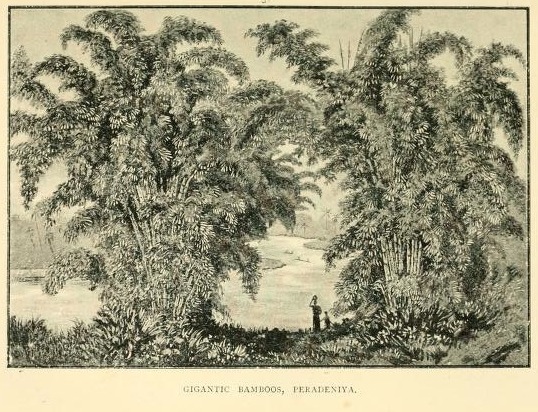
In the Near East, gravity, which comes free of charge, was also used for traditional execution. The Turks, for instance, used to execute by impaling people on a metal spear, a vivid practice known as “Chazuk.” A botanical parallel was in use in tropical regions of Asia, where instead of putting the bound condemned person on top of a spear, he was tied on top of a young palm or a bamboo. The plant shoot, in its search for light, grew quickly (a very relative term for the impaled one) through the condemned person. Such good plant growth was possible in the tropics, but not in the much more arid Near East. We see that when it was possible, biology was used, but when impossible, physics also served the purpose.
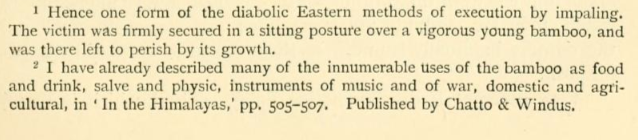
Impalement by bamboo growth originated in regions of Asia that could take advantage of the rapid growth of certain varieties of the bamboo plant. Details shown here are from Two Happy Years in Ceylon, Constance Frederica Gordon Cumming, Chatto and Windus, London, 1893. Be sure to read footnote 1 in this image. (below)
Ancient Roman Innovations
Still in the semi-arid Mediterranean, the Romans, who suffered from the consequences of severe deforestation, conserved good quality timber by the practice of crucifixion. They used wooden crosses repeatedly, and even forced the condemned people to carry the horizontal beam. An alternative tree-based method that saved the trees used in execution was to bend two trees till they were close and tie them with ropes so the ropes prevented them from straightening up. The condemned person was tied to the trees (an arm and a leg to each tree), the ropes holding the trees were cut. The end was quick, and again, there was no waste of timber. medieval European Innovations In then-wooded Medieval Europe, people were executed for centuries by the auto-de-fe, i.e., burnt alive on the stake. This spectacular procedure was carried on till the increasing depletion of the forests was recognized. Thus, in the 18th century, a new method, much friendlier to the environment, emerged: the guillotine. Taking into account the large number of people executed using the guillotine during the French Revolution, the continued use of auto-de-fe would probably have depleted the remaining forests of Western Europe.
The guillotine proved to be an environmentally friendly innovation in France. Drawing: History of the Guillotine, John Wilson Croker, John Murray, London, 1853.
North American Innovations
In a different wooded ecosystem, in North America, before the forests were cut down, condemned people were hanged on trees. Following the forest decline in many parts of the U.S., the electric chair, based on electricity produced from fossil oil or coal, was invented and used. Being industrialized, this method of execution suited the U.S. However, following the energy crisis of the 1970s, among the various measures to save energy, many of the U.S. states decided to use lethal injections.
“The end was quick,
and again, there was
no waste of timber.”
Conclusion: Execution and Conservation
We can therefore see that both regional ecology and environmental changes influenced the methods of execution in various countries and ecologies. In any case, a global trend of environmental conservation along with the exploitation of specific local resources is obvious in this colorful aspect of human culture.
Visit their website for more research that makes people LAUGH and then THINK.
The following is reprinted from The Annals of Improbable Research. Click to enlarge images.
by Simcha Lev-Yadun, Department of Science Education—Biology, Faculty of Science and Science Education University of Haifa, Oranim, Tivon, Israel.
with instructive illustrations and historical documentation selected by Alice Shirrell Kaswell, Improbable Research staff
The global energy crisis and other global changes have been studied from endless points of view. Here, I wish to discuss these matters, and also global ecology, from the point of view of the changing methods of executions, a point of view that has never been studied before.
Ancient Hebrews and Arab Innovations
The ancient Hebrews, living in the barren hill country of Judea and Samaria, executed people by stoning. The rocky, almost tree-less environment explains the use of this execution method. Arabs in the nearby sandy deserts of Saudi Arabia could not stone condemned people to death with sand particles, and instead used to decapitate them with a sword.
At least one form of impalement by stake is thought to be a Turkish innovation. Details here are from The Eastern Question: Its Facts and Fallacies, Malcolm MacColl, Longmans, Green and Co., London, 1877.

Ancient Turkish and Asian Tropical Innovations
In the Near East, gravity, which comes free of charge, was also used for traditional execution. The Turks, for instance, used to execute by impaling people on a metal spear, a vivid practice known as “Chazuk.” A botanical parallel was in use in tropical regions of Asia, where instead of putting the bound condemned person on top of a spear, he was tied on top of a young palm or a bamboo. The plant shoot, in its search for light, grew quickly (a very relative term for the impaled one) through the condemned person. Such good plant growth was possible in the tropics, but not in the much more arid Near East. We see that when it was possible, biology was used, but when impossible, physics also served the purpose.
Impalement by bamboo growth originated in regions of Asia that could take advantage of the rapid growth of certain varieties of the bamboo plant. Details shown here are from Two Happy Years in Ceylon, Constance Frederica Gordon Cumming, Chatto and Windus, London, 1893. Be sure to read footnote 1 in this image. (below)
Ancient Roman Innovations
Still in the semi-arid Mediterranean, the Romans, who suffered from the consequences of severe deforestation, conserved good quality timber by the practice of crucifixion. They used wooden crosses repeatedly, and even forced the condemned people to carry the horizontal beam. An alternative tree-based method that saved the trees used in execution was to bend two trees till they were close and tie them with ropes so the ropes prevented them from straightening up. The condemned person was tied to the trees (an arm and a leg to each tree), the ropes holding the trees were cut. The end was quick, and again, there was no waste of timber. medieval European Innovations In then-wooded Medieval Europe, people were executed for centuries by the auto-de-fe, i.e., burnt alive on the stake. This spectacular procedure was carried on till the increasing depletion of the forests was recognized. Thus, in the 18th century, a new method, much friendlier to the environment, emerged: the guillotine. Taking into account the large number of people executed using the guillotine during the French Revolution, the continued use of auto-de-fe would probably have depleted the remaining forests of Western Europe.
The guillotine proved to be an environmentally friendly innovation in France. Drawing: History of the Guillotine, John Wilson Croker, John Murray, London, 1853.

North American Innovations
In a different wooded ecosystem, in North America, before the forests were cut down, condemned people were hanged on trees. Following the forest decline in many parts of the U.S., the electric chair, based on electricity produced from fossil oil or coal, was invented and used. Being industrialized, this method of execution suited the U.S. However, following the energy crisis of the 1970s, among the various measures to save energy, many of the U.S. states decided to use lethal injections.
“The end was quick,
and again, there was
no waste of timber.”
Conclusion: Execution and Conservation
We can therefore see that both regional ecology and environmental changes influenced the methods of execution in various countries and ecologies. In any case, a global trend of environmental conservation along with the exploitation of specific local resources is obvious in this colorful aspect of human culture.
_____________________
This article is republished with permission from the July-August 2009 issue of the Annals of Improbable Research. You can download or purchase back issues of the magazine, or subscribe to receive future issues. Or get a subscription for someone as a gift!Visit their website for more research that makes people LAUGH and then THINK.
(YouTube link)
The Nelson Mandela Metropolitan University Choir treated unsuspecting shoppers at Greenacres Shopping Centre in Port Elizabeth, South Africa to a concert performance right there in the mall court. The stunt is part of a recruiting drive for NMMU. Link -Thanks, Marilyn!
The Ark in Space has some good news from Afghanistan, dressed up in a wonderful collection of snow leopard photographs.
The welcome discovery in Afghanistan will not take snow leopards off the endangered list, however. The area borders on Tajikistan, Pakistan, and China. If their area can be made into a reservation, they may be somewhat protected. Link -Thanks, RJ!
(Image credit: Flickr user Tambako the Jaguar)
The war torn country is home to a vigorous population of snow leopards. The World Conservation Society recently laid a number of camera traps in the Wakhan Corridor. This mountainous area is a long panhandle in the north east of the country and the camera traps captured snow leopards on film in sixteen places.
This is a remarkable turn out of events as it has been estimated that there are only around seven thousand snow leopards in the world, scattered across a dozen countries in Central Asia. Their habitat is usually over 10,000 feet above sea level but even at these heights snow leopards are often killed by shepherds for harrying their flocks.
The welcome discovery in Afghanistan will not take snow leopards off the endangered list, however. The area borders on Tajikistan, Pakistan, and China. If their area can be made into a reservation, they may be somewhat protected. Link -Thanks, RJ!
(Image credit: Flickr user Tambako the Jaguar)
The following is reprinted from the book Uncle John's Unsinkable Bathroom Reader.
For nearly twenty years after Neil Armstrong stepped onto the moon in July 1969, the Soviet Union categorically denied having a manned lunar program of its own. It wasn't until the late 1980s that we began to learn just how close they came to beating the United States to the moon.
HEARING IS BELIEVING
Not too long after 9:00 PM on the evening of April 11, 1961, a United States government listening post off Alaska picked up the sound of human voices speaking in Russian. That wasn't unusual; in the early 1960s, the Cold War was at its height, and the listening post had been set up for the purpose of intercepting Soviet communications.
But as the analysts studied the transmission, they realized that one of the voices was coming from space -low-Earth orbit to be exact- and the other voices were transmitting from the Baikonur Cosmodrome in Soviet Kazakhstan, headquarters of the USSR's space program. As the entire world would learn in a few hours, the 27-year-old cosmonaut Yuri Gagarin had just become the first human being to fly in space. As was typical with the Soviet space program, the launch had been kept a secret. The signals from space were probably the first inkling the United States had that it had been beaten in the space race once again.
SECOND PLACE
Gagarin had blasted off at 9:07 AM Moscow time on the morning of April 12th (Moscow was 12 hours ahead of Alaska). He made just one orbit around the Earth before landing back on Soviet soil at 10:55 AM. That's not much of a space flight by modern standards, but in 1961 it stunned the world. Just as it had when it launched Sputnik, the world's first artificial satellite, in October 1957, the Soviet Union had demonstrated that it, not the United States, was leading the way into space. The United States wouldn't be able to send an American astronaut, John Glenn, into orbit until February 1962.
JFK's QUERY
No one felt the sting of second place more than president John F. Kennedy. "Do we have a chance of beating the Soviets by putting a laboratory in space, or by a trip around the Moon, or by a rocket to land on the moon, or by a rocket to go to the moon and back with a man?" the president asked in a memo to his vice president, Lyndon Baines Johnson. "Is there any other space program which promises dramatic results in which we could win?"
JFK dispatched Johnson to NASA to get an answer. Wernher von Braun, head of rocket development, suggested that America had a chance of beating the Soviets in a flight around the Moon, but that it had an even bigger chance at being the first country to land a man on the Moon's surface. JFK weighed the options, and on May 25, 1961, made his famous speech committing the United States to landing a man on the Moon by the end of the decade.
NO CONTEST?
On July 20, 1969, the United States won the race to the Moon when astronaut Neil A. Armstrong became the first human being to set foot on lunar soil. But had the Soviets contemplated trying to beat the United States to the Moon? For more than two decades after the Moon landing, the official answer was a definitive, categorical "Nyet!" The Soviets claimed they skipped the Moon race in favor of the more practical challenge of putting a space station into Earth's orbit. And they succeeded- between 1971 and 1986, they launched seven different space stations into orbit.
The Soviets stuck to their we-didn't-shoot-for-the-Moon story until August 18, 1989, when the government's official newspaper, Izvestiya, admitted that the USSR had indeed tried to send a cosmonaut to the Moon, in what was one of the most closely guarded secret programs of the Cold War. They had actually come pretty close to succeeding: Were it not for one large technical challenge that proved insurmountable, the Soviet Union might well have won the race.
Continue reading
For nearly twenty years after Neil Armstrong stepped onto the moon in July 1969, the Soviet Union categorically denied having a manned lunar program of its own. It wasn't until the late 1980s that we began to learn just how close they came to beating the United States to the moon.
HEARING IS BELIEVING
Not too long after 9:00 PM on the evening of April 11, 1961, a United States government listening post off Alaska picked up the sound of human voices speaking in Russian. That wasn't unusual; in the early 1960s, the Cold War was at its height, and the listening post had been set up for the purpose of intercepting Soviet communications.
But as the analysts studied the transmission, they realized that one of the voices was coming from space -low-Earth orbit to be exact- and the other voices were transmitting from the Baikonur Cosmodrome in Soviet Kazakhstan, headquarters of the USSR's space program. As the entire world would learn in a few hours, the 27-year-old cosmonaut Yuri Gagarin had just become the first human being to fly in space. As was typical with the Soviet space program, the launch had been kept a secret. The signals from space were probably the first inkling the United States had that it had been beaten in the space race once again.
SECOND PLACE
Gagarin had blasted off at 9:07 AM Moscow time on the morning of April 12th (Moscow was 12 hours ahead of Alaska). He made just one orbit around the Earth before landing back on Soviet soil at 10:55 AM. That's not much of a space flight by modern standards, but in 1961 it stunned the world. Just as it had when it launched Sputnik, the world's first artificial satellite, in October 1957, the Soviet Union had demonstrated that it, not the United States, was leading the way into space. The United States wouldn't be able to send an American astronaut, John Glenn, into orbit until February 1962.
JFK's QUERY
No one felt the sting of second place more than president John F. Kennedy. "Do we have a chance of beating the Soviets by putting a laboratory in space, or by a trip around the Moon, or by a rocket to land on the moon, or by a rocket to go to the moon and back with a man?" the president asked in a memo to his vice president, Lyndon Baines Johnson. "Is there any other space program which promises dramatic results in which we could win?"
JFK dispatched Johnson to NASA to get an answer. Wernher von Braun, head of rocket development, suggested that America had a chance of beating the Soviets in a flight around the Moon, but that it had an even bigger chance at being the first country to land a man on the Moon's surface. JFK weighed the options, and on May 25, 1961, made his famous speech committing the United States to landing a man on the Moon by the end of the decade.
NO CONTEST?
On July 20, 1969, the United States won the race to the Moon when astronaut Neil A. Armstrong became the first human being to set foot on lunar soil. But had the Soviets contemplated trying to beat the United States to the Moon? For more than two decades after the Moon landing, the official answer was a definitive, categorical "Nyet!" The Soviets claimed they skipped the Moon race in favor of the more practical challenge of putting a space station into Earth's orbit. And they succeeded- between 1971 and 1986, they launched seven different space stations into orbit.
The Soviets stuck to their we-didn't-shoot-for-the-Moon story until August 18, 1989, when the government's official newspaper, Izvestiya, admitted that the USSR had indeed tried to send a cosmonaut to the Moon, in what was one of the most closely guarded secret programs of the Cold War. They had actually come pretty close to succeeding: Were it not for one large technical challenge that proved insurmountable, the Soviet Union might well have won the race.
In 1939, Adolf Hitler commissioned the Friedrich Krupp A.G. company of Essen, Germany to build a gun that would breach the French Maginot line. They responded with the "Gustav Gun," the largest gun ever built.
The description of this gun's destructiveness is at Gizmodo. Link -via the Presurfer
(Image credit: American Rifleman, February 1998)
Named after the head of the Krupp family, Gustav Krupp von Bohlen und Halbach, the Gustav Gun weighed in at a massive 1344 tons, so heavy that even though it was attached to a rail car, it still had to be disassembled before moving so as to not destroy the twin set of tracks as it passed over. This 4-story behemoth stood 20 feet wide and 140 feet long. Its 500 man crew, commanded by a Major-General (that's two stars), needed nearly three full days (54 hours, to be exact) to set it up and prep for firing. But when it did fire, whoowhee, hold on to your hat.
The description of this gun's destructiveness is at Gizmodo. Link -via the Presurfer
(Image credit: American Rifleman, February 1998)
(YouTube link)
In light of the recent fortunes of media mogul Rupert Murdoch, {wiki} here's a 1995 parody of the movie It's a Wonderful Life that inserts Murdoch as the principle character. The sketch is from the BBC TV series A Bit of Fry & Laurie, starring Stephen Fry and Hugh Laurie, but still contains language consider NSFW in the US. -via Dangerous Minds
Here's an online thesaurus that gives you a graphic look at how words relate. Neat! Or otherwise tasteful, refined, clean, tidy, smashing, great groovy, nifty, or keen! Link -via Breakfast Links
It should be apparent to regular readers that we have some Harry Potter fans here at Neatorama. The many posts and tributes are not just because we are obsessed, but the internet that we surf for neat things is wallowing in Pottermania as the eighth and final film of the series hits theaters this weekend. If you enjoy Harry Potter, get your fill while it lasts. For you Muggles who don't, hang on -it will all blow over in just a few days. Meanwhile, we have plenty of things for you to read that have nothing to do with wizards and spells.
Jill Harness looked up 10 of the Most Famous Teachers Ever, some of whom will surprise you!
Eddie Deezen brought us another tidbit from music history in Elvis, from the Waist Up.
From Uncle John's Bathroom reader, we learned the story of The Real Spartacus.
War and Social Upheaval Cause Spikes in Zombie Movie Production was a report from the Annals of Improbable Research.
Mental_floss magazine gave us some draft facts in The Past, Present, and Future of Being Called to Duty.
At NeatoBambino, you still have time to enter the Decipher The Doodle Contest. Give your best shot at figuring out what two children have painted together, and you cold win a t-shirt from the NeatoShop!
The mystery object in the What Is It? game this week is an anti-theft pocket watch attachment! When pulled by the chain the spikes would catch in the fabric of the pocket. You can see an explanatory graphic from the patent application at the What Is It? blog. The first commenter to give us the correct answer was kremer333, so he wins a t-shirt! The funniest answer was from The Professor, who wins a t-shirt from the NeatoShop with this poem:
When you've caught up, you'll always find more great reading material by browsing through The Best of Neatorama. Use the slider to pull up articles from different years, all the way back to 2006!
Jill Harness looked up 10 of the Most Famous Teachers Ever, some of whom will surprise you!
Eddie Deezen brought us another tidbit from music history in Elvis, from the Waist Up.
From Uncle John's Bathroom reader, we learned the story of The Real Spartacus.
War and Social Upheaval Cause Spikes in Zombie Movie Production was a report from the Annals of Improbable Research.
Mental_floss magazine gave us some draft facts in The Past, Present, and Future of Being Called to Duty.
At NeatoBambino, you still have time to enter the Decipher The Doodle Contest. Give your best shot at figuring out what two children have painted together, and you cold win a t-shirt from the NeatoShop!
The mystery object in the What Is It? game this week is an anti-theft pocket watch attachment! When pulled by the chain the spikes would catch in the fabric of the pocket. You can see an explanatory graphic from the patent application at the What Is It? blog. The first commenter to give us the correct answer was kremer333, so he wins a t-shirt! The funniest answer was from The Professor, who wins a t-shirt from the NeatoShop with this poem:
On Neato a picture that shows
A thingy that nobody knows
But this handy device
While it looks not so nice
Is great for just cleaning your nose!
When you've caught up, you'll always find more great reading material by browsing through The Best of Neatorama. Use the slider to pull up articles from different years, all the way back to 2006!
The first Harry Potter book came out in 1997. In the 14 years since then, some of the many fans of the book and movie series have tried to bring the world of the young wizard and his friends to reality. Take, for example, the sport of Quidditch.
Read about the other things from Harry Potter that have become a part of the real world at Ranker. Link -Thanks, Brian!
There is, in fact, an ACTUAL National Quidditch League and an International Quidditch Association. They even have a World Cup (like in Harry Potter and the Goblet of Fire). The International Rules are based on a game devised at Middlebury College in 2005, and it's now the basic model used throughout the United Kingdom, the United States and much of the rest of the world. Obviously, no magical Golden Snitches (which are supposed to be quasi-sentient, flying balls) are available, so instead individual players take on the role. Everyone is still required to run around on brooms, however.
Yes, that's right. People are running around on brooms in this sport, kind of like our grandparents used to do with those toy horses that freakishly were just a creepy-looking, lifeless, severed horse head at the end of a broom handle.
Read about the other things from Harry Potter that have become a part of the real world at Ranker. Link -Thanks, Brian!
Did you hear the one about the state that tried to make pi equal to 3.2 -by law? It's not a joke. It happened in Indiana in 1897.
It can't be done, but you don't have to be a math whiz to be a state legislator. Besides, Goodwin had his reasons for pushing the bill to redefine pi. Read all about that strange episode at mental_floss. Link
The story of the “Indiana pi bill” starts with Edward J. Goodwin, a Solitude, Indiana, physician who spent his free time dabbling in mathematics. Goodwin’s pet obsession was an old problem known as squaring the circle. Since ancient times, mathematicians had theorized that there must be some way to calculate the area of circle using only a compass and a straightedge. Mathematicians thought that with the help of these tools, they could construct a square that had the exact same area as the circle. Then all one would need to do to find the area of the circle was calculate the area of the square, a simple task.
It can't be done, but you don't have to be a math whiz to be a state legislator. Besides, Goodwin had his reasons for pushing the bill to redefine pi. Read all about that strange episode at mental_floss. Link
(YouTube link)
Kyle Jones set an iPhone inside his guitar to record video while he played. The distorted appearance of the strings is due to the rolling shutter effect, and is not exactly representative of how plucked strings look. -Thanks, Larry Colwell!
Email This Post to a Friend