
British builder Tommy Lynch woke up one morning after sleeping for 14 hours straight. A friend woke him up after being concerned that Lynch had slept so long, and found that Lynch was blue. That wasn't anything to do with his mood, but because his skin had turned an alarming shade of blue! They went directly to a hospital, where Lynch was given oxygen while being examined.
The first thing you think of when someone turns blue is a lack of oxygen. But Lynch didn't seem to have trouble breathing, despite his anxiety over his blue skin. You might assume it was due to colloidal silver, which was touted as a cure-all a few years ago, and turned some people's skin blue. Lynch had not been using colloidal silver. The cause of his malady was discovered in the emergency department, quite by accident. Read his story at People magazine. -via Fark
Miss Cellania's Blog Posts
In the event that you haven't seen any of the nominees for Best Picture at the 2026 Academy Awards, you might learn enough about them from the annual Honest Trailer to form some kind of opinion on who should win. Don't laugh, I have seen exactly none of them, but I probably will catch a few in the next couple of years on TV. Whether I will make that effort at all depends on who wins and what Screen Junkies can tell us about them. The only one that has been recommended to me is Sinners, but they are all rated pretty highly.
There's plenty of fun in the Honest Trailer. I'm going to put "Thousand Island stare" in my backpack to pull out at the proper time. That's golden. The best part is at the end, where they make a supercut showing how all these movies are the same, or at least incorporate all the same elements. The 98th Academy Awards will be bestowed this Sunday night.

We have long been fascinated with falling cats and their ability to land on their feet. So much so that we've dropped an astonishing number of cats in the name of science over the centuries. Even after the development of high-speed photography, experts disagree on how they do it, but there are several theories, including the “tuck and turn” model, the “falling figure skater” explanation, and the “bend and twist” method. My favorite is the "propeller tail" concept.
Recent research gives credence to the tuck and turn theory. The study began with a truly terrifying phrase in which each word is worse then the one before, until you get to the end: "A team of Japanese scientists removed the spines from five donated cat cadavers," and placed them in a twisting device. The researchers then moved on to live cats, but they neither had their spines removed nor were they put into a twisting device- they were just dropped, which is bad enough. The cats landed on their feet, and showed a marked preference in turning to their right. Learn more about this important research at Ars Technica. -via Damn Interesting
(Image credit: Yasuo Higurashi et al., 2026)
The 1927 German silent movie Metropolis gave audiences of a hundred years ago a fantasy glimpse a hundred years into the future. So what does Fritz Lang's vision mean in the world of 2026? The movie was groundbreaking in its special effects, and influenced all science fiction films that came afterward, and indeed filmmaking itself. The plot was more political, and wasn't all that impressive to viewers of the time. Reviews were mixed, and H.G. Wells called it "silly." Yet modern audiences recognize historical events that came afterward in the movie's elements.
The influence of Metropolis on later science fiction films is undeniable. It gave us the classic humanoid robot, cities with flying vehicles, and the mad scientist, not to mention innovative filmmaking techniques still used today. We'd all know that already, if we were inclined to sit through several hours of a black and white movie with no voices. DW History and Culture takes us through the history of Metropolis and why it still relevant today. -via Laughing Squid

Two million years ago, the area of France that became Le Puy-en-Velay was a huge lake with a volcano. As molten rock rose through the volcano, it cooled, shattered, collapsed, fused, grew, and became a volcanic plug. Over time, the volcano eroded away and the lake dried, leaving the volcanic plug looming above the town of Le Puy.
In 951 AD, Bishop Godescalc wanted to celebrate his return from a pilgrimage by building a shrine atop the plug. At the same time, Local cathedral dean Truannas also wanted a chapel up there, in gratitude that the village survived a plague. Together, they oversaw the beginnings of Saint Michel d'Aiguilhe, or St. Michael of the Needle. The only way to get to the chapel is by climbing 268 stairs, yet plenty of people do it. It's no wonder they added living quarters for the serving priest. Read about Saint Michel d'Aiguilhe and see plenty of pictures at Kuriositas.
(Image credit: PMRMaeyaert)
A couple of other platforms I use (not Neatorama) are always asking me to use AI to write a blog post. That seems infinitely silly because if I typed up what I wanted it to write, the post is therefore written. That's understandable because I am a blogger. But social media and even my email service wants me to use AI, and I just don't wanna. I know how to write a letter to communicate. Ryan George explains what could go wrong, and it's a lot.
No, I don't like artificial intelligence, and I don't like reading what AI has written. However, there are some uses for AI writing that may actually be helpful. A relative in the medical field has some AI program translate her notes into a report that a client can understand. Sure, she could write it herself; she's quite literate, but AI saves her time. Still, she reads the finished product for accuracy before sharing it.
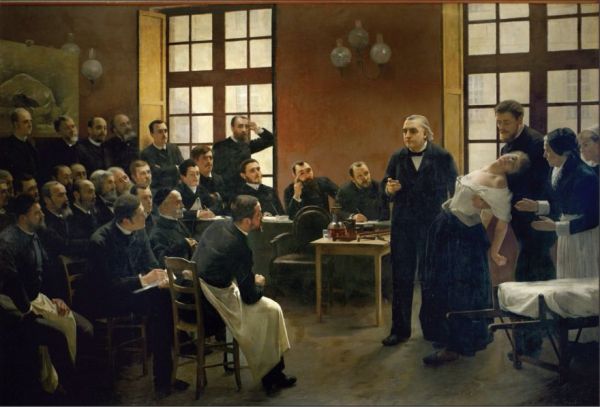
Through much of human history, men have been confounded by women. Men were (are often are still) seen as the default, and women as an inscrutable variant. So if something were wrong, or even just different about women, it must have something to do with their uterus. The word "hysteria" came from the Greek word for womb, hystera, and the malady called hysteria meant a uterus that moved about in the body, wreaking havoc on the other organs.
Doctors knew so much about hysteria that they put on public demonstrations of women displaying it with fainting and seizures, and came up with all sorts of remedies. Later on it was dubbed a mental illness, and became a catch-all diagnosis for women who experienced pain or "inappropriate" emotions. However, the symptoms of hysteria are easily explained by either real physical ailments men rarely suffered, society's unrealistic expectations for women's behavior, or a mental illness that would be likely be further explored in a man. Read the history of hysteria at Mental Floss.
(Image credit: André Brouillet)
An important part of most marriage vows is the limiting phrase "'til death do us part." That wouldn't be applicable at all when you marry someone who is already dead. In France, that was made legally possible in 1959. The case that changed the law was a disaster in Fréjus in which André Capra was killed and his fiancé Irene Jodart was not. Jodart was pregnant, and the press raised a lot of sympathy for her. President DeGaulle got involved, and new law was enacted to allow her child to be classified as legitimate.
Once the law was passed as a kindness to Jodart, the floodgates were opened and others filed for marriage to someone who was already dead, creating a new class of instant widows. The reasons ranged from the understandable to the bizarre, and not every case was accepted. Read about the French posthumous marriage law at Weird Universe. -via Nag on the Lake
A handheld rocket launcher is bad enough, so how about one that carries three rockets at a time? The YouTuber called Current Concept has a 3D printer and plenty of time, so that seemed like a challenge- the kind that will get you a knock on the door from some government agency. Still, he started out knowing nothing about rockets, so the main part of the story is figuring out how his rockets failed so hilariously. And they failed in every kind of way.
The next challenge was to design the revolver, which he skips through quickly. Maybe it's because he didn't want anyone to try this at home for national security reasons, but I believe it's because it wasn't quite as funny as the rockets. The rocket revolver finally worked! And you'll be glad to hear that the only one injured was himself.
There's a sponsor message from 4:28 to 5:13. -via Born in Space
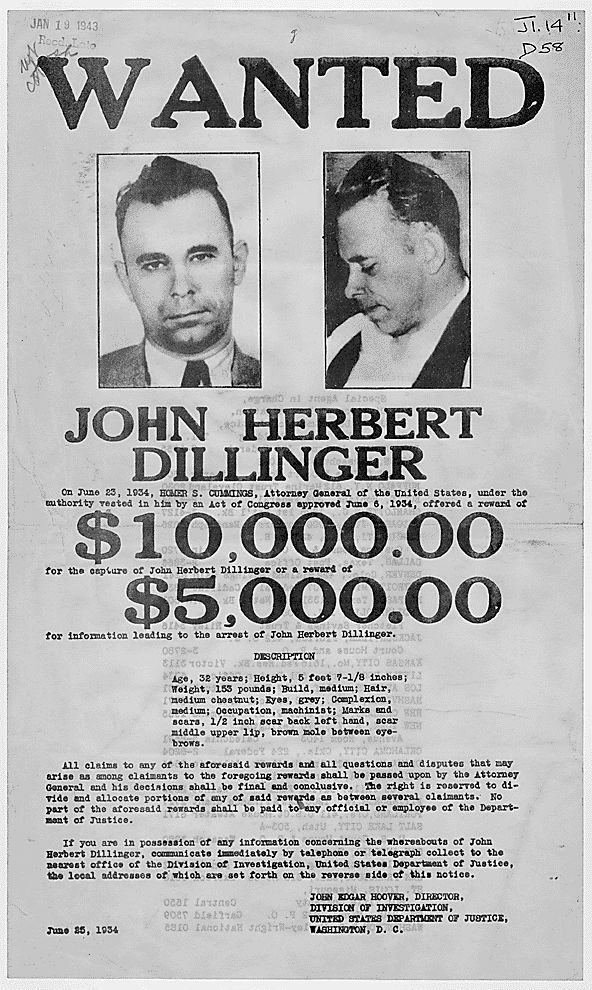
In January of 1934, John Dillinger was arrested in Arizona and extradited to Indiana, where he was lodged ion the Lake County Jail at Crown Point. The jail had a reputation as being extraordinarily secure. Another notable fact was that Lake County, which operated the jail, had a woman sheriff, which was quite rare at the time. Extra personnel were assigned to Dillinger. A few weeks later, he made his escape.
Dillinger pressed a gun into the back of a trustee, who became his hostage. Dillinger then locked the guards in a cell and took possession of their machine guns, and escaped in the sheriff's car. Dillinger was on the loose for 141 days before he was killed by federal agents outside a movie theater in Chicago. So how did he pull of the jailbreak? The "gun" he initially used turned out to be carved from wood, but we don't know if Dillinger made it himself. He had to have help, at least with arranging for the sheriff's car to be available. There were plenty of suspects, but no one was ever convicted of helping in the escape. Read what we know about Dillinger's jailbreak at Utterly Amusing.
(Image credit: U.S. National Archives and Records Administration)
This creek in a New Jersey forest has concrete walls on both sides that extend for miles. People on both sides noticed a fawn that had fallen in, and wasn't able to scale the wall to get back out. He was pretty small, and was injured besides. Local people kept returning to the site to see if he was still there, and that went on for two weeks. It became clear he wasn't going to get out on his own, so they called The Last Resort Wildlife Refuge. Nancy Warner responded and took stock of the situation. This would require some work. A carpenter and crew built a custom set of stairs for the deer! A bit of time and some deer chow, and the stairs did their work. The two weeks the deer spent by himself in the ravine were recovery time for the injury, and now he is free to find his family.
In western Switzerland, near the French border, in a valley called Val-de-Travers, lies the town of Couvet. That's where absinthe was first developed. The drink began to be commercially produced in the 19th century, and gained a reputation in Paris and around the world. Known as the green fairy, absinthe was rumored to cause hallucinations, but that was less from the wormwood and other flora than the alcohol content, which could reach 70%. Absinthe was banned in 1910, only re-emerging in 2005. But of course, it never really went away, especially in the lush forest of Val-de-Travers.
In this forest, there are fontaines froides (cold fountains), which are hiding places for a bottle of absinthe. During the ban, they were well hidden, known only to those who knew where to look. These became part of the valley's folklore, and are being kept alive today even when grocery stores carry absinthe. The custom brings tourists and hikers to Val-de-Travers as a bonus for enjoying the beauty of the area. Read about the charming fountains and the history behind them at Atlas Obscura.
It's hard to get anyone to watch a live-action film from a hundred years ago because they are black and white and silent. But animated cartoons? Those are still hilarious a hundred years later. Line drawings on film physically hold up better over time, and dialogue isn't necessary when the visuals are funny. Humor is based on the unexpected, and cartoons utilized funny scenarios that can't possibly happen in real life, like animals acting like people and extreme violence that leaves no damage. This mayhem included animated body parts stretching like rubber hoses, hence the name of the style. Rubber hose animation made cartoons big hits in the 1920s, and we still watch them today.
Rubber hose animation enlivened cartoons of the 1920s and '30s, then Disney came along with color and dialogue and realism and superseded the bizarre slapstick of rubber hose animation. More's the pity, but we still have those old cartoons.

There's a long history of people sailing across an ocean by themselves, or attempting to. Usually they are in small boats, which are easier to handle by oneself, which gives us the term "microyacht." As the boats got smaller, the competitive nature of the sport went from the accomplishment of making it across the ocean to racing other solo sailors to seeing who can make the smallest boat to get there in.
Andrew Bedwell is no novice in solo sailing, or even microyachting. His newest boat is the smallest yet, and will set a new world record if he makes it across the Atlantic in May. The route will take him 1900 miles from Newfoundland to Ireland. The microyacht, called the Big C V2, is only 4.5 feet wide. How long is it? He won't reveal that, but it is shorter than the current record holder, which was 5 feet, 4 inches long (1.63 meters). It is made of aluminum and carries solar panels, a power system, food and water, sails, and even has room for Bedwell to stretch his legs out when sitting inside. The Big C V2 can also be packed up and sealed in case of a storm. Read about the tiniest microyacht at Practical Boat Owner. -via Messy Nessy Chic
(Image credit: Andrew Bedwell)
I'm sure you've been puzzled by the meaning of a brand name at least once in your life, and found no one to ask that could shed a light on it. You may have found more confusion among those around you, as some see it one way and others have always seen it a totally different way, and neither side has ever considered the other interpretation.
Musician Ben Lapidus took a fresh look at the logo for PetSmart and saw how ambiguous it is. There's only one thing to do- write a song about it, and make it heavy metal so everyone will pay attention to this matter. It's not exactly an earth-shattering dilemma, but it will make you think. Maybe it's supposed to be ambiguous. Lucky for us, PetSmart saw Lapidus' video and issued a response.
Whew, aren't you glad that's been cleared up once and for all? -via Laughing Squid