
Depression is a horrible malady that's often hard to pin down. Situational depression is when you feel awful with a reason, like personal loss, trauma, or the world is falling apart, and clinical depression is a mental illness, but these lie on a spectrum and it's hard to determine where the line is. Medical science has some standards for diagnosis, but they can be subjective. There are no biological injuries that point out clinical depression, and treatments vary in effectiveness from person to person. Still, the worst is no treatment at all.
Adding to that, the very symptoms of depression make it hard to seek help. Then there's the stigma and expense attached to treatment. Sure, there are a few things you can do to fight depression, and those things are healthy whether you are experiencing depression or not. But it's very important to recognize the symptoms and seek help if you or someone you know is suffering from depression, no matter what form it takes. -via Geeks Are Sexy
Miss Cellania's Blog Posts
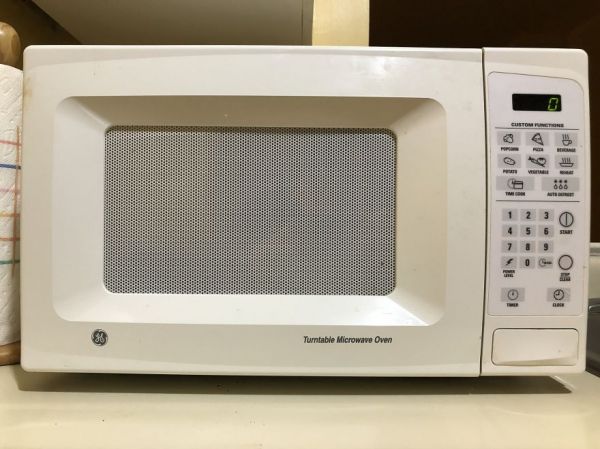
It never occurred to me to try frying foods in a microwave, and it sounds kind of dangerous. Frying means oil, and oil gets extremely hot. But it is possible. So what would you fry in there, anyway? The Takeout explains that you might want to fry garnishes until they are crispy, like fried onions to put on your salad or a sandwich. That way, you can use a small amount of oil and a small dish for a small amount of food and not have to wash a frying pan. They also explain the proper way to do it. Just be sure that you avoid splashing any oil as you remove the dish from the microwave.
But microwave frying will only work for a small amount of food- you won't get good results frying chicken in the microwave, for more reasons than one, which they also explain. But who fries just one piece of chicken at a time, anyway? Entrees for a family are worth pulling out the frying pan. Get a rundown on the practical way to fry some things in the a microwave at the Takeout.
(Image credit: Famartin)

Small arrowheads have been found in South Africa that date back 60,000 years, tens of thousands of years older than any other known poison arrows. What's even more intriguing, the traces of poison recovered from them are from the plant known as the Bushman's poison bulb (Boophone disticha). The poison extracted from the plant does not kill quickly, but will weaken prey over time. The small arrowheads indicate that they were made to deliver the poison instead of killing an animal outright. Such an arrow would slow the animal down, though, giving human hunters the advantage of their endurance and perseverance in taking down large prey.
The implications of this technique are that early Homo sapiens hunters were strategic thinkers who understood cause-and-effect and delayed results, in addition to the practice of using poison to their own advantage. Read about the discovery and what it means at Smithsonian.
(Image credit: Ton Rulkens)
A piano can produce beautiful music if you know how to play it, but what if you could see the music as well as hear it? This idea presented a challenge for the guys at HTX Studio (previously at Neatorama), and they spent three years making it happen. In this video, we get to see the many ideas that didn't work, which are all pretty cool anyway. With every failure, the challenge became more important, and that's why they persevered to the end.
The one guy with the dream (I wish we knew his name) also explains why the project meant so much. There is a great joy in seeing an idea successfully brought to life, especially if the one making it happen is you. That joy is there even when you didn't have to invent everything along the way. In that respect, we also have to admire his dedication to learning to play piano in those three years, in order to do the magic piano justice. The result is not only a fascinating musical instrument, but also beautiful music and an astonishingly high-quality DIY video.
-via Metafilter

The modern world is ripe for global viruses thanks to the relative ease of travel, but we also have tools on our side, like vaccines and infectious disease experts who monitor viruses around the world. Sure, the viruses that are the scariest are the ones we don't know about, and the ones we are very familiar with are bad enough, like influenza and COVID. There are also some viruses that are currently localized, but could become a problem if they spread.
For example, have you heard of the Oropouche virus? It's indigenous to the Amazon area, but in the last twenty years has started to pop up elsewhere. It is spread by insects, and those insects are increasing their range. Travelers also carry the virus to other parts of the globe. Bird flu was bad enough in birds, but it has spread to cattle, and can be transmitted from cattle to humans. And virologists are monitoring HIV infections, which are poised to rise under disruptions in international aid. Oh yeah, and measles, too. Read about the global viruses that now worry experts at the Conversation.
(Image credit: NIAID)
How many soldiers does it take to cut down a tree? In this case, it was 813, in a convoy of 23 heavily-armed vehicles supported by helicopters, fighter jets and bombers, and even rafts. While that sounds absurd on the surface, it was a response to a horrific murder. This all happened in the DMZ between North Korea and South Korea in 1976 (although the narration says 1973 at one point). Cold War tensions were high. In the Joint Security Area, a tree was blocking the view from the south, which was quite important for keeping an eye on North Korean activity. The first crew of 15 sent to trim the tree was attacked by North Korean soldiers, who killed two Americans with their own axes and injured others. Retaliation could have led to war between the two Koreas, which meant war between the US and China also. But the incident could not be ignored.
The response was to return and cut down the entire tree, using all the military might necessary to keep interference from the KPA from happening again. This was Operation Paul Bunyan. Half as Interesting takes us through the entire incident. The video is only 6:35; the rest is an ad.

The first Social Security numbers were issued in November of 1936 as part of the New Deal. It didn't take long for people to start appropriating numbers that were not assigned to them. In 1938, a wallet manufacturer included dummy cards in their wallets to show how cards would fit into the slots. They used a mockup of a Social Security card that displayed the real number of a company executive's secretary, Mrs. Hilda Schrader Whitcher. What could possibly go wrong?
People immediately began using the mockup card as their own Social Security card. It was printed in red instead of blue, but when the program was new, few people knew what the cards were supposed to look like. The wallet company claimed it was only half the size of a real card, but that makes no sense since it was made to show the size of a wallet slot, and a picture of Whitcher with the card shows it was the same size as her real card.
Over the years, 40,000 or so people have claimed the number 078-05-1120, even without the mockup card. Some still use it today! Read the story of the first major Social Security card fraud at the SS website. -via Weird Universe
Cities and states have climates and cultures attached to their names, and then it's easy to get a totally incorrect idea of where it is. The same happens when you take a piece of a round globe and straighten it out on a two-dimensional map. We think of Canada as north, Mexico as south, and South America as far south of the United States. But that doesn't tell the whole story. Laurence Brown pulled out a US map to determine where our National Parks are because he got a calendar of park posters for Christmas. That's when he found that what we think of the 48 contiguous United States doesn't have much to do with where they actually are. Besides what's in the video, commenters added more geographic facts that may blow your mind.
If you go south from Detroit, you enter Canada.
Over half of Canada's population lives south of the entire states of Washington and North Dakota.
The Atlantic Ocean enters the Panama Canal from the west and goes east to enter the Pacific.
Boston is roughly on the same latitude as Barcelona.
The whole of the contiguous USA is further south than the whole of Britain.
New Orleans is about the same latitude as Cairo.
The International Date Line crosses Alaska, so it is both the westernmost and the easternmost state. (not true; see comments)
The state closest to Africa is Maine.
Tijuana is closer to North Dakota than it is to Mexico City.
Texarkana, Texas, is closer to Chicago than it is to El Paso.
Berlin is farther north than Winnipeg.
See, we've all been fooled by the weather and our own mental maps!
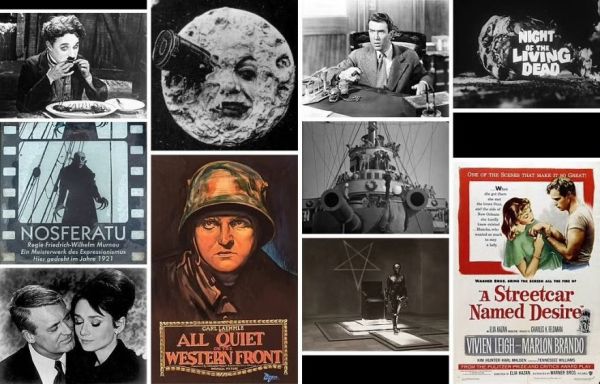
When you want to watch a movie but you don't want to pay for streaming services or cable, you can turn to the internet and pull up a full-length feature film that's perfectly legal to watch at WikiFlix, a depository of public domain films.
As of January first, all movies released in 1930 went into the public domain, meaning their copyright has expired. All movies made before that are also in the public domain. That includes films like Hell's Angels, All Quiet on the Western Front, Animal Crackers, and Anna Christie. All movies made before that are public domain, too, including many talkies. Films made later can be in the public domain for various reasons, like McLintock!, Night of the Living Dead, Charade, A Star Is Born, and The Day the Earth Stood Still. The newest one I found is a short from 2018. At WikiFlix, they are grouped by subject matter, and also include films from China, Japan, and the Soviet Union. See ya back in here in a couple of hours! -via kottke
The British TV series Doctor Who has been around since 1963, and in all those years he (or she) has always had plenty to say. You can imagine that someone who transcends time and space has picked up a fair amount of wisdom. The best definition of wisdom I've heard is the ability to separate what's important from what is not important. This compilation of quote from the series, offered as advice for 2026, gives us the Doctor's perspective on life, the value of every person, and the hope that all of us can become better than what we are now. He has the right thing to say in times of despair and grief, and the best quips to bring down those who should be brought down a notch. But it's not strictly profound quotes, because there's no point in being grown up if you can't be childish sometimes! -via Geeks Are Sexy
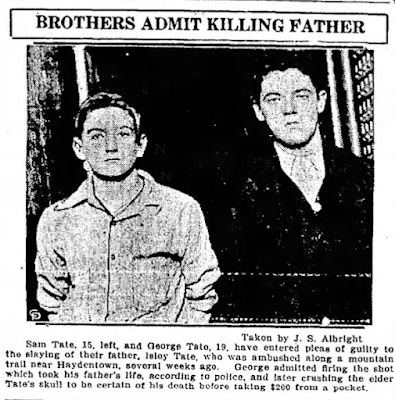
In the early part of the 20th century, Iley Tate was a prominent and wealthy landowner in Haydentown, Pennsylvania, in the hill country not far from the West Virginia border. He traded in livestock and owned the only general store for miles around. Tate had twenty children from several wives, two of whom he actually married. The last one was around 14-16 years old when they wed (she wasn't sure). Tate never backed down from a fight, and was willing to shoot anyone who crossed him. He shot and killed at least two people, although he was never convicted. He was also suspected of poisoning his first wife.
In the 1930s, Tate was living in West Virginia. In 1932, he was shot by his son George, who then smashed his skull with a rock to make sure he was dead. His brother Sam was with him. Another brother, John, was in on the plan. So was Tate's wife Nettie Belle, but she, pregnant at the time with her 12th child, was not charged in the case. The brothers went to trial where the defense appeared to be that their father needed killing. That's when Iley Tate's history of child abuse and child rape were uncovered. Read about the killing of Iley Tate at Pennsylvania Oddities. An addendum of the crimes of Tate's relatives is almost as horrific. -via Strange Company
Do you recall what huge news it was when red dye #2 was found to be carcinogenic and banned in the 1970s? In the grand scheme of things, that was just one of many steps along the way to banning food dye. It really didn't make much difference, as food scientists came up with new ways to make our food more red. It's a process that's been going on thousands of years. Food dyes were used to make food more attractive when it was less than palatable under the surface, or even spoiled. When we got tired enough of dangerous stuff added to our food, we introduced the Food and Drug Administration, which has saved a lot of lives.
At about the same time (well, the 20th century), food manufacturers came up with tons of new synthetic dyes to make processed food any color you can imagine. Each one is tested thoroughly, and many have been banned. Because it takes a long time to phase out these dyes, the industry comes up with new ones. But eventually, we are going to have to get used to food in its natural state, or at least dressed up with natural food dyes. Will that be so bad? Tom Blank of Weird History Food explains.
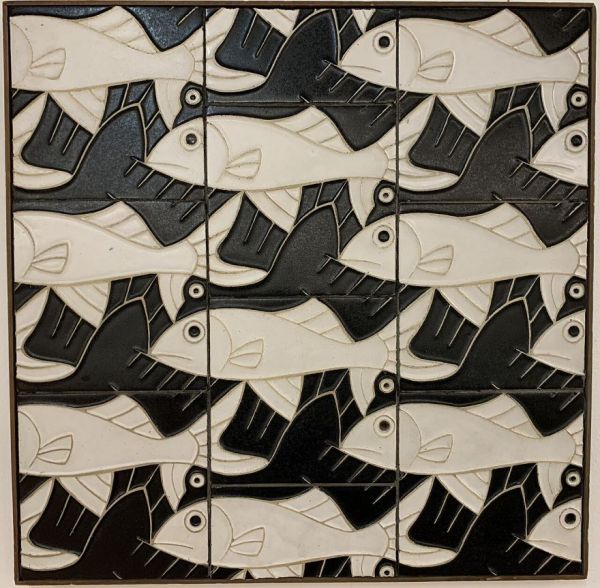
Tessellation refers to a set of geometric tiles that fit together perfectly. They can be very simple, like a checkerboard or subway tiles, or they can be delightfully intricate, like the tessellations of M.C. Escher. The fish and bird tiles shown here were designed for his house in Amsterdam.
People are still making representative tessellations like this, which is a bit easier with computer aided design. See plenty of examples at Tiled.art where artistic tessellations are animated. They go from a standard tile grid to a distorted grid to representative shapes featuring animals, people, and objects all fitting together with no gaps or overlaps. Watching these, you'll start to understand how they were designed.
And you can try it yourself! It may take a while to figure out all the tools, but once you get going, you start to understand how interlocking shapes can be created. I haven't gotten close to anything representative yet, but the further I go, the more fascinating it becomes. -via Metafilter
(Image credit: HenkvD)
Airlines always have trouble getting people to pay attention to the mandatory safety instructions. Unless it's their first flight, passengers have a tendency to zone out. Still, in the event of an emergency, it's crucial for these steps to be fresh in everyone's mind. Many airlines recruited their funniest flight attendants to give humorous monologues, and some produced videos filled with pop culture references to grab attention. Philippine Airlines goes a step further, and tells a story within a story while going over safety procedures.
Luisa faces a crisis that will affect the rest of her life. Will she follow her mother's advice, and wear her seatbelt properly? Will Diego be arrested for vaping? Will Anton find the emergency exit after he causes a sudden drop in cabin pressure? You will be on the edge of your seat as the drama unfurls. Then you'll have to watch it again to catch all the small but clever details. And you'll remember what to do if your tablet falls between the seats. -via reddit
In 1966, when Star Trek first graced our TV screens, the writers of the space drama set hundreds of years in the future were free to construct a historical timeline that led to intergalactic travel and the United Federation of Planets that spawned Starfleet. They had no clue that the franchise would last into the 21st century. After all, TV itself wasn't much of a thing a mere 20 years earlier. So they explained away, and when Star Trek returned in the 1980s and beyond, they stuck to the historical canon established by the original series, just filling in more details. And now we have eclipsed part of that constructed history already, making it into a fictional "alternative history."
In the Star Trek universe, 2026 was the year that World War III began. This 45-year war led to a loss of 30% of the human population, and the extinction of 600,000 plant and animal species. Yes, it was a nuclear war that wiped out many of earth's major cities. But it didn't just spring up suddenly. Before World War III, there was the Eugenics War and the Second American Civil War. Check out the details of Star Trek's World War III at Memory Alpha plus some more details on the year 2026 at the not-totally-canonical Memory Beta.