
There are two main reasons to buy Peeps. Either you are filling an Easter basket for the kids, or you have a great idea for a funny diorama and don't want to mold clay figures. But around Easter, they are sitting there in a store, five or ten in a box, at a rather low price, and your mouth waters at the anticipation of a sugar rush. By the time you get to the third one, you're full of regret.
But did you know that before 1955 Peeps had wings? They were works of confectionary art that really looked like cartoon chicks. But that's neither scalable nor affordable. The family that runs the Just Born company were inventors as well as confectioners, and they figured out how to get Peeps made in a hurry at mass scale- but they had to lose the wings. That made Peeps what they are today- an Easter tradition made of sugar and air that you can either eat or keep from year to year.
Miss Cellania's Blog Posts
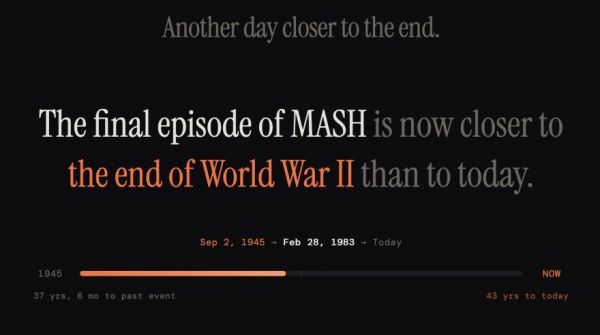
Does it ever feel to you that time is accelerating as you age? It happens to all of us. My mother used to say that life is a like a roll of toilet paper- it goes faster as you get closer to the end. The web toy Another Day highlights this time distortion by calculating how old the pop culture of your life really is. The first episode of South Park is closer to the moon landing than to today. The release of Toy Story is closer to the attack on Pearl Harbor than to today. The birth of Wikipedia is now closer to the release of Star Wars than to today. Well, pop culture sticks around, and if it's good, several generations will enjoy it. But you can put your own birthday into the calculator and feel really old.

Oh dear. I may have to go lie down for a while. The relevant discussion at Metafilter might make you feel even older.
Passover is the Jewish festival that celebrates the exodus of the Hebrews from Egypt. It begins at sunset on April 1st and continues through sunset on April 9th, and just in time we get the traditional song parody from the Jewish a cappella group Six 13 (previously at Neatorma). This year, it's a medley of Michael Jackson hits with new lyrics that explain the history that led to the holiday and the traditions of the Passover seder, from the wine to the bitter herbs, all created with nothing but the human voice.
The songs included in this video are "Billie Jean," "Wanna Be Startin’ Somethin’," "Beat It," "Smooth Criminal." and "Man in the Mirror." I would have included at least one song from The Jackson Five, but those songs are older than any member of the group. Maybe next year. Send this song to anyone you know who is celebrating Passover and wish them Chag Pesach Sameach!
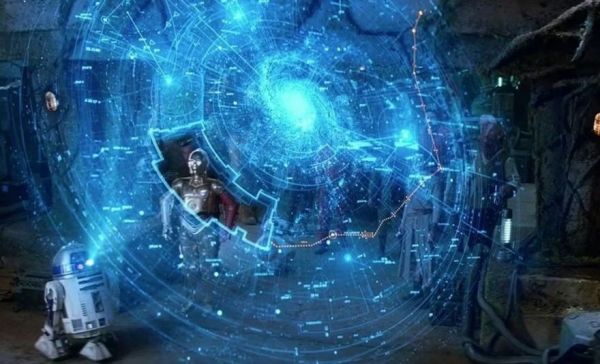
A long time ago in a galaxy far, far away, no one could find Luke Skywalker because the star map was missing the part that contained his planet in The Force Awakens. The Sith planet Exegol was hidden unless you had a specific compass in The Rise of Skywalker. Similar plot points were found in Attack of the Clones, Star Wars: Ahsoka, and in Skeleton Crew. Fans got tired of plots revolving around missing planets no one could find, and it became a joke.
But of all the Star Wars tropes, this one is the most scientifically accurate. Here on earth, astronomers make maps of the stars, but there is no one organization that is tasked with keeping them accurate. The latest are stored in bits and pieces on computers that are reliant on technology that goes obsolete quickly. And the facilities that make and store maps are dependent on funding, usually from governments that can change. Add on top of that the fact that objects in space move over time. Learn how the silliest trope in Star Wars is quite believable to folks who know stars at Inverse.
The latest question in the What If series (previously at Neatorama) concerns digging a deep hole in the ground. Our parents told us if we dug deep enough, we would come out on the other side of the earth in China. However, if you started in the United States and dug straight down, you'd end up in the Indian Ocean, west of Australia. Be that as it may, you can't dig through the earth's core, because it's too hot. And it gets too hot way long before you get near the core.
But in this scenario, heat isn't the only factor working against you. Randall Munroe also explains the difficulty of trying to dig such a hole, such as the logistocs and energy expenditure of removing the dirt once you get too deep to throw it, and the air pressure underground. That doesn't mean that people haven't tried it. You might recall this somewhat disturbing video of the deepest holes humans have dug.
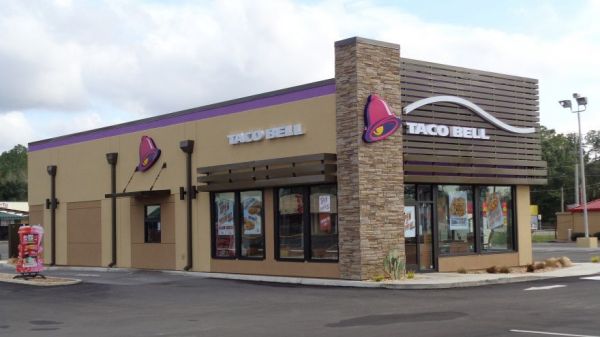
In the late 1980s, I became addicted to Taco Bell's Meximelts. It was a simple food, beef, tomatoes, and lots of cheese wrapped in a soft tortilla. You could eat them while driving, and best of all, they were only 79 cents. My family bought Meximelts in large numbers for about thirty years, but when the price reached $4 each, I quit buying them. Apparently, so did everyone else, and they fell off the menu in 2019. The chain figured no one wanted them, but it was the price that did the Meximelt in. Now I get soft tacos with no lettuce for $1.49 and pretend they are Meximelts.
The Meximelt is just one of the once-popular Taco Bell items that are no longer on the menu for one reason or another. Read about ten of these discontinued items at Mental Floss, and let us know which one you want to bring back.
(Image credit: Michael Rivera)
The legend of the Bell Witch is still told in Tennessee, and tourists can visit the Bell Witch Cave in Adams, Tennessee, which doesn't really figure into the story but has a replica of the Bell house and some artifacts from the family. John Bell and his family started undergoing paranormal experiences in 1817. Most of the incidents were poltergeist activity, although the word was not yet used in America at that time. The hauntings went on for years. The family kept the weird phenomena to themselves for months, and when the word got out, other families reported similar events.
The hauntings continued until John Bell, the patriarch of the family, died under mysterious circumstances in 1820. Bell had married his wife Lucy when she was 12 years old (he was 32). They moved to Tennessee after Bell beat a murder rap in North Carolina. The family eventually had nine children and a solid reputation in Tennessee. But the witch threatened Bell constantly, and some reports said his health was failing the entire three years of the hauntings. Or was he poisoned? Dr. Emily Zarka tells the tale of the Bell Witch.
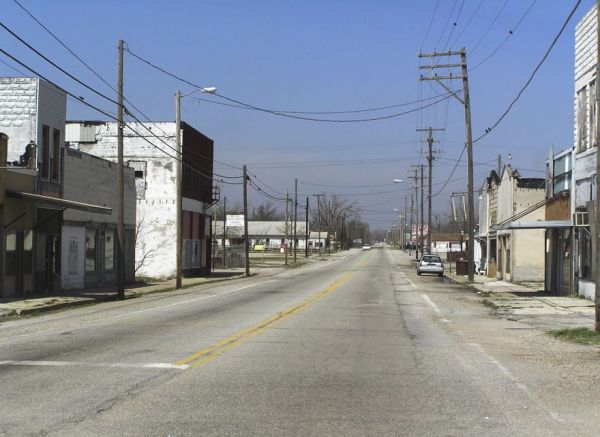
Picher, Oklahoma, was once a booming mining town of 20,000 people. The Eagle-Picher Company mined zinc and lead there for over a hundred years, but today it's a ghost town. The mine closed in 1967 and in 1983 Picher was declared a Superfund site, with dangerous levels of lead found in the city's residents. Underground mining left its buildings unstable. And a tornado wiped out 150 of the remaining homes in 2008. The government paid people to move away, and Picher city services ceased in 2009. Louise Story, who is on a quest to visit all 50 states, visited the eerie ghost town with her son, driving by the abandoned homes with the windows rolled up because of the toxic lead-filled air.
But they also visited Commerce, Oklahoma, less than five miles away, the boyhood home of Mickey Mantle. Story told her son about how his father, Mutt Mantle, and his grandfather Charlie trained him to be a switch hitter baseball star from an early age. It was only afterward, with a little research, that the stories she told of the two Oklahoma towns became connected. Read that story at Atlas Obscura.
(Image credit: peggydavis66)
We've watched movies and TV shows about space travel since we were little kids. Most of us have also watched the miracle of real space travel, such as the many videos we have of operations on the ISS. Have you noticed the real difference between the two? In the real world, we have not achieved artificial gravity. Not that we've ever tried to. But it's in every show involving space travel. That one system must require a lot of power.
Adam Schwartz (previously at Neatorama) took this idea and ran to its logical conclusion. When a ship's life support systems are failing, as happens a lot when you're trying to add drama to a plot, why not try turning off the artificial gravity system and use the enormous amount of power it's consuming for life support? One might think that the system is built like some modern electronics without an off switch. -via Geeks Are Sexy

President William Howard Taft was America's largest president at 340 pounds (although he lost 70 while in the White House). It's very likely the only thing you know about him is that he got stuck in a bathtub and had to be rescued. A replacement tub big enough for four men was installed afterward. The photo above, which made the papers in 1909, proves it. Except it doesn't. The story of Taft's bathtub is usually attributed to White House staffer Irwin Hood Hoover, whose memoir was published in 1934, long after the supposed bathtub incident and a year after Hoover's death. Those who know suspect the anecdote was added by the book's editors.
But there was a somewhat similar story about Taft's 1909 tour down the Mississippi River, and how the president's quarters aboard the steamship Oleander were outfitted with extra-large furniture- except for the bathroom, because fixtures couldn't be found in time. Read the real origins of the bathtub story that just won't go away at Smithsonian. Incidentally, the tub in the photo was never installed in the White House, but on another boat that took Taft to the Panama Canal.
YouTuber Brick Technology (previously at Neatorama) built a LEGO traffic simulation as a miniature version of Yuki Sugiyama's full-size traffic experiment on what causes traffic jams. While this involves a round track with no intersections or turns, the results are similar to what we may encounter in real life.
First he has to build a track using magnetic guidance, and then the trucks. They are programmed to act either like human drivers or robot drivers in the way they accelerate, slow, and stop. The results are dependent on the density of traffic, because one too many trucks will slow them all down. Then he throws in confounding factors: one drunk driver, then a real human with a controller, and finally he raises the speed limit. It's all chaos by the end. You might get the idea from this that robots drive better, but keep in mind there are no pedestrians or animals wandering onto this track. -via The Awesomer

We all want to save money on food, not just when prices spike above our budget, but always. We watch sale pries and clip coupons. But we should learn basic strategies for buying everything. Lauren Torres calls them "12 Cosmic Truths." They range from the basic awareness of reading labels and spotting a bargain to philosophical guides to shopping, cooking, and eating.
One that stood out to me is #6: "Taste cheap food often." You may have hated the generic or store brands that you ate when you were a kid, and considered it a luxury to get the famous brand. However, over many years, the big brands tend to take advantage of scale and reduce the quality of their ingredients or the amount of food you get. At the same time, off-brands have been working hard to earn your purchase. Check out the cheaper brands you rejected long ago, and you may be surprised at how tasty they've become.
Some of these "cosmic truths" are things you've heard before, but this list goes deeper into explaining the mechanisms behind them. Read all about the philosophy and process of grocery shopping at Bitches Get Riches. -via Metafilter
The Pan-American Highway is a road that goes from Prudhoe Bay, Alaska, in the Arctic Circle, to Ushuaia, Argentina, known as the most southern city in the world. It was going to be a railroad, but then cars were invented and that made construction easier. The United States has the most miles of the highway, but we had to cheat a bit to actually claim that. Yet a hundred years after the project was initiated, the highway is still not complete. The real problem is the Darién Gap, in southern Panama and western Colombia. So the highway gap is right where the two American continents meet.
Jay Foreman and Mark Cooper-Jones are the Map Men (previously at Neatorama). They make jokes aplenty while explaining how the Pan-American highway was conceived and what stopped its completion. There's a sponsor message from 4:43 to 6:10, and everything after 11:06 is promotional. -via Damn Interesting
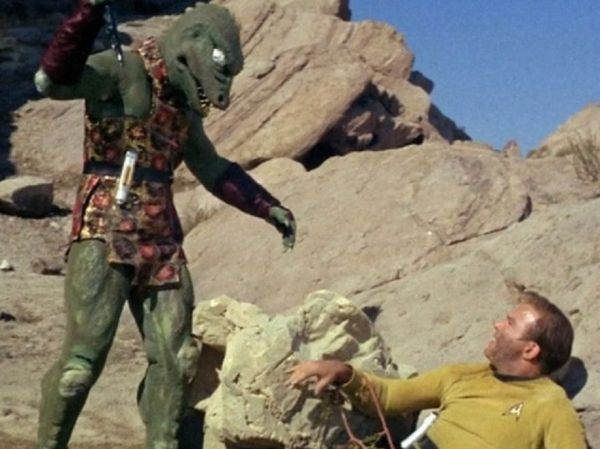
One of the funnier quirks of Star Trek is that all alien sentient life forms look just like humans, just with funny bumps on their faces or pointy ears. Better special effects gave us different aliens, but most still ended up with a head, eyes, mouths, and limbs. The new movie Project Hail Mary explores a different kind of alien life- things that don't resemble anything we've ever encountered before. And that's what we should really be looking for.
What if life on other planets isn't dependent on liquid water? What of the building blocks of life elsewhere were based on, say, silicon instead of carbon? The search for life elsewhere has been based on detecting signals that indicate planets are like earth, but that might not be necessary. The search for signals of an advanced technology may be looking for the wrong patterns, or may be a completely useless framework. Alien life may be different in more ways than we can even imagine, and a lot of that depends on how you define "life." The Conversation poses five ways we may have been thinking about alien life all wrong, with links to further information on each idea.
What do you do with a blind husky? In Dani's case, she was sent for euthanasia when she was just a puppy, possibly by a breeder who couldn't sell her. Dani was born without eyes. She was rescued from her fate by an organization that takes in special needs dogs, and then was adopted. Her new family had plenty of pets, but still had the time and patience that Dani needed.
Huskies are bred for the outdoors, and even a blind dog wants to run and play. Dani gets that chance with a long lead that keeps her in sight but still lets her go full speed ahead in a safe area. She also loves to play ball, and is used to losing it every now and then. She has no trouble getting around in familiar places, and not much trouble in unfamiliar places. That's a good dog. See more of Dani and her occasionally pink tail at Instagram.