
A strange formation of lights made their way across the sky over Texas in 1951. There were multiple reports, photographs, and even radar sightings. Once the sightings hit the newspapers, other accounts rolled in until the formation was dubbed "the Lubbock Lights." Those reports came not only from drunks and cranks, but also scientists, professors, and government employees. The Air Force took those reports seriously, but no explanation was ever offered.
Remember, this was in 1951, the era of experimental weapons and aircraft, Cold War espionage, and general distrust of ...everything. Reports of "flying saucers" had been a thing for a few years already, but aliens from outer space were not always the first thing that came to observers' minds. However, aliens or birds or hoaxes were always a possibility. Still, no explanation of the lights was confirmed, and the US Air Force began Project Blue Book to investigate what's going on up there. Dr. Emily Zarka gives us the rundown on the Lubbock Lights
Miss Cellania's Blog Posts
In English, L'Oeuf Electrique means electric egg. Why it was dubbed an egg is obvious, and the electric part is how it's powered. But don't expect to find one of these cars at your local dealer, because there was only one ever built, and that was in 1942.
Industrial designer Paul Arzens had already given the world La Baleine (the Whale), a huge art deco luxury gas guzzler. But then the Germans invaded France and suddenly gas was very difficult to get. Arzens experimented with converting existing vehicles to electric power, and learned some lessons. A large car would not do, so he had to start over from scratch. His electric car would have to be lightweight and easy to maneuver through city streets. Arzens hand-built the L'Oeuf Electrique out of aluminum and plexiglass, kept it small, and set it on three wheels. Most of the car's finished weight came from its battery, and the driver had surprisingly good visibility. Alas, there was no demand for new cars during the war, and afterward drivers went back to stylish gas guzzlers. Read about L'Oeuf Electrique at Utterly Interesting.
The term hypnosis grew out of the work of Franz Mesmer in the 18th century. He promoted the theory of animal magnetism and would cure illness with magnetic fluids. His successes were later attributed to the power of suggestion, which eventually gave us both the placebo effect and the concept of hypnosis. Hypnosis is based on the power of suggestion in humans, but was depicted in movies as a "power" to force people to do things they normally wouldn't, often for nerfarious purposes. As such, it was relegated to the realm of myth, entertainment, or just plain bunk.
The truth is that hypnosis is a technique that works on some people more than others, but is not as dramatic as the movies would have us believe. It's more of an exercise in opening one's mind to new ways of thinking and behaving, and can be therapeutic for certain purposes. -via Damn Interesting
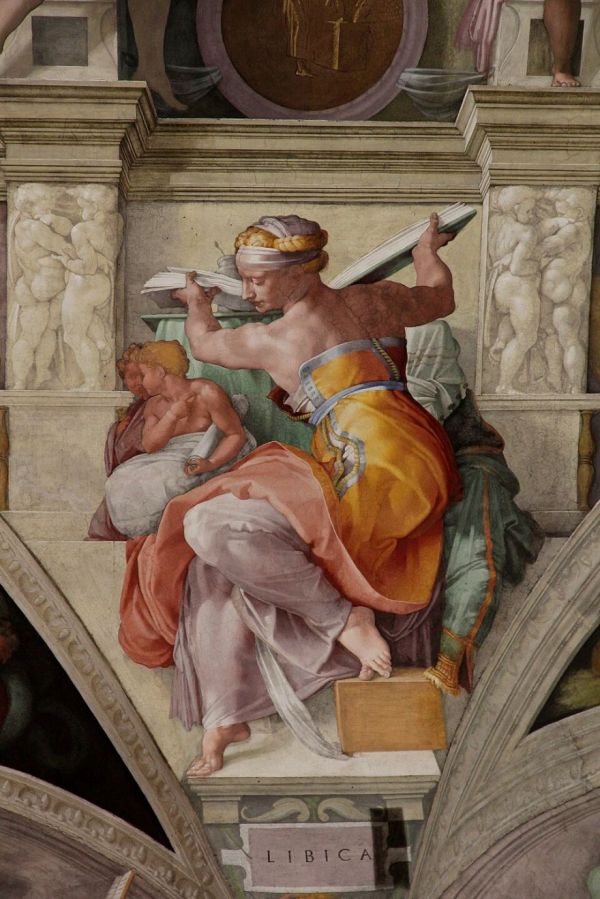
The problem with being a Renaissance man is that your favorite skill may not be as in-demand as your least favorite skill. Michelangelo was uniquely talented in all aspects of art: design, drawing, sculpting, and painting. He considered himself a sculptor foremost, but when the pope commissioned him to paint a fresco on the ceiling of the Sistine Chapel at the Vatican, he couldn't refuse (although he tried).
Michelangelo never liked to paint, preferring to draw instead. He spent several years on his back painting the chapel ceiling and complaining about it. “I am not in the right place – I am not a painter.” But he enjoyed the preparatory work, the overall design and the study sketches he made of the various characters and elements. One of those studies, of a woman's foot, was recently discovered and sold for more than $27 million, which is orders of magnitude above what Michelangelo was paid to paint the entire ceiling. Read more on Michelangelo's artistic inclinations at the Conversation.
(Image credit: Jörg Bittner Unna)
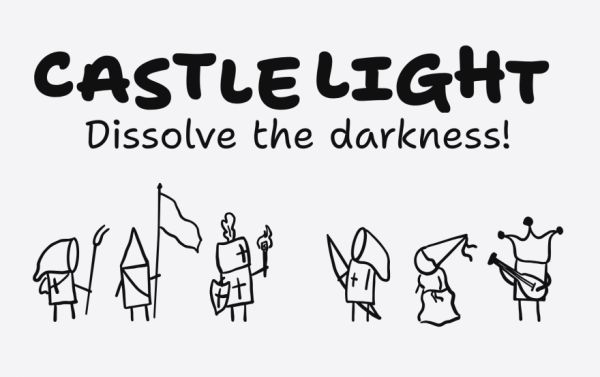
Imagine you are a spy in a medieval fantasy out on a dark night. You have a flashlight, but it only illuminates a small piece of what's in front of you. You move the flashlight around, trying to make sense of what you see. How fast can you figure out what's happening? That's the goal in the game Castlelight. You must discern who's doing what to whom from what little you can see. I aced the easy mode, then went to the medium mode and found out that what makes that level harder is the time limit. You might then consider the easy mode as your practice run. Maybe your flashlight batteries run out faster in the upper levels, which is anachronistic to the max. I can imagine this game would lose its charm after a few tries, since you'll memorize the scenes in time. Mefites report that it works better on some devices than others. -via Metafilter
In the original Star Wars, Obi-Wan Kenobi returns from the dead to remind Luke to trust the Force. In The Lion King, Mufasa appears in the clouds to advise Simba. Mulan had a whole group of ancient ancestors watching out for her. And if I recall correctly, something similar happened in Field of Dreams. Movies often have inspiring scenes of the lessons we learned from our forefathers coming back to save us when we really need it. But how far back can you go before the wisdom of our beloved relatives is totally useless?
Ryan George brings us just such a scene. His deceased grandfather shows up. Grandpa has no expertise to lend, yet he's supportive and encouraging. But then Great-great-grandpa appears, and he has no clue what's going on. Even if he did, he wouldn't approve. Don't be intimidated by the length of the video, the skit is only 3:50.
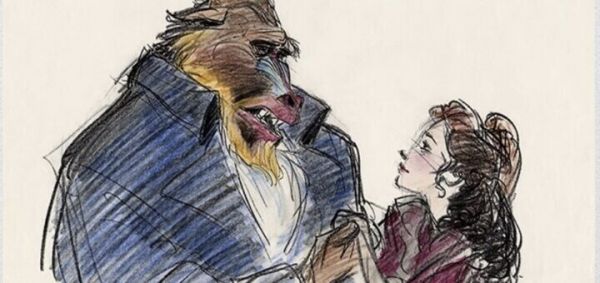
When you are assigned to create an animated character from scratch, the first ideas are rarely what eventually makes it to the screen. Even if you have an idea in your head from a familiar fairy tale, it might not be Disney-worthy, at least at first. When artists began working on the 1991 film Beauty and the Beast, they didn't know what kind of animal the Beast would be. The original French fairy tale doesn't say, although many people pictured a wolf. One of the concept drawings, shown here, depicts him as a mandrill, like Rafiki in The Lion King! Eventually, the Beast looked more like a bison in the finished film.
Other early drawings show us a Snow White who looked more like Betty Boop, Maleficent with insect antennae, a younger Cruella De Vil, and a jolly green Genie. See ten of these characters as you've never seen them before at Cracked.
We eat other living things, which are likely to contain parasites. Plant parasites don't worry us much because they are usually only dangerous to plants. But meat, on the other hand, sometimes has parasites that can survive inside us. Commercial meat producing facilities have made great strides in reducing parasites. Wild animals are more likely to contain them, but we don't worry about it because we cook our food.
But then there's sushi and sashimi, which are more popular than ever. Can you get parasites from eating raw fish? Yes, if you catch your own fish and take it home and slice it into your own fresh sashimi. Fish vendors, food processors, and restaurants have strict procedures to kill parasites before you have a chance to consume them. MinuteFood goes through the process, so you can stop worrying about it. I've never worried about it because I don't like fish and would never eat it raw anyway. This video is seven minutes long; the rest is an ad. -via Geeks Are Sexy
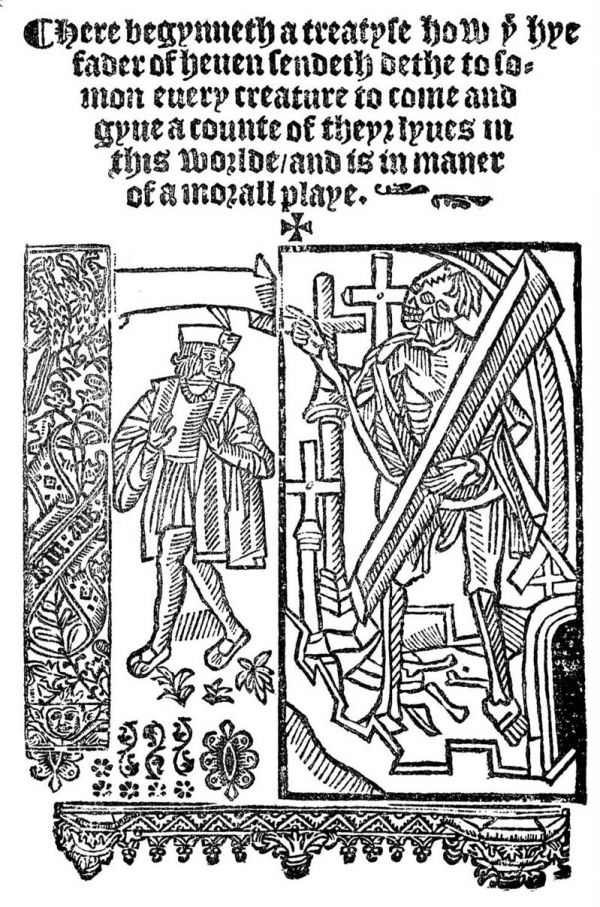
The English language we use today is different from the language we used 100 years ago. And 200 years ago. But we still read books that are a couple hundred years old, even if the vocabulary and style are a little different. How about 400 years ago? Sure, we can still read a King James Bible. But as you go further back, English begins to resemble a different language entirely. The Dead Language Society presents a challenge in the form of a fictional blog. Each post uses the language of 100 years earlier than the one before. How far back can you understand what these posts are saying?
Most people seem to hit a wall at around the year 1400 or 1100. The fictional blog text is followed by an explanation for each of the posts so you can learn a bit about why English changed so much during each century. Read all of it -or as much as you can- at the Dead Language Society. -via Metafilter
Up until 552 AD, Europe paid dearly for a luxurious fabric from China called silk. It was lightweight but strangely strong, felt good against the skin, and came in amazing colors and patterns. What was it made of? How did they produce such beautiful fabric with it? That was a mystery that ancient China was careful not to reveal, because they were making a ton of money sending silk along a trade route that became known as the Silk Road. They kept the existence of the silk worm, and the food it ate, a secret. But they also had some really advanced technology for fabric production that worked on principles that eventually made their way into our modern computers. However, travelers from Europe made their way into China and back eventually.
This simple video of the silk making process is more interesting than it has any right to be. There's a 70-second skippable ad at 4:07. -via Damn Interesting

The Sycamore Gap Tree was planted in the late 19th century next to Hadrian's Wall in Northumberland, England. The tree became famous when it was featured in the 1991 movie Robin Hood: Prince of Thieves. It became a popular tourist attraction and has been called "the most photographed tree in England." The sycamore even won the England Tree of the Year award in 2016. Then in September of 2023, someone cut it down in the middle of the night.
The British were enraged, and the story made international news. Eventually, Daniel Graham and Adam Carruthers were arrested for the offense, which was charged as "criminal damage." The case was elevated to the High Court due to the publicity, but it seemed strange because that court normally deals with only the most heinous crimes, and many of those involved couldn't really see what this offense was. The trial was a circus, the defendants weren't at all believable, and some elements of the crime seemed to come directly from Grimm's Fairy Tales. Read about the bizarre aftermath of the death of a tree at Harpers. -via Nag on the Lake
(Image credit: Gordon Leggett)
Brothers and sisters can be best friends or serious rivals, often both in a single day. Families do their best to make their children get along, because they'll be related for life. It doesn't work that way in all families, and can be quite opposite in some non-human families.
Living species have varying reproductive strategies. Plants and insects produce as many offspring as possible because most of them will not survive. Mammals produce fewer offspring, but devote lots of time and energy to keeping them alive. Then there are some species, like certain fishes and birds, that nurture their young while not getting too attached to them. They depend on sibling rivalry to cull the herd, so to speak, and keep only the fittest as their surviving progeny. MinuteEarth introduces us to some species that actually encourage offspring to kill each other. It seems a cruel strategy, but nature is only interested in what works. The video is only 2:25; the rest is an ad.
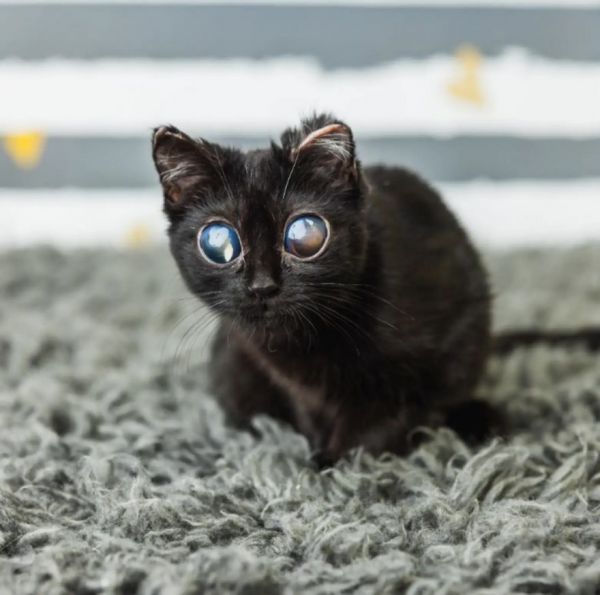
Look at the eyes on this kitten! She can't be real, can she? Dorito is a five-month-old black kitten in Minnesota who looks like she's been Photoshopped or is a product of AI. But she is very much real, and has those hypnotic eyes as a result of illness. Her swollen eyes are a rare symptom of feline infectious peritonitis (FIP).
Dorito and her sister Cheeto were found behind a dumpster and came into the care of the Bitty Kitty Brigade. Both kittens were ill, but Dorito's eyes began to swell as they were treated. A veterinary ophthalmologist diagnosed her with FIP and she has undergone treatment. She is now disease-free and the pressure in her eyes is back to normal, but no one knows if they will ever return to a normal size. Dorito and Cheeto have been adopted by their foster family. Dorito has limited eyesight, and requires eyedrops because she can't fully close her eyes even when sleeping. See more of Dorito, including videos. -via Fark
(Image credit: The Bitty Kitty Brigade)

The trend these days is away from having a bar of soap in your shower or on your bathroom sink, and more toward a bottle of liquid soap or shower gel. Younger people see a communal bar of soap as dirty, with an ick factor of imagining other people touching it. However, soap in a solid bar is more environmentally-friendly, less expensive, and lasts longer. Plenty of liquid soap users don't think about any of these factors because using liquid soap out of a pump bottle is just what's done in the modern world.
Dan Kois will defend bar soap until the end. He writes about the history of soap, including his personal history with Irish Spring, and the advantages of a simple bar in your bathroom. In preparing for this extensive essay, he even engaged a microbiology lab in testing the bacteria on soap and the poufs people use with liquid soap. Read all about the simple bar of soap and why we should be bringing it back at Slate. Here's an alternative link if that one doesn't work.
(Image credit: Dwight Burdette)
Most people become disgusted when they find a foreign object in their food, and even more so when that object is alive. Musician Simon Curtis, on the other hand, didn't lose it when he found a frog in his lettuce. Making a simple salad in the middle of the night turned out to be an adventure he never expected. He kept the frog in the lettuce container because it was too cold to put it outside. Well, Tony, as he named the frog, didn't want to stay in the plastic box. He didn't just get out of the box, he wandered from room to room exploring his new home, and getting pretty dirty in the process. You have to admire Tony's adventurous spirit, but you also don't want to step on a frog just walking through the house. Simon went from simply not wanting the frog to die to showering his new pet with everything a little frog could want in life. Tony lucked out!