Miss Cellania's Blog Posts

A Non-Math Look at Math Objects

I found out something neat about three-dimensional shapes. Many strange mathematical solids are constructed by rotating the plane of a two-dimensional shape around an imaginary axis. Think of the flat holiday decorations you fold out around its spine/axis. Once I understood what is called a "surface of revolution" in my mind, the construction of many odd mathematical shapes began to make sense.

Superegg

(Image credit:  Sir48 at da.wikipedia)

A superegg is a mathematical shape constructed by rotating a superellipse around an axis to the formula of |x/a|2.5 + |y/b|2.5 = 1, where a/b = 4/3. (If you search for "superegg formula", you are liable to find something completely different.) But you don't want to bother with formulas, do you? Just look at it! From the side, the superegg looks a bit like a cylinder, but has no corners. If you cut one horizontally, the cross-section will be a circle. However, unlike a natural egg, you can stand the superegg on its end -either end, as a matter of fact, as it is vertically as well as horizontally symmetrical, although it has no straight lines that you can find -although the curvature is zero at the ends, the "ends" are actually quite small and appear to be rounded. The superegg was popularized by Danish mathematician and physicist Piet Hein, who used the shape in designs for household items such as furniture, ice cubes, and candles, as well as a novelty toy (sometimes referred to as a stress-reliever) by itself.

Torus


I learned about the torus from crossword puzzles. If the clue says "donut shape", the answer is torus. The solid is produced by rotating a circle around an imaginary axis, but in this surface of revolution, the axis is outside the circle. The resulting shape is a ring torus. Other torus shapes are produced when the axis is touching or slightly inside the circle. Some really strange mathematical shapes are produced when the rotating plane of the circle is not quite round, or is itself rotating around a point in the plane.  A toroid is a ring or donut shaped solid produced by a surface of revolution not necessarily limited to a circle. For example, a square used in this manner will produce a ring that would be uncomfortable on your finger. A toroidal polyhedron is a torus constructed with or converted into flat surfaces, with the shape dependent on how many flat surfaces you use. Toroidal Polyhedron would be a cool name for a band.

Gömböc


You might remember Weebles -they wobble, but they don't fall down. However, if the heavy weight in the bottom of the toy ever came loose, you had a Weeble that fell down. In 1995, Russian mathematician Vladimir Arnold questioned whether there could be a 3-dimensional shape that would always return to its original position without the help of internal weights. If a shape could be found that had as few as two points of equilibrium, one stable and one unstable, the shape would naturally return to balancing on the one stable point. For a long time, mathematicians thought the shape was impossible. But in 2006, Gábor Domokos and Péter Várkonyi developed the gömböc. This odd shape has only two points it could possibly balance upon, and the point on top is too "pointed" to be stable. So, if you roll a gömböc around, it will soon right itself, returning to an upright position because of its shape, not because of any internal irregularities. It's a Weeble that doesn't wear out! Objet Geometries made the first fabricated gömböcs. They were numbered as a limited series (inside, using transparent materials of the same density as the rest of the object) and professor Arnold was presented with number one. You can buy one of your own.

Continue reading

Colorful Photographs from the '30s and '40s


The Denver Post has printed a gallery of color pictures taken by photographers of the the US Farm Security Administration/Office of War Information during the Great Depression and World War II. Most were transferred from color slides. The photographs are now part of the Library of Congress. Link -via Metafilter

(Image credit: Russell Lee/Library of Congress)

Your Chance to Win with How Did You Know?


The first day of the new mental_floss/Neatorama How Did You Know trivia hunt is up at mental_floss! Once again, you have a chance to win prizes from the NeatoShop each of the next four days, and more prizes for the ultimate winner next week. Check in every weekday, follow the clues to figure out the quiz, and you just may be a daily winner. Even if you aren't, the daily clues will help lead you to the ultimate answer next week! Link

Ansel Adams Photos from Garage Sale Worth $200 Million

Rick Norsigian's hobby of bargain-hunting at rummage sales has paid off big time.
Two small boxes he bought 10 years ago for $45 -- negotiated down from $70 -- are now estimated to be worth at least $200 million, according to a Beverly Hills art appraiser.

Those boxes contained 65 glass negatives created by famed nature photographer Ansel Adams in the early period of his career. Experts believed the negatives were destroyed in a 1937 darkroom fire that destroyed 5,000 plates.

"It truly is a missing link of Ansel Adams and history and his career," said David W. Streets, the appraiser and art dealer who is hosting an unveiling of the photographs at his Beverly Hills, California, gallery Tuesday.

The photographs apparently were taken between 1919 and the early 1930s, well before Adams -- who is known as the father of American photography -- became nationally recognized in the 1940s, Streets said.

Link -via Boing Boing

Cat on a Leash

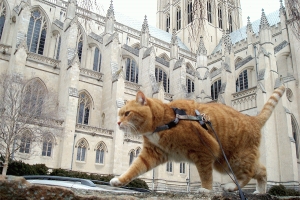
Salon writer Sarah Hepola moved to tiny apartment in Manhattan and found the lack of space severely affected her cat Bubba. Should she take him outside on a leash? Have you ever been able to leash-train a cat?
I know, I know, a cat leash is a ridiculous idea. Cats are too prickly, too willful to endure such pampered indignity. I might as well suggest my cat learn to make a delicious veal parmigiana, or play Bob Dylan songs on the harmonica. In five years of living in New York -- a city that prides itself on its vast parade of human experience -- I've only seen one cat on a leash. (Putting the ratio of strangers' penises to leashed cats at 2:1.) The New York Times wrote about a real estate broker on the Upper West Side  who leash trained his cat, which suggests just how remarkable the feat is. Even the phrase "cat on a leash" has a campy spark of the impossible, like something you'd see in a Farrelly brothers movie, or hear about in a novelty song: "Cat on a leash! He don't eat quiche!"  But if you start digging a bit into the world of cats on leashes, what you will discover is just how many people have already tried it.

After much angst, Hepola tried a leash on her cat and was surprised by how the adventure turned out. You might not be so surprised. Link

8 Famous Sea Monsters And Their Real Life Equivalents


If you look hard enough, even the most outlandish legends have a grain of truth somewhere. Reports from antiquity of sea monsters may be fantastic, but they describe what someone at least thought they saw at one time. Consider the sea monk, described in 1546 (left). It sure looks like someone drew it from their imagination. But then look at the sea creature called a Jenny Haniver (right). Read about this and other monsters that may now be explained scientifically. Link -via Gorilla Mask

See also: Baby Stingray

Give NeatoGeek a Caption!

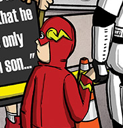
The new caption contest is up at NeatoGeek! This week, the featured picture is a comic by cartoonist Joel Watson (what you see here is only a detail). The best caption will win a t-shirt from the NeatoShop, so look around and pick one out to include with your entry. http://www.neatorama.com/neatogeek/2010/07/27/caption-contest-4/

Caddyshack Turns 30


The movie Caddyshack was released on July 25th, 1980. My, has that really been 30 years? What better to celebrate than a Lunchtime Quiz from mental_floss! Test your recall of this now-classic film. I only scored 50%; you will do better. Link

Nara Dreamland


Kyle Merriman recently visited Nara Dreamland, the abandoned Disneyland knockoff theme park in Nara, Japan that was built in 1961 and closed in 2006. He found it to be fairly intact, except for the fact that there are no people there and the weeds have grown everywhere. See the state of the park in a gallery of 56 photographs. http://www.brandknewme.com/?p=845

Previously at Neatorama: Nara Dreamland, an Alternate Universe Disneyland

The Formation of a Lightning Bolt


(YouTube link)

This video of a lightning bolt was filmed at 9,000 frames per second. The entire minute-and-a-half video covers less than two seconds of real time. Is this cool or what? -via Dr. Isis

Cosplay at Comic-Con 2010


Geeks Are Sexy proves that some are indeed in this collection of costumed participants at Comic-Con 2010, last week in San Diego. In addition to these, they are asking for your cosplay photographs to be published in another post. Link

(Image credit: Flickr user Arnold Tijerina)

Flugtag World Record


(YouTube link)

The term Flugtag is German for "flight day". The Red Bull Flugtag in St. Paul, Minnesota, was Saturday and the homemade flying machine competition took place on the Mississippi River. As many as 90,000 people turned out to see entry after entry plunge into the river. A new world record for these events was set by a team called Major Trouble and the Dirty Dixies, whose glider flew 207 feet! After seeing the other nine top finishers in the video at the link, you will be even more impressed by that 207-foot flight. http://www.startribune.com/lifestyle/99177024.html -via TYWKIWDBI

Comic Sans Gets Dissed


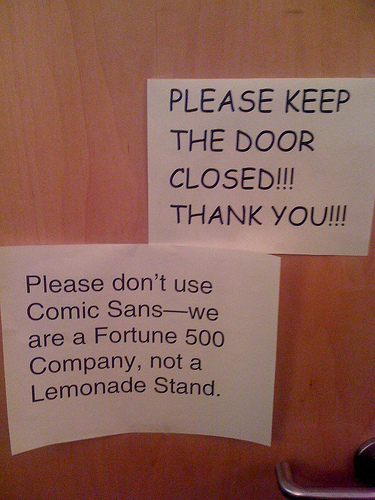
Once again: if you want to be taken seriously, don't use the Comic Sans font in your passive-aggressive notes. Link -via I Met a Possum

Which Came First, Under the Dome or The Simpsons?

Johnny Cat pointed out that Stephen King's latest movie novel Under the Dome may cause you to recall the 2007 film The Simpsons, as both involve a city suddenly isolated under a glass dome.
Fans seem less convinced that the novel's conceit – a town discovers that it is encased in a giant dome, put there by an unknown force – is so terrific. Many took to the internet to point out that a similar plot was the basis for The Simpsons Movie. King took to his website to respond that he had never seen the movie and that the similarity came as a complete surprise. Fans reacted with incredulity, pointing out that not only is King a pop- culture omnivore, but has played on stage with The Simpsons creator Matt Groening in his Rock Bottom Remainders band. King then gave a different account of the book's origins, this time saying he started it in 1978 or thereabouts, and wrote a second, unpublished version called The Cannibals in 1985. In order to silence any accusations of plagiarism, he published the first 60 pages on his website (in the original IBM typescript to prove its age).

But the problem is not who had the idea first. King may argue that "stories can be no more alike than snowflakes" as "no two human imaginations are exactly alike", but Stephen King novels and Simpsons movies are similar in that they are big pop-culture events aimed at roughly the same sort of audience – and with such events, the concept is as important as the execution. Also, both film and novel use their conceit to give dramatic focus to tales of the interconnected lives of a large cast of everyday small-town Americans. It doesn't matter whether King has seen the film; his readers have, and this takes some of the shine off his novel.

If you've seen the movies and read the book, let us know what you think. http://www.independent.co.uk/arts-entertainment/books/reviews/under-the-dome-by-stephen-king-1818801.html -via The Litter Box

Ancient Ninja: Separating the Men from the Myth

The following is an article from Uncle John’s Bathroom Reader Plunges Into History Again.

You've seen these men in black everywhere, usually in a group, threatening a movie hero. But how much do you really know about the dark warriors of feudal Japan? It's time to separate the men from the myth.

1. The ninja were a clan of evil assassins for hire.

Myth! In the movies, ninja are portrayed as evil mercenaries crawling out of the woodwork to make sashimi out of the good guy. In reality, they were mountain people of Japan who were systematically harassed by the samurai ruling class 400 years ago. Mostly they farmed. For self-defense when outnumbered, the ninja created a fighting system call Ninjutsu, "the art of stealth". When money got tight the occasional ninja would sell his skills. These few renegades created the stereotype of ninja as the warrior killer.

2. One ninja could sometimes defeat five soldiers.

Fact! Ninja specifically trained to fight more than one opponent. But they considered escape a victory. Their big-city oppressors outnumbered them, so training involved "dirty" fighting tactics that would scare or injure adversaries just long enough for ninja to get away. The samurai were trained in one-on-one fighting against an opponent who actively engages, not a slippery man in black who kicks you in the toe and disappears. Ninja learned to get the job done quickly. A ninja boxing match wouldn't make a good spectator sport: one pokes the other in the eye and climbs a tree.

(Image from the film Sengoku Yaro. Source: Vintage Ninjas)

3. All ninja were male.

Myth! Lady ninja were called kunoichi. Occasionally, some wielded swords like the men, but most often, they were trained as spies and messengers to help gather information that would help their clan. Kunoichi used the illusion of helplessness to their advantage, wielding secret weapons like sashes, fans, combs, and umbrellas when forced to fight. n occasion, they assassinated unsuspecting "suitors". They even carried a bag of little, bladed finger gloves that gave them the equivalent of iron press-on nails of death!

(Image from the film Kaze no Bushi. Source: Vintage Ninjas)

4. Ninja practiced black magic and had supernatural powers.

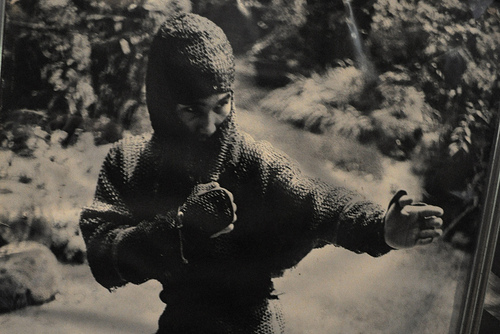
Myth! While ninja may have appeared magical, they put their pajamas on one leg at a time, just like everybody else. In battle, though, they used this legend to frighten their enemies. The height of ninja activities was during the 1600s; but by the 1800s, most ninja action involved farming or looking for work. Yet ninja buzz kept growing through art, theater, and word of mouth. By the 1900s, ninja were portrayed as practically superhuman.

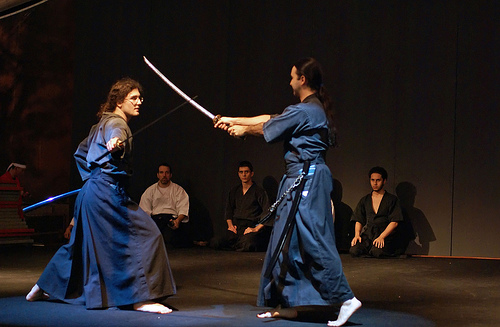
(Image credit: Flickr user Jérôme Sadou)

5. Ninjas always wore black.

Myth! In real life, ninja dressed for the job at hand; they usually looked like everyone else. When sneaking into an enemy lair, they wore the uniforms of their adversaries to trick them. By the Edo Period (1603-1867), their exploits were famous enough to hit the Kabuki theater. Taking the stealthy reputation of the ninja into consideration, Kabuki troupes decided to portray ninja the same as stagehands-dressed all in black so as not to be seen by the audience. Henceforth, all ninja were portrayed in black.

6. Ninja in training walked through fire, stood under freezing waterfalls, and dangled themelves over cliffs.

Fact! As Japan's Edo Period wore on, the ninja became less secretive. There were no more feudal wars left to fight. Ninja masters wrote books, opened schools to teach others, and became scholars. And their fighting became world famous. In the 1980s, the American film Enter the Ninja set off a brief ninja craze in the United States, and lots of schools opened (some more authentic than others). There are thousands of practicing ninja in the United States today.

(Image credit: Flickr user RodrigoFavera)

______________________________

The article above is reprinted with permission from Uncle John's Bathroom Reader Plunges Into History Again.

The book is a compendium of entertaining information chock-full of facts on a plethora of history topics. Uncle John's first plunge into history was a smash hit - over half a million copies sold! And this sequel gives you more colorful characters, cultural milestones, historical hindsight, groundbreaking events, and scintillating sagas.

Since 1988, the Bathroom Reader Institute had published a series of popular books containing irresistible bits of trivia and obscure yet fascinating facts. Check out their website here: Bathroom Reader Institute


Email This Post to a Friend
""

Separate multiple emails with a comma. Limit 5.


Success! Your email has been sent!

close window

Page 2,265 of 2,623     first | prev | next | last

Profile for Miss Cellania

  • Member Since 2012/08/04


Statistics

Blog Posts

  • Posts Written 39,341
  • Comments Received 109,554
  • Post Views 53,129,985
  • Unique Visitors 43,698,048
  • Likes Received 45,727

Comments

  • Threads Started 4,987
  • Replies Posted 3,730
  • Likes Received 2,683
X

This website uses cookies.

This website uses cookies to improve user experience. By using this website you consent to all cookies in accordance with our Privacy Policy.

I agree
 
Learn More