
I don't know about younger viewers, but those of us who watched all the Star Wars movies in order of their release have always been baffled by the implications of retconning. It was bad enough that the secrets kept in the first movie, then revealed in the second and third, made it clear that Lucas was making it up as he went along.
Every time a new prequel came out, the effort to bring familiar characters back only screwed with the timeline and ruined the logic of the first movie that captured our imaginations. "New" characters turned out to have been there all along. More implausible connections between them were revealed. Sure, Lucas explained that the droids had their memories wiped between the prequels and the original trilogy, but that doesn't work for a Wookiee. Or for Obi-Wan Kenobi, who knew everything all along, but refused to reveal anything actually useful. Matthew McCleskey gives us the spoiler version that might have been. -via Geeks Are Sexy
Miss Cellania's Blog Posts
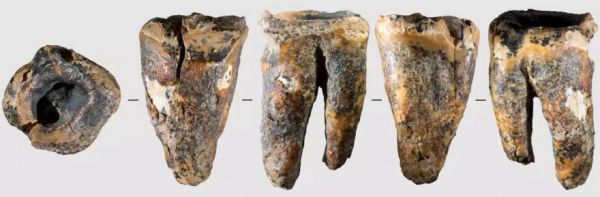
On a long drive this week, I heard three different reports on NPR about a Neanderthal tooth that has been discovered with a deliberately-drilled hole in it. The tooth also shows evidence that it was used for chewing after the hole was drilled! A bioarchaeologist described the tooth and the stone drill used to make the hole, which tells us that Neanderthals not only had the skills, but the cooperation and trust to perform such surgery. A modern dentist described that the problem was probably terrible pain from a swollen infection. He said it would have taken at least an hour to painfully drill into the tooth, but the patient must have understood the relief to come afterward. The tooth, from a cave in Siberia, was dated to 59,000 years ago. We don't know what, if any, pain relief was available to Neanderthals.
The drilled hole extends into the tooth pulp, which would have destroyed the nerve and is somewhat analogous to a root canal. In most early human dentistry, the normal cure would have been to pull the tooth. Read about the tooth and what it tells us at NPR.
(Image credit: Zubova et al./PLOS One)
Motor vehicles are prohibited in Denali National Park in Alaska, except for buses that shuttle visitors through a limited area. Rangers patrol on foot, on horseback, in helicopters, or with dogsleds. For more than 100 years, Denali has raised sled dog puppies in their own breeding program in conjunction with reputable Alaskan breeders. On March 30, sled dog Spark gave birth to six puppies in the park. Some of these will be swapped with other litters from breeders, and four that show the best qualities of a sled dog will grow up to be official Denali canine rangers. This year's puppies are named after national parks: Sequoia, Mammoth, Rainier, Teton, Mesa, and Acadia. They are now six weeks old, and you can peek in on them anytime with the Denali Puppy Cam! Keep in mind that Denali is four hours behind the Eastern Time Zone. If the puppies are asleep, scroll down to read about Denali's puppy program. -via Metafilter

John Adams and Thomas Jefferson collaborated on the Declaration of Independence in 1776. They both served as US president, then retired, and notably died on the same day, the 50th anniversary of the country's founding, on July 4th, 1826. Those are things you already know about the two men. You might also know that the two friends had a falling out over politics after the Revolutionary War, and went years without speaking.
However, in the 15 years before their deaths, the two Founding Fathers reconnected by correspondence. They reminisced about how the Declaration came about, and their memories didn't always agree. But they were both aware of the lack of documentation as it was happening, and that their later correspondence would become part of the nation's historical record. Those letters reveal fundamental differences in the way that Adams and Jefferson understood the nature of the general public and how they would guard the liberties they fought for.
We tend to think of navies as a military force that deploys on the high seas. The US not only uses its navy for ocean battles, but traditionally for troop transport to faraway wars before air travel. But how would a country house and train a navy without seaports? There are seven landlocked countries in the world that maintain navies as a separate branch of their military forces. The "how" behind those forces comes down to the fact that oceans aren't the only bodies of water in the world. But the "why" is way more interesting, and each country has their own story. Some are responding to real threats, and some are legacies of a complicated history. In the case of Laos, we don't know much about it at all, but I'm sure they have their reasons in their own cultural context. This video from Half as Interesting is a minute shorter than it looks, since an ad is at the end.
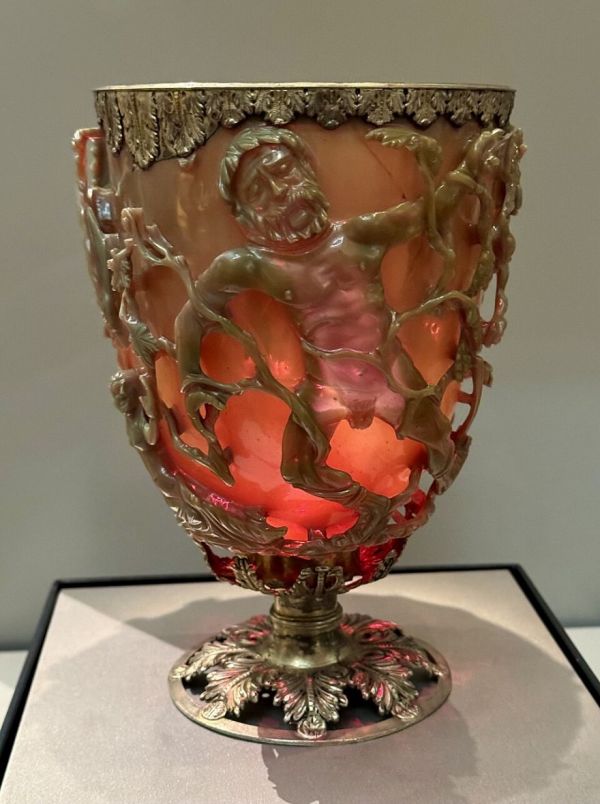
This is the Lycurgus Cup, a glass vessel dating back to Roman Empire of the fourth century. It is made of intricately-carved glass with a strange property. Under normal light, it appears to be an opaque jade green. But lit from the back, it glows a translucent red! This is dichroic glass, and displays different colors because of nanoparticles of gold and silver embedded in the glass. It is the only intact example of such glass, although a few shards of broken glass have been identified as dichroic. This property was only understood more than a thousand years later when scientists recreated it using nanotechnology. However, experts believe that the colloidal gold and silver were introduced into the molten glass by accident, since nanoparticles are too small to be seen by the naked eye.
The real miracle, as I see it, is that a glass cup from the fourth century has survived fully intact instead of being smashed to smithereens, which is what's happened to most of the glassware I've owned. The Lycurgus Cup is indeed cracked, and held together by its metal rim around the top. The mythology depicted in its carving tells a story in itself, as detailed at the DeBrief. -via Strange Company
(Image credit: Chappsnet)
Two brothers play guitar while they pass the time watching their flock of sheep. The sheep appreciate the music, especially the littlest lamb. The older brother, Joseph, attributes his talent to his father's guitar instead of his years of practice. The younger brother, Isaac, is appalled to learn that Joseph is planning to leave home for a career in music. Is he upset at losing his best friend, or is he worried that he won't be able to step into his brother's shoes? Joseph is simply spreading his wings as an adult, but leaving home is never easy. Isaac has never been without his brother, and it shakes his entire world.
The sweet story called Farewell is Luke Lee's final film as a student a Calarts before he graduates. We wish him well in the animation field. You can see more of his work at YouTube or at Instagram. -via Kuriositas

Catfishing is a term for nefarious scams involving false identities, but in this case, it's a word meaning fishing in categories. Articles on Wikipedia are categorized, and an article may appear in many different categories. Can you identify a Wikipedia article by its categories? Each category is a clue that narrows it down. The game Catfishing gives you ten chances to show your smarts, and those ten articles change every day. The game does not rely on exact spelling or punctuation, and will steer you if you are close. There's even an option to award yourself half a point for being "close enough."
It's not easy. I'm not great with remembering people's names, and one was a subject I know absolutely nothing about. At the end, I kicked myself for missing a couple I should have known. My final result was 6/10 last night, but I learned something, and even looked up a couple of subjects. Try out today's game! -via Metafilter
The most mundane things can have a way more interesting history than you know. Consider the lowly screwdriver. They come in all shapes and sizes, but the one you grab the most has a handle that is comfortable and just plain works for whatever it is you use a screwdriver for. And that's no accident. Its design has more features than you've ever considered, and its development goes back over a hundred years. Every part of it has a purpose from its six sides to the flutes and pommel. Along the way, fancier ideas have been proposed as improvements, but they've never really been able to beat the shape you've come to know.
Woodworker Rex Krueger knows tools. In this video, you'll learn about not only screwdrivers, but other tools that factor into the story, plus you'll learn how to use the features of a screwdriver to get tasks done more efficiently. (via kottke)
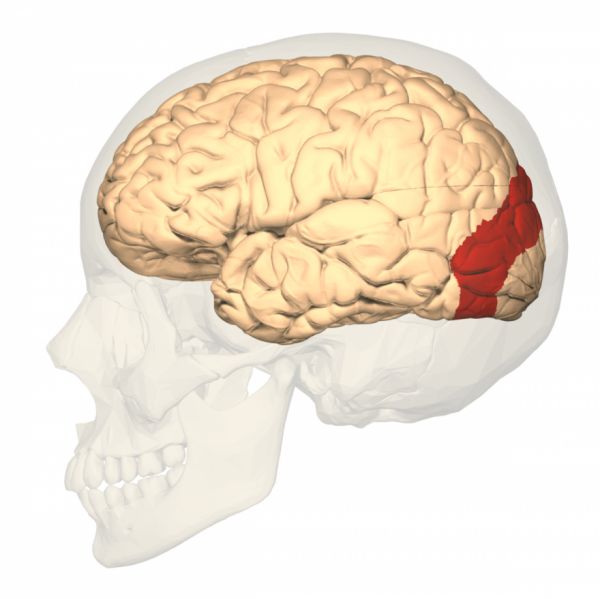
Sometimes clues to a disease come from the people who don't get it. A 1950 study of the psychological lives of blind people revealed that there are no cases of people who had been blind since birth developing schizophrenia. Double-checking through larger health records confirmed the fact. Those who suffer an eye injury or otherwise become blind after seeing in childhood might develop the disease as much as anyone else, but those who were born with a malfunctioning visual cortex in the brain do not.
The visual cortex plays a big role in detecting signals from the outside world and sorting them out. The brain spends a lot of energy ranking visual stimuli to calculate which is important and using those signals to make sense of the world. In schizophrenic patients, this ranking seems to go haywire, and the brain cannot ignore random signals. When there is no visual stimuli in the visual cortex, that part of the brain is often repurposed for other tasks. Does this reorganization of brain tasks provide some kind of protection against schizophrenia? The answer may lie in the complex way in which our brains work. Read about this intriguing research at the Conversation. -via Damn Interesting
(Image credit: Database Center for Life Science(DBCLS))
Trying to contain or control the flow of lava from an erupting volcano seems like a fool's errand. It would be much better to avoid building communities anywhere near a volcano. But volcanos can go millions of years between eruptions, and people don't mind living near what they figure is an extinct volcano. They often have rich soil for crops. So we are occasionally surprised by an eruption, which can be devastating.
People have attempted several different methods for controlling lava flow, including bombs, water, and dikes (although I'm not sure that would be the right term, since it's lava instead of water), with varying results. Oh yeah, and sacrifices, which isn't addressed in this video at all. It turns out that one method seems to work best, but only when the community is prepared way ahead of time. That's not much help when an "extinct" volcano decides to suddenly resurrect itself, but it's better than nothing. Or as one commenter put it: "Well as long as you stay on the furniture and don’t touch the floor you should be fine."
It's already May the eighth in Britain, and so Sir David Attenborough is celebrating his 100th birthday. Born on May 8, 1926, the British broadcaster and naturalist joined the BBC in 1952, when it was fairly new and few people had television sets. He himself had never seen television before. Attenborough worked on several shows, then became the host (what the British call a presenter) of the show Zoo Quest in 1954. Since then he's brought us dozen of shows on the world's animals in their natural habitats. He also became an executive at the BBC.
Attenborough's nature documentaries have inspired children to become scientists, filmmakers, and conservationists. His shows, from Zoo Quest to Life on Earth to Blue Planet have given us a new way to see the world around us. Read about Attenborough's influence on what a nature documentary can be.
Tributes to Attenborough's very public and inspiring career are rolling in, and he took time to record a message of appreciation for his fans.
Specialized employment, or working a job for money, has existed for only a few thousand years of human history. Before that, people were pretty much all farmers, and before that, we were hunter-gatherers. We think of that as a hard life, but studies show that procuring enough food to eat didn't take up nearly as much time as you might think. YouTuber Axen illustrates how ancient people really spent their time, and you might end up being jealous. Just remember, today we have ice cream.
But there are a couple of caveats here. This was from a time when there were fewer people and plenty of resources. Living in a warm climate meant you didn't have to spend a lot of time storing up firewood, building warm homes, and making warm clothes. That changed when humans used their free time to wander into new territory for new resources when the world grew more crowded. As that happened, they eventually had to spend more time defending the community from enemies as well. And no matter what time period you target, women still had the added burden of reproduction and child care.
In the past few weeks, Americans under 50 have been looking up the siege of the American Embassy in Tehran to understand the tensions between the US and Iran. Meanwhile, other incidents that have nothing to do with the US were happening at the same time, because groups of people have always been horrible to other groups of people.
On April 30, 1980, six gunmen from the Democratic Revolutionary Front for the Liberation of Arabistan (DRFLA) stormed the Iranian Embassy in London. They were Iranian Arabs opposed to the new government, supported and armed by Iraq. They took 26 hostages, mostly embassy employees, but also British and international contractors, visitors, journalists, and one policeman. The terrorists demanded the release of Arab prisoners in Iranian jails and safe passage out of Britain. Margaret Thatcher refused to promise safe passage. The siege went on for six days, until the British SAS staged a terrifying but brilliant raid to end the standoff. Read what led to the crisis, what happened behind the scenes day-by-day, and the fallout afterward at Utterly Interesting.
When I started watching this video, I thought it was going to be a rehash of the Lutz family story that inspired The Amityville Horror. But this is one I'd never heard before- it's far less supernatural and therefore scarier. Derek and Maria Broaddus bought a house in Westfield, New Jersey, in 2014. They immediately started renovations to get the house ready for them and their three children to move into. They also started getting eerie letters from an anonymous writer. The letters revealed that someone had them under surveillance, and intended to keep watching them. The letters continued and became more threatening, and the Broaddus family delayed moving in.
Their story was published at a blog in 2018, and was eventually made into a TV show, The Watcher, which ran for seven episodes in 2022. Weird History gives us the rundown on what happened and some speculation about why it happened. No perpetrator has ever been identified. But you might want to watch something a little more benign to clear your head after hearing what the Broaddus family went through.