
Photographer Caren Alpert takes pictures of food. Really, really close-up pictures of food. What you see here are cake sprinkles, shot at a 65x magnification. See more at her website. Link -via Boing Boing
Miss Cellania's Blog Posts
Photographer Caren Alpert takes pictures of food. Really, really close-up pictures of food. What you see here are cake sprinkles, shot at a 65x magnification. See more at her website. Link -via Boing Boing
Thieves in Vienna, Austria made off with 21 tons of mustard and ketchup.
Authorities are on the lookout for the missing mustard as well as the $22,000 trailer. Link -via J-Walk Blog
(Image credit: the NeatoShop)
The loot was in a semitrailer parked in a lot over the weekend northwest of Vienna. Police say the truck driver showed up Monday to deliver his cargo only to see the trailer missing.
Police assume the thieves were more interested in the trailer than its contents.
Authorities are on the lookout for the missing mustard as well as the $22,000 trailer. Link -via J-Walk Blog
(Image credit: the NeatoShop)
The Kermode bear, also called a spirit bear, is a walking contradiction. One in ten black bears on Prince Royal Island, British Columbia are born white. National Geographic tell us more about spirit bears.
There's also a related photo gallery at NatGeo. Link
(Image credit: Paul Nicklen)
Neither albino nor polar bear, the spirit bear (also known as the Kermode bear) is a white variant of the North American black bear, and it's found almost exclusively here in the Great Bear Rainforest. At 25,000 square miles—one and a half times as big as Switzerland—the region runs 250 miles down Canada's western coast and encompasses a vast network of mist-shrouded fjords, densely forested islands, and glacier-capped mountains. Grizzlies, black bears, wolves, wolverines, humpback whales, and orcas thrive along a coast that has been home to First Nations like the Gitga'at for hundreds of generations. It's a spooky, wild, mysterious place: There are wolves here that fish. Deer that swim. Western red cedar trees that have stood a thousand years or more. And a black bear that is white.
There's also a related photo gallery at NatGeo. Link
(Image credit: Paul Nicklen)
(YouTube link)
Cartoonist Winsor McCay {wiki} creates an early movie animation in this 1911 film, originally entitled Winsor McCay, the Famous Cartoonist of the N.Y. Herald and His Moving Comics but often just called Little Nemo, after McCay's comic strip. Most of the video is a dramatization of how the animation came about. The actual animation happens about eight minutes in. McCay later went on to produce Gertie the Dinosaur, which many of us learned was the "first" animated movie. -via Buzzfeed
One hundred years ago, women in Britain who wanted to vote were considered terrorists. Many were jailed, and although Scotland Yard wanted to record them in photographs, the women refused to cooperate. So in 1912, officials purchased a camera and hired a paparazzi-style photographer to shoot the inmates from a distance. BBC news explained how and why these photographs were taken. You can see an online collection of the photos, which give us a glimpse into the world of suffragettes and how they were treated by police. http://www.howtobearetronaut.com/2011/07/suffragette-surveillance-1913/ -via Metafilter
(Image credit: © National Portrait Gallery, London)
Plants and herbs play a big part in the magic of Harry Potter. The students of Hogwarts encounter plants that scream, pulsate, spew poison, and most importantly, become ingredients in magic potions. What's more is that many of those fantastic plants are based on real plants, or at least real legends of plants. Garden Design gives us the lowdown on the fictional and the actual botanical specimens mentioned in the series. For example, in Harry Potter and the Sorcerer's Stone, we meet a plant that grabs people with its tendrils, intending to eat them!
An entire list of plants from the series are examined in this article. Link -Thanks, Claire!
Carnivorous trees have popped up now and again in various superstitious texts, including one outrageous tall tale invented by a 19th-century German explorer named Carl Liche who claimed to have seen an eight-foot-tall plant with long hairy tendrils pick up a woman—supposedly belonging to what was later deemed a fictional Malagasy tribe—and devour her whole. Liche's story, which was written up as a non-fiction travel account in the South Australian Register, was later found to be completely false.
An entire list of plants from the series are examined in this article. Link -Thanks, Claire!

This chart from Jorge Cham of PhD Comics is more relevant than ever. However, I've heard that it only applies to Americans. Link -via Chart Porn
We only keep a landline so I can call my cell when I lose it in the house. - @bulls_horns
This Tweet hit the nail on the head, so it had to be turned into a Twaggie, illustrated by artist Jeff Naslund. See more of his work at Twaggies. Link
(YouTube link)
The Google translation from Norwegian is a bit rough, but it appears that 66-year-old business owner Harald Mikkelsen of Alta, Norway, stopped a thief who was making a getaway by lifting the car with his tractor! Mikkelson only lowered the getaway vehicle when police arrived, 45 minutes later. The incident was captured on video by tourists, and Mikkelsen has become a national celebrity for his actions last Friday. Link -via Arbroath
Have you ever wondered what makes the famous and expensive Baccarat crystal so special? This pretty video by James Bort following the glass workers who hand craft it may give you some clues. Link
Jill Harness is getting ready to cover Comic Con this week in San Diego. I hope she brings back lots of pictures! As a preview, she's posted a roundup of quite a few products that will be officially unveiled at, or exclusive to, the convention, like this awesome limited edition Nerd Domo. See the rest at Rue the Day. Link
Jim asked Julie to marry him by creating a website with comics drawn of their lives together. This may sound like something you've seen before, but there are parts along the way that will draw you in and make you wish them happiness forever. A video of her reaction has been added at the end. Link -via the Presurfer
(YouTube link)
Josh proposed to Brook and took the idea of a "leap of faith" to a ridiculous level! I don't think her "No way!" is a rejection; I think she was only shocked and probably trying to lower her blood pressure. -via I Am Bored
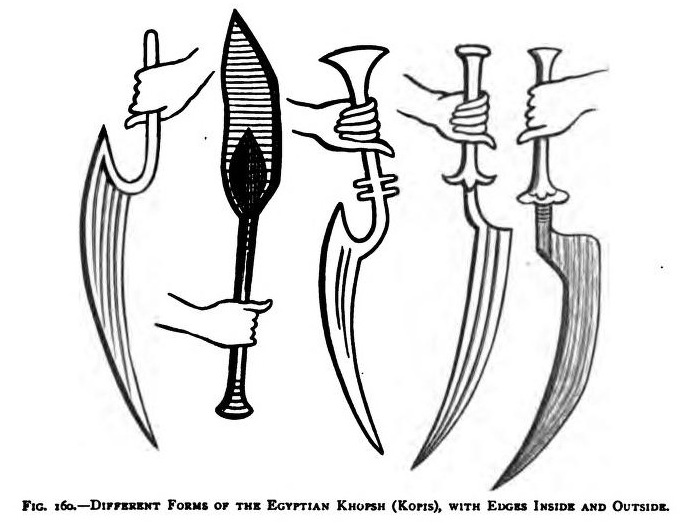
Ancient Arab swords. Note that some designs were more commonly used for decapitation, and other designs less so. Drawing: The Book of the Sword, Sir Richard Francis Burton, Chatto and Windus, London, 1884.
The following is reprinted from The Annals of Improbable Research. Click to enlarge images.
by Simcha Lev-Yadun, Department of Science Education—Biology, Faculty of Science and Science Education University of Haifa, Oranim, Tivon, Israel.
with instructive illustrations and historical documentation selected by Alice Shirrell Kaswell, Improbable Research staff
The global energy crisis and other global changes have been studied from endless points of view. Here, I wish to discuss these matters, and also global ecology, from the point of view of the changing methods of executions, a point of view that has never been studied before.
Ancient Hebrews and Arab Innovations
The ancient Hebrews, living in the barren hill country of Judea and Samaria, executed people by stoning. The rocky, almost tree-less environment explains the use of this execution method. Arabs in the nearby sandy deserts of Saudi Arabia could not stone condemned people to death with sand particles, and instead used to decapitate them with a sword.
At least one form of impalement by stake is thought to be a Turkish innovation. Details here are from The Eastern Question: Its Facts and Fallacies, Malcolm MacColl, Longmans, Green and Co., London, 1877.
Ancient Turkish and Asian Tropical Innovations
In the Near East, gravity, which comes free of charge, was also used for traditional execution. The Turks, for instance, used to execute by impaling people on a metal spear, a vivid practice known as “Chazuk.” A botanical parallel was in use in tropical regions of Asia, where instead of putting the bound condemned person on top of a spear, he was tied on top of a young palm or a bamboo. The plant shoot, in its search for light, grew quickly (a very relative term for the impaled one) through the condemned person. Such good plant growth was possible in the tropics, but not in the much more arid Near East. We see that when it was possible, biology was used, but when impossible, physics also served the purpose.
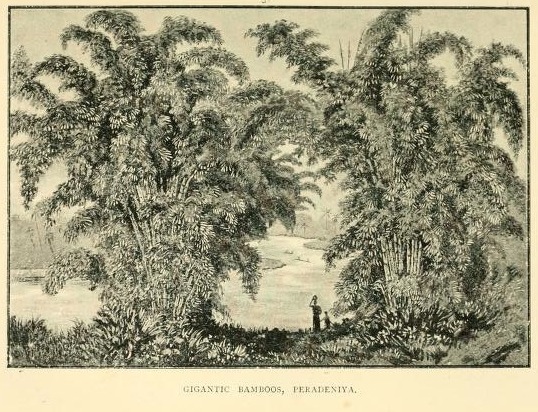
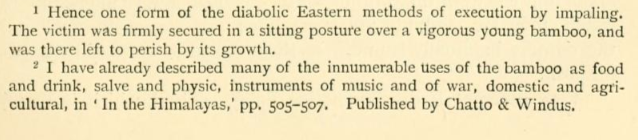
Impalement by bamboo growth originated in regions of Asia that could take advantage of the rapid growth of certain varieties of the bamboo plant. Details shown here are from Two Happy Years in Ceylon, Constance Frederica Gordon Cumming, Chatto and Windus, London, 1893. Be sure to read footnote 1 in this image. (below)
Ancient Roman Innovations
Still in the semi-arid Mediterranean, the Romans, who suffered from the consequences of severe deforestation, conserved good quality timber by the practice of crucifixion. They used wooden crosses repeatedly, and even forced the condemned people to carry the horizontal beam. An alternative tree-based method that saved the trees used in execution was to bend two trees till they were close and tie them with ropes so the ropes prevented them from straightening up. The condemned person was tied to the trees (an arm and a leg to each tree), the ropes holding the trees were cut. The end was quick, and again, there was no waste of timber. medieval European Innovations In then-wooded Medieval Europe, people were executed for centuries by the auto-de-fe, i.e., burnt alive on the stake. This spectacular procedure was carried on till the increasing depletion of the forests was recognized. Thus, in the 18th century, a new method, much friendlier to the environment, emerged: the guillotine. Taking into account the large number of people executed using the guillotine during the French Revolution, the continued use of auto-de-fe would probably have depleted the remaining forests of Western Europe.
The guillotine proved to be an environmentally friendly innovation in France. Drawing: History of the Guillotine, John Wilson Croker, John Murray, London, 1853.
North American Innovations
In a different wooded ecosystem, in North America, before the forests were cut down, condemned people were hanged on trees. Following the forest decline in many parts of the U.S., the electric chair, based on electricity produced from fossil oil or coal, was invented and used. Being industrialized, this method of execution suited the U.S. However, following the energy crisis of the 1970s, among the various measures to save energy, many of the U.S. states decided to use lethal injections.
“The end was quick,
and again, there was
no waste of timber.”
Conclusion: Execution and Conservation
We can therefore see that both regional ecology and environmental changes influenced the methods of execution in various countries and ecologies. In any case, a global trend of environmental conservation along with the exploitation of specific local resources is obvious in this colorful aspect of human culture.
Visit their website for more research that makes people LAUGH and then THINK.
The following is reprinted from The Annals of Improbable Research. Click to enlarge images.
by Simcha Lev-Yadun, Department of Science Education—Biology, Faculty of Science and Science Education University of Haifa, Oranim, Tivon, Israel.
with instructive illustrations and historical documentation selected by Alice Shirrell Kaswell, Improbable Research staff
The global energy crisis and other global changes have been studied from endless points of view. Here, I wish to discuss these matters, and also global ecology, from the point of view of the changing methods of executions, a point of view that has never been studied before.
Ancient Hebrews and Arab Innovations
The ancient Hebrews, living in the barren hill country of Judea and Samaria, executed people by stoning. The rocky, almost tree-less environment explains the use of this execution method. Arabs in the nearby sandy deserts of Saudi Arabia could not stone condemned people to death with sand particles, and instead used to decapitate them with a sword.
At least one form of impalement by stake is thought to be a Turkish innovation. Details here are from The Eastern Question: Its Facts and Fallacies, Malcolm MacColl, Longmans, Green and Co., London, 1877.

Ancient Turkish and Asian Tropical Innovations
In the Near East, gravity, which comes free of charge, was also used for traditional execution. The Turks, for instance, used to execute by impaling people on a metal spear, a vivid practice known as “Chazuk.” A botanical parallel was in use in tropical regions of Asia, where instead of putting the bound condemned person on top of a spear, he was tied on top of a young palm or a bamboo. The plant shoot, in its search for light, grew quickly (a very relative term for the impaled one) through the condemned person. Such good plant growth was possible in the tropics, but not in the much more arid Near East. We see that when it was possible, biology was used, but when impossible, physics also served the purpose.
Impalement by bamboo growth originated in regions of Asia that could take advantage of the rapid growth of certain varieties of the bamboo plant. Details shown here are from Two Happy Years in Ceylon, Constance Frederica Gordon Cumming, Chatto and Windus, London, 1893. Be sure to read footnote 1 in this image. (below)
Ancient Roman Innovations
Still in the semi-arid Mediterranean, the Romans, who suffered from the consequences of severe deforestation, conserved good quality timber by the practice of crucifixion. They used wooden crosses repeatedly, and even forced the condemned people to carry the horizontal beam. An alternative tree-based method that saved the trees used in execution was to bend two trees till they were close and tie them with ropes so the ropes prevented them from straightening up. The condemned person was tied to the trees (an arm and a leg to each tree), the ropes holding the trees were cut. The end was quick, and again, there was no waste of timber. medieval European Innovations In then-wooded Medieval Europe, people were executed for centuries by the auto-de-fe, i.e., burnt alive on the stake. This spectacular procedure was carried on till the increasing depletion of the forests was recognized. Thus, in the 18th century, a new method, much friendlier to the environment, emerged: the guillotine. Taking into account the large number of people executed using the guillotine during the French Revolution, the continued use of auto-de-fe would probably have depleted the remaining forests of Western Europe.
The guillotine proved to be an environmentally friendly innovation in France. Drawing: History of the Guillotine, John Wilson Croker, John Murray, London, 1853.

North American Innovations
In a different wooded ecosystem, in North America, before the forests were cut down, condemned people were hanged on trees. Following the forest decline in many parts of the U.S., the electric chair, based on electricity produced from fossil oil or coal, was invented and used. Being industrialized, this method of execution suited the U.S. However, following the energy crisis of the 1970s, among the various measures to save energy, many of the U.S. states decided to use lethal injections.
“The end was quick,
and again, there was
no waste of timber.”
Conclusion: Execution and Conservation
We can therefore see that both regional ecology and environmental changes influenced the methods of execution in various countries and ecologies. In any case, a global trend of environmental conservation along with the exploitation of specific local resources is obvious in this colorful aspect of human culture.
_____________________
This article is republished with permission from the July-August 2009 issue of the Annals of Improbable Research. You can download or purchase back issues of the magazine, or subscribe to receive future issues. Or get a subscription for someone as a gift!Visit their website for more research that makes people LAUGH and then THINK.
(YouTube link)
The Nelson Mandela Metropolitan University Choir treated unsuspecting shoppers at Greenacres Shopping Centre in Port Elizabeth, South Africa to a concert performance right there in the mall court. The stunt is part of a recruiting drive for NMMU. Link -Thanks, Marilyn!
Email This Post to a Friend