
Anything new and different naturally scares some people. Not all people, but enough people so that Something had to Be Done. That was usually a ban. Chill Dude Explains brings us ten goofy stories about things we take for granted today that totally frightened everyone when they were new, and were made illegal in one place or another at one time or another. If you've followed Neatorama for a long time, you will be familiar with many of these stories.
It's not always an overreaction. The first blood transfusions were deadly, because the scientists who tried them didn't know enough about blood yet. Lucky for us, they eventually figured it out. At least one is completely political- the printing press was a great leap forward in information and literacy, but those in authority fear a well-informed populace. Scary new ideas eventually become everyday things, and we all get used to them. Still, you'll have to get past how Chill Dude Explains pronounces "margarine" to get into the video. He's probably only heard it called "spread."
Miss Cellania's Blog Posts

Oklahoma State Court of Appeals judge Kenneth D. Bacon loved to fly in his open-cockpit Starduster II. On a summer day in 1976, he flew to Kansas alone, and was caught in a bank of black clouds that suddenly appeared, although the forecast was for a completely sunny day. Bacon looked for a place to land, and was shocked to see an enormous airport with runways that looked 7,000 feet long! It was labeled as Habit Field, but he couldn't find a radio frequency, and heard no signal from the tower. Nevertheless, he finally landed and found no one there at all. He described it as an extremely eerie experience. At the next airport over, he was told that "no one lands there." Then they found damage to Bacon's plane that shouldn't have been possible. Read his account of that strange day at Strange Company.
Of course, I had to know more. Naval Air Station Hutchinson was created in 1942. What was the navy doing in Kansas? Well, it was wartime. The airfield was built on 2,565 acres and the runways indeed grew to 7,000 feet. After the war, the airfield was shuttered, and went into private hands briefly, but then was repurposed for naval training. It became a Kansas Air National Guard Base in 1957. It was closed in 1967. Then it became a commercial airport called H.A.B.I.T. (Hutchinson Air Base Industrial Tract). In the late '70s, it was used for a commercial skydiving operation called Sunflower Field. By the end of the century, it was an oversized glider airport. You can read an extensive history of the airport at this site, starting about halfway down the page, with lots of pictures.
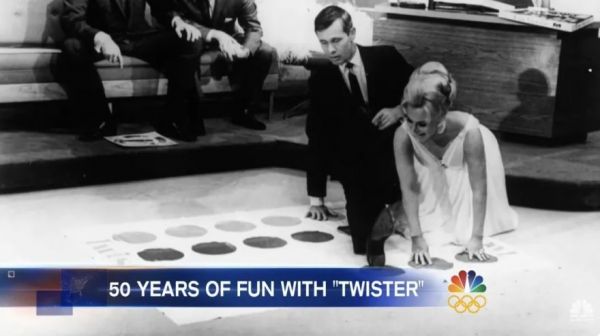
When Reyn Guyer invented the game Twister (originally called Pretzel), he wasn't thinking of the unspoken taboo on touching other people's bodies. He was concentrating on the novelty of a board game where the players become the playing pieces. He might have envisioned it as a family game. Either way, it was hard to market. Reviewers thought it was too risqué, and it was even called “sex in a box.”
But then an executive at Milton Bradley got the idea to give a game to Johnny Carson to play on The Tonight Show. Twister was still very new, and Carson tried it out with his guest Eva Gabor on May 3rd, 1966 (60 years ago tonight). They had a good time and plenty of laughs. That appearance not only introduced the public to Twister, it gave them permission to try it themselves. After all, it was played on broadcast TV! Never mind that The Tonight Show was the most risqué part of the TV schedule at that time. Sales took off the very next day, and Twister became a lasting hit. Read the history of Twister and how it took hold in American culture at Smithsonian.
(Image credit: NBC News/YouTube)
The urge to make a baby laugh, and the joy we get from it, is no accident. It's a adaptation that makes us rear children in a way that helps them develop the skills they need. At only a few months old, babies laugh when you play peekaboo because they are learning about object permanence. At first, you are performing a magic trick for them, and it takes some time before they get that straightened out. Their laugh is reinforced when you keep doing this pleasurable activity, so they learn to laugh at what they enjoy. But their brains are also forming important concepts that build upon each other, step-by-step. Children will continue to laugh at peekaboo for years, but the game later grows into more complicated forms of play that also expand their brains' understanding of the world. This TED-Ed lesson doesn't really go into that pleasurable feedback loop, but spending a weekend with my grandchildren drove it home for me.
Once thought to be impossible, two runners finished the London Marathon in under two hours on April 26th. Sabastian Sawe of Kenya clocked in at 1:59:30, while Yomif Kejelcha of Ethiopia followed at 1:59:41. If those two hadn't participated, the third place finisher, Jacob Kiplimo of Uganda, would still have set a world record. Such accomplishments require talent, dedication, and training. But what kind of East African training brings such results?
There's a big difference between marathon training in Ethiopia and the US, which harness completely different athletic philosophies. In the US, training relies heavily on science, using the latest technology to monitor the physiology of runners, leading to custom-tailored training regimens for each athlete. Although it's called the Norwegian style, this training uses the philosophy of rugged individualism America is noted for. In Ethiopia, training focuses on community, leadership, and mentorship. No one runs alone. The idea is that endurance can be taught, and the secret of long distances lies in knowing when to hold back and let the body recover, and when to push harder. This method also keeps runners going because they enjoy doing it together. Read about the differing philosophies of marathon training at Aeon. You can also listen to it as a podcast. -via Nag on the Lake
This trail cam footage shows a mother cougar with three half-grown cubs visiting a stash of deer meat. And purring and squeaking. They look healthy and well-fed. But the surprise is where this happened. It was near Voyageurs National Park in Minnesota! We think of cougars as residents of the American West, but they once roamed the entire country. Over the last couple of decades, there have been sightings in Minnesota, mostly on trail cams, of solitary cougars, but this sighting is the first of cubs in Minnesota in more than a century.
When an electronically-tagged deer died in March, it was found covered in leaves, raising suspicions that a cougar may have killed it. Researchers planted cameras near the carcass, hoping that the cats would return to feast again. They were surprised to see four cougars return to the site, meaning that cougars are once again reproducing in Minnesota instead of just passing through. Read more about this discovery at MPR. -via Metafilter
 (Image source: Tokitsukazes)
Look at this adorable Australian brushtail possum! No, they don't all look like this. This little girl has a melanin deficit, but apparently not a carotene deficit. Can you guess what they named her? Sure you can. This was one of the many responses to several reddit threads soliciting memorable animal pictures from redditor's home countries. Some have stories attached that explain why the animal is so cool, like the raccoon that broke into a liquor store and got drunk, and a Ukrainian hero dog who detects landmines. Some are just funny, like this deer that was interviewed for a TV report in Estonia.
 (Image source: AmarineQ)
Others include pigs walking into a pub called the Golden Lion (Pumbaa visiting Simba?), a rescued dog that was identified as a wolf at the vet's office, and the famous Australian drop bear. See a few dozen of the best examples at Bored Panda.
The award-winning animated short film Ducks starts out cute with a baby observing a normal day in the park, and gets cuter- for a little while. And then nightmare fuel starts creeping in. Don't let that stop you; there's no real horror here, just a throwback to the bizarre cartoons of the early internet. The first thing we learn is that not all ducks are the same. They can vary in surprising ways. They don't appear to be completely nefarious, but you get a sneaking suspicion that they could be.
It's not until the very end of the short that you realize it's a public service announcement. You might even be able to guess what it is along the, but only if you know and care about ducks. For most people, it will be a complete surprise. This film is by AJ Jeffries, who has an extensive catalog of cartoons you might want to check out.

Bird's nest fungus sounds like a type of fungus that grows on bird's nests- maybe the kind of thing you'd recognize in the taste of bird's nest soup. But that's not what it is at all. It's a fungus that looks like a tiny nest, complete with eggs inside! There are 60 to 70 different species of bird's nest fungi, under the family Nidulariaceae, which comes from the Latin term for little nest. They are found all around the world, and tend to grow on organic surfaces, like tree branches or fallen logs.
But why do they look like bird's nests? It's not camouflage, but a reproductive strategy. The "eggs" contain fungus spores. They develop inside a shell, which opens up when the eggs are ready. Then it waits for rain. A single raindrop splashing into the "nest" will propel the spore-carrying eggs as far as three feet away, where they land on some other organic material to start growing a new pod. Read about these fungi and see plenty of picture (plus a video) at Kuriositas.
(image credit: JuliaC2006)
Somewhere along the lines, a long time ago, ruling families got the idea that their blood was better than everyone else's, so they wanted keep reproduction in the family, so to speak. This was also a convenient way to keep inherited wealth from being divided. But inbreeding will catch up with you sooner or later, as more and more harmful genes have the chance to get doubled up. The case we are most familiar with is that of Charles II of Spain, whose family tree was not only a wreath, but even more resembled an Euler diagram.
But he was far from the only victim of royal inbreeding. It's always been common in Europe. Loony Throne takes us through several dynasties in which inbreeding made a lasting mark on history. It would have been far healthier to accept the children of these kings' and queen's extramarital relationships with commoners, before their bloodline crashed into a wall. The exception is Queen Victoria's family. In that case, the harm wasn't a confluence of inbreeding leading down to one last tragic ruler, but in her scheme of marrying off her children and spreading a genetic disease to other ruling families of Europe.

Karahan Tepe is an archaeological site near Göbekli Tepe in Turkey, and has been dated back to between 10,000 and 9500 BCE. That would make it the oldest known village on earth. Of course, "known" is doing a lot of heavy lifting here, since earlier villages built with wood or other organic material could have vanished completely. Karahan Tepe was built of stone.
The common understanding of the birth of civilization is that nomadic people settled down in permanent communities in order to grow grain crops. But new findings from Karahan Tepe reveal what the residents ate, and it was mostly gazelle meat and wild legumes, not grains. Such a diet, while monotonous, would provide the protein required for building the stone walls, monuments, and carvings found on the site. This 12,000-year old community may have delved into agriculture of some sort, but it mainly relied on hunting and gathering while its people built something truly lasting. Read about Karahan Tepe and what we've learned from it at the Debrief. -via Strange Company
(Image credit: Campels)
Forensic linguistics deals with the study of language used in legal cases. Not lawyer talk, but things like figuring out who wrote something when they aren't identified. I've been delving into that type of puzzle just today, in reading about Trota of Salerno and which medical texts she did and didn't write, and Luke, who wrote two books of the Bible. So I was surprised to see a video about the science of these investigations.
FBI forensic linguists learned an awful lot about the Unabomber by the manifesto he released. It didn't contain any identifying information, but it was so long that his writing style was a treasure trove of clues. Most communications from unknown perpetrators are much shorter, but there are techniques that police can use to trace them back to a suspect. Half as Interesting shows us some of those techniques that have cracked cases before just from some anonymous writing. This video has one minute of advertising at the end.
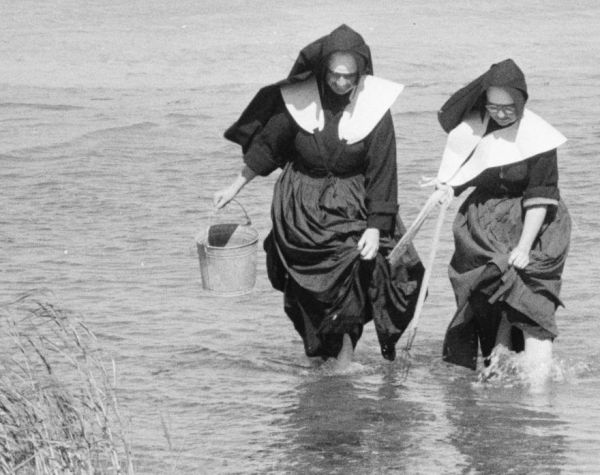
One of the earlier breakthroughs in fertility treatment was the development of the drug Pergonal in the 1940s, which contained hormones that stimulate ovulation. Most women produce their own follicle-stimulating hormone (FSH) and luteinizing hormone (LH) all their lives, but during pregnancy and after menopause, the hormones are no longer utilized and are excreted in urine. The amount of FSH and LH in the urine is an indicator of pregnancy, and led to the development of at-home pregnancy tests.
The Italian pharmaceutical company Istituto Farmacologico Serono that developed Pergonal had trouble getting enough of these hormones to test the drug, much less run clinical trials for fertility treatment. But the Vatican owned the majority of the company, so the pope okayed a plan to collect urine from post-menopausal nuns at retirement convents. When 30,000 liters were collected, they had just enough hormones for Pergonal to go to clinical trials. The drug was used for several decades until synthetic hormones were developed. Ironically, the use of Pergonal was crucial in developing IVF treatments, which the Vatican opposes. Read about the nuns' urine and the hormones it contained at Amusing Planet.
(Image credit: Toni Frissell)
Master mixer Bill McClintock (previously at Neatorama) is back with his latest project, which he calls "Psycho-Push-it" by Salt-Knot. It basically uses the instrumental track of Slipknot's 2008 song "Psychosocial" with the vocals from Salt-N-Pepa's 1987 hip hop hit "Push It." To be honest, this mashup actually includes music and lyrics from both songs, to mix things up a bit.
It works well, because this is what McClintock does. He finds the most disparate songs you can think of and makes them sound good together. Also consider that both songs, as different as they are and 20 years apart, can be found on the same playlists for an awful lot of people, and can even be heard on the same radio stations. Just because you like metal doesn't mean you can't like hip hop. You'll like this version.
When Shigeru Miyamoto designed a new game for Nintendo in 1981, he was hoping to use Popeye and his friends as characters, but couldn't get permission. So he concocted a cast of new characters, one of which was a plumber with a mustache who wore red overalls. He was dubbed Jumpman, because that's what he did in the game. Bluto became an ape called Donkey Kong. The game did well, and Miyamoto used the characters in other games. The eight-bit Jumpman was easily recognized with his red clothes and mustache, and became a fan favorite. In 1982, he was named after the landlord of Nintendo's American office, Mario Segale. With the name Mario, he grew a backstory as an Italian American living in Brooklyn. He got a brother named Luigi when a game required two protagonists.
In 45 years, Mario has gone from an improvised eight-bit character to the face of Nintendo, with three movies, three theme parks, three TV series, and appearances in many games. His appeal is that he is Everyman, a regular Joe with a regular job who takes on brave quests but doesn't use violence unless he absolutely has to. Read how Mario began, and how he changed and grew with the video game industry to his global fame today at Rolling Stone. -via Everlasting Blort