What is now Arlington National Cemetery was once the home of Robert E. Lee and his wife, Mary.
Mary Lee dreaded the thought of abandoning Arlington, the 1,100-acre estate she had inherited from her father, George Washington Parke Custis, upon his death in 1857. Custis, the grandson of Martha Washington, had been adopted by George Washington when Custis' father died in 1781. Beginning in 1802, as the new nation's capital took form across the river, Custis started building Arlington, his showplace mansion. Probably modeled after the Temple of Hephaestus in Athens, the columned house floated among the Virginia hills as if it had been there forever, peering down upon the half-finished capital at its feet. When Custis died, Arlington passed to Mary Lee, his only surviving child, who had grown up, married and raised seven children and buried her parents there. In correspondence, her husband referred to the place as "our dear home," the spot "where my attachments are more strongly placed than at any other place in the world." If possible, his wife felt an even stronger attachment to the property.
Mary Lee packed up and left in 1861, just ahead of the Union Army. Even after the federal government began burying soldiers on the property, the Lees fought for the return of their home. Smithsonian Magazine has the rest of the story of how the estate became the hallowed ground it is today, a resting place and a memorial to American military personnel who died in service to their country. Link
This is a physics-based game in which you design your own tools to accomplish tasks and collect cogs (which help you accomplish more tasks). At first, I thought it might be difficult to understand, but there are hints, prompts, and do-overs along the way. Before long, I was really into it and had to force myself to get back to work! From Aardman Studios, the folks behind Wallace and Gromit. Link-Thanks, Evan Duval!
For more than a century, "Taps" has been the bugle call to mark the day's end and evening rest in the U.S. military. Its soothing 24 notes have comforted many when played as a final farewell to a former soldier laid to rest. Given its long history, it's not surprising that it is the subject of many legends.
Birth of "Taps"
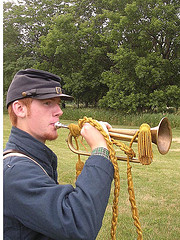
By the Civil War, bugle calls existed for all types of commands-from "Time to get up!" to "Wear your overcoat today!" or "If you're sick, now's the time for sick call!" But it was during the Civil War's Peninsula Campaign in July 1862 that "Taps" became the bugle call command to extinguish all lights and fires and prepare for sleep. Historians agree on when and where "Taps" was first played, but there's more than one version of the story surrounding its origin and composer. (Image credit: Flickr user yark64)
Believe It Or Not
One popular story says that the man who first ordered "Taps" played was Union Captain Robert Ellicombe. While encamped with the Army of the Potomac at Harrison's Landing, Virginia, Ellicombe risked enemy fire to rescue a wounded soldier. When the captain lit a lantern, he realized that the young man was dead, and a Confederate soldier, but even more shocking-the young man was his own son. Inside the soldier's pocket was a musical score. Ellicombe requested that a bugler play his son's composition at the burial, and that was when the Army of the Potomac first heard the somber music of "Taps".
The country's foremost authority on the tune as well as the former curator of Arlington National Cemetery's "Taps" Bugle Exhibit, Jari A. Villanueva, researched the story and found no record of any Captain Ellicombe in the Union Army or at Harrison's Landing. What Villanueva did find was an episode of Ripley's Believe It Or Not television show where the tragic tale of a Union father and a Confederate son first aired.
Butterfield's Lullaby
The true history of the birth of "Taps" was told by bugler Oliver Norton in an 1898 letter he wrote in response to a Century Magazine article that claimed the origin of the tune was unknown. Norton explained that he knew how "Taps" originated because he'd been the first to play it.
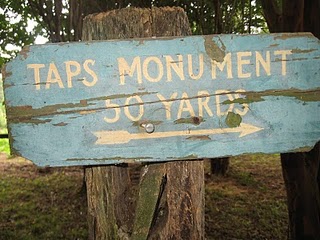
According to Norton, one July evening he was called to the tent of Major General Daniel Adam Butterfield, the chief of staff for the Army of the Potomac. Encamped at Harrison's Landing, recovering from a defeat at the hands of General Robert E. Lee's army, Butterfield's exhausted and wounded soldiers suffered from heat, mosquitos, dysentery, and typhoid. The standard bugle call for lights-out had a harsh military cadence, and Butterfield thought a more soothing bugle call might help his men rest. (Image credit: Civil War Librarian)
The general handed Norton an envelope with musical notes written on the back and asked the bugler to play them. The bugler lengthened some notes and shortened others until the sound was melodious and slow enough to suit Butterfield, who ordered the melody played every evening at the final bugle call. Century's editors wrote to Butterfield, who confirmed the incident.
Last Call, Boys!
General Butterfield didn't actually compose the tune, sometimes called "Butterfield's Lullaby", but had simply revised an early French version of the "Scott Tattoo". (A tattoo was a bugle call used to order soldiers to leave a tavern and return to their quarters for the night.) The name "Taps" probably came from an obsolete drum roll command called "Taptoe" that ordered tavern keepers to turn off their keg spigots at the end of an evening.
A Smash Hit
From the first night he played it, Norton knew that "Taps" would be a hit. In his letter to the magazine he wrote, "The music was beautiful on that still summer night, and was heard far beyond the limits of our Brigade. The next day I was visited by several buglers from neighboring Brigades, asking for copies of the music, which I gladly furnished."
"Taps" wasn't just a Union favorite. Confederates heard the tune in their nearby camps and liked it so much that by 1863 the Confederate army's mounted artillery drill manual contained the order that "'Taps' will be blown at 9:00 at which time all officers will be in quarters."
The Last Goodbye
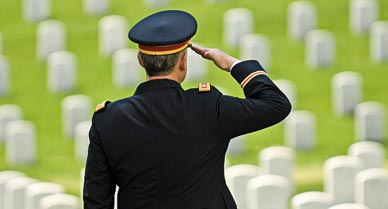
(Image credit: Mass Communication Specialist 1st Class Chad J. McNeeley, from the Flickr stream of Beverly & Pack)
"Taps" was first used for military funeral services out of necessity. In 1862 Captain John Tidball presided over the burial of one of his fallen men. Tradition ordered that three rifle volleys would be fired at the ceremony, but Tidball's troops were hidden in the woods, and he feared that any nearby enemy would hear the gunshots, figure out their location, and then attack them in the belief that there was a resumption of hostilities. To substitute for the rifle volley, the captain ordered the bugler to sound "Taps".
Playing "Taps" became an unofficial custom at Union army funerals. The rebels also played the call to honor fallen soldiers-most notably at the 1863 funeral of General Thomas "Stonewall" Jackson after his death by friendly fire in the Battle of Chancellorsville.
After the Civil War, "Taps" became an official bugle call of the U.S. Army, and by 1891 an official order in the U.S. Army Infantry Drill Regulations made the bugle call mandatory at formal military funerals and memorial ceremonies.
A Fallen President
Possibly the most memorable rendition of "Taps" was played on November 25th, 1963, at the funeral of President John F. Kennedy. A World War II veteran, Kennedy was buried with full military honors at Arlington National Cemetery. At the ceremony, the command for present arms was given, and the traditional three volleys were fired. Then Sergeant Keith Clark of the U.S. Army Band played "Taps"-not on a bugle but on a B-flat trumpet.
Clark had played the call perfectly hundreds of times at hundreds of ceremonies. In fact, he'd played it in President Kennedy's presence only two weeks earlier at the Tomb of the Unknowns on Veteran's Day. But this time, as he played, he "cracked" the sixth note so that it sounded shortened and off-key. Clark admitted that nervousness was the cause, but the media immediately assumed that the cracked note was intentional, and they found it especially poignant.
Newsweek described the broken note as "a tear". William manchester, author of Death of a President, described it as a "cactch in your voice or a swiftly stifled sob." For about two weeks following the presidential burial, other Arlington buglers missed that same sixth note.
Since 1988, the Bathroom Reader Institute had published a series of popular books containing irresistible bits of trivia and obscure yet fascinating facts.
You've heard of war bunkers and subways and fallout shelters, but this list of hidden places has more than I ever knew about, like how Seattle created an underground level in one fell swoop.
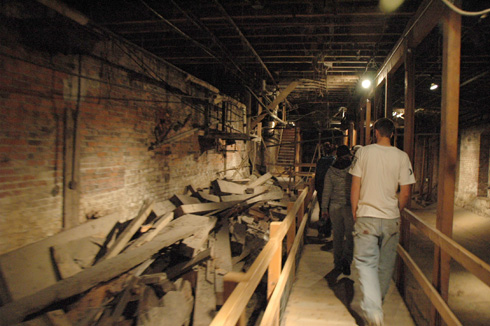
The Great Seattle Fire of 1889 put an end to the first Seattle, with civic leaders making two important decisions. The first was a building ordinance specifying that all new constructions must be of brick or masonry. The second was to elevate the new city above the tideflats, effectively turning the second story of buildings into the new ground floor. Shop-keeps quickly rebuilt, and sidewalks and streets were planted one story higher than before, creating underground passageways lined with the original storefronts.
There are 15 other places and stories as well at Nile Guide. Link -via Holy Kaw!
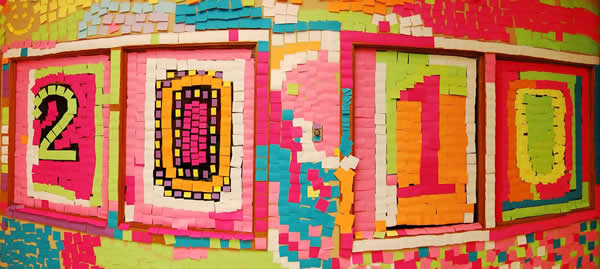
There's no word on what school this is, or even what state it's in, but the pictures are stunning! The class of 2010 decorated the science hall with colorful post-it notes on all four walls, as you'll see in a panoramic photograph at the link. The results are worth keeping around for a while. http://topcultured.com/awesome-post-it-senior-prank/ -via Digg
Adam Savage of the TV show Mythbusters explains an experiment that the Discovery Channel rejected. Did your mother ever say "The box is more nutritious!" when you asked for sugary cereal? Adam and Jamie set up a test to find out if that's true, which turned out completely different from anything they expected. This is an excerpt from Savage's speech at Maker Faire. Subject matter may be disturbing to some viewers. You can watch the entire speech at FORA.tv. Link -via Digg
You might have noticed that some images were missing from some posts this morning. Thanks to our programming expert, the issue was soon resolved and everything should be back to normal now! If you notice anything still awry, let us know.
To make sure you don't miss anything at Neatorama, here's what he did this past week. Jill Harness looked at internet advertising campaigns in the post Does Viral Marketing Make You Sick? with some examples of really cool videos that disappointed us when we later found them to be professional ads.
Congratulations to prize winners attorneyadrian and Jaded Unicorn for winning prizes in this week's What Is It? game!
Congratulations to Ben Dussault, Leah and Margaret, Ian, and Kim Kutz, who all won prizes in the How Did You Know? contest we sponsored in collaboration with mental_floss.
The Neatorama Mini-Hunt sent you searching for awesome things to win The Book of Awesome by Neil Pasricha.
And we're in the last few days of the Upcoming Queue competition, with an iPad at stake. Go take a look at the submissions and vote for the ones that should be featured on our main page!
You're invited to join in the discussion with the daily question at Facebook and keep up with even more neat links with our Twitter feed!
Dairies in Switzerland make many varieties of Swiss cheese, and only some kinds have the holes we associate with it. Gadling has a short course in Swiss cheese making from the Appenzeller cheese dairy in Stein, Appenzellerland, Switzerland.
Now, onto what you'll learn about the 700 year old Appenzeller cheese, renowned as the "spiciest cheese from Switzerland:"
The dairy guys get to work at about 4 AM to receive and test the milk brought in by local farmers. They test it to ensure that the cows ate nothing but hay and meadow grass. If farmers bring in bad milk once, they get a warning; twice and they are banned.
To create a consistent product, part of the milk is skimmed, then slowly re-added to the whole milk to ensure an exact fat content. This is a practice older than most cheese dairies.
That's only the very beginning of the process. If you are ever in Switzerland, you can take a tour of the cheese plant yourself! Link
Derek Eads created this cool game based on Nicholas Cage and his movies! Can you match the character's hair (as portrayed by Cage) to the movie it appeared in? Link -via The Daily What
Once a year, in mountainous Ha Giang province of northern Vietnam, married people can get away and enjoy a couple of days with on old flame -and it's considered okay! The participants gather in the village of Khau Vai on the 26th and 27th of the third month, using the lunar calendar, in order to rekindle lost loves from the past.
Legend has it an ethnic Giay girl from Ha Giang province fell in love with an ethnic Nung boy from the neighboring province of Cao Bang.
The girl was so beautiful that her tribe did not want to let her marry a man from another tribe and a bloody conflict ensued between the two tribes.
Watching tragedy unfold before them, the two lovers sorrowfully decided to part ways to avoid further bloodshed and to restore peace.
But to keep their love alive they made a secret pact to meet once a year on the 27th day of the third lunar month in Khau Vai. Thereafter, the hill village became known as a meeting place for all of those in love.
One married couple came to Khau Vai together, as both were meeting former lovers. Read more in this story by Nguyen Van Vinh. Link -via Gadling
TV Tango has a list of everything special on TV for the Memorial Day holiday weekend. You wouldn't want to miss a marathon showing of your favorite show, whether it's The Andy Griffith Show, Spongebob Squarepants, Doctor Who, or America's Next Top Model. There are also specials to remind us what Memorial Day is all about, with documentaries, war movies, and tributes to those who gave the last full measure. Link -via Interesting Pile
When Ralph Nader wrote the book Unsafe at Any Speed, the US Government sat up and took notice. Highway deaths were unacceptably high, and someone had to do something about it. In the 1960s, 70s, and 80s, a government program actually developed the RSV, a car that had many new safety features. The government tinkered with the design, the features, and tried to sell the idea of a safer car to the automobile industry and the public. What happened to this program? It's a long story, but in the end, the RSVs were destroyed.
Then-NHTSA chief Jerry Curry contended the vehicles were obsolete, and that anyone who could have learned something from them had done so by then. Claybrook, the NHTSA chief who'd overseen the RSV cars through 1980, told Congress the destruction compared to the Nazis burning books.
"Junking those cars was a terrible idea," said Kelley, who now teaches at Tufts medical school. "What is the benefit of keeping anything that's historically important? The future wants to know more about the past, and when you destroy the past, you destroy the future's access to knowing about it."
"I thought they were intentionally destroying the evidence that you could do much better," said Friedman.
Read the complete story at Jalopnik. Link -via Metafilter
Korean designer SungKug Kim made this bicycle and a couple of others which incorporate the shapes of antlers and horns and named the art project Bi-King. http://kitsunenoir.com/2010/05/26/bi-king-by-sungkug-kim/ | Artist's site -via Chris Tackett
How well can you judge how fattening a food may be by looking at it? In this Lunchtime Quiz at mental_floss, you'll be presented with a pair of dishes. All you have to do is decide which one contains more calories. It's not as easy as you might think; I scored only 59%. Link