
This couple in Mexico were considering getting a dog, but fate intervened. A kitten mysteriously showed up at their house, riddled with fleas and other parasites. Lilo needed help, and when he got it, he wasn't about to let these wonderful people go. He became a velcro cat, following them everywhere.
The guy says it makes "zero sense" that Lilo just showed up like that. As an old cat lady, it makes plenty of sense to me. Lilo didn't walk to their home. Someone who cares so little that they didn't get their cat spayed ended up with a bunch of kittens. As soon as they were barely old enough to be weaned, any kitten not given away got a ride to a random neighborhood and was put out. The kitten is desperate for help, and will approach every human until they find a kind soul. I can't tell you how many cats I've gotten that way. You can see more of Lilo and his loving nature at Instagram.
Miss Cellania's Blog Posts
On Valentine's Day in 1991, a new film opened that ruined quite a few romantic evenings. Silence of the Lambs had been marketed with few clues as to its content, and became a monster hit. Thirty-five years later, it is mainly remembered for the character of Hannibal Lecter. People forget that he wasn't the villain in the movie. They forget how little screen time he had. And many never even knew that it wasn't the first time Lecter was in a movie. Anthony Hopkins portrayal of the cannibal killer stayed with audiences forever.
In an excerpt from a new book about Hannibal Lecter, we learn that Thomas Harris, who created Hannibal Lecter as the author of the novel, couldn't watch the movie, or even get through the trailer. Silence of the Lambs made Anthony Hopkins a sex symbol decades after he began film work. Audiences were glad that Lecter not only survived the movie, but gained his freedom. Read how Silence of the Lambs took audiences by surprise and made Hannibal Lecter an antihero. -via Metafilter
The recoil of a rifle can leave quite a bruise if you aren't properly braced. Most people only have to learn this lesson once. A young man named Rob noticed this force and imagined making a jetpack out of the recoil force of a rifle. Is this at all plausible? He submitted it to Randall Munroe and Henry Reich of the What If? series (previously at Neatorama) as a theoretical question. They tackle those questions seriously, no matter how dumb they sound. The answer is "sort of," meaning that you could do it, but it would be difficult, ridiculous, and not worth the effort.
But there are guns that have more powerful recoils than a mere rifle. And that's where this theory gets interesting. Not that we're ever going to try making a jetpack from a gun, but the existence of a gun that could do it is both interesting and unnerving.
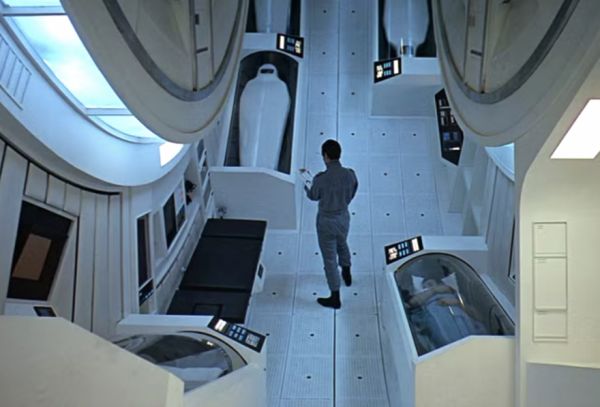
Suspended animation in movies is an easy way to skip very long space flights. Launch, go to sleep, and wake up on a habitable world light years away to find that you are no older. These fictional trips often involve low temperatures as a sort of cryopreservation. The idea of suspended animation came from hibernation, when animals sleep through the winter until there is more food available in the spring.
Except that's not how hibernation actually works. It doesn't require cold, and it doesn't necessarily involve sleep. And it can vary depending on the animal and the conditions it is hibernating to escape. Hibernation, or torpor, is the animal's ability to reduce its metabolism, therefore requiring less energy. In an era in which we are considering long distance space travel for real, a reduction in energy consumption would be quite useful, even more so than combatting the boredom of traveling in space for years. The question of aging is another factor. Will humans ever be able to hibernate to "bear" long space trips? If we can, it probably won't resemble what you've seen in movies.
After World War II, the race was on for the US to build more and better technology than the Soviet Union, which gave us many weird projects that were launched without anyone asking what could possibly go wrong. Space, being the final frontier, was at the head of the list (along with nuclear arsenals, of course). But communications was also important. We didn't have communication satellites yet, so the next best thing would be to fling something into space that radio signals could bounce off of, like 480,000,000 copper needles. And they did it! Somehow, no one could foresee the problem of space junk in the early 1960s. After all, nothing was up there, so why would it bother anyone? Project West Ford required several attempts, but they eventually got those needles into space. This video from Half as Interesting is only seven minutes long; the rest is an ad.
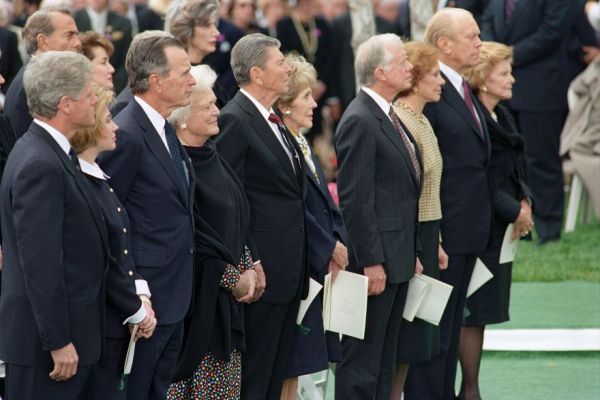
Only one of these five presidents made this list.
Most of the 45 men who became President of the United States were well educated and began public service as lawyers or military members (or both) and worked their way up the political ladder. Teddy Roosevelt and Thomas Jefferson are well-known for their many accomplishments outside of the White House. Then there are a few you might not realize were experienced in something completely different from what they are remembered for. One president knew seven languages besides English, and worked as an interpreter as well as a diplomat. Another had completed medical school. One had an original proof for the Pythagorean theorem published in a scientific journal. And you may be surprised by the only president who held a patent.
In the run up to President's Day in the 250th year of our country, Smithsonian will, no doubt, bring us lots of history and trivia about presidents. Today they tell us about eight presidents who had distinguished but lesser-known accomplishments outside of their presidential terms.
(Image credit: White House Photograph Office/Barbara Kinney)
In case you want to enjoy Bad Bunny's halftime show from the big football game yesterday, but you don't have much time and cannot understand Spanish anyway, Dustin Ballard of There I Ruined It (previously at Neatorama) has edited it down into a compact supercut. This version only has the "Eys." Yes, he has certainly ruined it this time. -via reddit
If you want to see the full presentation, it's at YouTube. Since you still don't know Spanish, or maybe you're not all that familiar with Bad Bunny's music, Becky Hammer offers a detailed explanation of every song and cultural element of the show. Be warned that the subject matter is sometimes NSFW. -via Metafilter
A couple more notes: The wedding was real. The grass and bushes were not. Yes, there were people inside the shrubbery, but they sadly did not dance. That was just the easiest way to get the greenery out onto the field and off again in a hurry.
We have plenty of painted portraits of Ludwig von Beethoven, but were they overly flattering? What did he really look like? We might have an idea from a forensic reconstruction by Brazilian designer Cícero Moraes. Moraes did not have a physical skull to work with, but he did have front and side photographs of Beethoven's skull (presumably taken when his body was exhumed in 1863). He fed data from the photographs into a 3D modeling program to recreate the skull in three dimensions. Then Moraes used standard forensic recreation methods to rebuild the flesh of the head and face. The results do resemble portraits of Beethoven, although the portrait artists were obviously impressed by the composer's reputation and character. Read through the process of recreating Beethoven's appearance at Bored Panda.
You can also see how Moraes recreated the appearances of Johann Sebastian Bach and Wolfgang Amadeus Mozart, although these were done using portraits only.
What's the worst thing artificial intelligence has done to us so far? We could make a list, and one of the things on it would be how it takes the joy out of watching videos on the internet. I can't tell you how many times I've found something that may be worth sharing, and as soon as someone comments that it's AI, the joy is gone.
The short film That's AI! illustrates this concept perfectly. Can that young man really be doing all those backflips, or is it artificially-generated? If you can't believe your eyes online, how can you believe your eyes in the real world? If we can't believe what we see, how are we to ever enjoy or even trust anything anymore? That said, this video is funny, and with the background music, it comes off as an ad. But it's not. And the kicker is that there was no artificial intelligence used in its making. -via the Awesomer
The Olympics showcases sports that most of us would never see otherwise. Once every four years, we follow speed skating, luge, curling, and slalom and suddenly become experts in our minds. And occasionally we got a glimpse into what goes on behind those sports. Just the other day we found out that how the fit of a ski suit is very important in the sport of ski jumping. There are plenty of other obscure rules for Olympic sports. Did you know that colored nail polish is not allowed in women's gymnastics? Maybe we can assume it's not allowed in men's gymnastics, either. And the authorities of water polo are rightfully concerned about whether athletes have clipped their toenails. Mental Floss goes over these restrictions in a list of ten obscure Olympics rules.
One rule, however, needs an update. Backflips were banned from figure skating after the 1976 games. We were all astounded when Surya Bonaly of France did a backflip on ice in 1998. She was penalized, but is remembered to this day. In 2024, the International Skating Union decided to reverse the rule and make backflips okay. US figure skating star Ilia Malinin is currently taking advantage of the rule change by stealing the show at the Milano-Cortina Winter Games in Italy.
Benedict Cumberbatch has become a favorite reader for Shaun Usher's Letters Live series because he reads letters with such dramatic flair. In this performance at the Southbank Centre in London last month, he delivers a pitch-perfect reading of a letter written to a bank in 2009.
The writer has been a customer of the unnamed bank for thirty years, yet they still managed to screw him over with their new automatic systems designed to take every bit of humanity out of the business of banking. No doubt you will feel exactly what this customer is feeling, because we've all experienced the same type of horror. In response, he decides to give them a taste of their own medicine, in excruciating detail. I sure wish we had the rest of the story, meaning how the bank responded. We know they kept the letter because it was so good. I have a sneaking suspicion that every bank employee who read it was nonetheless helpless to provide any kind of relief for the writer. And what he's on about has only gotten worse in the years since. -via Laughing Squid
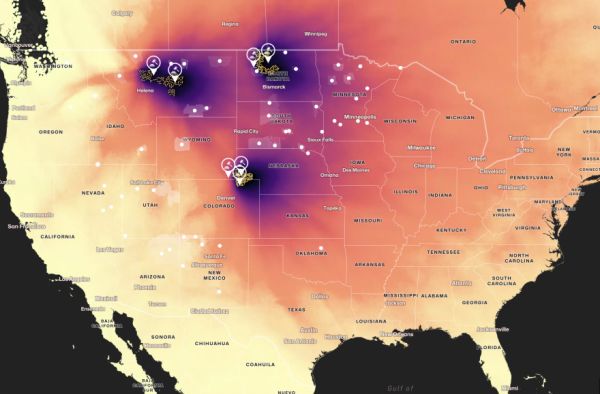
The Air Force has plans to upgrade and re-arm existing obsolete nuclear missile sites in the US. Maps Mania alerts us to an interactive map project concerning these missile silos. The locations are common knowledge thanks to satellite technology. Under the Nuclear Sponge theory, these missiles silos are located in relatively low population areas of the country, under the assumption that in a nuclear war, the enemy would attack these silos first, which would then affect fewer people. Small consolation for those who live in these areas.
However, nuclear fallout following such an attack would cover much larger areas, depending on wind and weather. USA Today posted an interactive map showing which areas would be most affected under different weather models, indicating that highly-populated areas would not be safe even if a nuclear attack was limited to the silos. You can also explore the original map called Under the Nuclear Cloud without all the scrolling context at Columbia University. -via Nag on the Lake
The premise of the short film Forevergreen is simple: a pine tree adopts a baby bear. Yes, there's a lot more to it, but that synopsis was all I needed to want to watch it. The tree makes a surprisingly good parent, but things go sideways when the bear reaches adolescence and is lured off by the temptations of the outside world. Then you start to see that it's a version of Yogi Bear. No, it's Smokey Bear. No, really, it's The Giving Tree. Or maybe it's the story of Groot. It's a bit of every story about trees or bears, but mainly it's about love. And junk food.
Nathan Engelhardt and Jeremy Spears spent five years making Forevergreen in their free time with no budget, and now it's nominated for an Academy Award. We'll find out who wins on March 15th. Meanwhile you can see a behind-the-scenes video about Forevergreen here. -via Kuriositas

The Olympics are underway in Italy, with venues scattered across a wide area of the Alps whether there is snow cover or not. The magic of artificial snow generation makes sure that what you see on TV appears perfect for skiing, snowboarding, and cross-country racing. In fact, many of the races at the Beijing Olympics in 2022 were run completely on machine-generated snow. Yet the lack of reliable snow over the past few deacdes affects the ability of athletes to train for the competitions in their home countries.
Any Olympic course that doesn't have adequate natural snow will be groomed with manmade snow, which is real snow made from real water, but it's not the same. Flakes of natural snow are varied due to temperature, humidity, and other factors. Manmade snow is more uniform, and tends to compact faster. This leaves the courses slicker and often more dangerous. Read about the effects of using manmade snow at the Olympics at the Conversation.
See also: The Science of the Winter Olympics.
(Image credit: Jon Wick)
Warning: This POV footage may induce vertigo.
Ride along with freestyle motocross star Colby Raha as he breaks a world record. But that's only half the ride, and he does it twice. The frightening course was set up at the Record Breakers event in Mesa, Arizona on January 31st. First, he has to get up to speed. Then he jumps 275 feet over a pool with no margin for error. Then he zips up a quarter pipe, straight up, and lands in one piece. I'm impressed, but it's not quite a world record, so he tries it a second time.
The part where Raha has to go quite some distance to get back where he started is kind of cute, with fans waving him on. So he does the whole run again, this time reaching 90 feet above ground on the quarter pipe for a big air world record. I would recommend watching this GoPro video in full screen mode for maximum terror. -via Born in Space