
This creek in a New Jersey forest has concrete walls on both sides that extend for miles. People on both sides noticed a fawn that had fallen in, and wasn't able to scale the wall to get back out. He was pretty small, and was injured besides. Local people kept returning to the site to see if he was still there, and that went on for two weeks. It became clear he wasn't going to get out on his own, so they called The Last Resort Wildlife Refuge. Nancy Warner responded and took stock of the situation. This would require some work. A carpenter and crew built a custom set of stairs for the deer! A bit of time and some deer chow, and the stairs did their work. The two weeks the deer spent by himself in the ravine were recovery time for the injury, and now he is free to find his family.
Miss Cellania's Blog Posts
In western Switzerland, near the French border, in a valley called Val-de-Travers, lies the town of Couvet. That's where absinthe was first developed. The drink began to be commercially produced in the 19th century, and gained a reputation in Paris and around the world. Known as the green fairy, absinthe was rumored to cause hallucinations, but that was less from the wormwood and other flora than the alcohol content, which could reach 70%. Absinthe was banned in 1910, only re-emerging in 2005. But of course, it never really went away, especially in the lush forest of Val-de-Travers.
In this forest, there are fontaines froides (cold fountains), which are hiding places for a bottle of absinthe. During the ban, they were well hidden, known only to those who knew where to look. These became part of the valley's folklore, and are being kept alive today even when grocery stores carry absinthe. The custom brings tourists and hikers to Val-de-Travers as a bonus for enjoying the beauty of the area. Read about the charming fountains and the history behind them at Atlas Obscura.
It's hard to get anyone to watch a live-action film from a hundred years ago because they are black and white and silent. But animated cartoons? Those are still hilarious a hundred years later. Line drawings on film physically hold up better over time, and dialogue isn't necessary when the visuals are funny. Humor is based on the unexpected, and cartoons utilized funny scenarios that can't possibly happen in real life, like animals acting like people and extreme violence that leaves no damage. This mayhem included animated body parts stretching like rubber hoses, hence the name of the style. Rubber hose animation made cartoons big hits in the 1920s, and we still watch them today.
Rubber hose animation enlivened cartoons of the 1920s and '30s, then Disney came along with color and dialogue and realism and superseded the bizarre slapstick of rubber hose animation. More's the pity, but we still have those old cartoons.

There's a long history of people sailing across an ocean by themselves, or attempting to. Usually they are in small boats, which are easier to handle by oneself, which gives us the term "microyacht." As the boats got smaller, the competitive nature of the sport went from the accomplishment of making it across the ocean to racing other solo sailors to seeing who can make the smallest boat to get there in.
Andrew Bedwell is no novice in solo sailing, or even microyachting. His newest boat is the smallest yet, and will set a new world record if he makes it across the Atlantic in May. The route will take him 1900 miles from Newfoundland to Ireland. The microyacht, called the Big C V2, is only 4.5 feet wide. How long is it? He won't reveal that, but it is shorter than the current record holder, which was 5 feet, 4 inches long (1.63 meters). It is made of aluminum and carries solar panels, a power system, food and water, sails, and even has room for Bedwell to stretch his legs out when sitting inside. The Big C V2 can also be packed up and sealed in case of a storm. Read about the tiniest microyacht at Practical Boat Owner. -via Messy Nessy Chic
(Image credit: Andrew Bedwell)
I'm sure you've been puzzled by the meaning of a brand name at least once in your life, and found no one to ask that could shed a light on it. You may have found more confusion among those around you, as some see it one way and others have always seen it a totally different way, and neither side has ever considered the other interpretation.
Musician Ben Lapidus took a fresh look at the logo for PetSmart and saw how ambiguous it is. There's only one thing to do- write a song about it, and make it heavy metal so everyone will pay attention to this matter. It's not exactly an earth-shattering dilemma, but it will make you think. Maybe it's supposed to be ambiguous. Lucky for us, PetSmart saw Lapidus' video and issued a response.
Whew, aren't you glad that's been cleared up once and for all? -via Laughing Squid
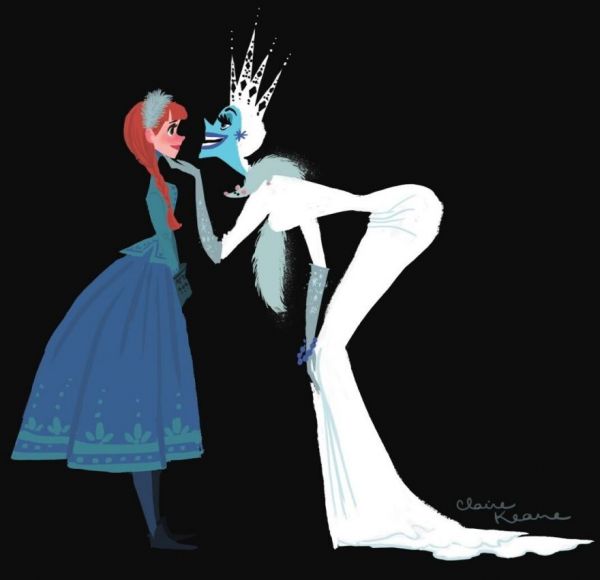
Getting a glimpse of the earliest versions of beloved Disney characters was a hit, so why not do some more of them?
The 2013 movie Frozen was the culmination of Disney's decades-long quest to make a movie out of the 1844 Hans Christian Andersen fairy tale The Snow Queen. If you're familiar with it, you know the Queen is the villain of the tale, cold but still beautiful. An early draft of the Disney character has her rail-thin, with blue skin, spiky hair, and the makeup of an elderly grand dame. That was before they decided that Elsa wouldn't be a villain after all. The early versions of Wreck-It Ralph were monsters, resembling a yeti or a bear and in some cases, sporting horns. And Stitch from Lilo and Stitch was a terrifying tiger with a rat head. See ten more early versions of Disney characters who looked nothing like the finished product at Cracked.
How does a mere notepad inflict damage in a duel armed only with a pencil? By drawing on your opponent. The first with a full mustache and beard is the loser. Then one duelist figures out how to make himself more intimidating, a decision that may have won the competition but that he regrets the next day.
You might recall the Bent Objects series of whimsical sculptures made by Terry Border. They were everyday objects made into sentient beings doing everyday stuff to make you smile. It's been ten years since we posted them, and most of those links are no longer available. Now Border is back, experimenting with a new medium- video! Yes, he's done some digital videos over the years, yet this is his first old-fashioned stop-motion version of his signature objects, this time two notepads dueling it out with pencils. He thought it would be too tedious, and now he says it turned out to be a pleasant experience. -Thanks, Terry!
— Miss Cellania (@misscellania) March 5, 2026
During the rise of the Nazi regime, radio was used as a propaganda tool to indoctrinate the German people and convince them of the inevitability of the Third Reich. The British were above such tactics, at least on the surface, as the BBC continued to broadcast strict truth during World War II. But they also had a secret program, a string of radio stations in the Political Warfare Executive (PWE), based out of the rural village of Milton Bryan. This program hired talented musicians, writers, and actors who were German refugees and not trusted for other British positions in the war effort.
These propaganda stations broadcast big band music in German, often with rewritten lyrics designed to make soldiers homesick. The news they read was a combination of confusing war plans and rumors, laced with enough true gossip to convinced listeners they were broadcasting from Germany. Agnes Bernauer, a young aspiring actress and singer who was a half-Jewish refugee from Germany, became Vicky with Three Kisses, seducing German soldiers with her voice by singing and telling soothing tales of British propaganda. Read how all that worked out pretty well at Smithsonian.
When is a lie a lie? That may seem like a simple question on the surface, but there are many factors to consider. When you say something complimentary to avoid insulting someone with your honest opinion, we call it a "white lie," but it's still a falsehood. You could say the same thing about embellishing a story for drama, or about passing along a lie that we don't know is false. How about when you word something in an ambiguous way that gives you plausible deniability? Should we define a lie by the literal words, the intent behind those words, or the perception of the listener? It's very possible to say one thing with words while implying something completely different with body language and tone of voice. Does this make one of them technically a lie?
Linguist Dr. Erica Brozovsky (previously at Neatorama) explains how complicated lying is, from animals that use camouflage to criminal perjury. It's no wonder lie detectors don't work.
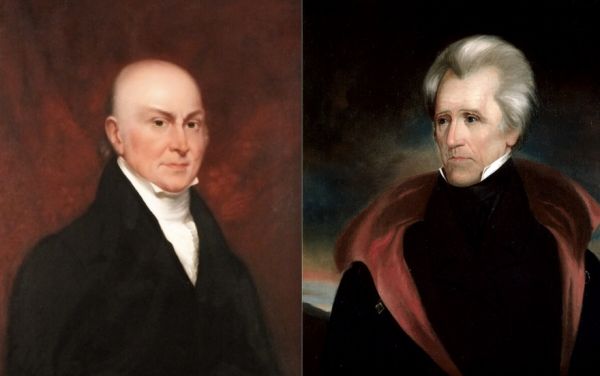
A bizarre possibility in the Electoral College voting system is that a candidate may win the popular vote and still lose the election. For one thing, the weight of electoral votes do not represent the population of all states equally. For another, the "winner take all" apportionment of electoral votes in most states means that even if a candidate wins 49% of the state's votes, none of those votes are represented in the electoral count. Five times in US history, the winner of the presidential election did not get a majority of the nation's votes.
In one case, the election of 1824, there were four leading candidates (all from the same party!), Andrew Jackson, John Quincy Adams, William H. Crawford, and Henry Clay. Jackson won more votes than the other three, but did not get enough electoral votes to secure the election. The decision was thrown into Congress, who chose John Quincy Adams. That election was enough to destroy the party, and Jackson was elected outright in 1828. Read about all five instances when the winner of the presidential election did not win the popular vote at Mental Floss.
When a ventriloquist provides a voice for his dummy, the illusion works because you are focused on the dummy delivering the lines and you're not looking at the ventriloquist. In the age of video, you can go back and focus on the ventriloquist and see his/her lips moving. That's the way you should watch this compilation- focus on Peter Tork's lips, not who is actually speaking.
Tork had a habit of mouthing lines that weren't his while shooting the sitcom The Monkees. According to comments at Metafilter, this is very common among beginning actors, because it helps with timing and catching your cue. The real trick is to learn how to keep up with memorized dialogue without moving your lips. As it is, we rarely see it because we focus on the actual speaker.
OR... was Tork actually delivering all the lines in the show, while everyone else just moved their lips? We may never know.

Although neither astronomers nor meteorologists can say for sure, the convergence of two phenomena could mean that the Aurora Borealis will be at its peak in March. First, there is the equinox. The vernal equinox is on Friday, March 20, when the angle of the earth sees the sun cross the equator, which doubles the chance of auroral activity. Second, the sun is still in its solar maximum, the peak of the sun's magnetic activity in an eleven-year cycles. The actual peak was last October, but it is a months-long maximum.
So when an equinox occurs during a solar maximum, the aurora lights up the sky more spectacularly than ever. Will the Northern Lights be visible further south than usual? We don't know, but if you were ever planning to travel to the higher latitudes to see the lights, now would be a good time to do so. LiveScience explains the phenomena that make it happen. -via kottke
(Image credit: United States Air Force/Senior Airman Joshua Strang)
Ancient anatomists knew about the pancreas. Not only did we butcher animals long before we had writing, but humans were also studied after death. Still, they didn't know what the organ was for- maybe it was just padding between other organs. German anatomist Johann Wirsung made a discovery about the inner workings of the pancreas, and he was shot and killed for his efforts!
But that was not the last of the violence involving research on the pancreas. As medical science advanced, we learned that the pancreas secreted digestive fluids that contained insulin, necessary for regulating carbohydrates in the body. Could we make insulin ourselves to help people with diabetes? Yes, but it would take a team of great minds to accomplish that, and those minds did not get along with each other. Over hundreds of years, scientists studying the pancreas fought over who would get credit for medical breakthroughs, leaving the pancreas with a soap opera of human egos surrounding it.
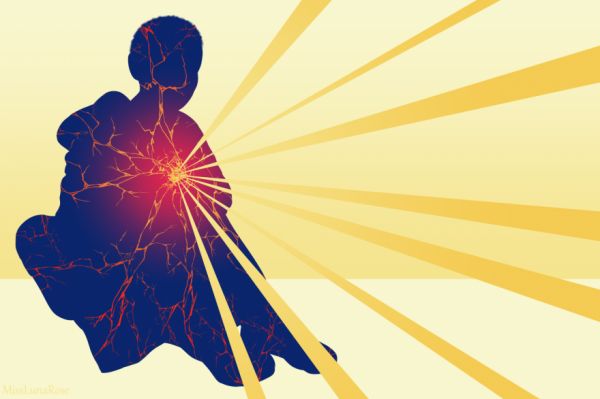
We are all familiar with the tendency of medical professionals to dismiss a woman's pain. There are several reasons for this, and one of them may be that women on average report pain for a longer period after an injury than men do. Research shows that this is a real physical difference, and new research may explain why.
Using studies on mice, scientists identified a molecule named interleukin-10 (IL-10), used by our immune systems, that will dampen pain on nerve receptors. Male mice produced more of the white cells that deliver IL-10, and recovered faster. The next question was why, and it turns out the answer is testosterone and other androgens. When they gave testosterone to female mice, or when they restricted it from male mice, the difference in recovery time disappeared. Read about this research, and how it may lead to new therapies for pain and healing at ZME Science.
(Image credit: MissLunaRose12)
In the 1970s, Alice Cooper burst onto the music scene with his shock rock about not liking school and not being a nice guy. He wore creepy makeup, brought snakes onstage, and worst of all, he had a woman's name! It was cool to like Cooper because it was subversive, but the songs were good, too. Some years later, it became clear that he was a serious musician who had a great hook for the time, and was a regular guy underneath the makeup. When he made enough money to move to a ritzy neighborhood, he became great friends and played golf with neighbors like Groucho Marx and Glen Campbell.
Mike Erskine-Kellie relates a golf outing with Cooper in an animation from the point of view of a cranky old man who still sees him as the unholy demon singer that first grabbed the spotlight. Contains some NSFW language. -via Nag on the Lake