This video provides an overview of how to make an origami hang glider, and how to propel it around a room by creating a wave of air. The project apparently was developed as a teaching tool for students in school, but it is so "neat" that it should also appeal to adults. Those wishing to access detailed instructions for these hang gliders (and a wide variety of other "science toys") should visit the link below.
Perhaps best known for their sketch "The Front Fell Off," John Clarke and Bryan Dawe have also tackled the mortgage crisis. Here they offer a lucid explanation of the Gulf oil spill tragedy.
"You're not going to have a problem before you start."
Many people are surprised to learn that it is possible for a layman to repair a butterfly's broken wing. This video, prepared by the Live Monarch Foundation, begins with a demonstration of how to apply a cardboard splint to a fractured wing; all that one needs is a few household items and a modicum of dexterity.
The second part of the video shows how to attach a new wing when a major portion of the original one is missing; for this you would need to get one of the spare wings you keep around the house...
Some butterflies are truly ephemeral, with a lifespan measured in days; for those species a repair would not be practical. Monarchs however, can live for six months; a repaired wing may allow it to fly from the Upper Midwest to Mexico. Whether it's worth your time and effort is of course your decision.
This is the time of year when tent caterpillars make their presence known; emerging from eggs that have overwintered on tree branches, the caterpillars' first task in the spring is to create a tent. Most people don't realize that these tents are quite elaborate solar energy stuctures that allow the caterpillars to optimize their body temperatures.
The tent of the eastern tent caterpillar is among the largest built by any tent caterpillar. The tents are constructed in the crotch of the host tree and are typically oriented so that the broadest face of the structure faces the southeast, taking advantage of the morning sun... The silk is laid down under slight tension and it eventually contracts, causing the newly spun layer of silk to separate from the previously spun layer...
Light has a great effect on the caterpillars while they are spinning and they always spin the majority of their silk on the most illuminated face of the tent. Indeed, if under experimental conditions the dominant light source is directed at the tent from below, the caterpillars will build their tent upside down...
Eastern tent caterpillars are among the earliest of caterpillars to appear in the spring. Because the early spring weather is often cold, the caterpillars rely on the heat of the sun to elevate their body temperatures to levels that allow them to digest their food... The tents act as miniature glass houses, trapping the heat of the morning sun and allowing the caterpillars to warm more quickly than they would if they remained outside the tent. Studies have shown that basking, aggregated caterpillars can achieve temperature excesses of as much as 44°C.
For a less sanguine view of tent caterpillars, see this rant at the Seattle Times.
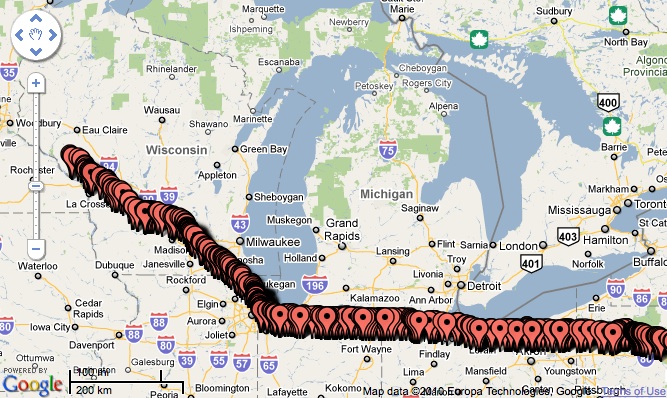
This radar image was obtained by the National Weather Service Weather Forecast Office in La Crosse. The area depicted is where the states of Minnesota, Wisconsin, and Iowa meet.
A mayfly hatch along the Mississippi River was caught on Doppler radar out of NWS La Crosse this evening. The radar view below shows an image at 9:13 p.m. CDT on Saturday, May 29, 2010. The bugs are showing up as bright pink, purple, and white colors along the Mississippi River mainly south of La Crosse, WI. After the bugs hatch off the water and river areas, they are caught in the south-southeast winds while airborne for about 10-20 minutes.
This video purports to show a golf ball striking a steel plate at 150 mph, with the action filmed at 70,000 frames per second. At several YouTube postings of the same sequence, the discussion threads are dominated by incredulity, with opinions being presented that a real golf ball cannot deform to this degree, and that what is shown is another type of ball resembling a golf ball, or else pure computer graphics (or, as the YouTube crowd says, "photoshopping.") The discussion at Neatorama will presumably be more intelligent and well-informed. What do you think? A real regulation golf ball?
In an essay at The Telegraph, photography critic and picture editor Lucy Davis muses about the palettes used by well-known artists.
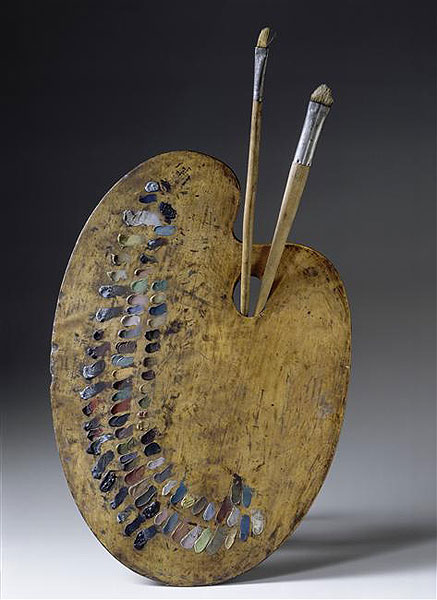
Some artists mix every gradation of colour they will need for a painting before they start, others as they need them. “My freshly arranged palette, brilliant with contrasting colors, is enough to fire my enthusiasm,” noted Delacroix in his Journal in 1850. The French artist was meticulous in his arrangement of colours, and when unwell, would take his palette to bed and spend the entire day just mixing new shades.
The actual palettes of Renoir, Seurat, Degas, Delacroix (above), Moreau, Gauguin, and Van Gogh are illustrated, accompanied by commentary on how the physical layout of colors on the board may influence the figurative "palette" of color choices used by the artist for his work.
Victorious armies have employed graffiti to celebrate their conquests for millennia. A photoessay at Poemas del río Wang utilizes images from the archives of LIFE magazine and other sources to document the extensive graffiti that characterized Berlin after the defeat of Hitler.
The inscriptions remained intact for fifty years in the closed and isolated Reichstag. It was only in the 90s that they were discovered by Karin Felix, a collaborator of the restorations. She prepared a first, complete catalog of the inscriptions and she has made inquiries about the persons and the stories behind the names.
During the restoration of the Reichstag, some of the graffiti was conserved as an item of historical interest.
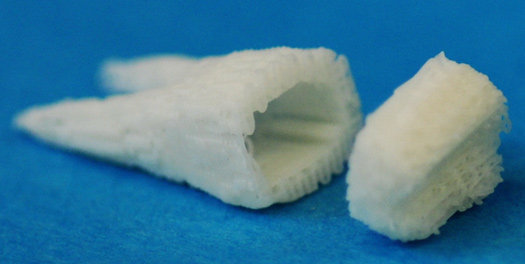
Dr. Jeremy Mao, a research physician at Columbia University, has developed a technique for regrowing teeth in a patient's mouth.
An animal-model study has shown that by homing stem cells to a scaffold made of natural materials and integrated in surrounding tissue, there is no need to use harvested stem cell lines, or create an environment outside of the body (e.g., a Petri dish) where the tooth is grown and then implanted once it has matured. The tooth instead can be grown “orthotopically,” or in the socket where the tooth will integrate with surrounding tissue in ways that are impossible with hard metals or other materials.
The procedure could eliminate the need for dentures and conventional dental implants.
Matt Green is a 30-year old man who decided to walk across the United States. He's not doing this to raise funds for a charity or to call attention to a cause; it's a "for the heck of it" adventure. He intends to walk 3,000 miles, from Rockaway Beach, New York to Rockaway Beach, Oregon, pushing a cart which carries (among other items) his food, clothing, basic camping equipment, two books, pepper spray, and duct tape.
When I’m driving, I find myself saying “Oh, I should have stopped there” as I go flying by something that looks interesting. The idea of having to impede your progress, turn the car around, and find a place to park is such a mental barrier to exploring when you’re driving. Even on a bike there’s a hesitancy to stop and climb off the saddle to go check something out. But it’s easy when you’re walking. You don’t have to stop what you’re doing; you just walk in a different direction for a little and have a look around.
I’m very drawn to the simplicity of this whole pursuit. Each day I’ll wake up, pack all my possessions back in my cart, and walk a little farther. That’s it. That’s the extent of my world. I’m just walkin’. I think everyone dreams about such a simple existence from time to time, when the worries and pressures of modern life start to accumulate. This is my chance to live that dream for a while, and see how the reality compares to the fantasy.
He is travelling without a support team, so to a certain extent he relies on the kindness of strangers, and he documents those encounters and his other experiences with photos at his very interesting website (including, to date, 24 "awesome mailboxes.")
The Chicago Tribune has assembled a brief photoessay highlighting the 20 National Monuments receiving the fewest visitors in 2009, based on National Park Service data. The "winner," with only 14 visitors for the whole year, was Aniakchak, Alaska (pictured above):
No roads will take you to Aniakchak National Monument and Preserve, on the Alaskan peninsula 450 miles southwest of Anchorage. To access this park you'll need to hire an air taxi or a power boat. The park encompasses a 6-mile-wide, 2,000-foot-deep caldera formed by the collapse of a 7,000-foot mountain and offers visitors a taste of one of the wildest terrains in Alaska.
About half of the others are in Arizona and New Mexico, but you can also find peace and quiet in National Monuments in the Virgin Islands, Missouri, Colorado, Idaho, Texas, Nebraska, Wyoming, Virginia, and Alabama. Details at the link.
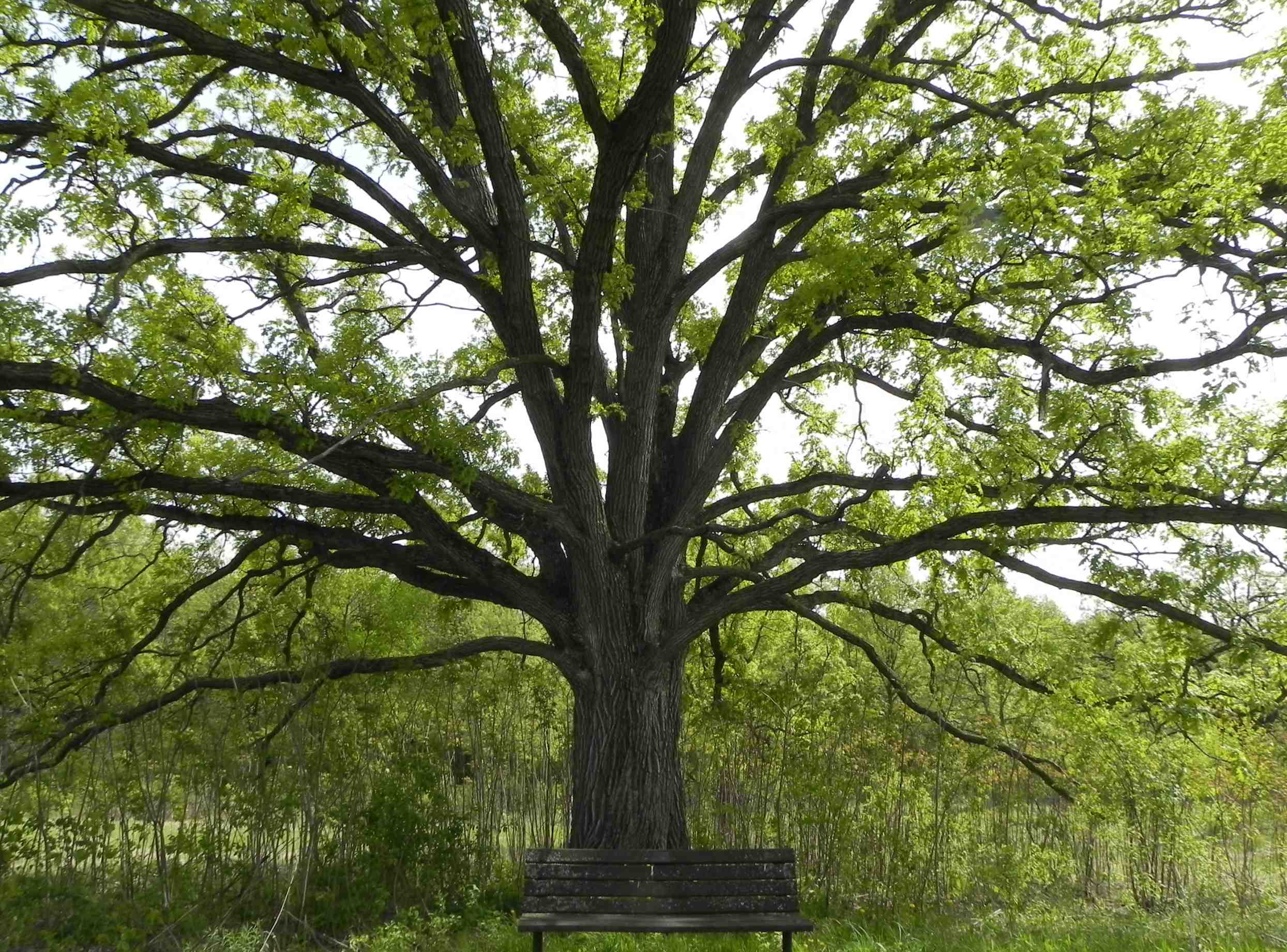
Probably no tree better symbolizes Britain than Quercus robur, the native oak. In an essay at the BBC's News Magazine, historian Simon Schama reviews its significance.
The tree is Britain, after all.
Boscobel oak, where Charles II hid from Cromwell's army after the battle of Worcester.
And the song Nelson's sailors are said to have sung at Trafalgar? "Hearts of oak are our ships, jolly tars are our men."
But then, with a sudden chill, you remember something else. A story that seemed to come and go from the papers, but terrible in what it reported: that a mysterious blight is attacking Quercus robur, up and down the length of Britain.
No-one seems to know why it is happening or how to stop it, how to save infected trees. Apparently the "die-back" period (a horrible term) from the first tell-tale signs of shrivelled foliage to complete tree death is about five years: the life of a Parliament.
Schama reviews previous disasters that have befallen Britain's oaks, including hurricane-induced devastation in the 18th century, and the "acorn fever" that followed.
Naval officers on leave, like Collingwood, went around surreptitiously scattering acorns from holes in his breeches in the parks of his unsuspecting hosts. And the all-time champion was the lord-lieutenant of Cardiganshire, Colonel Thomas Johnes, who between 1795 and 1801 planted some 922,000 sturdy oaks.
The prognosis re the current epidemic is rather grim. Articles at the Telegraph and The Independent offer more details re the science of the disease.
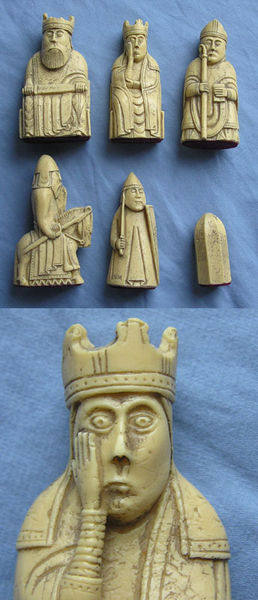
The museums and toystores of the world are replete with an endless variety of chessmen, but the ones depicted above have a most interesting provenance.
The chessmen are the most precious archaeological treasures ever discovered in Scotland. It is believed they were made in Trondheim, Norway, in the late 12th century and dug from the sands of Lewis's Atlantic coast in 1831... The pieces are brownish-white, the colour of tobacco-stained teeth, and are made from the tusks of walruses hunted, most likely, in Greenland. They are covered in tiny grooves, like frost veins on a window pane, which are thought to be the marks left by insects burrowing in the white Lewis sand...
Most striking of all are the facial expressions. These are not the interchangeable symbolic pieces of a modern chess set. These figures seem frozen in the moment of feeling strong emotions. The larger king gives a saucer-eyed scowl and looks set to pull his sword from its scabbard. The queens, as if in response, seem flustered, their palms pressed to their cheeks...
The pieces are now stored at both the National Museums Scotland and The British Museum, and are going on tour this week. Futher details about these interesting game pieces are available at the Scotland on Sunday link.
Also nicotine! A study conducted at the University of Haifa revealed that bees prefer nectar containing those psychoactive substances.
Flower nectar is primarily comprised of sugars, which provide energy for the potential pollinators. But the floral nectar of some plant species also includes small quantities of substances known to be toxic, such as caffeine and nicotine... Caffeine is found at concentration levels of 11-17.5 milligrams per liter, mostly in citrus flowers. In the nectar of grapefruit flowers, however, caffeine is present in much higher concentrations, reaching 94.2 milligrams per liter...
The results showed that bees clearly prefer nectar containing nicotine and caffeine over the “clean” nectar. The preferred nicotine concentration was 1 milligram per liter, similar to that found in nature. Given a choice of higher levels of nicotine versus “clean” nectar, the bees preferred the latter.
The presumption is that natural selection has favored those plants that satisfy the desires of their pollinators. Further studies are underway to ascertain whether the bees are addicted to caffeine and nicotine.