John Farrier's Blog Posts

Quarantine Rapper is Back


(YouTube Link)


Christiaan Van Vuuren created a viral video two months about about his experiences in quarantine for drug-resistant tuberculosis. He's still there, and has had plenty of time to hone his video editing skills:

It has now been 102 days that I’ve been here in the hospital all up, isolated with a case of Multi-Drug Resistant TB. I am here under a strict regiment of 6 different antibiotics, and a couple of other medications to help with the side effects of those. Over this time I have been lucky enough to have access to a computer with music and video production capability!!! So far I have really enjoyed making videos and connecting with people around the world through the internet, as it’s been a great way for me to keep my mind off all the treatment, and make me feel as if I’m actually achieving something in here, rather than wasting the time away staring at the walls!….. For this most recent music video, I really wanted to do something that was out of control – so I enlisted the help of my brother. He is only able to come in for short visits here and there, for which he has to get masked up and wear protective gloves, but it was enough for us to be able to go silly with his digital handycam.


via Nerdist

University Offering Master's Degree in Vampiric Literature

Would you like to get course credit for reading Anne Rice? The University of Hertfordshire is offering a new master's program that focuses on vampires in fiction:

In a bid to make the most of that interest, George is launching, in September, what seems to be the world's first master's degree in vampire literature. "In the months I've been planning the conference I've fielded a huge number of inquiries from people all over the world who are interested in studying vampires, zombies and the undead at a higher level," she says. "I had the idea of offering the master's as a direct follow-up from the conference. I thought it was crucial to have a way of extending this burst of awareness." The best papers from the conference will be collected in a book, which will become a textbook for the MA students.


Link via io9 | Image: Warner Bros.

Frank Lloyd Wright's Fallingwater in LEGO


It took LEGO artist Matija Grguric 7 months and 15,000 bricks to recreate Frank Lloyd Wright's masterpiece Fallingwater. It's currently on display at a museum in Zageb, Croatia. Grguric writes:

Scale of the building is minifig, or approximate 1:40. One of the issues was how to make the stone walls of the building. The result here is made out of 4 different shades of grey (old grey and bley). Other was the terrain and vegetation. In the end I decided to make it in winter atmosphere. Snow is something I always enjoy, and I was always more of a winter type of person, so here it is - my first snowy MOC. :)

Building process spread over total of almost 7 months, and the structure is made out of more than 15000 bricks (just an approximate guess). It is placed on 6 48*48 baseplates, and measures 115 x 80 x 50 cm. It weights more than 20 kg.


Link via DVICE

Previously on Neatorama:
Fallingwater: The Movie
Frank Lloyd Wright's Fallingwater Recreated with Half Life

Physicists Claim to Have Synthesized Superheavy Element 117 for the First Time

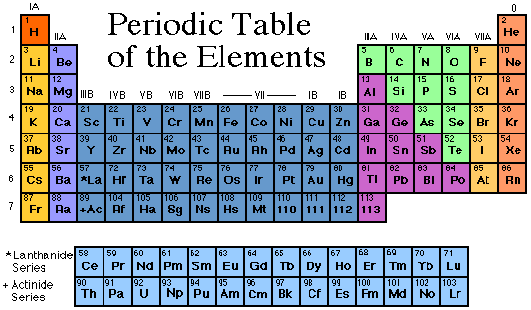
A team of Russian physicists claims to have, for the first time, synthesized element 117. This element does not occur in nature and the sample was created in a laboratory:

A team led by Yuri Oganessian of the Joint Institute for Nuclear Research in Dubna, Russia, reports smashing together calcium-48 — an isotope with 20 protons and 28 neutrons — and berkelium-249, which has 97 protons and 152 neutrons. The collisions spit out either three or four neutrons, creating two different isotopes of an element with 117 protons.[...]

The researchers briefly spotted signs of element 117 during two runs of collisions lasting 70 days each. In their paper, the researchers report observing the heavier isotope of element 117 decay with a half-life of 78 milliseconds; they measured the lighter one’s half-life at 14 milliseconds.

The new element, which has yet to be named, slips into a place on the periodic table between elements 116 and 118, both of which have already been discovered. Such superheavy elements are usually very radioactive and decay away almost instantly. But many researchers think it is possible that even heavier elements may occupy an “island of stability” in which superheavy atoms stick around for a while.


Link via Wired | Image: NASA

Underwater Art Museum

A museum is under construction off the coast of Cancun. By the end of the year, divers may be able to visit four hundred sculptures in a maritime park:

The cement sculpture, called 'The Collector', shows a figure who records bottled treasures in logbooks. It weighs four tonnes and is anchored 26 feet under the sea. Divers watch a yellowtail damselfish nibble on algae growing from the sculpture's pant leg, which its creators hope will eventually sprout colourful coral.

About 400 life-size casts will be submerged off the resort of Cancun by the end of 2010. It is hoped that the low-acidity cement figures, designed to be anti-corrosive and mimic rock, will be transformed over time into artificial reefs. Some will be in shallow waters for snorkellers to enjoy.[...]

"The park managers were looking for an alternative to manage the tourists. The idea was to concentrate everyone in one place," said de Caires Taylor, who has also built an underwater sculpture park in Grenada, West Indies.

The 400 figures, weighing 180 tonnes in total and to be named 'Silent Evolution', will be submerged in a barren, flat expanse of the park, which lies between Cancun and nearby islands.


Link | Photo: Reuters

The New York City Fire Department's Fancy New Boat

New York City has over four hundred miles of coastline, and consequently the police and fire departments of that city need advanced boats that can fight crime, fires, and respond to disasters in the water. The Three Forty Three, named after the 343 firefighters who died on 9/11, will soon replace a firefighting vessel launched in 1954. At a cost of $27 million, it has a crane that can extend fifty feet over the water, a decontamination shower, and an on-board triage center:

•The vessel is the longest and heaviest fireboat in the world, Mr. Cassano said. Its speed is about double that of the McKean, and it pumps about 50,000 gallons of water a minute — about 30,000 more than the McKean. (A regular fire truck pumps about 1,000 gallons a minute.) For fuel fires, the new boat has 3,600 gallons of foam concentrate; the McKean had 500.

•The Three Forty Three has a pressurized cabin, "and there will be filters for the air so we can get close to a hot zone," said Mr. Cassano, referring to chemical spills. "In the past, if we knew there was a chemical incident we couldn't get very close."


Link via Fast Company | Image: New York Times

10 Acclaimed Authors Who Wrote Only One Novel

One-hit wonders aren't restricted to music. Some giants of literature wrote only one novel, and you can view a list of them at the link. Among them is Anna Sewell, who wrote Black Beauty:

Sewell didn’t start off her life intending to be a novelist. Indeed, she didn’t begin writing Black Beauty until she was 51 years old, motivated by the need to create a work that encouraged people to treat horses (and humans) humanely, and it took her six years to complete it. Upon publication it was an immediate bestseller, rocketing Sewell into success. Unfortunately, she would not live to enjoy but a little of it as she died from hepatitis five months after her book was released.


What novels on the list have you read?

http://onlinedegreeprograms.org/blog/2010/10-acclaimed-authors/ via The Presurfer | Photo: University of South Carolina

How Americans' Diets Have Changed Over the Past Century


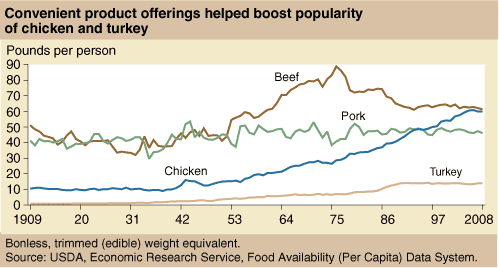
A recent issue of a US Department of Agriculture publication includes an examination of how America's food choices have changed over the past one hundred years. As you can see from one of the charts provided in the article, we're eating a lot more chicken. The authors explain why:
Chicken availability over the past 100 years illustrates the effects of new technologies and product development. Increased chicken availability from 10.4 pounds per person in 1909 to 58.8 pounds in 2008 reflects the industry’s development of lower cost, meaty broilers in the 1940s and later, ready-to cook products, such as boneless breasts and chicken nuggets, as well as ready-to-eat products, such as pre-cooked chicken strips to toss in salads or pasta dishes.

Broilers were first marketed in the 1920s as a specialty item for restaurants. By the mid-1950s, innovations in breeding, mass production, and processing had made chicken more plentiful, affordable, and convenient for the dining-out market and for cooking at home. Media coverage of health concerns associated with total fat, saturated fat, and cholesterol in the last quarter of the 1900s may have contributed to a rise in chicken tacos and turkey burgers.

Link via Ace of Spades HQ

Woman Crashes Car into Hair Salon, Stays for Appointment

Marion Zock, 82, knows the importance of keeping an appointment:

An elderly Michigan woman who accidentally crashed her car into a hair salon while attempting to park said she stuck around the scene to keep her appointment.[...]

Police said there were two injuries reported as a result of Zock's crash into the store, an employee who returned to work later in the day and a young girl whose arm was bruised.

Zock said she remained at a salon to keep her appointment


Link via Stuff | Photo: Big Pond News

Little Kid Parallel Parks Masterfully


(YouTube Link)


This viral video shows a little boy who parallel parks his toy car like an expert stunt driver.

via Urlesque

Amazonian Tribe's Language Has No Tenses, Numbers over Five

Anthropologist Pierre Pica has spent ten years studying the Munduruku tribe of the Brazilian Amazon region. Their language has no tenses, plural forms, or numbers greater than five. Pica described life in a society where quantification was largely unnecessary:

To get to the Munduruku, Pica had to wait for some locals to take him to their territory by canoe.

"How long did you wait?" I inquired.

"I waited quite a lot. But don't ask me how many days."

"So, was it a couple of days?" I suggested tentatively. A few seconds passed as he furrowed his brow: "It was about two weeks."

The more I pushed Pica for facts and figures, the more reluctant he was to provide them. "When I come back from Amazonia, I lose sense of time and sense of number, and perhaps sense of space." This inability to give me quantitative data was part of his culture shock. He had spent so long with people who can barely count that he had lost the ability to describe the world in terms of numbers.


The rest of the article describes at length how people understand numbers cross-culturally.

Link via The Presurfer | Photo: Wikimedia Commons

Kentucky State Officials Must Swear an Oath against Dueling

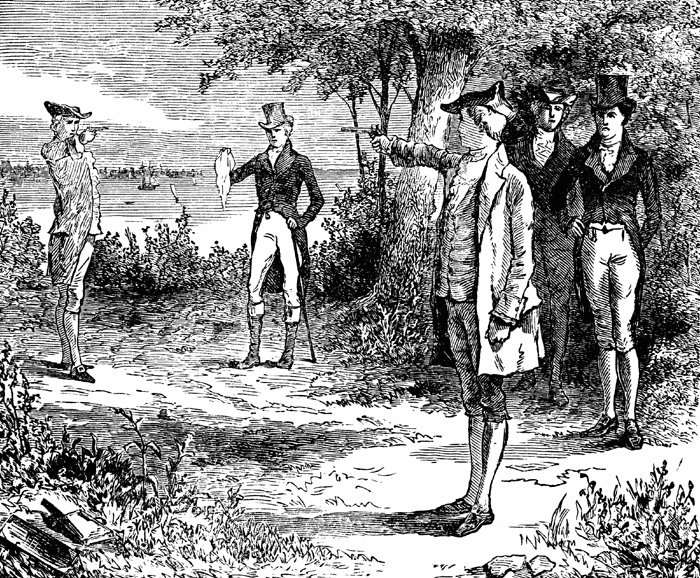
The oath of office for officials in the State of Kentucky includes an affirmation that the person has never fought a duel:

Typically, a judge and honoree stand facing each other, right hands raised. The judge recites the oath of office with its words proudly repeated.

Then comes this reference: "I, being a citizen of this State, have not fought a duel with deadly weapons within this State nor out of it, nor have I sent or accepted a challenge to fight a duel with deadly weapons, nor have I acted as second in carrying a challenge, nor aided or assisted any person thus offending, so help me God."


Some legislators want to remove this part of the oath. No, not because they want to start challenging enemies to meet them with saber or pistol, but because it seems so weird to modern America.

http://www.npr.org/templates/story/story.php?storyId=124616129&ft=1&f=1003 -- thanks, Larry Saunders! | Image of Hamiton/Burr duel, University of South Florida | Previously on Neatorama: Throwing Down the Gauntlet

Inverse-Square Law Tattoo


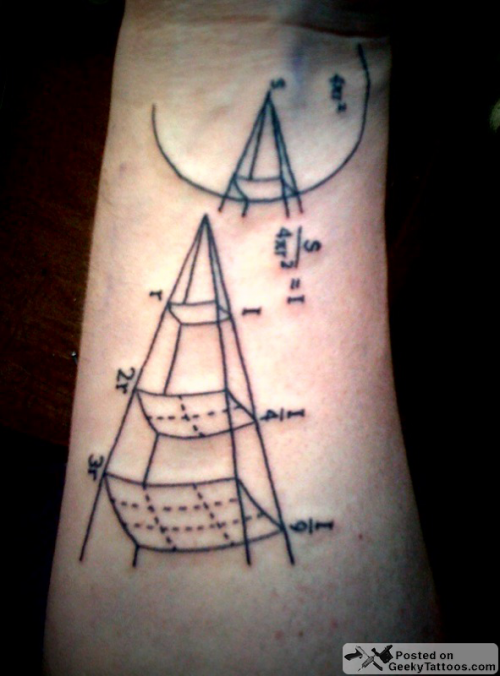
Atlanta-based photographer Erik Dixon got a tattoo illustrating the inverse square law, which "...is the physics equation for the fall off rate of light radiating from a source point. Something I use every time I shoot. This also applies to gravity and sound."

If you were to get an intellectual tattoo, what would it be?

Link | Photo: Erik Dixon/Geeky Tattoos

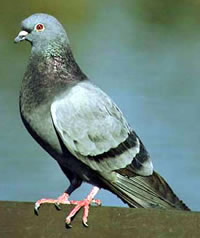
Pigeons Outperform Humans at Monty Hall Dilemma

The Monty Hall Problem is a common mathematical fallacy based on Monty Hall's game show Let's Make a Deal. It works like this:

Imagine that you’re in a game show and your host shows you three doors. Behind one of them is a shiny car and behind the others are far less lustrous goats. You pick one of the doors and get whatever lies within. After making your choice, your host opens one of the other two doors, which inevitably reveals a goat. He then asks you if you want to stick with your original pick, or swap to the other remaining door. What do you do?


It's counterintuitive to many people, but switching doors will double your chances of winning:

The problem is that most people assume that with two doors left, the odds of a car lying behind each one are 50/50. But that’s not the case – the actions of the host beforehand have shifted the odds, and engineered it so that the chosen door is half as likely to hide the car.

At the very start, the contestant has a one in three chance of picking the right door. If that’s the case, they should stick. They also have a two in three chance of picking a goat door. In these situations, the host, not wanting to reveal the car, will always pick the other goat door. The final door hides the car, so the contestant should swap. This means that there are two trials when the contestant should swap for every one trial when they should stick. The best strategy is to always swap – that way they have a two in three chance of driving off, happy and goatless.


The bad news is that according to a scientific study, pigeons are better as this task than we are:

Each pigeon was faced with three lit keys, one of which could be pecked for food. At the first peck, all three keys switched off and after a second, two came back on including the bird’s first choice. The computer, playing the part of Monty Hall, had selected one of the unpecked keys to deactivate. If the pigeon pecked the right key of the remaining two, it earned some grain. On the first day of testing, the pigeons switched on just a third of the trials. But after a month, all six birds switched almost every time, earning virtually the maximum grainy reward.


Link via The Presurfer | Photo: Library of Congress

The Stirling Engine


(YouTube Link)


The above video shows Stirling engine enthusiasts motoring around on the River Thames. This engine, invented in 1816 by Robert Sterling, consists of, at minimum, two pistons, one of which is heated. Karim Nice of How Stuff Works explains the cycle:

1. Heat is added to the gas inside the heated cylinder (left), causing pressure to build. This forces the piston to move down. This is the part of the Stirling cycle that does the work.

2. The left piston moves up while the right piston moves down. This pushes the hot gas into the cooled cylinder, which quickly cools the gas to the temperature of the cooling source, lowering its pressure. This makes it easier to compress the gas in the next part of the cycle.

3. The piston in the cooled cylinder (right) starts to compress the gas. Heat generated by this compression is removed by the cooling source.

4. The right piston moves up while the left piston moves down. This forces the gas into the heated cylinder, where it quickly heats up, building pressure, at which point the cycle repeats.


The Stirling engine never caught on as well as internal combustion engines did, but has in recent years caught the attention of solar energy developers.

Information Link and Fanclub Link via View from the Porch

Email This Post to a Friend
""

Separate multiple emails with a comma. Limit 5.


Success! Your email has been sent!

close window

Page 1,186 of 1,332     first | prev | next | last

Profile for John Farrier

  • Member Since 2012/08/04


Statistics

Blog Posts

  • Posts Written 19,971
  • Comments Received 52,521
  • Post Views 31,883,754
  • Unique Visitors 26,162,591
  • Likes Received 29,425

Comments

  • Threads Started 3,801
  • Replies Posted 2,324
  • Likes Received 1,744
X

This website uses cookies.

This website uses cookies to improve user experience. By using this website you consent to all cookies in accordance with our Privacy Policy.

I agree
 
Learn More