BioCouture is an environmental sustainability project by designer Suzanne Lee to grow fabric for clothing using bacterial cellulose. The resulting sheets can be molded while wet, or cut and sewn when dry. Examples of her work are currently on display at London's Science Museum.
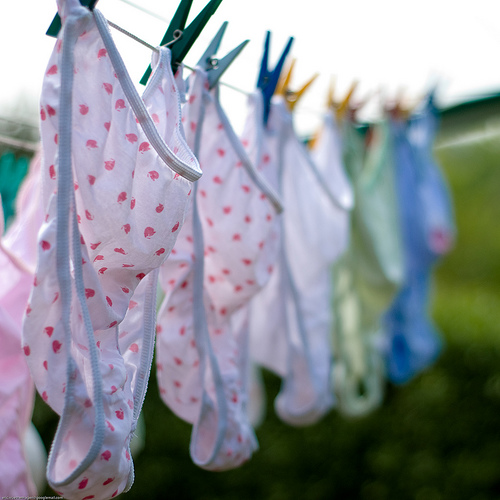
Someone kept stealing underwear from clotheslines in Portswood, UK. The perpetrator, the victims discovered, was a cat who took the panties and brought them back to his owner as presents:
Eager to please his new owners, Peter and Birgitt Weismantel, 13-year-old Oscar had been bringing home presents to the family home in Portswood, a suburb of the southern coastal town of Southampton.
"He started bringing socks home a few months ago and then gardening gloves which we tracked to our neighbor," his owner Peter Weismantel told the Southern Daily Echo newspaper.
"Then we had a situation in which he brought back young women's underwear," said Peter, 72.[...]
On average he commits 10 robberies a day.
"He brings them back as presents," Birgitt told the Echo. "We can't give him back now as he makes such an effort with all these gifts. He's got a lovely personality and is a very loving cat.
Link | Photo by Flickr user eriwst, used under Creative Commons license
Leroy Anderson (1908-1975) was a composer of pops orchestral music. In 1950, he wrote "The Typewriter", a short piece that featured a mechanical typewriter. The above video is a 2008 performance of that piece by the Strauss Festival Orchestra, featuring percussionist Martin Breinschmid on the typewriter.
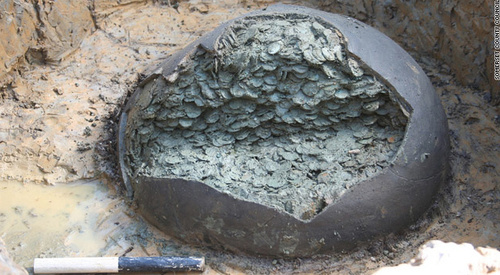
Dave Crisp, using only a metal detector, found a hoard of more than 52,000 Roman coins in Frome, UK. They were sealed inside a pot about 30 cm underground:
Somerset County Council archaeologists excavated the pot -- a type of container normally used for storing food -- it weighed 160kg (350 pounds) and contained 52,500 coins.
The hoard was transferred to the British Museum in London where the coins were cleaned and recorded.
The coins date from AD 253 to 293 and most of them are made of debased silver or bronze.
You can view a photo gallery of the treasure trove at the link.
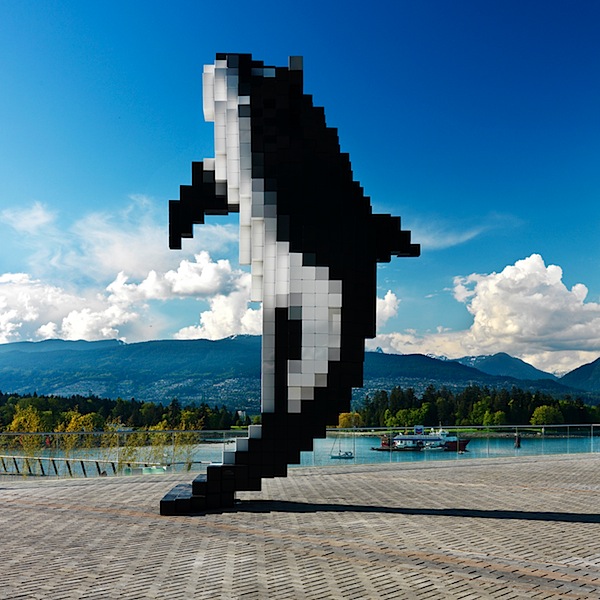
Douglas Coupland made this pixelated sculpture of an orca. It's located at the Vancouver Convention Centre. Coupland is also a novelist and playwright, and we've previously featured his innovative trailer for a book.
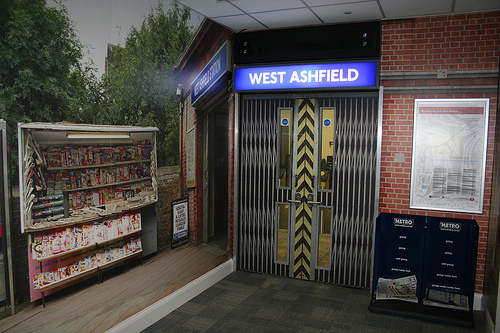
There's a London Underground station that never moves a single passenger. That's because it's a mock-up built to train new employees. The station, located in West Kensington, is designed to be as realistic as possible:
The tube station is probably the highlight for any visitor and in addition to looking like a tube station, it also behaves a bit like one. When a train is due to arrive, although no physical train appears, the platform rumbles, speakers drown out conversations and there is even a fan in the corner blowing to simulate the wind blast that heralds the arrival of the train.
What would you add to make the simulator truly realistic?
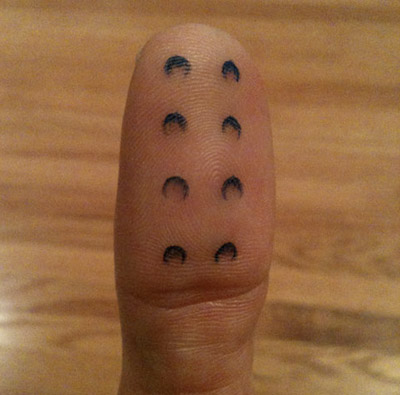
LEGO artist Nathan Sawaya had a tattoo artist mark his thumb so that it looks like a LEGO brick:
Every single day, I snap together bricks. Each day I am pressing down on the bumps of each brick to make sure there is a tight fit. And if I press real hard, the bumps leave little marks on myfingers and thumb. What better way to pay tribute to my medium of choice, then permanently inking those marks on to my thumb?
Four years ago, we wrote that the US Army was developing body armor that is normally a liquid, but turns into a solid when it's hit. Britain's military researchers have come up with something similar, but now there's clear evidence that it can withstand the impact of a bullet:
The BAE scientists describe it as "bullet-proof custard".
"It's very similar to custard in the sense that the molecules lock together when it's struck," explained Stewart Penny, business development manager in charge of materials development at the company.[...]
"In standard bullet-proof vests, we use thick, heavy, layered plates of Kevlar that restrict movement and contribute to fatigue," said Mr Penny.
In the tests, scientists used a large gas gun to fire ball bearing-shaped metal bullets at over 300 metres per second into two test materials - 31 layers of untreated kevlar and 10 layers of kevlar combined with the shear-thickening liquid.
"The Kevlar with the liquid works much faster and the impact isn't anything like as deep," he explained.
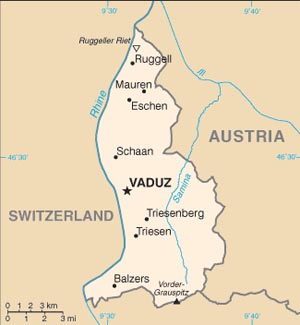
Rapper Snoop Dogg tried to rent the entire Principality of Liechtenstein -- all 62 square miles of it -- in order to record a music video:
Snoop was reportedly trying to shoot a music video in the tiny Western European country, but was rebuffed ... and not because trying to rent an entire country is a crazy thing to do. Says Liechtenstein property agent Karl Schwaerzler, "We've had requests for places and villages but never one to hire the whole country before. It would have been possible, but Snoop Dogg's management did not give us enough time."
A shop in a mall in Shenyang, China, lets women vent their frustrations by smashing household items:
The venting store located in the fourth floor of a shopping mall has a sign "No Men" at the door.
The store is divided into several zones such as a living room and a bedroom. Wang Jingyu, the business manager of the shopping mall said they would like to open a kitchen-like zone later, and they have done this so "women can come here to feel like they are in their own homes but without any limitations, and they can break anything here."
Customers wear protective helmets and gloves so that they don't get hurt. They're limited to 1 minute of mayhem, so they have to go somewhere else if they want to go totally psycho.
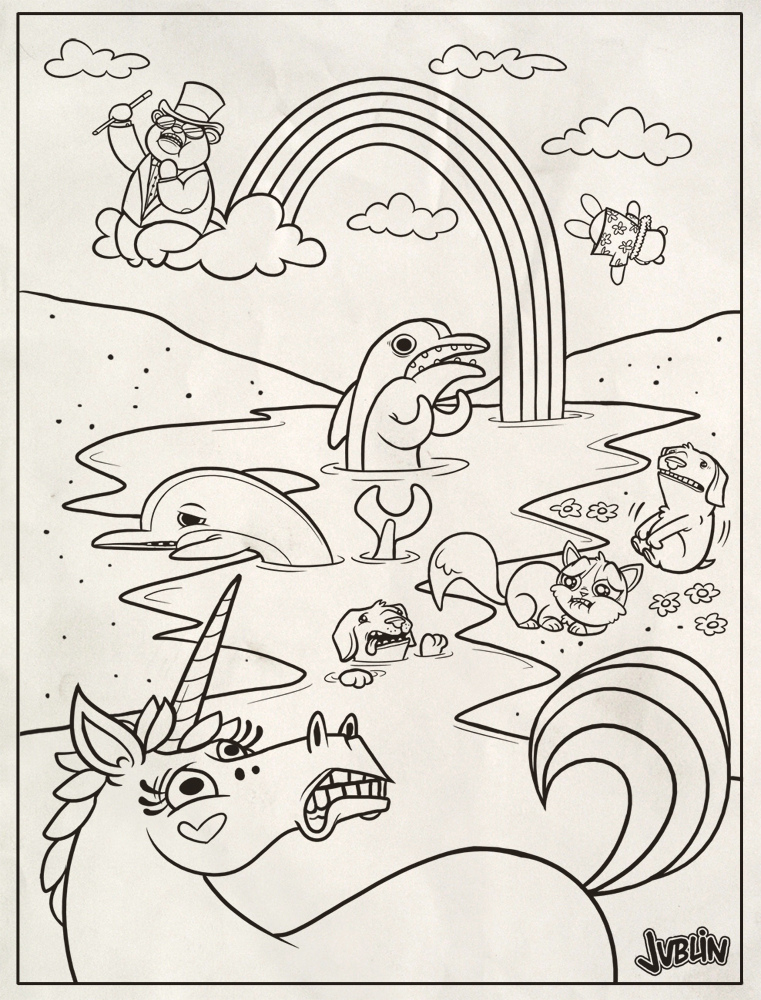
California-based artist Justin White (Jublin) made a coloring page so that kids can enjoy the unnatural wonders of the Gulf of Mexico oil spill. He colored it in here, if you'd like to see one completed version.
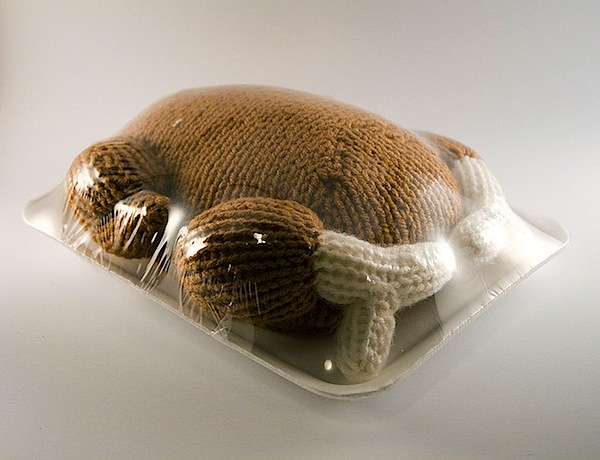
Stephanie Casper, a design student at the Pratt Institute, knitted a few meats. They're shrink-wrapped, so as long as they haven't been out of the fridge too long, they're probably safe to cook and eat.
AIDS researchers discovered an antibody in one patient that is able to defeat 91% of all known strains of HIV:
The HIV antibodies were discovered in the cells of a 60-year-old African-American gay man, known in the scientific literature as Donor 45, whose body made the antibodies naturally. The trick for scientists now is to develop a vaccine or other methods to make anyone's body produce them as well.[...]
HIV is a highly mutable virus, but one place where the virus doesn't mutate much is where it attaches to a particular molecule on the surface of cells it infects. Building on previous research, researchers created a probe, shaped exactly like that critical site, and used it to attract only those antibodies that efficiently attack it. That is how they fished out of Donor 45 the special antibodies: They screened 25 million of his cells to find 12 that produced the antibodies.
Donor 45's antibodies didn't protect him from contracting HIV. That is likely because the virus had already taken hold before his body produced the antibodies. He is still alive, and when his blood was drawn, he had been living with HIV for 20 years.
The researchers hope to use this discovery to develop a vaccine for HIV.
Phoenix-based artist Emily Costello made this portrait of Frida Kahlo out of (apparently) pieces of aluminum cans. It currently hangs in the Halperin & Lake Collection. She plans to create a similar portrait of a Mexican wrestler.
...is about the size of a small bus. It was built by Joe Ciaglia of California Skateparks, and in this video, he and his friends decided to take it for a ride at Camp Woodard, Pennsylvania.
via Geekologie | Previously: World's Largest Skateboard Ramp