The commercial for Huggies' latest product is both funny and somewhat disturbing. Mostly funny. It's a diaper design that looks like blue jeans. The ladies (and some of the men) stop and stare and ask themselves, "What's in his diaper?"
YouTube user spinningfancy recorded the playful relationship between human toddler Lula and Leonard, the African Leopard Tortoise. At 1:30 they have a tea party on the lawn.
Medical researchers at Imperial College in London found that autistic kids have a particular chemical in their urine. This finding could be used to create a simple urine test that could be used to diagnose the disease early:
Using nuclear magnetic resonance (NMR) spectroscopy to analyse the children's urine, they found that each of these groups had a distinct chemical fingerprint, with clear and significant differences between children with autism and unrelated controls.[...]
Autism is currently diagnosed using a series of behavioural tests, and while children can show symptoms of the condition when as young as 5 months old, a clear diagnosis is not usually possible until they are age 2 or 3 years. This is problematic, because there is growing evidence that the earlier behavioural therapies for autism are started, the better the chances of children being able to lead relatively normal lives.
"If you could identify kids who were at risk much earlier by a chemical test rather than by observing the manifestation of full-blown behaviour, we could get them into therapy much earlier," says Nicholson.
The Onion News Network commentators and pundits have a good point -- many violent video games are not realistic enough to prepare children to survive in a post-apocalyptic wasteland. For example, swallowing pills that you find lying on the ground won't cure zombie bites. In fact, it may even poison you, leaving you too weak to outrun the undead hordes.
One of the bad things about neglecting your family so that you can focus on business and networking with your smart phone is that a lot of people tend to hold you in low moral regard. The solution to this problem is the BabyBerry -- a smart phone that looks like a real baby.
Don't worry, this isn't a real product. It's just a clip from the BBC comedy sketch show Mitchell & Webb.
An old essay by parenting columnist Barbara F. Meltz was passed around the gunblogosphere a few weeks ago. Meltz addresses a specific child safety issue: guns in the homes of your children's playmates.
The nightmare scenario is that your kid goes to play at the home of his friend. The home has unsecured firearms, and kids are curious so...well, you can imagine what happens next. And has happened to some kids and their parents.
Meltz proposes that parents simply ask the parents of playmates if they have firearms. If the answer is yes, ask how they are secured.
As a father and gun owner, I would have absolutely no problem with a parent asking these questions. My rifle is kept unloaded in a locked case, and I don't want my child playing in a home where a firearm is kept in any other condition. Rather than be offended at the query, I'd be impressed at the parent's good sense.
Meltz's question also brings something else to mind. There are safety issues beyond guns whenever a child makes an unsupervised visit to a friend's home.
What questions should a parent ask before letting his or her child visit the home of a friend?
Lenore Skenazy is a mother, the author of the book Free-Range Kids, and an advocate for allowing children to wander in public without adult supervision. Most famously, she allowed her nine-year old son to travel across New York City on the subway by himself. Skenazy argues that the dangers to free-roaming children are overstated, but that denying children unsupervised time out of the home is detrimental to their development.
Skenazy has therefore declared today, May 22, Take Your Kids to the Park and Leave Them There Day. The idea is that parents should take their children to a public park, tell them how to get back home, and then leave them there at the park to do so:
And once again, let me reiterate that this is not a day to leave our 2-year-olds in the park. It is meant for kids age 7 or 8 and up. And it needn’t be more than an hour or even a half hour. And you can just take a walk around the block, if that’s all you or your child are ready for. And you can give them cell phones! I just want to get kids out of the house so they can frolick and maybe even plan to do this strange thing where they ask a friend to “come out and play” again. And it’s a great time for parents to meet each other, too! The way to really make any community safe requires reviving just that — community! Connect with your neighbors and everyone watches out for everyone else.
What do you think of the free-range kids movement?
I don't like The Giving Tree by Shel Silverstein. I know that it's supposed to be about the selfless love of a parent to a child. But it's really about a very abusive, exploitative relationship, and it glorifies the tree for staying in it. This is a very bad message to give to children, and consequently, I don't allow it in my house.
Rainbow Fish by Marcus Pfister isn't terrible, but I think that it could be misinterpreted by a young child. It's teaches the virtue of sharing, but implies that it's possible to buy friends by giving people your possessions. We have a copy in my house, but when I read it to my toddler, I change the words so that Rainbow Fish sells his scales, invests his earnings, and becomes "the richest fish in the sea."
What do you consider to be the worst children's book?
Neatorama's own Stacy Conradt has a new article up at Mental Floss detailing ten unusual places that women have given birth unexpectedly. Here's a sample:
5. In a tree. In 2000, about a million people in Mozambique were forced from their homes when floodwaters ravaged the country. Or make that a million and one. A Sophia Pedro lived in a treetop for four days, waiting for her rescue and hoping that it would come before her baby did. Rescue did come, but it was moments too late – just minutes after the woman gave birth in the treetop, medics descended from a helicopter to retrieve them and cut the umbilical cord. Sophia and her daughter both recovered just fine.
Researchers at the University of Toronto found that children who can lie effectively become superior thinkers later in life:
Researchers have found that the ability to tell fibs at the age of two is a sign of a fast developing brain and means they are more likely to have successful lives.
They found that the more plausible the lie, the more quick witted they will be in later years and the better their abiliy to think on their feet.
It also means that they have developed "executive function" - the ability to invent a convincing lie by keeping the truth at the back of their mind.
Link | Photo (unrelated) via US Department of Health and Human Services
Emily Yoffe writes an advice column for Slate called "Dear Prudence." Recently, one father asked her how he should deal with taking his young daughter into a public restroom. Should he use the men's or the women's? Yoffe wrote:
Dad, you need to get out of the ladies' room. It is cleaner and nicer, but even though you're accompanied by your little girls, you are going to freak people out. I also agree the men's room is not ideal. But you can quickly glance inside, make sure there is no one at a visible urinal, and whisk the girls into a stall with you. Ideally, you should get in the habit of anticipating toilet needs so that before it's an emergency, you have a chance to see if you can locate single-stall facilities that allow you to lock the door. Sometimes there are special handicapped or family toilets at museums, etc., that would work. In a year or so, when you feel your older daughter shouldn't be entering the men's room at all, you can stand outside and wait for a mother and child and ask the mother if she will keep an eye on your little girl while she does her business. And thank you for a toilet question that does not involve the country-dividing issue of toilet seat up or down.
What do you think the fathers of young daughters should do in this situation?
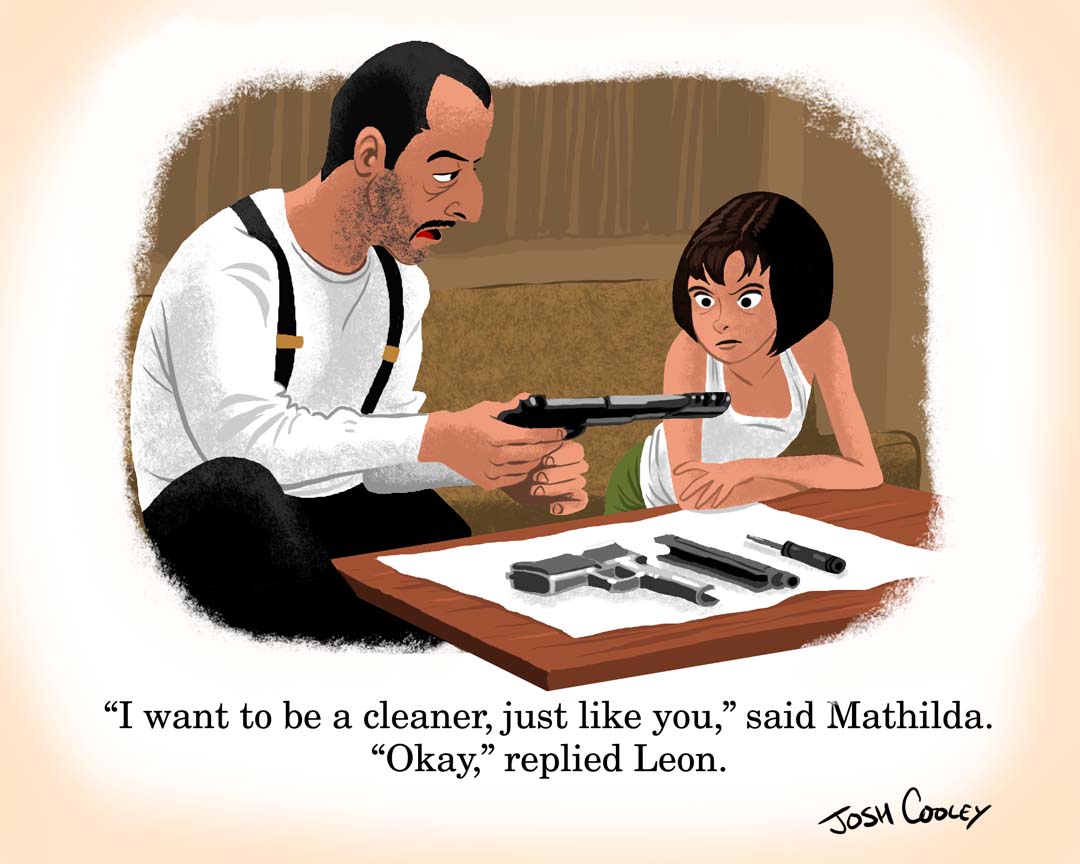
Little Golden Books are a series of classic American children's picture books, first published in the 1940s by Simon and Schuster. Pixar artist Josh Cooley has created a series of illustrations in the classic style of these books consisting of scenes from movies that are hilariously inappropriate for children. Pictured above is a scene from the 1996 movie The Professional about a young girl who befriends a hitman.