Are you easily entertained by flashing lights and shiny objects? Well, then, good news! You'll like this trippy display of computer graphics which, Google Translate suggests, is a promotional video for a French telecommunications company. It's called "ENVISION: Step into the Sensory Box."
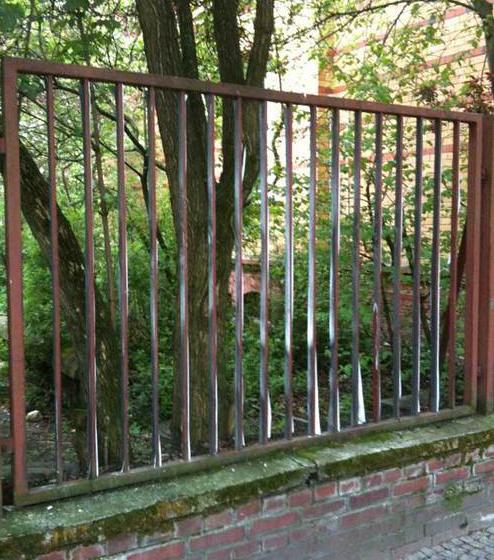
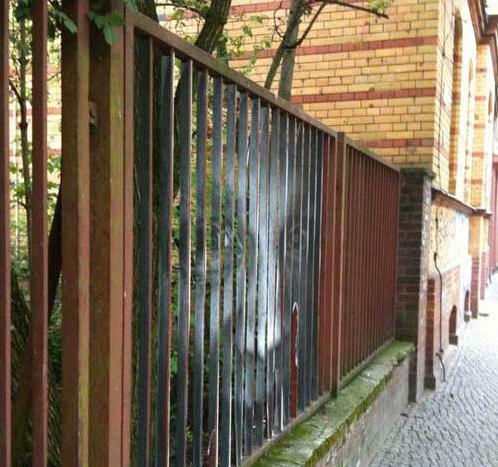
It looks like an old, rusty fence, right? Just take a step to the left and look at it again.
It's a human face! This graffiti is located on a fence in Berlin and was created by Mental Gassi, a German art collective that places large human faces in public places.
Generally, pacemaker batteries last for several years. But a new technology developed by researchers at Joseph Fourier University in France may make that long-lasting battery obsolete. This device may be able to generate electrical energy by absorbing glucose inside the human body. It's sort of like hosting an alien parasite, except without the irritating chest-bursting side effects. In Fast Company, Kit Eaton writes:
The trick the scientists worked out was to build the cell's electrodes out of compressed graphite, which has been treated with enzymes that oxidize incoming glucose molecules, with a resulting release of electrical energy. Add in a plastic-based membrane that only permits glucose and oxygen to penetrate and some platinum wiring and what you get is the world's first successful glucose fuel cell that can harvest chemicals already present in a living organism. It's capable of putting out a peak power of 6.5 microwatts in its experimental implementation, which is not enough to power a typical pacemaker (which needs around 10 microwatts) but the team is confident that the tech can be optimized to achieve this power output.
So what's all the buzz about this device? Its potential is absolutely incredible for medical devices that are permanently implanted into patients' bodies--things like pacemakers at the moment, but potentially in the future including gizmos like insulin pumps or, just possibly, an artificial heart. In one stroke, this reduces the need for complex surgery to replace the conventional power cells inside these devices, with all sorts of health and lifestyle benefits of having a reliable self-fueling electricity supply--along with the undeniable cachet of turning its users into genuinely bionic people
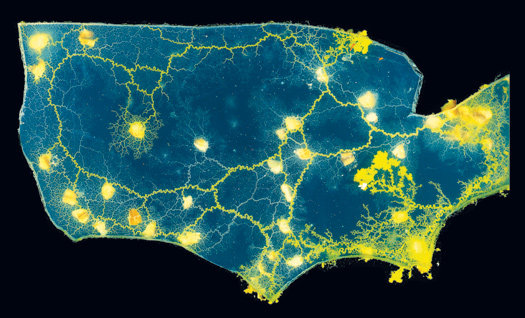
No, it's not just a weird work of art, but a demonstration by two scientists about how a slime mold can be used to plan road and communications networks efficiently:
Physarum polycephalum, a type of slime mold, grows tendrils in search of food and withdraws extraneous arms to focus on the most efficient paths between sources. Although the American map is just an illustrative model made for Popular Science, researchers in the U.K. have used slime mold to create similar replicas of local roads and railways, backed up by computer models. Andy Adamatzky and Jeff Jones, specialists in unconventional computing at the University of the West of England in Bristol, found that, left to its own devices, the slime mold mimicked a good part of the country’s actual road systems. Because slime mold finds the paths that are most resilient to faults or damage, it could be used to make mobile-communication and transportation networks hardier.
Videos at the link.
http://www.popsci.com/science/article/2010-05/slimeography | Photo: Andy Adamatzky and Jeff Jones
German artist Aram Bartholl often juxtaposes online life with real life, as seen in his giant Google Maps indicators and actualization of World of Warcraft avatars. One of his recent projects is to place CAPTCHAs -- the images of letters and numbers used to prevent computers from creating accounts with online services -- in public spaces. Bertholl places them next to graffiti tags because graffiti, like CAPTCHAs, are codes that can only be read by certain people. The project is called "Are You Human?"
There's an annual remote control submarine regatta in Canberra, Australia. Here's a 2008 video of a RC surface warship in a pool dropping exploding depth charges on a RC submarine cruising beneath it. Below you'll see a video showing a subsurface perspective of what I think is the same incident.
The Inntel Hotel in Zaandam, the Netherlands, is intentionally designed to look like traditional houses of the region stacked on top of each other. It's 11 stories tall and has 160 rooms. This hotel, designed by Wilfried van Winden, opened last March.
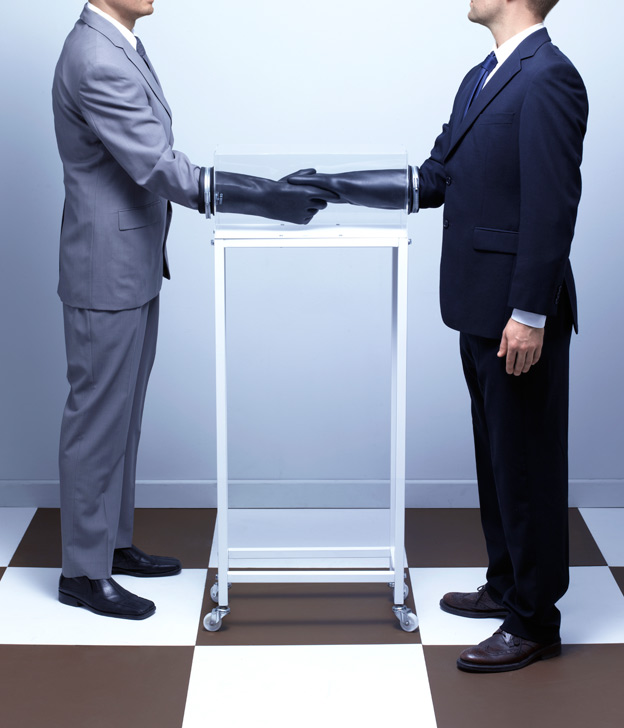
Among other social purposes, the handshake is a means of expressing reconciliation between estranged participants. To help people get to that point, designer Dominic Wilcox made this art installation: The Pre-Handshake Handshake Device.
A traditional handshake can sometimes be just too big a step for those entrenched in their dislike of the other. No matter how important it is for two people to reconcile their differences they simply can’t get over their pride and lower themselves to the symbolism of a handshake with the other party.
I designed this product in an attempt to give those people a new, more acceptable alternative. I hope that this device will lower the bar for initiating reconciliation from the heights of the full contact hand on hand handshake to a more palatable non contact handshake. I plan to contact embassies around the world where resentment is prevalent. I would like to see all family counseling offices have one in their meeting rooms. I would encourage anyone who has fallen out with a friend, family member, work colleague, gang member or world leader to use the Pre-handshake Handshake Device and let bygones be bygones.
Three British pranksters, reflecting upon the great seafaring history of their nation, decided to paddle an inflatable bouncy castle across Italy's Lake Garda. They did so during a major international regatta, and brought along a man in a shark costume (just to be prepared). The act was a publicity stunt for a project called Live Every Litre, which hopes to encourage young people to travel.
Designer Mike Clare made roll cookies that have a marker that can be detected by augmented reality software. When he waves one of the cookies in front of the webcam, his computer displays a colorful symbol on it.
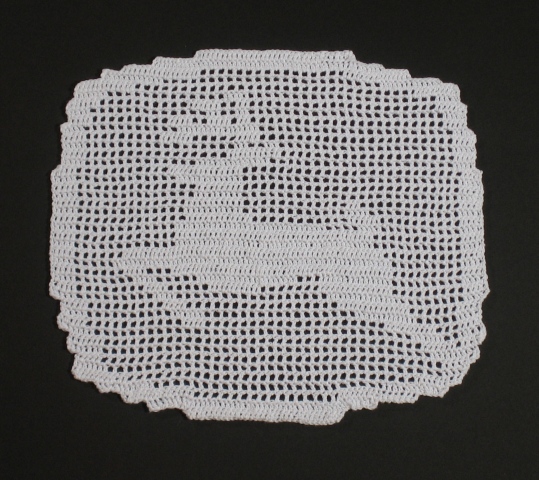
Artist Nathan Vincent creates doilies with traditionally masculine themes in order to explore gender roles in Western society:
My work explores gender permissions and the challenges that arise from straying from the prescribed norms. It questions the qualities of gender by considering what constitutes masculine and feminine. It critiques stereotypical gender mediums by creating "masculine objects" using "feminine processes" such as crochet, sewing, and applique.
http://nathanvincent.com/section/5896_2D_WORK.html via DudeCraft
In American culture, the standardized fallout shelter sign is an icon of Cold War life. Bill Geerhart of Conelrad, a website specializing in the social history of the Cold War, wrote an article that can be called the definitive history of the sign. The project was headed up by an Army Corps of Engineers manager named Robert Blakely, who navigated the sign through the bowels of the US federal bureaucracy. The earliest version was created by a graphic arts company in Virginia:
Blair, Inc. frequently worked on government contracts and the ideas generated in Blakeley’s office were shared with their designers. Blakeley stated to CONELRAD that he provided the following basic guidelines to his people to convey to Blair, Inc.: “I gave them the fact that it had to be a simple reproducible image…and I did say ‘tell them that in the design they had to have a place for us to print directional arrows.’” Blair, Inc. was also instructed by Blakeley that the sign “had to be something that would get people’s attention and give them direction to the location.” To this end, Blakeley said that he asked a representative from the company what the best color combination was for this purpose. The response that came back as quoted by Blakeley was: “orange or yellow and black is the one that is most dominantly used in the graphics field.” He added “And I said ‘if that’s right, let’s do that and it was that simple.”
First, men covered with sheets, one by one, entered the reading room at the New York Public Library and engaged in normal library patron activities. People noticed, and the dramatic tension began to build. Then our four heroes appeared to deliver the library from this paranormal menace.
For our latest mission, we brought the movie Ghostbusters to life in the reading room of the main branch of the New York Public Library. The 1984 movie begins with a scene in the very same room, so we figured it was time for the Ghostbusters to make an encore appearance.
Tyler Cowen of the blog Marginal Revolution responded to an interesting question by a reader. It was:
If you could create a punctuation mark, what would its function be and what would it look like?
Cowen responded:
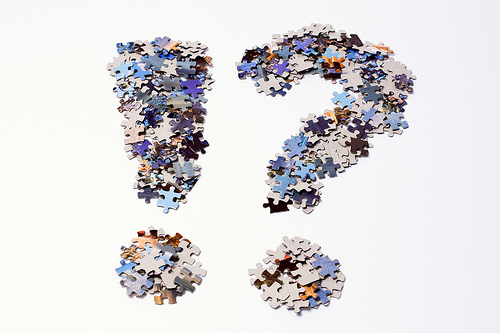
I've always liked the chess marks "!?" and "?!" and wondered why they weren't used in standard English. The former refers to a startling move which is uncertain in merit and the latter refers to a dubious move which creates difficult to handle complications.
How would you respond?
Link | Image by flickr user Horia Varlan, used under Creative Commons license