Hair ice, also called silk frost, is a type of ice formation that looks like silk and seems to only appear on woody, barkless materials on the ground. The ice structures tend to grow out of a small pore in the wood, sort of like hairs on the human head. Dr. James Carter has more on the phenomenon (and more photos too) on his site.
Geeks and geekettes rejoice, you can finally buy a sweet pair of styling shoes that pay homage to your favorite sci-fi movie. The one pictured above is the Luke Skywalker version. I think the coolest is the slave Princess Leia one in purple and gold, but to be fair, it probably won't match most of your clothes.
Has anyone actually seen these on sale yet? I want a pair.
Can you imagine telepathically sending messages to those around you, seeing out of a tooth or discovering a volcanic crater filled with all types of new species never before seen by man? Scientists can and while many of the new discoveries listed on this WebEcoist article have been featured on Neatorama before, they are all fascinating enough to deserve a second look.
What's your favorite recent discovery? I personally like the volcanic crater the best because I'm a sucker for animals.
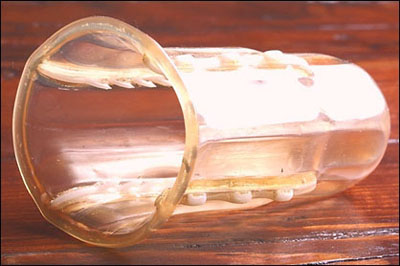
A new "anti-rape" condom could protect women in dangerous areas from being attacked. The device is a female condom filled with sharp, microscopic barbs that will attach themselves to flesh. The theory is that while the attacker is stunned and doubled-over with pain, the woman will have a chance to flee the scene before the rapist has a chance to do further damage to her. Once it latches on to the skin, the condom can only be removed surgically, which will mean that attackers will have to go to the hospital and risk getting caught.
While I can certainly see value in this device, I can't help but think of all those situations where things could go wrong. What do you think readers? A great idea or a huge mistake waiting to happen?
Most animals don’t like being dressed up in human clothes, but we love to make them do it anyway –after all, it is absolutely adorable. Of course, some animals love it. My own dog seems to get a little strut in his step when he wears one of his cute little tee shirts –he isn’t a big fan of rain coats though. Of the handful of critters that seem to enjoy playing dress up, an even smaller group has actually enjoyed a relative amount of success from their imitation of human clothing. In honor of National Dress Up Your Pet Day, we at Neatorama celebrate the few, the brave, the clothed.
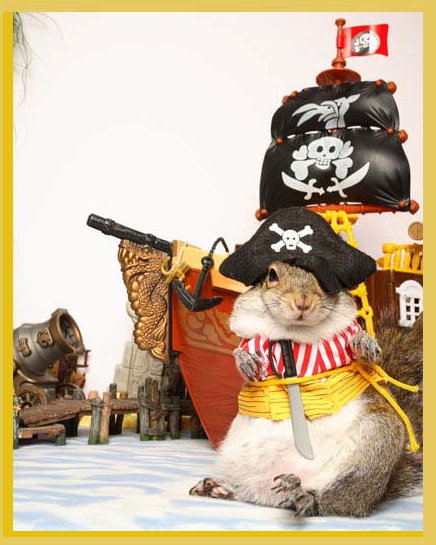
Sugar Bush Squirrel
While most pets who agree to wear costumes tend to be dogs, the animals that have become best known for their clothing antics are a variety of species. One of the best known costumed animals is Sugar Bush Squirrel, whose owner, Kelly Foxton, started making her tiny little outfits and photographing her in wonderfully elaborate settings. Foxton soon started adding the images to a website, where Sugar Bush developed a huge cult following. Since then, the little critter was featured in a number of advertisements and has been the subject of a documentary. Sugar Bush even holds the unofficial title of World’s Most Photographed Squirrel --someone call Guinness quick! Source Sugar Bush Squirrel Website, Sugar Bush Squirrel The Movie Image Via Sugar Bush website.
Keyboard Cat
Of course, some animals are costumed out of necessity. If it weren’t for Keyboard Cat’s stylish garb, you would be able to see his owner’s hands manipulating him to play the piano. It’s just not the same getting “played off” by a Keyboard Cat who doesn’t appear to be doing the work himself. There are over 4,000 videos of Keyboard Cat playing someone off these days, but the original was done by Brad O'Farrell who actually got permission from the film’s original owners for both his clip and anyone who followed in his remashing footsteps. It should be noted that this meme, which exploded last year was actually filmed back in 1984. Since then, “Fatso,” as he was known by his close family, has passed. Let’s pay our respects to this beloved kitty icon by enjoying Keyboard Cat play off a Glen Beck guest as he passes out. A moment of silence while you watch, please.
Pankun is another star of internet videos you may recognize. He is the Japanese chimp often paired up with a bulldog named James and then asked to do simple human tasks. Best of all, Pankun is usually dressed in human clothing while he does sit ups, buys birthday cakes and rides Segways. In some ways, he's the Japanese, reality-television version of the old Lancelot Link show. He now lives in a Japanese zoo called Cuddly Dominion, where he and James put on live acts. His current show casts him as an astronaut that has landed on the planet Inusaru. Here's an old Pankun clip where the chimp gets a birthday cake, which is stolen by a hawk. Fortunately, he recovers the cake and brings it home in time for his party, where a good time is had by all.
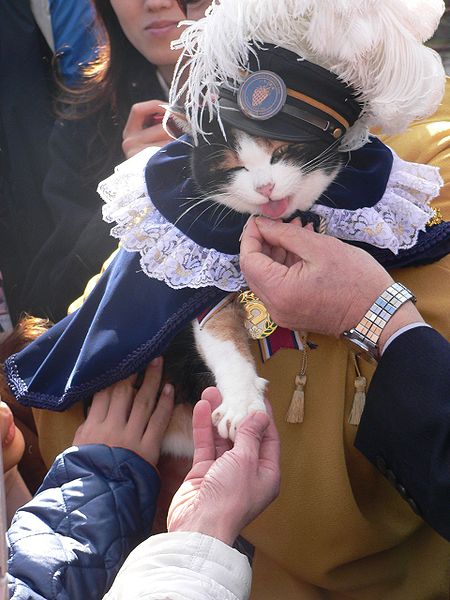
Speaking of Japanese animal celebrities, frequent Neatorama readers are also sure to remember Tama the Station Cat. Tama’s story started when the Wakayama Electric Railway decided to unman all of their stations and hire only one person at each stop to serve as the station master. At Kishi station, a neighborhood grocer named Toshiko Koyama was named as the station master. Koyama had adopted a number of stray cats, feeding them at the station. In 2007, the company opted to name one of the strays, Tama, as the official station master. In lieu of pay, Tama has been rewarded with free cat food, and a cool hat. Tama’s success actually helped increased traffic to the area and brought 1.1 billion Yen to the local economy. As a result, the company promoted her to “super station manager,” and she is now the only female manager in the company. She now has two feline assistant station masters at her disposal. As an extra honor, the governor of Wakayama has provided her with a medallion representing her honorary knighthood. Source Wikipedia, Japan Probe Image Via Wikipedia user Takobou
Mr. Winkle
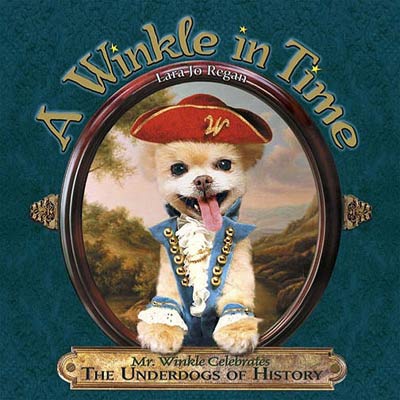
I wrote about Mr. Winkle before in the famous shelter dogs article. He is a unique mix that looks somewhat teddy bearish. While he started out on the streets, his adopted owner, magazine photographer Lara Jo Regan, has given him everything a pup could ever dream of, including his own internet site and web television show. Mr. Winkle’s been featured on Sex and The City and a number of news programs. As for his costume work, there’s plenty of dress up photos available on his site. You can even buy books and calendars of his pin up works. Source Mr. Winkle Website, Wikipedia Image Via Mr. Winkle's site.
Oscar
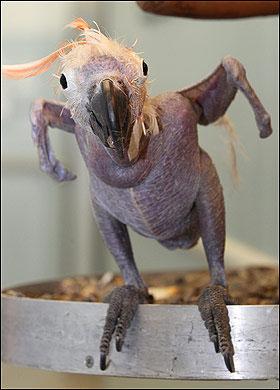
Oscar is the one animal on this list that is known for being totally naked. While she may look cute dancing and singing, her hard life makes her an inspirational tale of overcoming hardships. In her early years, Oscar actually was rescued from a crack house by police officers. After suffering from both a beak and feather disease, she completely lost all of her feathers, even after she was nursed back to health by the Humane Society. At the time, vets gave her only six months to live --over 13 years ago. Since then, Oscar was adopted by Cherie Wachter, who takes great care of her and has been known to post naked videos of the little bird all over the internet. Oscar’s feathers may never grow back, but her brave spirit has never dwindled. Source DListed, Huffington Post Image by Barry Bland via The Sun. Well readers, now it’s your turn. Any of you know any famous dressed up animals not mentioned here or care to share some of your favorite costumed pet pics?
Today would be Jack London’s 134th birthday. The man was not only one of the most popular writers at the turn of the last century, he was also one of the first writers to see his novels be turned into a movie. In fact, his novel, The Sea Wolf, was adapted into the first full-length feature film. Also notably, he was one of the first celebrities to use his endorsement to advertise a product --in his case, grape juice and dress suits. To honor this prolific man, let’s take a look at the life and times of Jack London.
Who’s Your Daddy?
Jack London never was certain of who his actual father was, although most biographers believe his dad was astrologer William Chaney. His mother, Flora Wellman, claimed that Chaney insisted she have an abortion and that when she refused, he refused all responsibility for the child and left the city. Flora shot herself as a result of her overwhelming depression. Although she survived, she was temporarily deranged, and after Jack was born, she gave him to an ex-slave named Virginia Prentiss. After Flora married a Civil War veteran named John London, baby Jack was given back to the her, but Virginia remained a strong maternal figure to Jack throughout his life.
When Jack was 21, he searched for newspaper reports of his mother’s attempted suicide and was able to research the name of his supposed biological father. He wrote to William Chaney, but William claimed he couldn’t be Jack’s father because he was impotent. He claimed Flora slept around and that she had slandered him when she said he told her to get an abortion. Needless to say, Jack was devastated.
Education Versus Working Life
Jack grew up very working class and was forced to educate himself in the public library, as he could not afford to attend primary school. He was mentored by Oakland public librarian Ina Coolbrith who became California’s first poet laureate later on. Jack referred to Coolbrith as his “literary mother.” At only 13, Jack started working at Hickmott’s Cannery clocking in for anywhere between 12 and 18 hours per day.
In an effort to get out of this difficult life, he borrowed money from his foster mother and bought a boat. He then started working as an oyster poacher. Within only a few months, his boat was damaged beyond repair and he soon started working for the California Fish Patrol to hunt down fish poachers. A few years later, Jack started protesting and fighting for labor unions in Kelly’s Army. He was known for giving stump speeches on Socialism to eager-eared workers. Soon enough, he spent 30 days in jail in Buffalo on vagrancy charges. The experience disturbed him seriously and he later wrote about it:
"Man-handling was merely one of the very minor unprintable horrors of the Erie County Pen. I say 'unprintable'; and in justice I must also say undescribable. They were unthinkable to me until I saw them."
He returned to California where he finally started school at Oakland High. It was here, in the school magazine, that he was first published. His first story was Typhoon off the Coast of Japan, a recount of his experiences as a sailor. While attending classes, he was inspired to become a writer when he read the book Signa by Ouida, which told the story of an unschooled Italian peasant who became a famous opera composer. He credited this book as being the seed of his writing career. After high school, Jack eventually was able to attend the University of California, Berkeley. Unfortunately, the depression he began to experience after recently hearing from his father, paired with crushing financial circumstances, forced him to leave school only a year later.
Inspiration For "Bucks"
Most people know that Jack London was part of the Klondike Gold Rush, as this was the setting for his most popular story, Call of the Wild. Not everyone knows that the main character in the story, a dog named Buck, was based on a dog that Jack’s landlords had lent to him while he stayed in Dawson. While in the north, he developed a number of health problems, including scurvy, which eventually led to the loss of his four front teeth. The many hardships he faced during this period later served as inspiration for what is often called his greatest short story, To Build A Fire.
Breaking Into The Business
When Jack left the Klondike, he wanted to escape the difficulties of working class life and he realized his ticket out was his writing. Jack's first work printed by a major publisher, To the Man On Trial, ended up almost causing him to quit as soon as he started because the publisher was so slow to pay and the pay itself was so low. His second published story actually ended up being his first paid assignment, as they actually came through with payment on time. Luckily, that second story’s payment gave him the motivation he needed to continue writing, he entered his field at just the right time, as magazine production (and subsequently, the market for short fiction stories) was skyrocketing due to new technologies that allowed for lower production costs. Among the first stories he sold were Batard and Diable, which were two very similar stories about a French Canadian man who brutalized his dog, who then kills the man out of revenge. Those familiar with The Call of the Wild will recognize these plot lines as being fairly similar to the novel.
Eugenics Versus Love
Jack’s first marriage was to a friend Bessie Maddern. The couple never actually had a romantic relationship together --even after their marriage. They agreed to be married because they believed they would be able to produce strong and healthy children. While they had a loveless marriage, things remained exceptionally cordial before the children came along; Bessie edited Jack’s manuscripts and helped him improve his writing. After they had children though, the relationship became strained. Jack complained that “every time I come back after being away from home for a night she won't let me be in the same room with her if she can help it." Not surprisingly, the couple’s relationship ended in divorce.
Jack’s next marriage was notably more successful, largely because it was based on love and not good genes. While his nickname for Bessie was “Mother-Girl,” his nickname for his new wife, Charmian Kittredge (pictured at right), was “Mate Woman.” With Charmian, Jack found more than a friend, he found a soul mate and a lover. She had been raised without prudishness and was very open to any and all of Jack’s lustful fantasies --this certainly helped keep Jack interested, as he was known for being a bit of a womanizer at the time.
The Making of a Historic Park
Speaking of his true loves, Jack was enamored with the ranch he bought in Sonoma County in 1905, saying, “next to my wife, the ranch is the dearest thing in the world to me." Jack wanted his ranch to become its own money making enterprise and dedicated a lot of his time to growing and improving the farm. It wasn’t long before he started writing only to support his farm. His daughter, Joan, noted that after 1910, "few reviewers bothered any more to criticize his work seriously, for it was obvious that Jack was no longer exerting himself." While the ranch ended up being a failure, Jack was largely ahead of his time and would likely have thrived in today’s eco-friendly world. He was one of the first U.S. farmers to practice the concept of sustainable agriculture and designed the first concrete silo built in California. His home was designed and constructed by the finest Italian and Chinese stonemasons. Unfortunately, just before the mansion was completed, it was destroyed by fire. Nowadays, his ranch is a National Historic Landmark and part of the Jack London State Historic Park.
A Rip Off Artist?
Many people, both past and present, have claimed London plagiarized much of his work. To some extent, the accusations were fair. When accused of basing The Call of the Wild on Egerton R. Young’s My Dogs in the Northland, Jack admitted that it was a "source" and he said he wrote a letter to the author thanking him for the inspiration. Jack even bought plots and novels from Sinclair Lewis and used them as his own.
The most damning case against him involved a chapter in his book The Iron Heel. Jack claimed that he based this chapter on a speech by the Bishop of London that he clipped from an American newspaper that he didn’t realize was actually an excerpt from an ironic essay by Frank Harris called “The Bishop of London and Public Morality." Harris was angered by this use of his essay and he argued that he should receive 1/60th of all royalties for the book. On the other hand, some of the plagiarism accusations against Jack were merely a result of his using newspaper stories to inspire his plots.
A 1901 newspaper article criticized how similar his “Moon-Face” story was to Frank Norris’ “The Passing of Cock-eye Blacklock.” London defended himself by proving that both stories were inspired by the same newspaper story. Soon, there was even a third similar story discovered to have been written about the same article. This one was published a year earlier. When criticized for writing a story directly from a non-fiction article by Augustus Biddle and J. K Macdonald, London argued that it was fair game, saying, "I, in the course of making my living by turning journalism into literature, used material from various sources which had been collected and narrated by men who made their living by turning the facts of life into journalism."
A Contradictory Nature
Like most of us, Jack London was an extremely complex individual. As a result, many of his views seemed contradictory, even hypocritical. He was a life-long socialist, but was devoted to monetary pursuits. While he always looked to his black foster mother as a role model and worried about the white man destroying indigenous cultures, he also bought into Social Darwinism and eugenics. While he was a self-proclaimed alcoholic, he supported prohibition.
Death and Conspiracies
Jack died in 1916 of uremia. The kidney stones and dysentery he was suffering from at the time were extremely painful, so he was taking morphine, which may have contributed to his death. Because he wrote so many stories about people who killed themselves though, many people mistook his death for a suicide. A decade later, a writer known as B. Traven started to become known as “the German Jack London.” This author kept his identity secret his entire life, which led to some people speculating that Jack actually was B. Traven. Some supporters of the theory claim that Jack faked his own death only to reappear as the German later on. Funny enough, Traven’s own widow revealed his identity after his death, but some conspiracy nuts still claim he was actually Jack London, while others claim he was actually Ambrose Bierce.
It seems strange that a man best known for creating the quintessential detective, who based his deductions solely on reason, would also be one of the biggest proponents of Spiritualism around the turn of the last century. Equally strange is that a man who based his career of performing illusions and magic tricks was one of the most stringent disbelievers of the same religion. Perhaps strangest of all was the friendship of these two men, Sir Arthur Conan Doyle and Harry Houdini.
Good Beginnings
Houdini met Doyle while doing a performance tour in Europe. While the magician did not believe in Spiritualism, he had a strong interest in the subject and said many times that he did desperately want to believe, as he truly wished to speak to his beloved deceased mother. Doyle was already well-known for his support of the belief by this point, and was considered by many to be a saint of Spiritualism. When he met Houdini, he went about bringing him to some of the best mediums in Europe in an attempt to convert the magician. At this point, Houdini attempted to lead Doyle to believe that he was very open to the idea, but just undecided. He did enjoy hearing about the religion from a person he considered to be on the same intellectual plane as himself and not an entirely gullible person. Still though, the magician was able to see through the parlor tricks used by the mediums that Doyle brought him to. The more of the mediums he saw, the less convinced he became. While he did not yet begin exposing the frauds, he did record their methods and become increasingly frustrated with their taking advantage of people’s trust.
At Cross Purposes
Soon enough, Houdini started to begin his famous crusade against fraudulent mediums. He eventually even became part of a Scientific America committee offering a massive reward to anyone who could prove their methods were authentic --of course, no one ever managed to claim the reward. As his fame grew for these acts, Houdini even started attending séances in costume, taking with him a reporter and a police officer. Funny enough, Doyle actually supported these efforts at first, because he was afraid the fakes would damage the religion’s legitimacy. Although Houdini offered to show Doyle how to spot the tricks used by mediums, Doyle insisted that the mediums he knew were extremely honest and would never cheat their followers. As Houdini started to push Doyle even further to admit the people were acting dishonestly, Doyle soon converted to the belief that Houdini himself was one of the most powerful mediums around. Doyle and other Spiritualists who held this belief claimed the magician actually dematerialized himself to make his famous escapes. They believed he was working to discredit other mediums so he could gain publicity and take his act even further. Doyle expressed many of these beliefs in his last book, The Edge of the Unknown. Houdini, unfortunately, was caught between a rock and a hard place with these accusations. He couldn’t actually reveal his tricks, but by not doing so, the Spiritualists still had ammo to claim he was a medium. While he simply stated that his escapes were all performed by physical means, these tales haunted him until his death.
Attempting to Convert Doyle
In an attempt to prove to Doyle that his performances only involved trickery, Houdini offered to perform a special trick for his friend. The two men were joined by the Bernard Ernst president of the American Society of Magicians for the test, which started with a room filled with a slate, five cork balls and some white paint. Doyle was instructed to choose one of the balls at random and then place it in the container of paint. He was then given a pencil and a piece of paper and was told to go wherever he wanted to write a message of his choice on the paper. Houdini and Ernst stayed in the room, while Doyle left the house, walked three blocks away and then wrote a message on the paper. He then folded the paper, put it in his pocket and returned to the house. Upon his return, Houdini instructed Doyle to pick up the ball and put it on the slate. The ball then began to roll over the slate, where it spelled out the words Mene Mene Tekel Upharsin, the same words Doyle wrote on the paper. While Houdini devised this test to show Doyle these methods all involved simple tricks, Doyle was convinced more than ever that Houdini was a medium.
Attempting to Convert Houdini
The two continued to be friends and spent a vacation together in Atlantic City shortly after Doyle’s speaking tour in New York. During the vacation, Doyle’s wife, lady Jean offered to perform a séance for Houdini. He accepted, trusting her sincerity and honesty, and tried to completely accept the realism of the experience. As stated earlier, Houdini wanted to believe, he still had not found anyone who was worth believing in though. He was particularly excited about the séance when Jean announced that she would be try to contact his mother. Houdini said, “I had made up my mind that I would be as religious as it was in my power to be and not at any time did I scoff during the ceremony… with a beating heart I waited, hoping that I might feel once more the presence of my beloved mother." Lady Jean entered a trance during the séance and her hand started moving, scribbling words across paper, which Doyle then handed to Houdini. The message detailed his mother’s pleasure in finally getting to contact her son. They started off saying, “Oh my darling, thank God, thank God, at last I'm through. I've tried, oh so often -- now I am happy. Why, of course, I want to talk to my boy -- my own beloved boy -- friends, thank you, with all my heart for this." After the séance, Houdini wrote a small note on the bottom of the paper, saying, “Message written by Lady Doyle claiming the spirit of my dear Mother had control of her hand -- my sainted mother could not write English and spoke broken English.” A few months after the Doyle’s returned home to England, Houdini went public about the incident. He said there was no chance his mother had been summoned in the séance based on her poor English and the fact that she never learned to read or write. He said he believed the Doyle’s did not deceive him intentionally, but were victims to their own gullibility. Doyle tried to argue against these claims by saying that language is universal to the dead. He also said Houdini was too nervous about the encounter to accept that it was his own mother speaking to him from the beyond.
The End of It All
After this, the pair tried to maintain some level of strained friendship, but the final blow came when Houdini began publicly attacking Mina “Magery” Crandon. His Scientific American panel was fervent in discrediting Mrs. Crandon after she came forward to claim the prize. Doyle was a huge supporter of Crandon, even praising her in his later book The History of Spiritualism. “The commission is, in my opinion, a farce," he wrote, "and has already killed itself." The two began privately quarreling, but by 1923, the were exchanging criticizing letters to one another via the New York Times. After they publicly feuded when their tours happened to cross in Denver, they stopped talking for good. A few years later, Houdini died. When his wife, Bess began clearing out his property, she uncovered a huge collection of books on Spiritualism and she opted to send them to Doyle. The author wrote back to her, stating his reluctance to accept the gifts though, because he thought Houdini harbored bad feelings against him up until the time of his death. Bess wrote back and said that Houdini had, in fact, held out hope of contacting his mother up until his death and even told her so on his death bed. She assured Doyle that Houdini carried no resentment towards him and that the press had greatly exaggerated the feud between the two. She best summed up Houdini’s thoughts by writing, “he was deeply hurt whenever any journalistic arguments arose between you and would have been the happiest man in the world had he been able to agree with your views on Spiritism. He admired and respected you --two remarkable men with different views.” Source #1, #2, #3, #4
When passengers on a Continental flight out of Houston were told their flight would be delayed because of otters, a lot of them laughed, thinking it was a joke. It wasn't.
There were a number of otters set to travel in the cargo area, but one somehow managed to escape its cage. "We watched them take them off the plane in a box, and the next thing we know one of the otters got loose and took off across the tarmac," said passenger Harvey Bullock.
The flight ended up being delayed a full 80 minutes, but at least the passengers were able to make cheesy 'otters on a plane' jokes for the rest of their lives.
If you don't celebrate Christmas because you belong to the Church of the Flying Spaghetti Monster, there's no reason you can't still enjoy delicious goodies this holiday season. Here's instructions on how to make your own edible spaghetti monster, complete with edible googly eyes.
Being raised in sunny San Diego, I never even got to build a snowman before. That's why I find snow sculptures to be purely impossible and amazing. Even if you've grown up in the harshest winters around though, you're still certain to be impressed with these detailed snow sculptures on Web Urbanist.
Most people, including myself, tend to avoid getting close up to snakes, photographer but Guido Mocafico sees the beauty in the animals and managed to photograph them in an amazing way that makes the rest of us able to appreciate them.
Most gingerbread houses are humble homes with simple cookie walls and roofs and candy decor. Some gingerbread architects are far more inspired and artistic though, like the designers of the amazing gingerbread artworks on WebUrbanist.
2009 has been a great year for weird news. Asylum has collected the best weird stories this year that were featured on the Digg homepage. Remember when Woody Harrelson attacked a photographer, claiming he thought he was a zombie? Or when the girl with stars all over her face lied about falling asleep in the tattoo artist's chair?
Not Martha has instructions for making your own little tiny gingerbread houses that daintily sit on the edge of your mug, making for a festive and delicious accent to any cup of holiday coco. Link Via Laughing Squid