Seems legit. There can be no other explanation when this psychic went on Judge Judy and claimed that her tiny hand gave her psychic powers. I mean, look at it: that's one really tiny hand. This screen capture is making its round on the web, but we're sure that the woman has already known that.
On the other hand (hah!) this would make a great entry for the One Tiny Hand Tumblr.
Playing a computer game, listening to music, eating ... AND pooping at the same time? This kid will surely grow up to be a multitasking champ. Bravo, parents! Bravo!
That's Chuck McCarthy of History of Chuck eating from a bowl balanced on his head. Two hands, two spoons. One mouth and one epic beard. If that is not talent, I don't know what is.
When an English speaker doesn't understand something, he would say "It's all Greek to me." But have you ever wondered about the origin of that phrase? Why Greek? Why not, say, Urdu or Aramaic?
1. The Origin of "It's All Greek To Me"
According to Harry Oliver's Flying by the Seat of Your Pants: Surprising Origins of Everyday Expressions, it comes from the latin phrase Graecum est, non legitur or Graecum est, non potest legi (It is Greek; it cannot be read). Medieval Latin scribes in monasteries would write that phrase if they had trouble translating Greek alphabet and language, which was dwindling in use by the Middle Ages.
The phrase probably entered modern English usage when William Shakespeare used it in his 1599 play The Tragedy of Julius Caesar. Here it is in Act 1 Scene 2:
Cassius: Did Cicero say any thing?
Casca: Ay, he spoke Greek.
Cassius: To what effect?
Casca: Nay, an I tell you that, I'll ne'er look you i' the face again: but those that understood him smiled at one another and shook their heads; but, for mine own part, it was Greek to me.
I could tell you more news too: Marullus and Flavius, for pulling scarfs off Caesar's images, are put to silence. Fare you well. There was more foolery yet, if I could remember it.
In this context, an educated and wealthy aristocrat in the Roman Republic should be able to read and speak Greek. Casca, who speaks fluent Greek, is probably just playing dumb because he doesn't want to repeat a remark that is unflattering to Caesar.
2. Well, what do the Greeks say?
Obviously, when a Greek doesn't understand something, he doesn't say "It's all Greek to Me." Rather, he says, Αυτά μου φαίνονται κινέζικα, or "This strikes me as Chinese."
3. It's all ______ to me
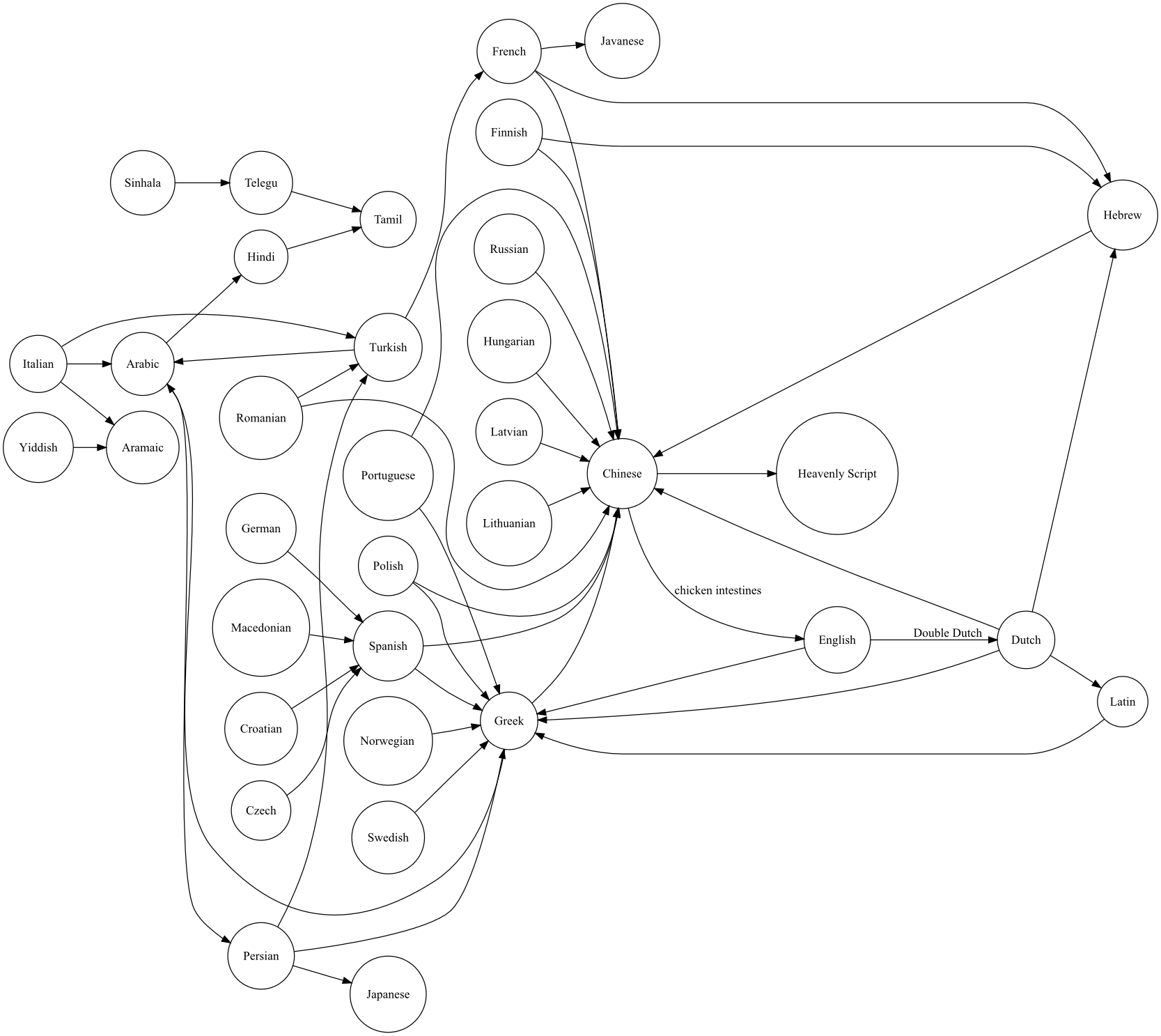
That brings up an interesting question: what language is deemed the most incomprehensible and therefore most worthy of the phrase "It's all ______ to me" in various countries? Wikipedia and Omniglot have the list of the idioms.
Mark Liberman of Language Log distilled the info into this nifty graphic:
The word "gringo," which is a Spanish slang to denote foreigners or non-native speakers of Spanish, comes from the phrase "hablar en griego" (or speaking in Greek). You can see how the phrase accusing someone of not being intelligible because he's speaking Greek eventually evolved into a slang for foreigners.
5. Coming Full Circle: Greeking ... in Latin!
When web or print designers create a mock up of a design with a block of text, they often put in place dummy text in the layout before the actual text is available. This process is called "greeking" and the most commonly used placeholder text is Lorem Ipsum, which is actually Latin, not Greek.
Jackie Chan has been busy fighting bad guys (drunken fist-style, perhaps) for the past three years, so you'll excuse him when he just found out that he's an Internet Meme.
Chan posted this picture of him looking confused (that's the meme) with the text, "I am an Internet Meme?" on his official Facebook page yesterday and immediately garnered over 9,000 comments and 320,000 likes from his fans.
The Interweb has been waiting for this for three years. It feels validated. Now, if only we can get Yao Ming to acknowledge his meme ...
Neatorama's favorite pun-steriffic street artist Hanksy is back at it again! This time, Hanksy left New York City and made his way west to Chicago, where he made these contributions to the city's urban scene.
A man, walking with a crutch, falls down. Would you help? Of course, you say? Would the man's appearance matter?
Be honest now.
Diego Dolciami and Matteo Moroni of DM Pranks decided to stage a social experiment in Italy. They filmed two scenarios: the first was with a well-dressed "businessman" in a suit. The second was with a homeless man in ragged clothing, carrying what seems to be his whole worldly possessions. In both instances, the men walked with a cane and fell down in front of strangers (both men and women).
Then, Dolciami and Moroni watched whether passers-by would help. They repeated the experiment 10 times each, and came to this shocking - or, depending on your point of view, obvious - conclusion that our decision to help someone in need is absolutely colored by our judgment of that person.
In 10 out of 10 cases, the businessman was helped by passers-by. But only 2 out of 10 instances was the homeless man rescued. Some people saw the homeless man fell down but hesitated to help, some approached but backed away when they saw the ragged clothings, and some didn't even stop at all.
Before you tsk, tsk-ed the choice of the people in the video clip, ask yourself what you would do. Would you be afraid that the homeless man might be crazy and try to hurt you if you tried to help? Maybe he's dirty and smelled bad?
Two-faced lover never looked this artistic! Berlin-based artist Sebastian Bieniek tells the story of a day in the life of a real life Janus in his photography series "Doublefaced."
Using eye pencil and lipstick, Bieniek created a simple yet arresting caricature - reminiscent of Picasso's women - of a two-faced girl waking up, eating, riding the subway and so on. Take a look:
Thai artist Nino Sarabutra laid down 100,000 hand-made miniature porcelain skulls on the floor and asked art gallery visitors to walk on them. With every step, visitors will be treading on skulls, which sets up the perfect background to dealing with their own mortality.
Sarabutra, trained in ceramic arts at a Bangkok university, asked her family, friends, neighbors, students - to help make the skulls. The craftmanship is quite striking: while each skull has the same general shape and size, it is also distinctly unique.
The exhibition, titled "What Will You Leave Behind?", also asked the gallery visitor to participiate by answering her question:
‘I want people to ask themselves how they live, what are they doing - if today was your last on earth, what will you leave behind?’
Sarabutra captured the visitors' answers and projected them on the gallery's wall as well as on her website. The answers range from the sublime "nothingness" to the cheeky "my body - for medical research." Mine would've been "a pile of debt" whereas Sarabutra's own would probably be "100,000 ceramic skulls no one would probably know what to do with."
You know the feeling that people are talking about you when they start whispering as soon as you enter the room? Well, don't walk into this cage of cotton-top tamarins at the Central Park Zoo in New York City!
Researchers Rachel Morrison and Diana Reiss of The City University in New York were doing a research project on the monkeys by recording their loud calls and "mobbing behavior" in response to seeing people they fear. But, when a supervisor whom the monkey disliked entered their enclosure, the researchers noticed that the monkeys went quiet.
It turns out that the tamarins weren't exactly silent. When Morrison and Reiss examined their recordings, they realized that the monkeys were still chirping, but in a volume too soft for humans to hear. In effect, the tamarins were whispering to each other, potentially about what to do about the intruder.
"Psst, could you believe what that guy's wearing?" Image:
Postdlf/Wikipedia
In the study, published in the scientific journal Zoo Biology, Morrison and Reiss noted that the "low amplitude vocalizations" were previously unknown in the species and that if it were not for their serendipitous recording and subsequent analysis of the spectrogram, the monkey whispers would likely have remained a secret of the tamarins.
"Although it is unclear what the motivational state of the tamarins was when in presence of the supervisor, it appears that they were responding to him as an ambiguous threat and may have been investigating the situation by cautiously approaching him to determine the actual level of threat and communicating to each other the appropriate behavioral response to take," the researchers said, as quoted by PopSci.
The researchers speculated that other species may utilize similar methods of communications to avoid being overheard by predators.
So the next time you go to the zoo and the monkeys turn quiet, they're probably talking about you!
Do you believe in God, or do you believe that there is no God*? Just how sure are you? Depending on your answer, you may be an atheist or a theist along the spectrum of surety with agnosticism on one end and gnosticism on the other.
(*Now, someone explain to me whether Zen Buddhists believe in God.)
Madrid-based Spanish street artist SpY went to Cologne, Germany, and decided to help the local police in keeping their car in mint condition. But is it art? What happens if there's a police emergency and the cop came out to see their car all wrapped up in plastic film? And how come the police drive such a nice BMW?
Actually SpY has done something like this before, wrapping a police car with police tape, so we're not sure whether this whole thing is real or staged.
Actually, samurai monkey is part of Los Angeles-based photographer Hiroshi Watanabe's latest art series, titled Suo Sarumawashi, which is centered around the ancient Japanese artform of Sarumawashi or Monkey Dancing.
Sarumawashi, as explained by the Kopeikin Gallery which is hosting Watanabe's exhibition, is a 1,000-year-old Japanese tradition that started as a religious ritual to protect the horses of warriors. The acrobatic stunts, dances, and comedic skits performed by trained macaque monkeys later developed into festival and imperial court entertainment, alongside Noh and Kabuki, as well as street performance.
Despite its popularity, sarumawashi almost became extinct in the 1970s. The urbanization of Japan and the rise of automobiles on Japan's crowded streets had sidelined sarumawashi, until a group of Japanese artists founded an organization dedicated to preserving the artform. Today, the group regularly tours Japan to perform.
So, you're a vegan and you're mad that you can't drink Starbucks' Pumpkin Spice Latte. Well, maybe you want to skip this post because your day ain't going to get much better. You see, almost *everything* in the world contains something made from animal parts and by-products.
Don't believe us? Here are 5 things in the world that you wouldn't believe are made from or contain animal by-products or use them in the manufacturing process:
1. Car Tires
Yes, tires are made of rubber, which are plant products but the wheel on the bus goes round and round with a little help from stearic acid.
Stearic acid is a fatty acid with many industrial applications - and when we say many, we mean a bajillion. This chemical compound is used as a surfactant and softening agent. It is found in soaps, cosmetics, detergents, lubricants, candles, food, and even fireworks. Car tires manufacturers use stearic acid as an additive to help "cure" the rubber in the tires and make them strong enough to hold their shape while under steady friction yet flexible enough to grip the road.
Oh, and that "stearic" in stearic acid is derived from the Greek word "stear" which means tallow, a rendered form of beef or mutton fat.
2. Drywall
Unless you live in a brick or mud house, then chances are, your wall is made of drywall or sheetrock. These are gypsum plaster sheets used to make interior walls and ceilings. Then, unless you live in an unfinished garage, chances are your walls are painted. Well, both drywall and paint contain animal by-products.
Drywall is made by creating a slurry of gypsum with additives such as starch, paper pulp and fatty acids like stearic acid (ta-da!) and oleic acid (also made from animal fat) as emulsifier and thickener.
3. Paint
Many brands of paint (even latex-based paint) contain a binder called casein, a protein found in cow milk. Never heard of casein? You may not know it, but you are familiar with casein: in its coagulated form, casein is called cheese.
4. Sugar
Good ol' white sugar isn't white to begin with. Rather, large sugar manufacturers use a filter made from bone char - basically charred ash of animal bones (mostly from cattle) - to decolorize sugar cane to the desired white form.
Well, how about if I just use brown sugar, you say. Turns out most brown sugar is just white sugar with molasses added as brown colorant.
5. Asphalt
Yes, that black stuff used to pave roads and parking lots contain glycerin, a release agent that prevents it from sticking to the containers, as well as other animal by-product based additives to help the ease of mixing and paving as well as control rutting and cracking.
Shorter days, leaves changing color and colder weather used to be the ways we can tell that fall is coming, but lately there's a new sign: Pumpkin Spice Latte is back at Starbucks.
Pumpkin Spice Latte, or PSL as it's known to afficionados, is a seasonal drink that Starbucks trots out every fall. Each year, the release becomes more highly anticipated than the previous one, and the cult following of the drink continues to swell. Last year, there were reports shortages of the PSL at some Starbucks locations, which caused a flurry of panicked tweets. The instant version of the popular latte popped up on eBay at double the price ... and promptly sold out. Thankfully, Starbucks was able to ship more of the PSL ingredients to its stores and averted a pumpkin riot.
This year, Starbucks released a secret code that you can whisper to your barista to get the Pumpkin Spice Latte before its official release date of September 3, much to the glee of its fans. But who exactly are those PSL fanatics?
White women in yoga pants, according to Flavorwire and the Interweb:
So. If PSL is your BFF, know this about your favorite drink:
1. Starbucks Has Sold 200 Million Pumpkin Spice Latte Drinks in the Past Decade
You read that right. Starbucks has sold more than 200 million of the PSL. At the basic price $4 and 300 calories for a 12-ounce tall size, that's $800 million dollars and 60 billion calories that we've spent and consumed on the stuff.
2. Vegans Are Hopping Mad
... because it turns out that the PSL can't be made vegan. Turns out, the Pumpkin Spice Latte contains condensed milk. Vegan and Starbucks afficionado Brent Caldwell of Ferndale, Michigan, had even started a Change.org petition to get Starbucks to create a vegan-friendly version:
I am a huge fan of Starbucks. My girlfriend and I will visit our favorite location up to four times a week. We are also both vegan. Normally this is not a tremendous issue at Starbucks because so many drinks can be made with vegan and dairy-free ingredients, which generally just means using soy milk instead of cows milk.
Sadly, in the case of the seasonal Pumpkin Spice Latte, this does not hold true.There is currently no vegan option for this drink mix, which is a total bummer. [...]
Many people are shocked to hear that the mix contains condensed milk because there's no way anyone would be able to tell walking into a store and placing an order. Employees don't even realize it has milk in it!
As of this morning, the petition has garnered over 9,000 signers. If that's not a First World problem, I don't know what is.